Researched overview. This guide is based on published dermatology guidance, not on hands-on product testing by BeautyKob. No product in this guide was tested by us.
Table Of Content
- Quick answer
- What sensitive skin is
- Ingredients that help
- Ingredients and habits to avoid
- A simple routine, in order
- How to patch test a new product
- Gentle exfoliation — once a week at most
- Calming masks — optional, not essential
- Seasons
- When your skin flares up
- Lifestyle — helpful, not a treatment
- Mistakes that make sensitive skin worse
- When to get help
- Summary
Quick answer
There is no single “special care formula” for sensitive skin. What works is a short routine built from gentle products: a mild cleanser, a simple moisturiser, and a broad-spectrum sunscreen with SPF 30 or higher every morning. The ingredients that matter most are the ones that support the skin barrier — ceramides, glycerin and hyaluronic acid — and the ones you leave out: fragrance, drying alcohol and strong acids.
If your skin is persistently red, sore, blistering, or you have a rash that does not settle, skip the new products and ask a dermatologist or pharmacist first. This guide is general information, not medical advice.
Contents: What sensitive skin is · Ingredients that help · Ingredients to avoid · A simple routine · Patch testing · Gentle exfoliation · Seasons · Flare-ups · Mistakes · When to get help

What sensitive skin is
Sensitive skin reacts easily — stinging, redness, dryness or itching after products, weather or friction that other people tolerate without trouble. It is not a diagnosis. It usually means the skin barrier — the outer layer that keeps water in and irritants out — is weaker than usual, so irritants get in more easily.
Common triggers are harsh cleansers, fragrance, strong exfoliants, very hot or cold weather, wind, pollution and friction from tight clothing. The first step is noticing what sets your skin off, so you can avoid it rather than adding more products to fix it.
Ingredients that help
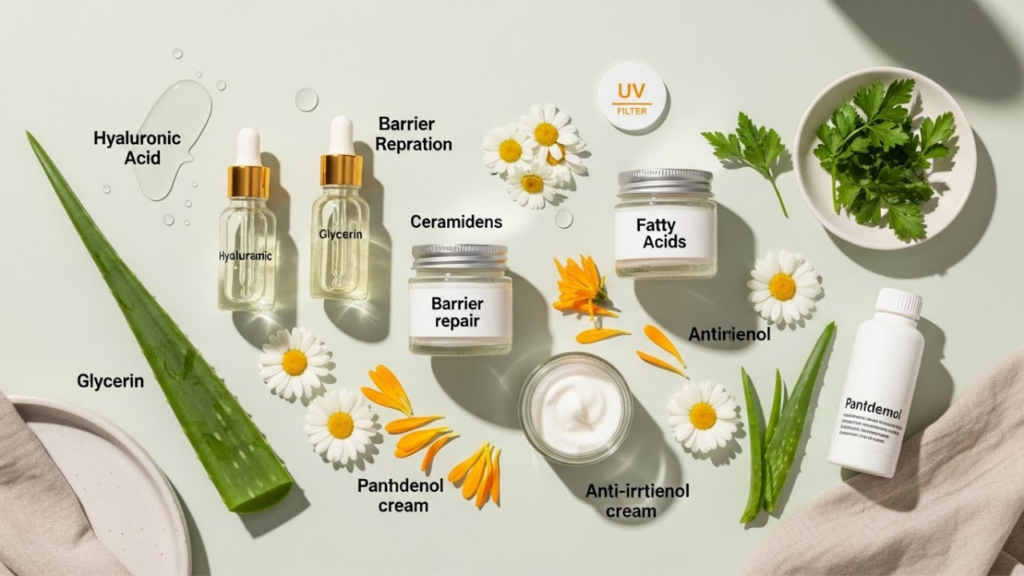
Hydration — glycerin and hyaluronic acid. Both are humectants: they draw water into the skin. Apply them to slightly damp skin, then moisturise over the top, or they can leave skin feeling drier.
Barrier repair — ceramides and fatty acids. Ceramides are fats that are naturally part of the skin barrier. Moisturisers containing ceramides and fatty acids help replace what a weak barrier is missing and keep irritants out.
Soothing ingredients — aloe, panthenol, chamomile, calendula, oatmeal. These are commonly used in products for reactive skin and are often described as calming. Be honest about the evidence: it is limited. They may feel soothing, but they are not proven treatments for redness or inflammation, and plant extracts can themselves cause reactions in some people. Patch test them like anything else.
Mineral sun protection — zinc oxide and titanium dioxide. These are mineral UV filters. They sit on the skin’s surface rather than being absorbed, and they are often better tolerated by reactive skin than chemical UV filters. A mineral sunscreen is a reasonable first choice for sensitive skin.
Ingredients and habits to avoid
- Fragrance and perfumes — one of the most common causes of reactions. Choose “fragrance-free”, and check the ingredient list: “unscented” can still mean a masking fragrance was added.
- Drying alcohol (alcohol denat.) high up the ingredient list.
- Strong acids and strong retinoids while your skin is reactive. If you want to try them later, introduce one at a time, at a low strength, and only when the skin is calm.
- Harsh scrubs and daily exfoliation. Physical scrubs and strong chemical exfoliants strip the barrier.
- Too many products at once. A long routine makes it impossible to tell which product caused a reaction. Fewer products, used consistently, work better for sensitive skin.
A simple routine, in order
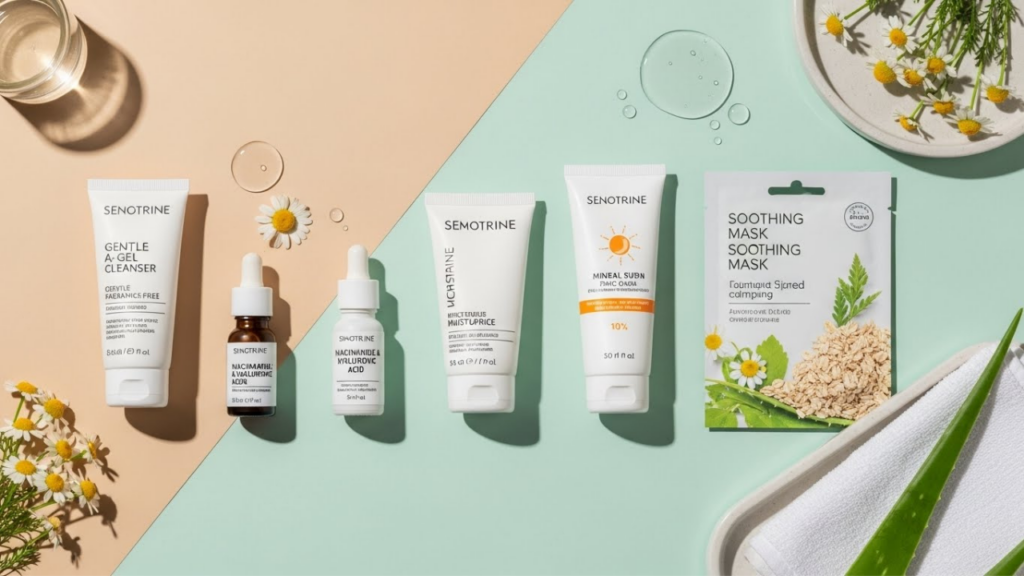
Apply products thinnest to thickest: cleanser, then serum if you use one, then moisturiser, then sunscreen in the morning.
Morning
1. Cleanse gently. Lukewarm water and a mild, fragrance-free, sulfate-free cleanser. Cream or gel textures suit sensitive skin. If your skin feels tight after washing, your cleanser is too strong.
2. Moisturise. A light cream or gel while the skin is still slightly damp.
3. Sunscreen — every morning. Broad-spectrum SPF 30 or higher, as the last step. The AAD recommends this daily, including on cloudy days, and reapplying every two hours when outdoors. (AAD sunscreen guidance)
Night
1. Cleanse. Remove sunscreen, makeup and the day’s build-up.
2. Moisturise. The same moisturiser, or a slightly richer cream if your skin is dry.
That is the whole routine. A serum with niacinamide or hyaluronic acid is optional — add it only if the basic routine is working and you want one extra step, and introduce it on its own so you can judge it.
How to patch test a new product
Do this before any new product goes on your face. The AAD’s method, as summarised by Healthline from AAD guidance:
- Choose a test spot about the size of a quarter, somewhere the product will not be rubbed or washed off — the inside of your forearm or the bend of your elbow.
- Apply the product twice a day for 7 to 10 days, using the amount and thickness you would normally use.
- Watch for a reaction. Redness, itching, burning, swelling, bumps or blisters mean stop — wash the product off and do not use it again.
- If the spot stays clear for the full 7 to 10 days, you can usually add the product to your routine.
A 24-hour test is not enough: allergic reactions can take 48 to 96 hours to appear. A home patch test is a precaution, not a diagnosis — it cannot guarantee your face will never react. (Healthline, summarising AAD guidance)
Gentle exfoliation — once a week at most
Sensitive skin does not need frequent exfoliation, and over-exfoliating damages the barrier and causes redness. If you exfoliate at all:
- Use a gentle chemical exfoliant — a low-strength lactic acid product or a PHA — not a harsh scrub.
- Start once a week. Increase only if your skin stays comfortable.
- Stop if you get redness, stinging, flaking or tightness.
- Do not exfoliate on the same night as a strong retinoid unless a dermatologist has advised it.
Exfoliation does not “tighten” skin. It removes dead skin from the surface, which can make the surface look smoother — that is all it does.
Calming masks — optional, not essential
A mask with oatmeal, aloe or chamomile can feel soothing. It is an optional extra, not part of the routine, and it does not replace daily cleansing, moisturising and sunscreen. Once or twice a week at most — more often adds another chance of a reaction without adding benefit. If a mask stings or reddens your skin, wash it off and do not use it again.
Seasons
Sensitive skin often gets drier in winter and oilier or more easily flushed in summer. Adjust the texture, not the whole routine:
- Winter: a richer cream, and a barrier cream if the skin feels raw in cold wind. Keep the cleanser gentle.
- Summer: a light gel or lotion moisturiser that does not clog pores. Sunscreen stays on all year round, whatever the weather.
- Change one thing at a time when the seasons change, so you know what helped.
When your skin flares up
Flare-ups happen even with a careful routine. When they do, simplify:
- Stop everything except a gentle cleanser, a plain moisturiser and mineral sunscreen.
- Do not add a new product while the skin is irritated.
- A cool compress can ease discomfort. Plain petroleum jelly can protect the area while it settles.
- If the flare-up does not settle within a few days, or it is spreading, blistering or painful, ask a dermatologist or pharmacist.
Lifestyle — helpful, not a treatment
Sleep, stress, food and water affect how your skin feels, but none of them is a treatment for sensitive skin. No diet, supplement or amount of water can be presented as a fix. What is fair to say: regular sleep and lower stress help some people feel their skin is calmer, and drinking enough water is part of general health. If a food or habit clearly triggers your skin, avoiding it is reasonable — but that is personal observation, not a rule for everyone.
Mistakes that make sensitive skin worse
- Washing away the skin’s natural oils with hot water and harsh cleansers.
- Skipping patch tests and starting strong actives or fragranced products.
- Using several new products at once.
- Changing products every few days, so the skin never settles.
- Exfoliating daily or using a scrub on reactive skin.
- Leaving the skin exposed to wind, sun and dry air without protection.
- Assuming “natural” means safe — plant extracts can cause reactions too.
When to get help
Ask a dermatologist or pharmacist if: your skin is persistently red, sore, swollen or blistering; you have a rash that does not settle; you have eczema, rosacea or acne that is getting worse; a product causes a reaction even after patch testing; or you are unsure whether an ingredient is safe for you.
Summary
There is no special formula. Sensitive skin needs a short, gentle routine: mild fragrance-free cleanser, moisturiser with ceramides, glycerin or hyaluronic acid, and broad-spectrum SPF 30+ every morning. Patch test every new product for 7 to 10 days, add one thing at a time, exfoliate at most once a week, and simplify back to the basics when your skin flares up.
Sources: AAD sunscreen guidance; AAD patch-test guidance as summarised by Healthline; NHS emollient guidance on humectants, emollients and ceramides. This is a researched overview, not a hands-on review.