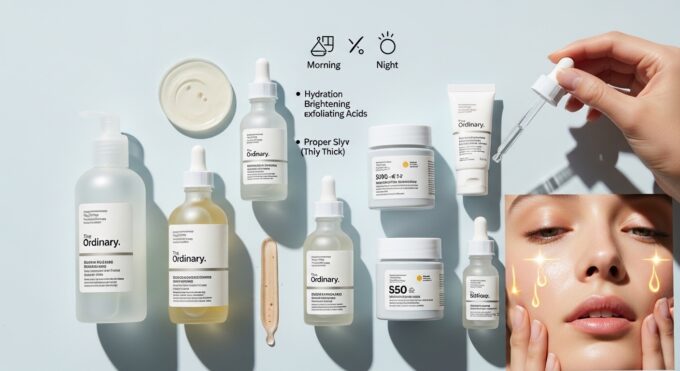
Researched overview. This guide is based on published dermatology guidance, not on hands-on product testing by BeautyKob. No product in this guide was tested by us.
Table Of Content
Quick answer
Dull skin looks flat, tired or greyish even when it is not dry or spotty. In most cases the fix is not more products. It is a short, steady routine: cleanse gently, add water back to the skin, use one brightening active at a time, moisturise, and protect with sunscreen every morning.
If your skin is red, painful, flaking badly, or has a rash, blisters or open sores, skip the actives and ask a dermatologist or pharmacist first. This guide is general information, not medical advice.
Contents: What dull skin is · A simple routine · Morning steps · Night steps · Choosing actives · By skin type · Mistakes · When to get help
What dull skin is — and what it is not
Dull skin is skin that does not reflect light evenly. It can look tired, uneven or greyish. It is not the same as dry skin, although dry skin can also look dull. It is not the same as oily skin, and it is not a diagnosis.
Common signs are: skin that looks flat even after moisturising, makeup that sits heavily, a slightly rough feel, and uneven tone. These signs alone do not tell you the cause. Sleep, sun exposure, dehydration, a damaged skin barrier and build-up of dead skin on the surface can all play a part, and often more than one applies at once.
You do not need to fix every possible cause at once. Start with the basics below for two to four weeks before adding anything new.

A simple routine
You need five kinds of step, not five of each kind:
- Gentle cleanser
- Hydration (a hydrating toner, essence or serum on damp skin)
- One brightening active (see below)
- Moisturiser
- Sunscreen in the morning
Use the same routine morning and night, with two differences: sunscreen is for the morning only, and exfoliation — if you use it — belongs at night, once a week to start.
Morning steps
- Cleanse gently. Lukewarm water and a mild cleanser. Avoid hot water and harsh scrubbing. If your skin feels tight after washing, your cleanser is probably too strong.
- Hydrate on damp skin. Apply a hydrating product with glycerin or hyaluronic acid while the skin is still slightly damp, then moisturise. Moisturisers work best when they combine a humectant (draws in water, e.g. glycerin, hyaluronic acid), an emollient (softens, e.g. ceramides, squalane) and, for dry skin, an occlusive (seals water in, e.g. petrolatum, shea butter).
- Brightening active. Use one, not three. Vitamin C in the morning is a common choice. Niacinamide is a gentler option for sensitive skin.
- Moisturiser. A light lotion for oily skin; a richer cream for dry skin.
- Sunscreen — every morning. Use a broad-spectrum sunscreen with SPF 30 or higher as the last step, after moisturiser. The American Academy of Dermatology recommends this daily, including on cloudy days, because UV rays pass through cloud and windows, and reapplying every two hours when outdoors, or after swimming or sweating. (AAD sunscreen guidance)

Night steps
- Cleanse. Remove sunscreen, makeup and the day’s build-up. Double cleansing is only needed if you wear heavy makeup or water-resistant sunscreen.
- Exfoliate — once a week to start, at most. A gentle chemical exfoliant (for example a low-strength lactic acid product) can help remove the dead skin that makes the surface look rough. Start once a week. Increase only if your skin stays comfortable. Stop if you get redness, stinging, flaking or tightness. The AAD’s guidance is to choose a method that suits your skin type and to exfoliate gently, not aggressively. (AAD, How to safely exfoliate at home)
- Hydrate and moisturise. The same hydrating step and moisturiser as in the morning. A slightly richer cream at night is fine if your skin is dry.
Do not exfoliate every night, and do not use an exfoliant on the same night as a strong retinoid unless a dermatologist has advised it.
Choosing actives — one at a time
| Active | What it is used for | Start here |
|---|---|---|
| Vitamin C (L-ascorbic acid or a gentler derivative) | Antioxidant; vitamin C is a cofactor for collagen synthesis in the body and can help the look of uneven tone over time | Morning, a few drops; start with a lower strength if your skin is sensitive |
| Niacinamide | Supports the skin barrier and can help the look of redness and uneven texture | Morning or night; usually well tolerated |
| Gentle AHA (e.g. lactic acid) | Removes dead skin from the surface | Night, once a week to start |
| Hyaluronic acid | Humectant — draws water into the skin | On damp skin, under moisturiser; it is hydration, not a treatment on its own |
| Retinoid / retinol | A vitamin A derivative; can irritate, especially at first | Night only, a pea-sized amount, a few nights a week at most — and only if you are not pregnant or planning pregnancy (see below) |
Do not start two new actives in the same week. If irritation appears, stop the newest product first and go back to cleanser, moisturiser and sunscreen until the skin settles.
By skin type
- Dull + dry skin: Focus on hydration and barrier support. Use a richer moisturiser, exfoliate less often, and avoid foaming cleansers that leave skin tight.
- Dull + oily skin: Use light, non-greasy formulas. You still need moisturiser — skipping it can leave skin dehydrated and looking flat. Gel or lotion textures usually suit oily skin.
- Dull + sensitive skin: Keep the routine shorter, not longer. Use fragrance-free products, introduce one active at a time, and patch test a new product on the inside of your arm or behind your ear first. If a product stings for more than a minute or two, wash it off.

Mistakes that keep skin dull
- Using several strong actives at once, or exfoliating daily.
- Skipping sunscreen — UV exposure can undo brightening work and add uneven tone.
- Changing products every few days, so you never learn what helps.
- Using hot water and harsh scrubs.
- Expecting a fixed result by a fixed date. Hydration can feel better within days, but changes in tone take weeks of steady use, and the timing varies from person to person. No routine can promise a specific result by a specific week.
When to get help
Ask a dermatologist or pharmacist if: your skin is persistently red, sore, swollen or blistering; you have a rash that does not settle; you have a skin condition such as eczema, rosacea or acne that is getting worse; or you are unsure whether an active is safe for you.
Pregnancy and breastfeeding: Topical retinoids are not suitable during pregnancy, because there is a risk they may cause birth defects, according to NHS guidance. (NHS 111 Wales, Acne) If you are pregnant, planning pregnancy or breastfeeding, avoid retinoids and ask a healthcare professional before starting any new active.
Summary
Cleanse gently, hydrate on damp skin, use one brightening active at a time, moisturise, and wear broad-spectrum SPF 30+ every morning. Exfoliate once a week to start. Keep the routine the same for a few weeks before judging it. If your skin becomes irritated, simplify back to cleanser, moisturiser and sunscreen.
Sources: AAD sunscreen guidance; AAD exfoliation guidance; NHS guidance on topical retinoids in pregnancy; NHS emollient guidance on humectants, emollients and ceramides. This is a researched overview, not a hands-on review.