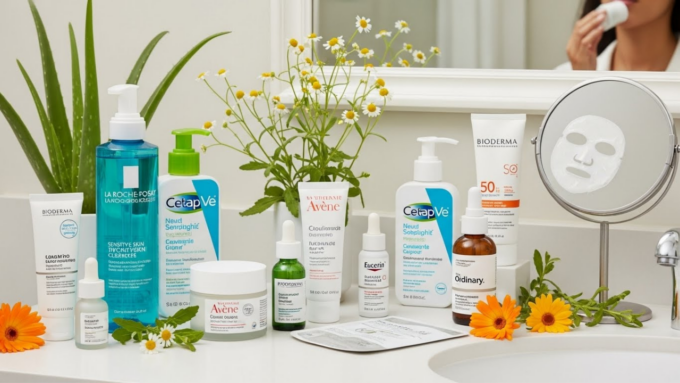
Researched overview. This guide is based on published dermatology guidance and published ingredient lists, not on hands-on product testing by BeautyKob. No product in this guide was tested by us, and no brand paid to be mentioned.
Table Of Content
Quick answer
There is no published, evidence-based ranking of the “top” sensitive skin care brands. A brand name on its own tells you very little. What matters is the label on the product in your hand: whether it is fragrance-free, how short the ingredient list is, whether it contains ingredients your skin has tolerated before, and whether you patch test it first.
Sensitive skin is skin that stings, burns, turns red or flares up easily after using products that other people tolerate without trouble. If that sounds like your skin, the advice below applies. If your skin is persistently red, sore, swollen, blistering, or you have a diagnosed condition such as eczema or rosacea that is getting worse, ask a dermatologist or pharmacist before trying new products. This guide is general information, not medical advice.
Contents: What sensitive skin is · Label words that mislead · What to look for · Brands the original article named · Choosing for your skin type · Patch test · Mistakes · When to get help
What sensitive skin is — and what it is not
Sensitive skin is not a diagnosis. It is a description of skin that reacts easily: stinging or burning after a product goes on, redness that lasts, dryness and flaking, or breakouts after a new product. The skin barrier — the outer layer that keeps water in and irritants out — is often weaker or more easily disrupted in sensitive skin, which is why gentle cleansing and moisturising matter more than any single “active” ingredient.
Sensitive skin is not the same as allergic skin, although the two can overlap. A product can sting without causing an allergy, and an allergy can develop to an ingredient you have used for years. That is why a patch test matters even for products marketed for sensitive skin.
Label words: what they do and do not mean
| Word on the label | What it means | What it does not mean |
|---|---|---|
| Fragrance-free | The product is presented as having no added fragrance ingredients. This is the most useful single filter for sensitive skin. | That no ingredient in it can irritate you. Other ingredients can still cause a reaction. |
| Unscented | The finished product has little or no noticeable smell. | That it contains no fragrance. “Unscented” products can contain masking fragrances that cover another smell — the American Academy of Dermatology warns about this. |
| Hypoallergenic | The manufacturer claims the product is less likely to cause an allergic reaction. | Almost nothing. The US Food and Drug Administration states there are no federal standards or definitions that govern the use of the term “hypoallergenic”, and manufacturers are not required to submit proof to the FDA for using it. |
| Non-comedogenic | The manufacturer intends the product not to clog pores. | That it will not cause breakouts. There is no regulatory standard or required test for this term either. |
| Dermatologist-tested | A dermatologist was involved in testing the product in some way. | That dermatologists recommend it, or that it is safe for your skin. There is no standard for what the testing involved. |
The practical rule: read the ingredient list, not the front of the bottle. If you know an ingredient has irritated you before, avoid it whatever the front of the bottle says. If the ingredient list is long and full of plant extracts and fragrance ingredients, it is a harder product to judge — and a harder one to blame if something goes wrong.
What to look for on a label
- Fragrance-free. The American Academy of Dermatology advises people with sensitive skin to use fragrance-free products, and to avoid products containing fragrance, alcohol, and harsh exfoliating acids on reactive skin.
- A short ingredient list. Fewer ingredients means fewer things that could irritate you, and it is easier to work out what caused a reaction.
- Barrier-supporting ingredients. Moisturisers commonly use ceramides, glycerin and hyaluronic acid. Ceramides are fats that occur naturally in the skin barrier; glycerin and hyaluronic acid are humectants, which draw water into the skin. These are well-established moisturiser ingredients, not treatments for a medical condition.
- Mineral sunscreen. For sun protection, sunscreens with zinc oxide or titanium dioxide as the active ingredients are commonly recommended for sensitive skin, because they sit on the skin rather than being absorbed into it. Use a broad-spectrum sunscreen with SPF 30 or higher every day, and reapply every two hours when outdoors, as the AAD recommends.
- No drying alcohol high on the list. Alcohol denat (denatured alcohol) near the top of an ingredient list can dry and sting sensitive skin.
What to be cautious about: products that list many plant extracts, essential oils or “natural” fragrance ingredients. “Natural” does not mean non-irritating — many plant extracts are common causes of contact allergy. The same applies to “clean” and “gentle” — neither word has a standard definition.
The brands the original article named
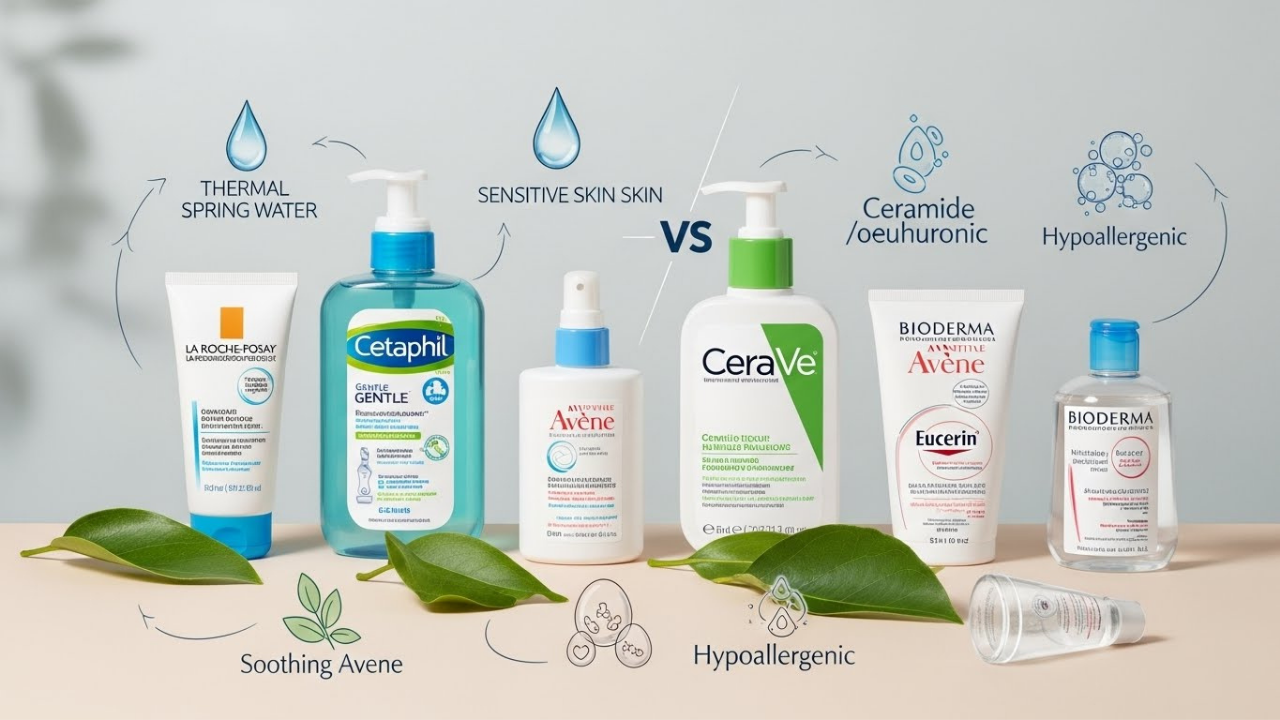
The original article listed seven brands. This guide does not rank them, and it does not recommend any of them. The table below says what each brand is known for and what its published ingredient lists actually contain, so you can judge the label yourself. Product facts were checked against published ingredient lists on 2026-11-06. Formulations change, so always check the label on the product you buy.
| Brand | What it is known for | What the label actually shows (verified examples) |
|---|---|---|
| La Roche-Posay | Pharmacy skincare, including the Toleriane line for sensitive skin | Toleriane Double Repair Face Moisturizer lists ceramide-3 (ceramide NP), niacinamide, glycerin and prebiotic thermal water. It is oil-free, fragrance-free and non-comedogenic. |
| CeraVe | Moisturisers and cleansers built around ceramides | PM Facial Moisturizing Lotion lists niacinamide, hyaluronic acid and three ceramides, and is oil-free, fragrance-free and non-comedogenic. Foaming Facial Cleanser lists three ceramides, niacinamide and hyaluronic acid, and is made for normal to oily skin. |
| Cetaphil | Simple, gentle cleansers and moisturisers | Gentle Skin Cleanser lists glycerin, panthenol (pro-vitamin B5) and niacinamide. It is soap-free and fragrance-free, and is made for normal to dry, sensitive skin. |
| Avène | Thermal spring water products for sensitive skin | Tolérance Extremely Gentle Cleanser is a no-rinse cleansing lotion with a short ingredient list built around Avène Thermal Spring Water. It is fragrance-free and made for dry, hypersensitive skin. |
| Bioderma | Micellar water and gentle cleansers, including the Sensibio line | Sensibio H2O is a micellar water with ten listed ingredients. It is fragrance-free, alcohol-free and non-comedogenic, and is made to be used without rinsing. |
| Eucerin | Pharmacy skincare, including lines for sensitive and eczema-prone skin | No specific Eucerin product was ingredient-verified for this guide, so no Eucerin product is named here. Check the label of any Eucerin product against the points above. |
| The Ordinary | Simple, low-cost serums with named active ingredients at stated strengths | Niacinamide 10% + Zinc 1% is a water-based serum with 10% niacinamide and 1% zinc PCA. It is fragrance-free and oil-free. Note that 10% is a high concentration — patch test it and introduce it slowly if your skin is sensitive. The original article linked this brand to ordinary.pk, a third-party reseller; buy from the brand or an authorised retailer instead. |
No brand in this table is “best” for sensitive skin in general. The right product depends on your skin: dry sensitive skin usually needs a richer cream; oily sensitive skin usually needs a light gel or lotion; reactive skin usually needs the shortest ingredient list you can find.
Choosing for your skin type
- Dry + sensitive: Prioritise a gentle, non-foaming cleanser and a richer moisturiser with ceramides and glycerin. Avoid foaming washes that leave your skin feeling tight.
- Oily + sensitive: Prioritise light, gel or lotion textures and oil-free moisturisers. You still need moisturiser — skipping it can leave skin dehydrated and more reactive.
- Combination + sensitive: Use a gentle cleanser and a light moisturiser overall, and a richer cream only on the dry areas if you need it.
- Reactive (stings easily, flares up often): Keep the routine as short as possible — cleanser, moisturiser, sunscreen. Introduce one new product at a time, and patch test it first (see below). Avoid strong actives such as retinoids and high-strength exfoliating acids until your skin is settled, and ask a dermatologist before using them.
Patch test before you commit
The American Academy of Dermatology recommends testing a new product before using it on your face. Apply the product to a quarter-sized patch of skin where it will not be rubbed or washed away — the underside of your arm or the bend of your elbow — twice a day for 7 to 10 days. For a rinse-off product such as a cleanser, leave it on for about five minutes, or as long as the label says, then rinse it off. If the test area becomes red, itchy, swollen or painful, stop using the product. If the area stays clear for the full 7 to 10 days, the product is less likely to cause a reaction on your face — but a patch test cannot guarantee it.
A 24-hour test can miss an allergic reaction, which often takes several days to appear — that is why this guide uses the AAD 7–10 day patch-test method.
Mistakes that make sensitive skin worse
- Switching brands or products every few days, so you never learn what helps and what harms.
- Introducing several new products at once. If your skin reacts, you will not know which one caused it.
- Using harsh scrubs or strong exfoliating acids on already reactive skin.
- Skipping patch tests because a product says “for sensitive skin” on the front.
- Skipping sunscreen. UV exposure can worsen redness and uneven tone, and it undermines any routine.
- Treating food or water as a skin treatment. Eating well and drinking water are good for your health, but no food has been shown to “desensitise” skin, and no amount of water “lubricates skin cells”.
When to get help
Ask a dermatologist or pharmacist if: your skin is persistently red, sore, swollen or blistering; you have a rash that does not settle; you have eczema, rosacea or acne that is getting worse; or a product you have used for a long time suddenly starts to sting. Bring the product with you, or a photo of its ingredient list — that is what a dermatologist needs to see.
Summary
There is no evidence-based ranking of sensitive skin brands. Choose by the label: fragrance-free, a short ingredient list, barrier-supporting ingredients such as ceramides, glycerin and hyaluronic acid, and mineral sunscreen with SPF 30 or higher. Do not trust “hypoallergenic”, “unscented” or “dermatologist-tested” as guarantees — none of them has a standard definition. Patch test every new product for 7 to 10 days, introduce one product at a time, and keep the routine short.
Sources: US FDA, “Hypoallergenic” Cosmetics; American Academy of Dermatology guidance on sensitive skin, patch testing and sunscreen; published ingredient lists for the products named (CeraVe, La Roche-Posay, Cetaphil, Avène, Bioderma, The Ordinary). This is a researched overview, not a hands-on review.