Researched overview. This guide is based on published dermatology guidance, not on hands-on testing by BeautyKob. No product, supplement or brand is recommended, and no dose is given.
Table Of Content
Quick answer
When skin is irritated, the fastest help is simple: remove whatever caused it, cool the area with cool water or a cold compress, and moisturise with a plain fragrance-free moisturiser while the skin is still slightly damp. Do not add new products, actives or home remedies on top of irritated skin — most of them make it worse. Mild irritation often settles within a few days with gentle care, but there is no fixed schedule, and irritation linked to a skin condition can take longer. If the skin is blistering, oozing, very painful, spreading, or shows signs of infection, get medical help promptly. This guide is general information, not medical advice.
Contents: What irritation is · The first 10 minutes · What to stop immediately · Remedies, honestly · What makes it worse · The simplified routine · Ingredients, honestly · Diet, water and stress, honestly · When to get help · Patch test · FAQ
What irritation is
Three words are often mixed up, and they mean different things:
- Irritation is damage to the surface of the skin from direct contact with something — a harsh soap, a strong product, hot water, rubbing, or cold wind. It usually settles once the irritant is removed.
- Inflammation is the immune system’s response to injury, infection or an irritant. The area becomes red, warm and swollen because blood flow increases. Inflammation is a warning sign, not a disease in itself.
- Itch is a signal sent by the nerves that makes you want to scratch. It can come from dry skin, insect bites, allergic reactions or skin conditions. Scratching damages the barrier further and can turn an itch into a rash.
Common signs of irritated skin are redness, swelling, warmth, itching, dryness or flaking, and a stinging or burning feeling. Some people get small bumps or a rash that follows the shape of the contact — a line where a necklace clasp sat, or a patch where a new detergent touched the skin.
Common causes include fragrance, alcohol and some preservatives in products; hot showers and over-exfoliation; cold wind, low humidity and sun; stress and poor sleep, which can make skin more reactive; and skin conditions such as eczema, psoriasis, rosacea, dry skin and hives. Sudden causes include insect bites, heat rash and scabies — scabies is an infestation by mites that causes severe itching, especially at night, and needs medical treatment.
The first 10 minutes
Do these four steps, in order, and nothing else:
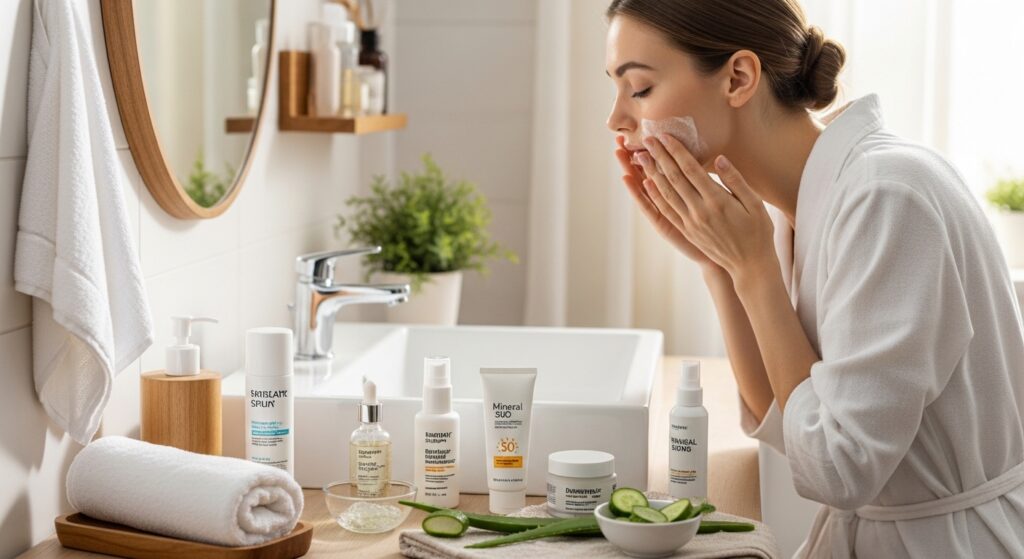
- Remove the trigger. Take off the product, the jewellery, the tight clothing, or move away from the heat or cold. Wash the area with cool water to remove any product, sweat or allergen. Do not scrub.
- Cool it. A cold compress — a clean cloth wrapped around ice, or a cloth soaked in cool water — for 10 to 15 minutes. Never put ice directly on the skin; it can damage very sensitive skin.
- Pat dry gently. Use a soft towel and pat. Do not rub.
- Moisturise while the skin is still slightly damp. A plain, fragrance-free moisturiser traps moisture better on damp skin than on dry skin. That is the whole first response, and it takes under 10 minutes.
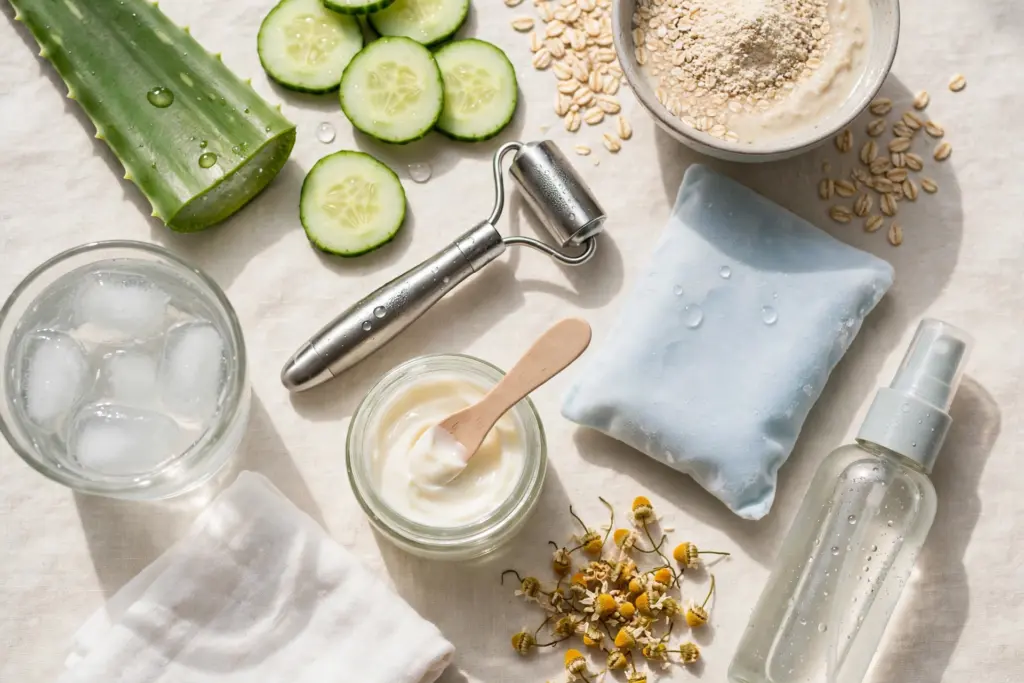
If the irritation covers a large part of the body, a lukewarm bath with colloidal oatmeal for 15 to 20 minutes can help. Colloidal oatmeal is finely ground oats that dissolve in water; it forms a protective layer on the skin and reduces itching. The US FDA lists colloidal oatmeal as a skin protectant.
What to stop immediately
Stop all of these until the skin has fully settled — redness and stinging gone, not just better:
- All actives. Retinoids, vitamin C serums, exfoliating acids, and any product that stings.
- Exfoliation. Do not exfoliate irritated skin at all — not even once a week. Exfoliating removes the protective outer layer and slows healing. Wait until redness and stinging have fully resolved before resuming, and then start gently.
- Fragrance and alcohol. Fragranced moisturisers, toners, soaps and laundry products. Use fragrance-free versions until the skin is calm.
- Makeup and fragranced sunscreen. Skip makeup for a day or two. If you need sun protection, use a plain mineral sunscreen once the skin has settled; while it is raw and stinging, shade and clothing are safer.
- Hot water and harsh washing. Lukewarm water only, short showers of 5 to 10 minutes, and a mild cleanser. Hot water strips natural oils and makes itching worse.
- Touching and scratching. Friction and bacteria from hands make irritation worse. Keep hands off the area.
Remedies, honestly
| Remedy | What it can do | What it cannot do |
|---|---|---|
| Cold compress / cool water | Cools the skin and reduces swelling and the urge to scratch | Treat the cause; the effect lasts while it is applied |
| Colloidal oatmeal | Forms a protective layer and reduces itching; useful for widespread irritation | Heal the skin on a schedule |
| Aloe vera gel | Cools and hydrates lightly; feels soothing on sunburn and razor irritation | Treat irritation; choose pure gel without fragrance |
| Plain fragrance-free moisturiser | Seals in moisture and supports the barrier while the skin recovers | Rebuild the barrier or heal skin faster |
| Coconut oil | The fatty acids help maintain the barrier and reduce moisture loss on dry, flaking skin | Suit irritated facial skin — it can clog pores and is not the first choice for the face, especially acne-prone skin |
| Wet wraps | A real technique used for eczema flares: moisturiser, then a damp cloth, then a dry cloth over it | A home remedy to try without guidance — ask a dermatologist first |
What makes it worse
Do not put any of these on irritated skin:
- Apple cider vinegar. Vinegar is an irritant. Putting it on irritated skin — diluted or not — makes irritation worse. Vinegar is a cleaner, not a skin treatment.
- Baking soda. It disrupts the skin’s pH and breaks down the protective layer. It does not calm itching; it causes more damage.
- Tea tree oil. Tea tree oil is itself a common irritant and allergen. It does not belong on irritated skin, and even diluted it can sting and worsen a reaction.
- Menthol products. Menthol feels cooling, but it can sting raw or irritated skin. Skip it until the skin has settled.
- Epsom salts and Dead Sea salts. There is no good evidence that magnesium from a bath soak reduces swelling or soothes irritated skin. A plain lukewarm bath is enough.
- Witch hazel. It is an astringent that can dry and sting irritated skin. It does not shrink swelling.
- Indigo naturalis. It is put into creams for psoriasis, and there is some small-study evidence for it, but it is not a home remedy for irritated skin. Psoriasis needs a dermatologist.
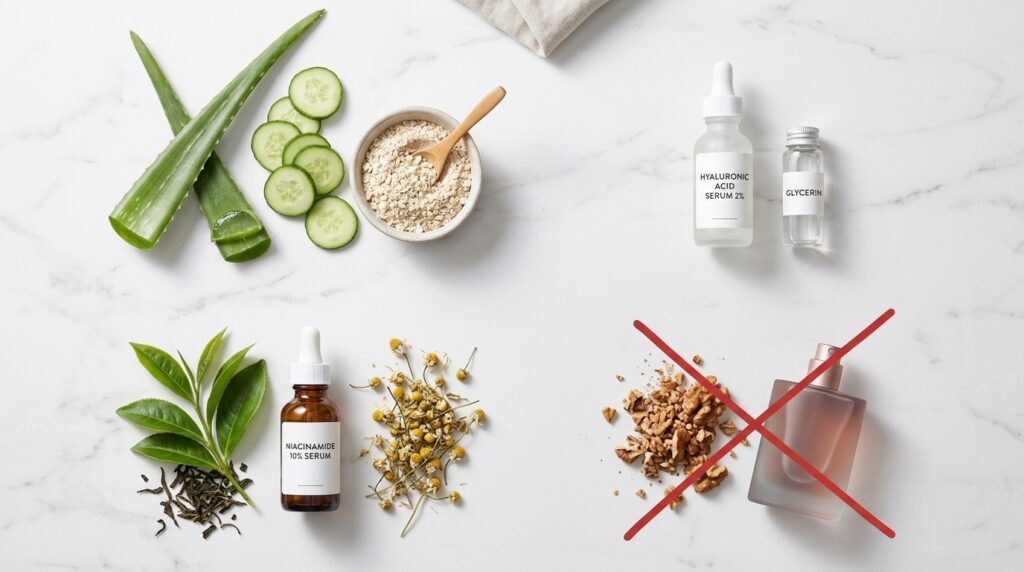
- Green tea and chamomile. Cooled green tea or chamomile can feel soothing, but the evidence for reducing redness is limited. They are comfort measures at most, not treatments. Calendula does not heal cuts or irritation quickly.
If a remedy stings for more than a minute or two, wash it off. Stinging is the skin telling you to stop.
The simplified routine
While the skin is irritated, use the shortest routine that works:
- Cleanse. A mild, fragrance-free, soap-free cleanser, lukewarm water, fingertips only. Pat dry.
- Moisturise. A fragrance-free moisturiser with ceramides, glycerin or hyaluronic acid, applied to slightly damp skin. A moisturiser supports the barrier; it does not rebuild it, and no moisturiser heals skin faster than another.
- Protect. Once the skin has settled, broad-spectrum sunscreen SPF 30 or higher every morning, reapplied every two hours when outdoors. Mineral sunscreens with zinc oxide are usually less irritating to sensitive skin than chemical ones. While the skin is raw, use shade and clothing instead.
- Nothing else. No toner, no serum, no exfoliant, no facial oil, no mask. Add things back one at a time, days apart, once the skin is fully calm.
Ingredients, honestly
- Ceramides, glycerin, hyaluronic acid. The three ingredients that matter most for irritated skin. Hyaluronic acid and glycerin are humectants that draw water in; ceramides are lipids that support the barrier. None of them heals skin on a schedule.
- Niacinamide. Supports the barrier and can help the look of redness. It is usually well tolerated, even on sensitive skin.
- Aloe vera and colloidal oatmeal. Cooling and soothing, with limited evidence. Useful comfort measures.
- Cucumber. Feels cooling; no proven effect on redness or irritation.
- Squalane and jojoba oil. Light oils that can seal in moisture at the end of a routine. Oils do not hydrate on their own — water moisturises, oil seals.
- Avoid: denatured alcohol, added fragrance, physical scrubs, and any product that lists a strong acid or retinoid. All of them strip natural oils or cause friction, which slows healing.
Diet, water and stress, honestly
- Food. A balanced diet supports general health. Fatty fish, leafy greens, berries and nuts contain omega-3 fatty acids and antioxidants, but eating them does not treat skin inflammation, and no “anti-inflammatory diet” calms irritated skin on a schedule. Diet is not a treatment.
- Water. Drinking water is good for your general health, but it does not directly hydrate skin or maintain the skin barrier. Topical moisture is what hydrates skin.
- Stress. Ongoing stress can make skin more sensitive and slower to settle. Short walks, breathing exercises and regular sleep can help you feel better, but they are not a skin treatment, and they do not lower cortisol on a fixed schedule.
- Humidity. A humidifier can help keep skin comfortable in winter or in air-conditioned rooms. Indoor humidity around 40 to 50 percent is a reasonable target.
- Triggers. Keep a short log of new products, foods and environments when irritation starts. Removing one variable at a time is the best way to find the cause.
When to get help
See a dermatologist if the irritation lasts more than 2 weeks, if it spreads to other areas, or if it does not improve with gentle home care. A dermatologist can examine the skin and, if needed, do a patch test to find the exact cause.
Get medical help within 24 hours if you have any of these signs of infection: fever with a rash, severe pain, spreading redness, growing warmth, or pus. These need treatment, not home care.
Professional treatments for chronic irritation linked to conditions such as eczema and psoriasis include prescription corticosteroid creams, light therapy and calcineurin inhibitors. The strength and duration are decided by a dermatologist. If skin problems keep coming back, a doctor can check for underlying causes such as thyroid disease or an immune-system problem; blood tests and allergy panels can help find causes that cannot be seen on the skin.
| Sign | What it means | Action |
|---|---|---|
| Redness spreading | Irritation is not contained | See a dermatologist |
| Pus or increasing warmth | Possible infection | Seek care within 24 hours |
| Fever with rash | Possible systemic infection | Seek care within 24 hours |
| Irritation lasting 2+ weeks | Not resolving with home care | Schedule a skin exam |
| Severe pain | Beyond typical irritation | Seek medical attention promptly |
Patch test
Once the skin has fully settled, patch test any new product before using it on your face. The American Academy of Dermatology recommends testing a new product before using it on your face: apply a small amount to a quarter-sized patch of skin on the inside of your arm or the bend of your elbow, twice a day for 7 to 10 days. If there is redness, itching or swelling, do not use it on your face. A 24-hour test can miss an allergic reaction, which often takes several days to appear — that is why this guide uses the AAD 7–10 day patch-test method. Do not patch test on skin that is still irritated.
Frequently asked questions
Q1: How long does it take for irritated skin to calm down?
There is no fixed schedule. Mild irritation often settles within a few days with gentle care; irritation linked to an underlying skin condition can take 1 to 2 weeks or longer to fully resolve.
Q2: Can I still exfoliate when my skin is irritated?
No. Exfoliating irritated skin removes the protective outer layer and slows healing. Wait until redness and stinging have fully resolved before resuming exfoliation.
Q3: What is the fastest way to calm irritated skin?
Remove the trigger, cool the skin with a cold compress, then follow with a fragrance-free moisturiser. That combination addresses heat, contact with the irritant, and moisture loss at the same time.
Q4: How can I reduce facial redness overnight?
Apply a cold compress for 10 minutes before bed, then use a fragrance-free moisturiser with niacinamide. Sleeping with the head slightly raised can reduce overnight fluid build-up in facial tissue. Do not expect redness to be gone by morning.
Q5: What is the best thing to put on dry, irritated skin?
A fragrance-free moisturiser containing ceramides and glycerin. These ingredients support the barrier while pulling in and holding moisture.
Summary
Calming irritated skin fast means doing less, not more: remove the trigger, cool the area, and moisturise with a plain fragrance-free moisturiser on slightly damp skin. Stop all actives, exfoliation, fragrance and hot water until the skin has fully settled. Cold compresses, colloidal oatmeal and aloe vera can help; vinegar, baking soda, tea tree oil and menthol make it worse. There is no fixed healing schedule. Patch test new products for 7 to 10 days once the skin is calm, and get medical help within 24 hours for signs of infection, or see a dermatologist if irritation lasts more than 2 weeks.
Sources: American Academy of Dermatology, 7 Rosacea skin care tips (patch-test method: apply a new product to a quarter-sized patch of skin on the inside of the arm for 7–10 days); American Academy of Dermatology, How to select anti-aging skin care products (broad-spectrum sunscreen, SPF 30 or higher every morning, reapply every two hours outdoors). This is a researched overview, not a hands-on review.