Researched overview. This guide is based on published dermatology guidance, not on hands-on testing by BeautyKob. No product, supplement or brand is recommended, and no dose is given.
Table Of Content
Quick answer
Oily skin comes from overactive sebaceous glands, and you cannot wash the oil away permanently — cleansing removes the oil that is there, and the glands keep making more. The goal is not oil-free skin; it is clean, comfortable skin with a working barrier. That means a gentle gel or foam cleanser twice a day, a light moisturiser even on oily skin, and broad-spectrum sunscreen SPF 30 or higher every morning. Harsh cleansers, alcohol toners and daily exfoliation do not reduce oil — they strip the barrier and leave skin irritated. This guide is general information, not medical advice.
Contents: What oily skin is · The zone map · Morning routine · Evening routine · Exfoliation rules · Ingredients, honestly · What to avoid · Daily habits · Diet, water and stress, honestly · Makeup tips · Professional options · Seasons · When to get help · Patch test · FAQ
What oily skin is
Sebaceous glands make sebum, the natural oil that protects and waterproofs the skin. Oily skin means those glands are more active than average. Five things drive it:
- Genetics. The size and activity of sebaceous glands are inherited. Larger glands make more sebum, and no routine changes that.
- Hormones. Androgens drive sebum production. Activity rises during puberty, menstruation, pregnancy and periods of stress.
- Harsh products. Sulfate-based cleansers and alcohol toners strip the barrier. The skin does not “pump out more oil” to compensate — that idea, often called rebound oil, is disputed, not proven — but stripping the barrier does leave skin irritated and uncomfortable.
- Heat and humidity. Warm, humid weather increases sebaceous gland activity. Oily skin is usually worse in hot, humid weather and better in dry, cool weather.
- Wrong products. Heavy creams and occlusive oils can trap sebum under the surface and make skin look oilier.
Signs of oily skin: shine on the forehead, nose and chin within a couple of hours of washing; visible pores, most often on the nose and cheeks; recurring blackheads, whiteheads or breakouts in oily areas; makeup that slides off after a few hours.
The zone map
Most oily skin is not oily everywhere. The usual pattern is:
- T-zone (forehead, nose, chin). The oiliest area, with the most sebaceous glands. This is where shine, blackheads and enlarged-looking pores show up first.
- Cheeks. Often normal or dry, even when the T-zone is oily. This is combination skin.
- Jawline and neck. Usually normal. Treat them gently; they do not need the same products as the T-zone.
The practical point: do not treat the whole face the way you treat the T-zone. Use lighter products on oily areas and richer cream only on the dry areas. A product that suits the T-zone can irritate dry cheeks, and a rich cream that suits dry cheeks can clog the T-zone.
How to check: cleanse with a gentle cleanser, pat dry, and use no products for an hour. Press a clean tissue to the forehead, nose, chin and cheeks. Oil on the tissue from the T-zone only means combination skin. Oil from everywhere means oily skin. No oil anywhere means dry skin.
Morning routine
- Cleanse. A gentle gel or foam cleanser, lukewarm water, for about 60 seconds. Hot water strips the barrier; lukewarm water cleans just as well. Pat dry with a soft towel — do not rub hard.
- Toner (optional). A hydrating toner can help the skin feel comfortable after cleansing. Skip alcohol-based astringent toners; they dry the surface and irritate the barrier. If you use a toner with exfoliating acids, use it only on the days you exfoliate, not every morning.
- Serum (optional). A niacinamide serum is a reasonable choice for oily areas. Niacinamide supports the barrier and can help the look of redness and uneven texture; the evidence that it reduces oil production is weak, and no percentage figure should be taken as a promise.
- Moisturiser. A light, oil-free gel moisturiser, about a pea-sized amount for the whole face. Skipping moisturiser does not reduce oil — dehydrated skin can feel tight and look shiny at the same time, and a light moisturiser keeps the barrier comfortable.
- Sunscreen, last step. Broad-spectrum SPF 30 or higher, applied generously. Choose a mattifying, oil-free formula if you prefer it, or a gel or water-based sunscreen, which usually feels lighter on oily skin. Reapply every two hours when outdoors. Do not skip sunscreen on oily skin: UV rays oxidise sebum and damage the barrier.
Evening routine
- Double cleanse. First, a micellar water or cleansing balm to remove sunscreen, makeup and pollution. Second, a water-based gel or foam cleanser to remove what is left. Two gentle passes clean better than one harsh one.
- Exfoliate (once or twice a week, not every night). See the exfoliation rules below.
- Toner (optional). A hydrating toner, or nothing at all. If you use retinoids, skip any exfoliating toner on retinoid nights — an acid-based toner can make retinoid irritation worse.
- Treatment. One active at a time. A retinoid such as retinol or prescription tretinoin can help regulate cell turnover and reduce the plugging that leads to acne; start at two nights a week and increase slowly over weeks. A benzoyl peroxide spot treatment can be used only on active acne, to avoid drying the skin around it. Do not start a retinoid and a chemical exfoliant in the same week.
- Moisturiser. A light gel moisturiser after the treatment actives. On retinoid nights, moisturiser before and after the retinoid — the “sandwich” method — can make it easier to tolerate.
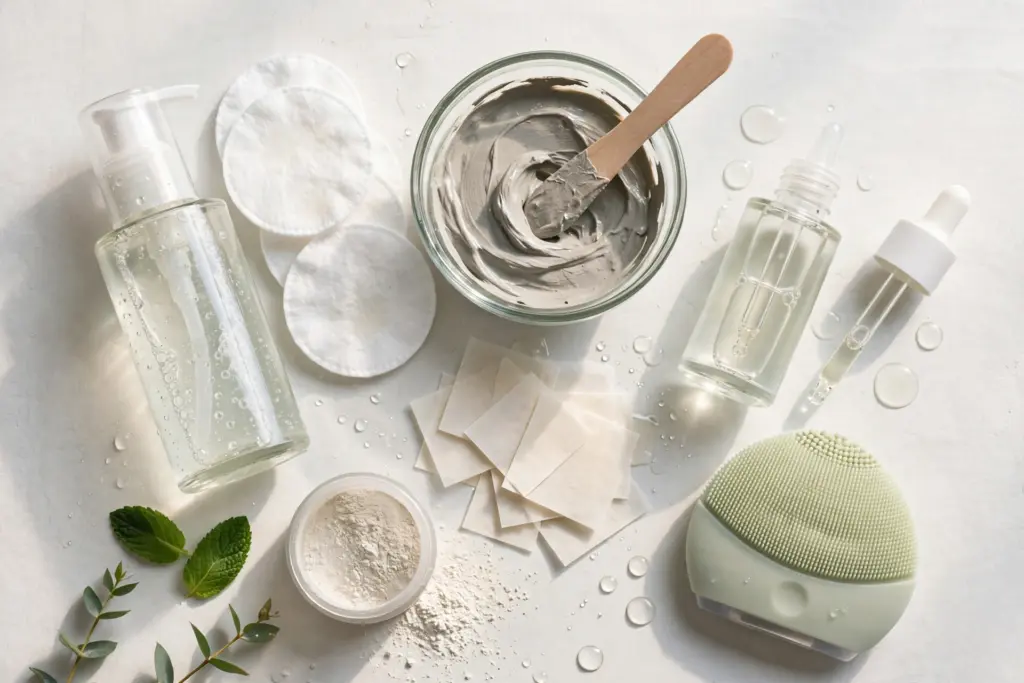
- Weekly mask (optional). A clay mask with kaolin or bentonite, applied to the T-zone only, for 10 to 12 minutes, once a week. Clay absorbs excess surface oil for a short time; it does not change how much oil the glands make.
Exfoliation rules
- Once or twice a week to start. A low-strength chemical exfoliant is enough. Increase only if the skin stays comfortable.
- Do not exfoliate daily. Daily exfoliation strips the barrier and increases inflammation, which makes oiliness and breakouts worse, not better.
- Do not exfoliate on the same night as a retinoid when starting out. Introduce one active at a time so you know which one is causing a problem.
- Stop if you get burning, persistent redness, or more oiliness within a day of exfoliating. Those are signs of over-exfoliation, and the fix is a break, not a different exfoliant.
- Physical scrubs are not necessary. If you use one, it should be very gentle and used rarely. The idea that scrubs cause “micro-tears” is unverified, but coarse scrubs do irritate the skin.
Ingredients, honestly
| Ingredient | What it can do | What it cannot do |
|---|---|---|
| Niacinamide | Supports the barrier; can help the look of redness and uneven texture; usually well tolerated | Reduce oil production on a schedule — the evidence is weak, and no percentage should be taken as a promise |
| Salicylic acid (BHA) | Exfoliates inside the pores and can help with blackheads | Clear oily skin on its own; no strength is recommended here |
| Zinc PCA | Used in products for oily skin; evidence for controlling sebum is limited | Control oil production on a schedule |
| Glycerin | A humectant that draws water in without adding oil | Treat oily skin on its own |
| AHAs (glycolic acid, lactic acid) | Exfoliate dead surface cells and can smooth texture | Be used daily without irritating the barrier |
| Retinol / retinoids | Help regulate cell turnover and reduce pore plugging over months | Work in weeks; safe in pregnancy (they are not — avoid retinoids if pregnant, planning pregnancy or breastfeeding, and ask a healthcare professional) |
| Clay (kaolin, bentonite) | Absorbs excess surface oil for a short time in a weekly mask | Change how much oil the glands make |
| Aloe vera gel | Soothes and hydrates without adding oil | Tighten pores — pores cannot open, close or tighten |
What to avoid
- Alcohol-based toners. They dry the surface and irritate the barrier. They do not reduce oil in the long run.
- Sulfate cleansers. Strong sulfate cleansers over-strip the barrier and leave skin irritated. A gentle cleanser cleans just as well.
- Heavy creams and oils on oily areas. Occlusive products can trap sebum and make the surface look oilier. Use them only on dry areas, if at all.
- Fragranced products. Fragrance is a common irritant. It does not increase oil production, but it can irritate skin that is already reactive.
- Petrolatum fears. Petrolatum does not clog pores — it is non-comedogenic. Avoiding it on oily skin is unnecessary, and a lip balm with petrolatum does not cause breakouts around the mouth. What matters is whether a product irritates your skin.
- Comedogenicity ratings. The 0–5 comedogenicity scale comes from old rabbit-ear studies and is not validated for human skin. Do not choose or reject a product on its rating alone.
- Daily exfoliation and double actives. Starting several strong actives in the same week makes it impossible to tell which one is causing a problem.
Daily habits
Small habits matter more than weekly treatments:
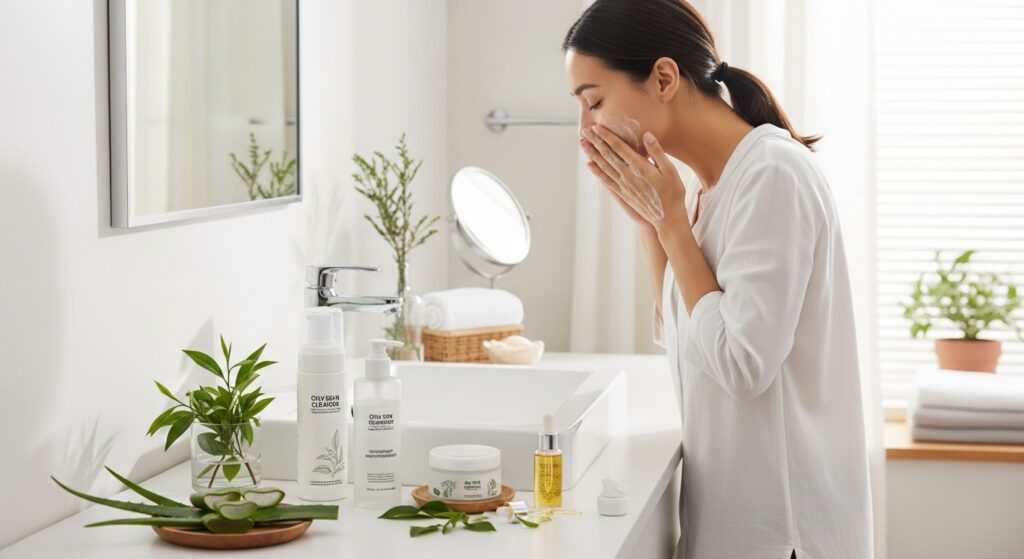
- Cleanse in the morning. Sebum builds up overnight; a morning cleanse removes it before you apply anything else.
- Double cleanse every evening. Skipping the evening cleanse on tired nights leaves sunscreen and makeup on the skin, which can clog pores overnight.
- Change pillowcases every 2 to 3 days. Pillowcases collect sebum, dead skin cells and product residue. A fresh pillowcase is the point; silk is not necessary — it helps with friction and breakage, not with oil.
- Use a fresh face cloth each time. Do not reuse the same towel for several days; bacteria and sebum can be redistributed across the skin.
- Blot, do not wipe. Press a blotting paper to the T-zone for 5 to 10 seconds to absorb excess oil. Do not rub — rubbing disturbs sunscreen and makeup. Blot before reapplying sunscreen.
- Apply toner with hands or a pad, whichever you prefer. Hands waste less product; a pad can help spread an exfoliating toner evenly. Neither method increases absorption — nothing you do with your hands increases absorption.
Diet, water and stress, honestly

- Food. A balanced diet supports general health. High-glycaemic foods have been linked with acne in some studies, but the evidence is not strong enough for a dietary recommendation, and no specific sugar limit produces a measurable change in oiliness. Dairy has an association with acne mainly for milk, especially skim milk, but the evidence is not strong enough to recommend avoiding dairy. Omega-3 rich foods do not lower sebum production. Diet is not a treatment for oily skin.
- Water. Drinking water is good for your general health, but it does not directly hydrate skin or flush out pores. Topical moisture is what hydrates skin.
- Stress. Ongoing stress can make skin feel worse and flare-ups more likely. Short walks, breathing exercises and regular sleep can help you feel better, but they are not a skin treatment, and they do not lower cortisol on a fixed schedule. Adults need 7 or more hours of sleep a night.
Makeup tips
- Use oil-free, non-comedogenic foundation, blush, bronzer and primer. Silicone-based primers can temporarily fill pores and give a smoother surface for foundation.
- A translucent setting powder with a silica base can absorb excess oil in the T-zone during the day. Do not apply powder over dry areas — it looks cakey there.
- For touch-ups, use blotting papers rather than adding more powder, which can build up and clog pores.
Professional options
Chemical peels, microneedling and laser treatments are medical procedures with real risks, costs and recovery times. They can help some people with oily skin or acne, but they are not a shortcut, and no specific strength, wavelength or number of sessions should be taken as a promise. Discuss them with a dermatologist first, and be wary of anyone who promises a specific outcome. Prescription retinoids such as tretinoin or adapalene are prescription drugs used long term for oily, acne-prone skin; a dermatologist decides which one fits and how to use it.
Seasons
- Winter. Sebum usually decreases in colder weather, and indoor heating dries the surface. Switch to a gentler cleanser, add a hyaluronic acid serum on damp skin, and use a slightly richer moisturiser — a ceramide-rich lotion rather than a gel. Sunscreen is still necessary in winter: UV damage accumulates all year, including on overcast days. Use SPF 30 or higher.
- Summer. Heat and humidity increase oiliness. A lighter gel cleanser and a light gel moisturiser are usually enough. Blotting papers help during the day.
When to get help
See a dermatologist if oily skin produces persistent, painful cystic acne that does not respond to over-the-counter treatments within 8 weeks, or if oily skin appears alongside hair loss, irregular periods, or sudden hormonal changes — these can indicate an underlying condition that needs medical assessment. Find a dermatologist through your GP referral or a verified directory such as the American Academy of Dermatology database.
Patch test
Test any new product before using it on your face. The American Academy of Dermatology recommends testing a new product before using it on your face: apply a small amount to a quarter-sized patch of skin on the inside of your arm or the bend of your elbow, twice a day for 7 to 10 days. If there is redness, itching or swelling, do not use it on your face. A 24-hour test can miss an allergic reaction, which often takes several days to appear — that is why this guide uses the AAD 7–10 day patch-test method.
Frequently asked questions
Q1: Does moisturising make oily skin oilier?
No. Skipping moisturiser does not reduce oil. A lightweight, oil-free gel moisturiser hydrates without adding oil, and keeps the barrier comfortable.
Q2: How often should I exfoliate?
Once or twice a week to start, with a low-strength chemical exfoliant. Sensitive oily skin should exfoliate once a week. Daily exfoliation strips the barrier and makes oiliness and breakouts worse.
Q3: Can I use oil-based products?
Yes, some. Light, non-comedogenic oils such as squalane, rosehip and jojoba can work as the first step of a double cleanse, dissolving sunscreen and makeup. Avoid heavy oils on oily areas, and do not choose a product by its comedogenicity rating alone.
Q4: Is sunscreen necessary in winter?
Yes. UV radiation causes cumulative skin damage all year, including on overcast winter days. Use SPF 30 or higher in a lightweight lotion formula.
Q5: When to see a dermatologist?
If oily skin produces persistent, painful cystic acne that does not respond to over-the-counter treatments within 8 weeks, or if oily skin appears alongside hair loss, irregular periods, or sudden hormonal changes.
Summary
Oily zones cannot be washed oil-free — the glands keep making sebum, and the goal is clean, comfortable skin with a working barrier. Cleanse gently twice a day, double cleanse in the evening, exfoliate once or twice a week, and use a light moisturiser even on oily skin, with broad-spectrum SPF 30+ every morning. Harsh cleansers, alcohol toners and daily exfoliation do not reduce oil; they strip the barrier. There is no fixed timeline for improvement, and no product, food or habit changes how much oil the glands make on a schedule. Patch test every new product for 7 to 10 days, and see a dermatologist if cystic acne or hormonal symptoms persist.
Sources: American Academy of Dermatology, 7 Rosacea skin care tips (patch-test method: apply a new product to a quarter-sized patch of skin on the inside of the arm for 7–10 days); American Academy of Dermatology, How to select anti-aging skin care products (broad-spectrum sunscreen, SPF 30 or higher every morning). This is a researched overview, not a hands-on review.