Researched overview. This guide is based on published dermatology guidance and general sleep and wellbeing guidance, not on hands-on testing by BeautyKob. No product, supplement or brand is recommended, and no dose is given.
Table Of Content
- Quick answer
- What stress does after a long day
- Why evenings are different from mornings
- Principles of an effective evening routine
- The 10–30 minute evening reset
- 1. Transition from work to personal time
- 2. Release physical tension
- 3. Unload mental noise
- 4. Choose calm input
- Skincare in your evening reset
- Routines by energy level
- Bedtime wind-down
- The next morning
- What not to do after a stressful day
- How long before you notice a difference
- Build your own routine
- When routines are not enough
- FAQ
- Summary
Quick answer
Stress relief after a long day is not a luxury — it is recovery. After hours of deadlines, alerts and demands, your body stays in alert mode even when the work is done: heart rate up, muscles tight, mind still racing. A short evening routine — ten to thirty minutes of simple, repeatable steps — gives your body a clear signal that the day is over and it is safe to rest. It does not treat anxiety, burnout or any medical condition, and it does not “detox” or repair your skin overnight. What it does is help you wind down, sleep better, and start the next day steadier. This guide is general information, not medical advice.

Contents: What stress does after a long day · Why evenings are different · Principles · The 10–30 minute evening reset · Skincare in your reset · Routines by energy level · Bedtime wind-down · The next morning · What not to do · How long before you notice a difference · Build your own routine · When routines are not enough · FAQ
What stress does after a long day
Stress is the body’s alert response: heart rate rises, muscles tense, breathing quickens, and stress hormones such as cortisol rise. Short bursts of pressure are normal — the body is built to handle them and then settle. The problem after a long day is that the alert state does not switch off when the work ends. Emails stop, but the mind keeps replaying them. The meeting is over, but the shoulders stay tight.
Over weeks and months, staying in that alert state takes a toll: sleep gets lighter, moods get shorter, digestion feels unsettled, and small irritations feel bigger. These are signs your body needs rest, not signs of weak character. Burnout does not arrive suddenly — it builds up from tension that is never released.
Evening is when willpower is lowest. Complicated self-improvement plans fail at night because decision-making is exhausted. That is why evening routines need to be simple: a few steps, the same order, low effort, high comfort.
Why evenings are different from mornings
Morning routines are about waking up and getting going. Evening routines are about slowing down and switching off. Night stress is different because it accumulates — the whole day is replayed at once, and there is nothing new to distract from it.
Simple, low-effort habits work best at night: soft breathing, dim light, a warm shower, the same few steps in the same order. Repetition is what teaches your body that evening means safety. The way you close your evening shapes how you wake the next morning — not because the night “repairs” you (night is a practical time to rest, not a biological repair window), but because a calm evening makes falling asleep easier.
Principles of an effective evening routine
- Keep it simple and repeatable. A short routine you actually do beats a long one you skip. Ten minutes a day beats an hour once a week.
- Balance physical and mental release. Stress lives in the body and the mind. Gentle movement eases the body; writing thoughts down eases the mind. One without the other leaves half the tension in place.
- Consistency over intensity. The same few steps, most evenings, in the same order. A missed day does not undo the habit — just return to it the next evening.
The 10–30 minute evening reset
You do not need a long ritual. A loose order, the same most nights:
1. Transition from work to personal time
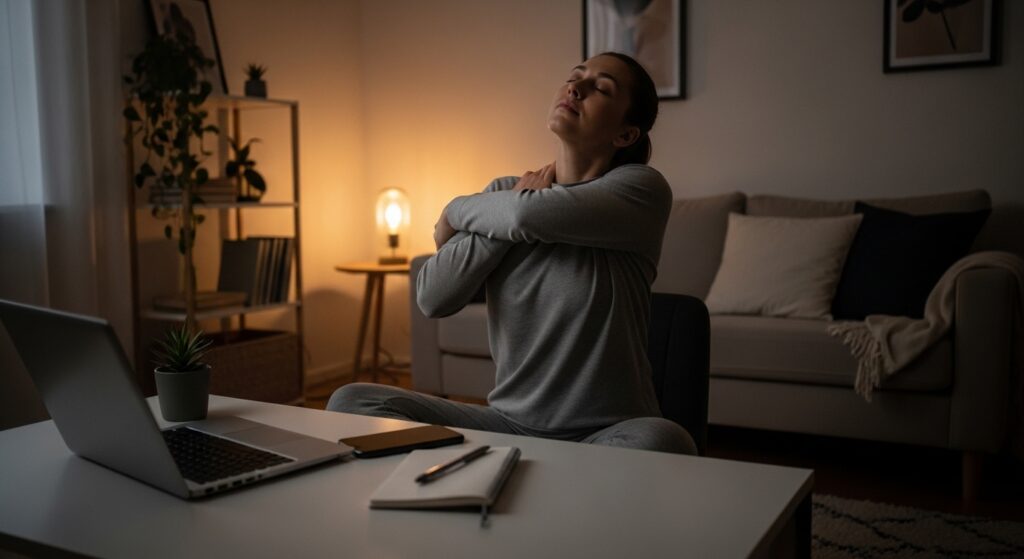
Your mind needs a clear sign that the working day is over. Change your clothes, wash your face, sit for two minutes doing nothing. Without a transition, work stress follows you into the evening.
2. Release physical tension
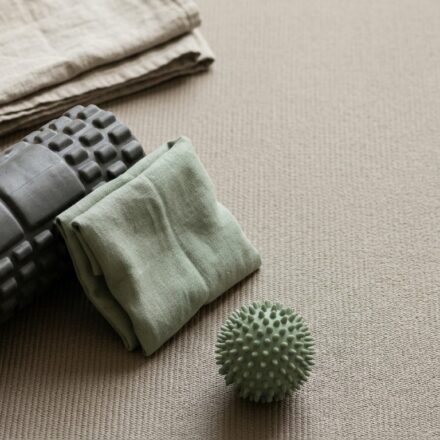
Stress gathers in the shoulders, jaw, neck and hips. Slow stretching with slow breathing helps the muscles let go. Breathe out a little longer than you breathe in — long, slow breaths out are calming. Avoid vigorous exercise late at night; it can wake you up instead of winding you down.
3. Unload mental noise
Evenings get noisy in the mind because the distractions stop. Write down unfinished tasks, worries, or tomorrow’s first three jobs — on paper, not in your head. The point is release, not solving anything. A voice memo works the same way.
4. Choose calm input
Low-stimulation input helps the brain slow down: soft music, warm lighting, silence, a slow walk, a book. Endless scrolling does the opposite — it keeps the brain alert and invites comparison, which adds tension rather than relieving it.
Skincare in your evening reset
Washing your face is a natural part of the transition — it marks the end of the day on your skin as well as in your mind:
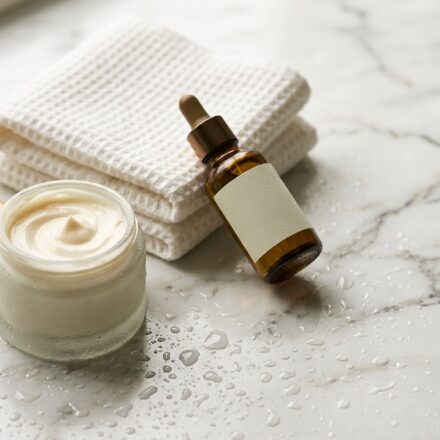
- Cleanse gently with lukewarm water and a gentle cleanser, using your fingertips. Pat dry — do not rub.
- Moisturise with a plain, fragrance-free moisturiser. Night is a practical time for treatments such as a retinoid, but only if your skin already tolerates them — retinoids are the strongest topical for fine lines, used slowly (start 2–3 nights a week, pea-sized, 3–6 months to judge), with a pregnancy warning. Do not start a strong active on a stressful evening.
- Patch test before you commit. The American Academy of Dermatology recommends testing a new product before using it on your face. Apply the product to a quarter-sized patch of skin where it will not be rubbed or washed away — the underside of your arm or the bend of your elbow — twice a day for 7 to 10 days. For a rinse-off product such as a cleanser, leave it on for about five minutes, or as long as the label says, then rinse it off. If the test area becomes red, itchy, swollen or painful, stop using the product. If the area stays clear for the full 7 to 10 days, the product is less likely to cause a reaction on your face — but a patch test cannot guarantee it.
A 24-hour test can miss an allergic reaction, which often takes several days to appear — that is why this guide uses the AAD 7–10 day patch-test method.
Routines by energy level
The right routine depends on how you are tired:
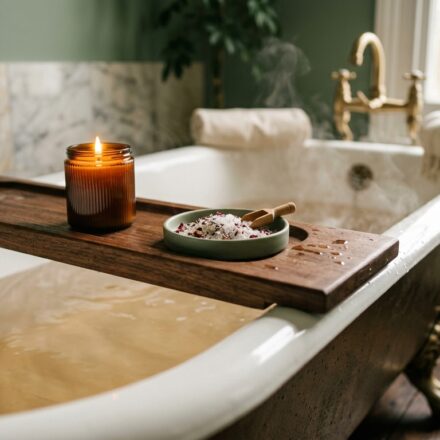
- Physically exhausted. Rest is the only job. Gentle breathing, lying with your legs raised, a warm bath. No exercise, no stimulating media.
- Mentally drained but physically alert. Light movement helps: a slow walk, gentle stretching, easy yoga. Movement shifts the mind’s energy into the body.
- Emotionally overwhelmed. Grounding helps: name five things you can see, feel the weight of your body on the chair, hold something cold, breathe slowly. Writing feelings down without judging them is release, not suppression.
Bedtime wind-down
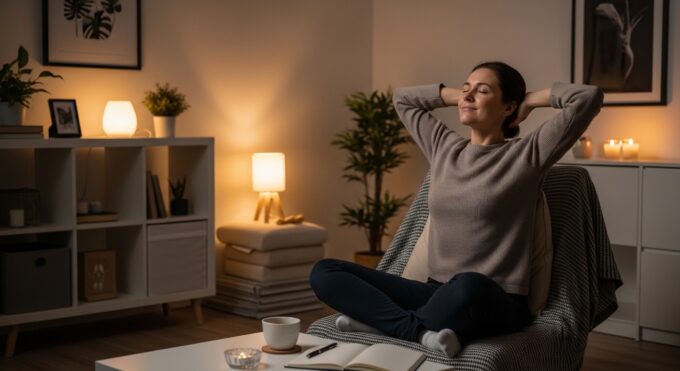
In the last hour before bed, dim the lights and lower the stimulation. Screens are the hardest part — bright light and endless content keep the brain alert. You do not need a total screen ban; choose low-stimulation material, or switch to audio, a book, or stretching instead. When the same steps repeat every night, the brain starts to associate them with rest. Sleep improves gradually through this signalling, not by force.
Adults need 7 or more hours of sleep a night (CDC). Poor sleep is linked to worse skin in observational studies — for example, one small study of 60 women (Oyetakin-White et al. 2015) found poor sleepers had roughly double the intrinsic ageing score and about 30% slower barrier recovery at 72 hours — but it was small, observational and funded by a cosmetics company, so it shows an association, not proof that bad sleep ages skin.
The next morning
A good evening makes the morning easier, and the morning routine is short: gentle cleanse, moisturiser, and broad-spectrum sunscreen with SPF 30 or higher, reapplied every two hours when outdoors. Sunscreen is the most effective anti-ageing step (Hughes et al. 2013). No evening routine replaces it.
What not to do after a stressful day
- Doomscrolling. Endless news and social media keep the brain on alert while distracting the mind. It prevents real recovery.
- Alcohol as a decompressant. It may feel relaxing at first, but it disturbs sleep and often leaves the next day worse.
- Working late into the night. Without a defined end point, the brain never gets the safety signal. Over time this keeps the alert state switched on.
- Ignoring body signals. Headaches, tense muscles, digestive discomfort and emotional numbness are signs of accumulated stress, not small things to push through. Noticing them is part of managing stress.
How long before you notice a difference
Change starts quietly. In the first few days you may feel a little calmer in the evening. Sleep may feel a little deeper. Muscles may feel less tight. After a couple of weeks, winding down usually gets easier and overthinking at night may ease. After about a month, the routine starts to feel automatic — the brain prepares for the wind-down and the shift to rest gets smoother. There is no fixed timeline and no dramatic transformation; the change is steadiness, not a sudden fix.
Build your own routine
Pick two or three anchors and make them yours:
- One physical release: gentle stretching, a slow walk, a warm shower.
- One mental unloading: writing thoughts down, a short list for tomorrow.
- One calming ritual: dim lighting, soft music, slow breathing, a book.
If you do not like meditation, do not force it. If you love music, use it. If you need structure, keep a regular time; if you prefer flexibility, attach the routine to something you already do, like brushing your teeth. Adjust with the seasons — energy changes through the year, and the routine can change with it without being lost. Consistency means repetition over time, not perfection. A day off does not reverse the progress.
When routines are not enough
Sometimes tiredness does not lift no matter what you try. If emotional numbness, persistent anxiety, irritability or hopelessness continue for weeks, or you feel withdrawn and disconnected from things that used to matter, that is more than ordinary tiredness. Therapy, medical advice or stress counselling can offer tools a self-directed routine cannot. Seeking help is not weakness — it is responsible self-care. Evening routines support wellbeing; they do not replace professional care when deeper help is needed.
FAQ
How long should a stress relief routine be?
Ten to twenty minutes is often enough. Consistency matters more than duration.
Is it okay to skip days?
Yes. Flexibility prevents extra pressure. Return gently the next day.
Can stress relief improve sleep?
It can help. A calmer evening makes falling asleep easier, and better sleep supports steadier moods and energy. It is not a treatment for insomnia or any sleep disorder.
Why does relaxation sometimes feel uncomfortable?
When your body is used to constant stimulation, slowing down can feel unfamiliar at first. That feeling usually fades with repetition.
Can routines reduce anxiety long term?
Routines can help you feel steadier and less tense day to day. They do not treat anxiety as a medical condition — if anxiety persists, ask a clinician.
Summary
After a long day, your body stays on alert even when the work is done. A short evening reset — a clear transition, gentle movement, unloading thoughts, calm input — gives it the signal to rest. Keep it simple, repeat it most evenings, and match it to how you are tired. Wash your face gently, moisturise, and patch test any new product for 7 to 10 days. In the morning, sunscreen SPF 30+ is the one step that matters most. Avoid doomscrolling, alcohol and working late. If low mood, anxiety or numbness persist for weeks, ask a professional — routines support wellbeing, they do not replace care.
Sources: American Academy of Dermatology, 7 Rosacea skin care tips (patch-test method: apply a new product to a quarter-sized patch of skin on the inside of the arm for 7–10 days); American Academy of Dermatology, How to select anti-aging skin care products (broad-spectrum sunscreen, SPF 30 or higher, reapply every two hours outdoors). This is a researched overview, not a hands-on review.