Researched overview. This guide is based on published dermatology guidance, not on hands-on testing by BeautyKob. No product, supplement or brand is recommended, and no dose is given.
Table Of Content
Quick answer
Buildup on skin and scalp is the slow accumulation of product residue, sebum, dead skin cells and soap residue that normal washing does not fully remove. On skin it looks dull, rough or clogged; on the scalp it feels waxy, heavy or flaky, and hair looks limp. Gentle removal works: a mild cleanser used properly, a clarifying shampoo roughly every one to four weeks depending on how much product you use, gentle exfoliation once or twice a week, and moisturiser afterwards while skin is slightly damp. Do not use vinegar, baking soda or strong scrubs on skin or scalp — they damage the barrier and make the problem worse. If flaking, itching or redness does not improve with gentle care, or if it spreads, see a dermatologist: dandruff, seborrheic dermatitis and psoriasis look similar to buildup but need different treatment. This guide is general information, not medical advice.
Contents: What buildup is · What causes it · Signs you have buildup · Removing buildup from skin · Removing buildup from the scalp · Dandruff, seborrheic dermatitis and psoriasis · What makes it worse · Preventing buildup · Patch test · When to see a dermatologist · FAQ
What buildup is
Buildup is residue that accumulates in small amounts over time: product residue from creams, styling products and dry shampoo; sebum, the skin’s natural oil; dead skin cells that have not been shed; and soap residue. On the face it sits on the surface and makes skin look dull, rough or clogged. On the scalp it can form a waxy, yellowish-white film near the hair roots, sometimes called a sebum crust — compressed layers of sebum, dead skin cells and product residue.
Buildup is a surface problem. It does not suffocate hair follicles or stop hair growing: a 2025 study of scalp shampoo use found that 28 days of shampooing increased scalp moisture without changing sebum secretion, and nothing in it supports the idea that residue chokes follicles. The fix is gentle, regular removal — not harsh scrubbing or strong chemicals.
What causes it
- Product residue. Heavy styling products, dry shampoo, waxes and silicone-based conditioners are the most common cause on the scalp. On the face, heavy creams, sunscreen and makeup left on overnight leave residue behind.
- Sebum and dead skin cells. Sebum mixes with dead skin cells and soap to form residue. Gentle shampoos that do not fully remove heavy products can leave more behind over time.
- Hard water. Water with high mineral content leaves deposits on hair and skin. Hard-water deposits are a surface effect only — they sit on the hair and skin, they do not damage the follicle or change how skin works.
- Not washing enough — or washing too harshly. Washing too rarely lets residue accumulate. Washing too harshly strips natural oils and irritates skin, which makes it look worse. Neither extreme helps; the middle is a mild cleanser used as often as the skin or scalp needs it.
Signs you have buildup
- Skin looks dull or hazy and does not improve with normal washing.
- Skin feels rough or bumpy, or pores look clogged.
- Hair looks heavy, limp or coated, and needs frequent washing to feel clean.
- The scalp feels waxy or flaky near the roots, and flakes stay attached rather than falling freely.
- Products seem to stop working — moisturiser sits on the skin, or shampoo does not lather as it used to.
Removing buildup from skin
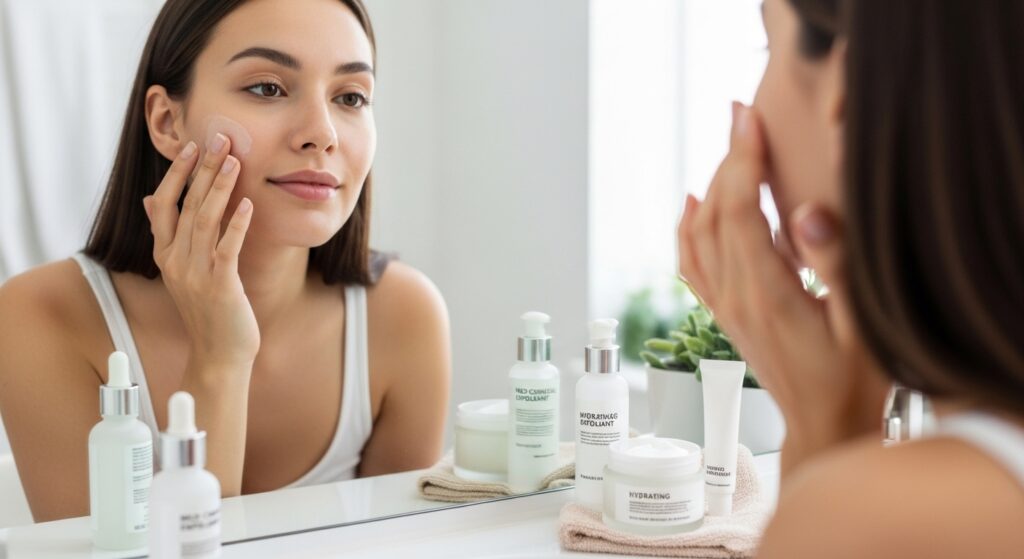
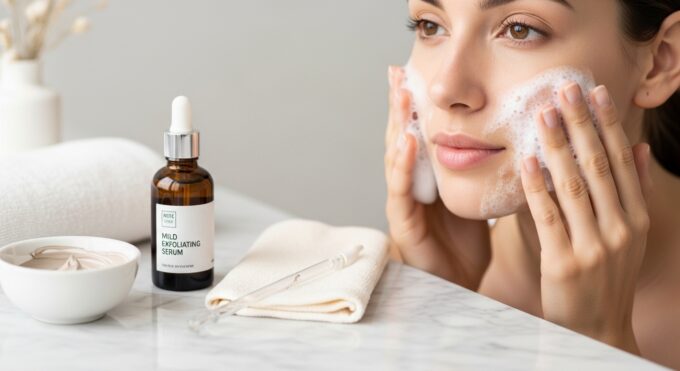
1. Use a gentle cleanser. A mild, fragrance-free cleanser with lukewarm water, fingertips only, pat dry. A gentle cleanser removes surface dirt, excess sebum and light product residue without disturbing the skin barrier. Wash as often as the skin needs it — usually twice a day for the face — and do not scrub.
2. Try an enzymatic cleanser. Enzymes such as papain from papaya and bromelain from pineapple break down the bonds between dead skin cells. Apply to dry skin and rinse after a minute or two. Enzymatic cleansers are among the mildest forms of chemical exfoliation and suit sensitive skin, but the evidence for them is limited — they are a gentle option, not a treatment.

3. Use a clay mask once a week. A thin layer of kaolin or bentonite clay, left for 10 to 15 minutes until partly dry, then rinsed with lukewarm water. Clay absorbs excess oil and residue from the surface. Once a week suits oily or combination skin; once a fortnight suits dry or sensitive skin. Do not let a clay mask dry completely hard — that over-dries the skin.
4. Clarifying pads, sparingly. Pads soaked in a gentle exfoliating acid can remove surface buildup in one step. Use them at night only, because chemical exfoliation makes skin more sensitive to UV, and always follow with sunscreen the next morning. If skin stings or flakes, stop.
5. Always finish with moisturiser. Moisturise soon after exfoliating or clarifying, while the skin is still slightly damp. A plain moisturiser with ceramides, glycerin or hyaluronic acid seals in water and supports the barrier. Moisturiser supports the barrier; it does not rebuild it.
6. Sunscreen the next morning. Exfoliated skin is more sensitive to sun. Broad-spectrum sunscreen SPF 30 or higher every morning, reapplied every two hours when outdoors.
Removing buildup from the scalp
Clarifying shampoo. A clarifying shampoo contains more surfactant than a daily shampoo and can help remove product residue, sebum buildup and mineral deposits. Use it roughly once every one to four weeks depending on how much product you use — heavy product users (dry shampoo, wax or hairspray daily) roughly every one to two weeks, minimal product users roughly monthly. Apply to wet hair, massage into the scalp with fingertips for two to three minutes, and rinse thoroughly. Do not use a clarifying shampoo daily; it is stronger than a daily shampoo and can dry the scalp out.
Scalp exfoliation, gently. Physical exfoliation with a soft-bristle scalp brush for a few minutes before shampooing can help remove dead skin and residue. Chemical scalp exfoliation with a gentle acid serum, left on for a few minutes before rinsing, is another option. Use fingertips, never fingernails — scratching the scalp with nails damages skin. Exfoliate the scalp at most once a week, and stop if the scalp stings, reddens or flakes more.
Double cleansing for heavy product use. Two successive washes per wash day: the first removes surface oil and product residue, the second cleans the scalp more thoroughly. This suits heavily producted scalps, especially if you use dry shampoo, styling wax or scalp serums daily.
Shampoo the scalp, not the hair length. Massage with fingertips in circular motions for 60 to 90 seconds before rinsing. Rinse with warm water for 60 seconds or more to remove residual shampoo. Wash as often as the scalp needs it — for most people that is two to four washes a week, but oily scalps may need more and dry scalps less. There is no single correct frequency.
Clean your tools. Wash hair brushes, combs and styling tools every week to remove sebum, dead skin cells and product residue. A brush coated in buildup puts residue back onto clean hair every time it is used.
Dandruff, seborrheic dermatitis and psoriasis
Buildup, dandruff, seborrheic dermatitis and psoriasis can look similar, but they are different problems with different treatments:
| Condition | Flakes | Where | What helps |
|---|---|---|---|
| Dandruff | Dry, white, fall freely | Scalp only | Antifungal shampoo with zinc pyrithione or ketoconazole; leave on for 5 to 10 minutes before rinsing. If it does not improve after about a month, see a pharmacist or doctor. |
| Product buildup / sebum crust | Waxy, yellow-white, stay attached | Scalp, near the hair root | Clarifying shampoo and gentle scalp care, as above. |
| Seborrheic dermatitis | Oily, yellow flakes | Scalp, eyebrows, sides of the nose | Antifungal shampoo plus regular gentle cleansing. It is an inflammatory reaction linked to yeast on the skin, and it needs a dermatologist if it does not improve. |
| Psoriasis | Thick, silvery-white scale | Scalp, often spreading beyond the hairline onto the forehead | Dermatologist-prescribed treatment. A clarifying shampoo cannot remove psoriasis scale, and it should not be scrubbed off. |
If antifungal shampoo does not help, that is a sign the problem is buildup, not dandruff. If flaking spreads beyond the scalp, or the scalp is red, sore or swollen, see a dermatologist — they can tell dandruff, seborrheic dermatitis, psoriasis, contact dermatitis and fungal infections apart, and each needs different treatment.
What makes it worse
- Vinegar rinses on the scalp. Apple cider vinegar is a cleaner, not a skin treatment. There is no good evidence it removes buildup or restores scalp pH, and it can irritate skin. Do not use it on skin or scalp.
- Baking soda paste. Baking soda is alkaline (pH 8.3) and disrupts the skin’s acid mantle (pH 4.5–5.5). It does not gently remove buildup — it damages the barrier. Do not use it on skin or scalp.
- Harsh scrubbing. Scrubbing hard, using abrasive pads, or scratching with fingernails damages skin and the scalp barrier and makes flaking worse.
- Tea tree oil, undiluted or strong. Tea tree oil is itself a common irritant and allergen. If it is used at all, it must be properly diluted and patch tested first — and it is not a first choice for an irritated scalp.
- Over-washing with strong products. Washing more than once a day with a strong shampoo strips natural oils and irritates the scalp. Wash as often as the scalp needs, with a mild product.
- Skipping moisturiser after exfoliating. Exfoliated skin loses water faster. Moisturise while skin is slightly damp.
- Believing “detox” kits. Skin does not need detoxing — the liver and kidneys handle waste removal. A “skin detox kit” is a marketing label, not a treatment.
Preventing buildup
- Choose water-soluble hair products where possible — they wash out more easily than heavy waxes and silicone-based products.
- Wash as often as the scalp needs, and rinse thoroughly.
- Use a clarifying shampoo roughly monthly if you use heavy products.
- Clean brushes and tools weekly.
- Keep the routine simple: fewer products means less residue to remove.
Patch test
Before using a new cleanser, exfoliant or scalp product on your face or scalp, patch test it: apply a small amount to a quarter-sized patch of skin on the inside of your arm or the bend of your elbow, twice a day, for 7 to 10 days. If there is redness, itching or swelling, do not use it. A 24-hour test can miss an allergic reaction, which often takes several days to appear — that is why this guide uses the AAD 7–10 day patch-test method. This is the American Academy of Dermatology’s patch-test method. Do not patch test on skin that is irritated or broken.
When to see a dermatologist
See a dermatologist if: the scalp is persistently itchy despite clarifying treatment; there is noticeable inflammation or redness at the scalp; hair is thinning or falling out where buildup sits; flaking spreads away from the scalp; or the problem does not improve after several weeks of gentle care. A dermatologist can tell the difference between buildup, dandruff, seborrheic dermatitis, psoriasis, contact dermatitis and fungal infections, which all need different treatment.
Frequently asked questions
Q1: How often should I use clarifying shampoo?
Roughly once every one to four weeks depending on how much product you use. Heavy product users need it roughly every one to two weeks; minimal product users need it roughly monthly. It is not a daily shampoo.
Q2: Can I remove product buildup without washing my hair?
A pre-wash scalp serum can loosen buildup before washing, but it does not replace washing. Apply it, leave it for 10 to 15 minutes, then wash as normal.
Q3: What is the white waxy buildup on my scalp?
It is a sebum crust — compressed layers of sebum, dead skin cells and product residue that accumulate when the scalp is not fully cleansed between washes. A clarifying shampoo and gentle scalp care remove it gradually over several washes. It does not suffocate hair follicles.
Q4: How long does it take to completely remove scalp buildup?
There is no fixed schedule. Light buildup can clear in a few washes; heavier buildup from months of heavy product use takes several weeks of consistent gentle care. If it does not improve after several weeks, see a dermatologist.
Summary
Buildup on skin and scalp is surface residue — product, sebum, dead cells and soap — that normal washing does not fully remove. Gentle removal works: a mild cleanser, a clarifying shampoo roughly every one to four weeks, gentle exfoliation once or twice a week, and moisturiser while skin is slightly damp. Vinegar, baking soda, harsh scrubbing and strong tea tree oil make it worse, not better. Dandruff, seborrheic dermatitis and psoriasis look similar to buildup but need different treatment, so see a dermatologist if gentle care does not help after several weeks. Patch test new products for 7 to 10 days, and protect exfoliated skin with SPF 30+ every morning.
Sources: American Academy of Dermatology, 7 Rosacea skin care tips (patch-test method: apply a new product to a quarter-sized patch of skin on the inside of the arm for 7–10 days); American Academy of Dermatology, How to select anti-aging skin care products (broad-spectrum sunscreen, SPF 30 or higher every morning, reapply every two hours outdoors). This is a researched overview, not a hands-on review.