Researched overview. This guide is based on published dermatology guidance, not on hands-on testing by BeautyKob. No product, supplement or brand is recommended, and no dose is given.
Table Of Content
- Quick answer
- Why routines get framed as “detox”
- What’s actually happening when skin looks dull or congested
- Key ingredients, honestly
- Exfoliants and absorbents
- Active ingredients with established research
- Ingredients with weaker or more preliminary evidence
- Building a routine that works
- The order actually matters
- Why consistency beats intensity
- Lifestyle factors, honestly
- Sleep, hydration and sugar
- Stress, exercise and screen time
- Common mistakes
- Skin fasting, honestly
- Patch test
- When to get help
- Frequently asked questions
- The bottom line
Quick answer
Skin does not need detoxing. The word “detox” is doing marketing work, not scientific work: skin does not store toxins the way the term implies, and the liver and kidneys handle waste removal. What a “detox routine” actually does is simpler and more useful — it removes surface buildup, supports the skin barrier, and gets out of the way of the skin’s own renewal process. The ingredients and steps in such a routine are mostly sound — gentle cleansing, exfoliation once or twice a week, a moisturiser, vitamin C, a retinoid used slowly, and daily sunscreen — but the “detox” framing oversells what is happening and how fast it happens. Results come from specific, well-understood mechanisms, not from pulling anything “out” of the skin, and they take weeks, not days. This guide is general information, not medical advice.
Contents: Why routines get framed as “detox” · What’s actually happening · Key ingredients, honestly · Building a routine that works · Lifestyle factors, honestly · Common mistakes · Skin fasting, honestly · Patch test · When to get help · FAQ
Why routines get framed as “detox”
Every day, skin is subjected to pollution particles, UV radiation, perspiration and cosmetic product residue. None of this is “toxic” in the sense the word usually implies, but it can contribute to clogged pores, dull texture and a weakened skin barrier over time. Reducing that buildup and supporting the barrier is the real mechanism behind most “detox” routines — the language is just borrowed from wellness marketing.
That does not make the routine useless. It just means the results come from specific, well-understood mechanisms rather than pulling anything “out” of the skin. A routine that cleanses gently, exfoliates mildly, hydrates and protects with sunscreen does real work. Calling it a “detox” does not add anything to it, and it sets up expectations — fast results, purged skin, a reset — that no routine can meet.
What’s actually happening when skin looks dull or congested
Two kinds of factors show up on skin, and they respond to different things:
- External factors — pollution, UV exposure, product residue — respond to topical care: gentle cleansing, exfoliation, barrier-supporting moisturisers, sunscreen.
- Internal factors — diet, sleep, stress, hydration — do not respond to anything applied to the skin’s surface, no matter how good the product is. Treating a stress-driven breakout purely with topical products tends to produce limited results, since the underlying driver has not changed.
Skin renews itself continuously, but there is no fixed schedule for it. The often-quoted “28 days” is a rounded rule of thumb, not a precise cycle: one careful calculation put skin-cell turnover at 47–48 days. Visible changes in skin texture typically take weeks of steady use, not days — and the range varies widely from person to person. Anyone promising results in a week is selling the promise, not the mechanism.
Key ingredients, honestly
Exfoliants and absorbents
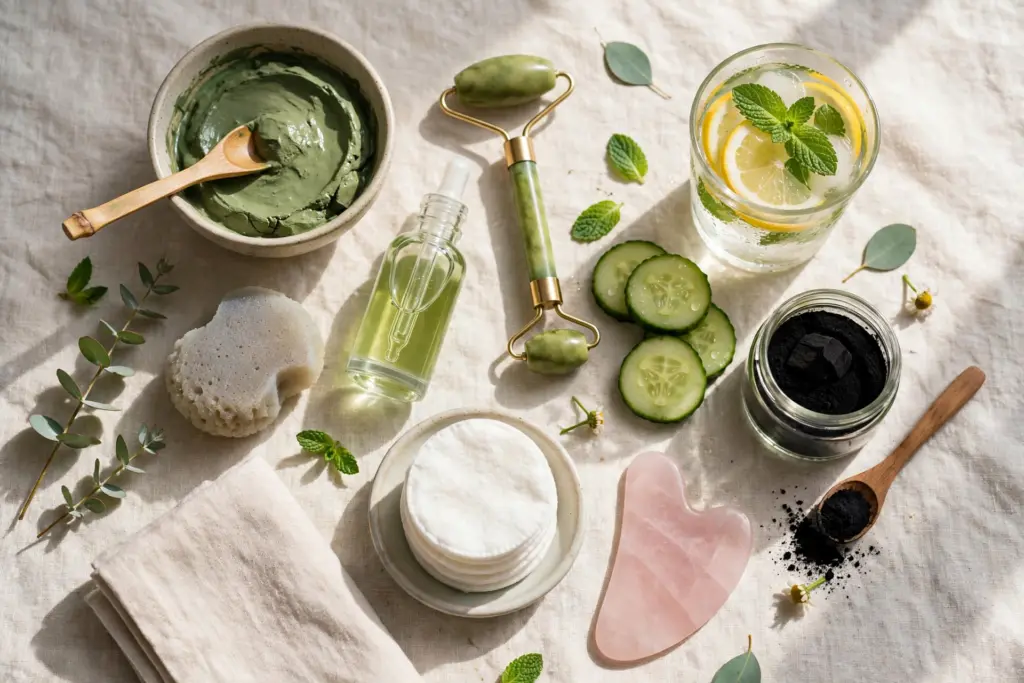
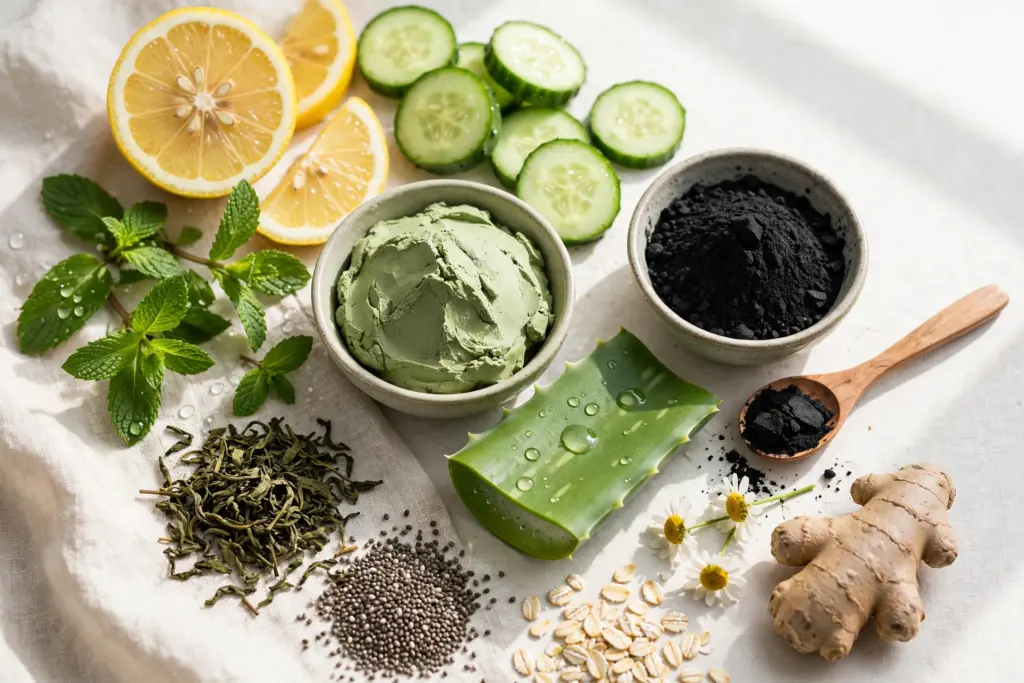
Activated charcoal and kaolin clay work through adsorption — fine particles that bind to oils and residue on the skin’s surface. Charcoal tends to be more drying; kaolin clay is gentler and better suited to drier or more sensitive skin, typically used in a weekly 10–15 minute mask. Coffee grounds and chemical exfoliants (AHAs/BHAs) work differently, physically or chemically removing dead skin cells rather than absorbing surface debris. Both categories share the same caution: more is not better. Exfoliating beyond two or three times a week tends to strip the skin barrier rather than improve texture. If you use both a clay mask and a chemical exfoliant, space them on different days — combining strong exfoliation methods in the same session is a common way to accidentally over-strip the barrier.
Active ingredients with established research
Vitamin C, retinol and hyaluronic acid each have a substantial research base, though the timelines are longer than most product marketing suggests. Vitamin C is an antioxidant and a cofactor for collagen synthesis in the body; it can help the look of uneven tone over time, generally over several weeks of consistent use, and its stability improves notably when formulated alongside ferulic acid. Retinol speeds up cell turnover and is genuinely effective for texture and fine lines, but it typically needs to be introduced gradually — two nights a week, building up over several weeks — to avoid irritation, and it takes three to six months to judge. Retinoids are not suitable in pregnancy. Hyaluronic acid is a humectant that draws water into the upper layer of skin, which is why it is most effective applied to damp skin rather than dry skin — it needs moisture nearby to draw from.
Ingredients with weaker or more preliminary evidence
Chlorophyll, turmeric and probiotics are increasingly popular in skincare marketing, and the underlying compounds (curcumin, live cultures, chlorophyllin) do have some antioxidant or anti-inflammatory research behind them. That said, the evidence for topical skincare formulations specifically — as opposed to the raw compounds studied in a lab — is thinner, and a lot of the current popularity is trend-driven rather than clinically established. They are reasonable ingredients to try, just not ones to build an entire routine’s expectations around. Probiotics in particular are not an established treatment: the gut-skin axis is real biology, but probiotics are not an established skin treatment per the 2024 AAD position.
| Ingredient | Main mechanism | Typical use | Evidence level |
|---|---|---|---|
| Kaolin clay | Absorbs excess oil | Weekly mask, 10–15 min | Well-established |
| Retinol | Speeds cell turnover | Nightly, built up gradually | Strong (well-studied) |
| Vitamin C | Antioxidant, supports collagen | Morning serum | Strong (well-studied) |
| Hyaluronic acid | Draws and holds moisture | Applied to damp skin | Strong (well-studied) |
| Turmeric/curcumin | Anti-inflammatory | DIY mask or serum | Preliminary for topical use |
| Probiotics | Supports skin microbiome | Oral or topical | Emerging, promising but limited |
Building a routine that works
The order actually matters
A basic routine works in a specific sequence: cleanse, exfoliate on some days, treat with serums (thinnest to thickest), moisturise, and finish with SPF in the morning. The order matters for texture and comfort — a heavy moisturiser before a serum makes the serum harder to spread and less pleasant to use. It does not change absorption: nothing you do with your hands or by layering order increases how much product is absorbed.
Sunscreen is the step most often shortchanged, but UV exposure actively undoes the benefits of every other step by generating new oxidative damage. A broad-spectrum SPF 30 or higher, reapplied roughly every two hours in direct sun, is what makes the rest of the routine’s effort actually stick. If a routine feels overwhelming, the two steps to never skip are moisturiser and sunscreen. Everything else can flex around your schedule; those two protect the progress already made.
Why consistency beats intensity
Most active ingredients need weeks of steady use before their effects become visible, since they are working with the skin’s natural renewal timeline rather than against it. Switching products every two or three weeks — a common habit when results feel slow — resets that clock instead of speeding it up. Commit to one routine for at least six weeks before judging it, and introduce one new active at a time so you know which one is causing a problem if irritation appears.
Lifestyle factors, honestly
Sleep, hydration and sugar
Short or disrupted sleep is linked to a more permeable skin barrier and faster moisture loss, and it makes puffiness and dark circles look worse. Sleep is a practical time to rest, not a biological repair window — there is no hour of the night when skin repair peaks, and no sleep schedule produces results on a fixed timetable. Adults need 7 or more hours a night (CDC).
Hydration matters in an unglamorous way: adequate water intake supports normal skin function, but drinking water does not directly hydrate skin, and there is no evidence that drinking more water beyond adequate hydration produces additional cosmetic benefit. Topical moisture is what hydrates skin.
Sugar’s effect is real but slow and modest: excess sugar over years is associated with stiffer collagen through glycation, a process where sugar molecules bind to collagen and elastin fibres. This is a slow, cumulative association, not something that shows up after a single indulgent week, and no food can be presented as a skin treatment.
Stress, exercise and screen time
Ongoing stress can make skin more reactive and slower to settle, and stressful periods often coincide with breakouts even when the skincare routine has not changed. The mechanism is not a simple chain — stress does not directly raise oil production on a schedule — and no relaxation technique lowers cortisol on a fixed timetable. Moderate regular exercise supports general health; it does not deliver nutrients to skin cells in a way that changes skin. Reducing screen time in the hour or two before bed can help sleep, which is good for general health. None of these lifestyle factors replaces a topical routine, but they set the ceiling on how much a topical routine alone can accomplish.
Common mistakes
| Mistake | Why it backfires | Better approach |
|---|---|---|
| Product-hopping every 2–3 weeks | Actives need weeks to show results | Commit to one routine for at least 6 weeks |
| Over-exfoliating | Strips the moisture barrier, worsens sensitivity | Cap exfoliation at 2–3 times weekly |
| Layering too many actives at once | Increases irritation risk, makes it hard to identify what’s working | Introduce one new active at a time |
| Skipping sunscreen | UV damage offsets progress from every other step | Apply SPF 30+ daily, reapply outdoors |
| Judging results after a few days | Skin renewal takes weeks, and the timeline varies | Wait several weeks of steady use before evaluating |
Skin fasting, honestly
Skin fasting means deliberately reducing product use to just cleanser and moisturiser for one to two weeks, to let an overloaded routine simplify and the barrier settle. It is a reasonable step if skin reacts poorly to new products or a heavily layered routine feels like too much — but it is not necessary for everyone, and skin does not become “dependent” on products or need to “recalibrate” its oil production. A full break from all products, including moisturiser and sunscreen, is not recommended: skin still needs cleansing, moisturising and sun protection every day. The gentle partial fast — cleanser and moisturiser only — is the only version this guide recommends, and even that suits some skin types better than others. If skin is irritated, raw or broken, do not fast — simplify to the shortest gentle routine and see a dermatologist if it does not settle.
Patch test
Before using a new product on your face, patch test it: apply a quarter-sized amount to the underside of your arm or the bend of your elbow, twice a day, for 7 to 10 days. If there is redness, itching, swelling or a rash, stop using it. A 24-hour test can miss an allergic reaction, which often takes several days to appear — that is why this guide uses the AAD 7–10 day patch-test method. This is the American Academy of Dermatology’s patch-test method.
When to get help
Ask a dermatologist or pharmacist if: skin is persistently red, sore, flaking or swollen; a product keeps stinging or causing breakouts; dark spots or wrinkles do not improve after several months of a steady routine; or you have a skin condition such as eczema, rosacea or acne that is getting worse. See a doctor promptly if a rash spreads, blisters or oozes, or if there is fever with a rash — those need medical care, not home care.
Frequently asked questions
Q1: Does skin actually release toxins during a “detox” routine?
Not in the literal sense the marketing implies — skin does not store and release toxins like a filter does. What a detox-style routine actually does is remove surface buildup and support the skin’s barrier function, which produces real but more modest results than the word “detox” suggests.
Q2: How long before a new skincare routine shows visible results?
Most active ingredients need weeks of consistent use to show visible change, tied to the skin’s renewal cycle, which varies from person to person. Early signs like reduced congestion can appear within a few weeks, with fuller results taking longer. There is no fixed schedule.
Q3: Can I use a clay mask and retinol in the same routine?
Combining them is fine, but not on the same day or in the same session — both can be drying or irritating, and stacking them increases the risk of barrier damage. A common approach is a clay mask once weekly and retinol on separate evenings, building retinol use gradually over several weeks.
Q4: Is drinking more water actually going to improve my skin?
Adequate hydration supports normal skin function, but there is limited evidence that drinking water beyond what your body needs adds extra cosmetic benefit. Dehydration does make skin look tighter and less resilient, so consistent hydration matters more as a baseline than as an active treatment. Drinking water does not directly hydrate skin.
Q5: What is skin fasting and is it actually necessary?
Skin fasting means deliberately cutting back to just cleanser and moisturiser for one to two weeks to let an overloaded routine simplify. It is not necessary for everyone, but it is a reasonable step if skin reacts poorly to new products. A full break from all products is not recommended.
The bottom line
The ingredients and steps in a “detox” skincare routine are mostly sound — clay, retinol, vitamin C and consistent SPF use are all backed by real evidence — but the “detox” framing oversells what is actually happening and how fast it happens. Skin does not need to be purged of toxins; it needs consistent support for its own renewal process, which takes weeks, not days. The people who see the best results tend to be the ones who pick a simple routine and stick with it, rather than the ones chasing the newest ingredient every few weeks.
Sources: American Academy of Dermatology, 7 Rosacea skin care tips (patch-test method: apply a new product to a quarter-sized patch of skin on the inside of the arm for 7–10 days); American Academy of Dermatology, How to select anti-aging skin care products (broad-spectrum sunscreen, SPF 30 or higher, reapply every two hours outdoors). This is a researched overview, not a hands-on review.