Researched overview. This guide is based on published dermatology guidance, not on hands-on testing by BeautyKob. No product, supplement or brand is recommended, and no dose is given.
Table Of Content
Quick answer
Tired-looking skin is usually dull, rough or flat-looking skin: dead skin cells sitting on the surface, skin that has lost water, and years of sun exposure showing up as uneven tone. Nothing refreshes it in a day. What honestly helps is a short, steady routine — gentle cleansing, hydration on damp skin, a plain moisturiser, and broad-spectrum sunscreen SPF 30+ every morning — plus gentle exfoliation once or twice a week and, for some people, a retinoid used slowly over months. Quick fixes such as a cold splash, a chilled sheet mask or makeup can make skin look fresher for a few hours; they do not change the skin underneath. Professional treatments such as peels, microneedling and laser resurfacing are medical procedures with real risks and costs, and they need a dermatologist first. This guide is general information, not medical advice.
Contents: What tired skin is · What makes skin look tired · What actually refreshes it · Ingredients, honestly · Quick refreshes, honestly · Professional treatments, honestly · Habits, honestly · What to skip · Patch test · When to get help · FAQ
What tired skin is
Tired skin is not a medical condition. It is a visible state: skin that looks flat, grey or dull, feels rough or uneven under the fingertips, and shows fine lines more clearly than usual. It is often confused with dehydrated skin, and the two frequently occur together — but they are different problems with different fixes.
- Dull skin lacks brightness and has an uneven texture, caused by dead-cell buildup on the surface, ageing, sun exposure or lifestyle factors. It responds to gentle exfoliation and brightening ingredients over weeks.
- Dehydrated skin lacks water content: it feels tight, looks sunken, and shows exaggerated fine lines. It responds to hydration — humectants such as hyaluronic acid and glycerin, and a moisturiser that seals water in. Drinking more water does not directly hydrate skin; topical moisture is what hydrates skin.
Dull skin and dehydrated skin often appear together, and dehydration makes the flat, grey appearance of dull skin worse. Sorting out which one is the main problem is the first step: if skin feels tight and looks sunken, hydration comes first; if it feels rough and looks flat, gentle exfoliation matters more.
What makes skin look tired
Dead skin cells building up. The skin sheds dead cells from its surface all the time, and that shedding slows with age, stress and poor skincare habits. When dead cells pile up faster than they are shed, the surface becomes thick and uneven, reflects light poorly, and looks flat and tired. Gentle exfoliation removes that layer; it does not change the skin underneath.
Dehydration. When skin loses water — from cold weather, low humidity, air conditioning, hot showers or harsh cleansers — fine lines look deeper and skin looks less plump. Hydration on damp skin plus a moisturiser that seals water in is the fix, not drinking extra water.
Sun exposure. Ultraviolet light breaks down collagen and elastin and promotes uneven pigmentation over years. Sun damage is the main external contributor to premature ageing and dullness, and it is also the most preventable: daily broad-spectrum sunscreen is the single most effective anti-ageing step.
Poor sleep and stress. Short or disrupted sleep makes puffiness and dark circles look worse and makes it harder to stick to a routine. Ongoing stress can make skin more reactive. Neither poor sleep nor stress directly creates dull texture, and no sleep schedule repairs skin on a fixed timetable — night is a practical time to rest, not a biological repair window.
Smoking and alcohol. Smoking narrows blood vessels and reduces the oxygen reaching skin, which is why smokers often have a grey, dull complexion. Alcohol dehydrates skin tissue and disrupts sleep. Stopping smoking and cutting back on alcohol help general health; they do not refresh skin on a schedule.
Ageing. From around the mid-twenties, collagen production gradually declines, and the cells that make collagen slow down. Skin becomes thinner and less able to bounce back. This is slow change, and the routine that helps is a slow, steady one — not a product that promises to reverse it.
Medical causes. A few medical conditions can make skin look persistently dull: low thyroid activity, iron deficiency, and skin conditions such as eczema or contact dermatitis. If skin stays dull and grey despite a steady routine for several weeks, or if there are other symptoms such as unusual tiredness, hair loss or a rash that does not settle, see a doctor. A doctor can check for medical causes with blood tests and a skin examination. Do not try to diagnose yourself from a skincare article.
What actually refreshes it
A short routine, done consistently, does more than a long routine done occasionally:
- Cleanse gently, twice a day. Lukewarm water and a mild, fragrance-free cleanser, fingertips only, pat dry. Cleansing removes makeup, sunscreen, sweat and pollution. Washing more than twice a day dries the skin out and makes it look duller, not cleaner.
- Hydrate on damp skin. Apply a hydrating serum or moisturiser to slightly damp skin — damp skin holds extra hydration. A moisturiser with hyaluronic acid, glycerin or ceramides is a reasonable choice.
- Exfoliate gently, once or twice a week. A low-strength chemical exfoliant, such as a lactic acid product, can help remove the dead skin that makes the surface look rough. Start once a week and increase only if your skin stays comfortable. Stop if you get redness, stinging, flaking or tightness. Sensitive skin should exfoliate once a week at most. Do not exfoliate on the same night as a retinoid when you are starting out.
- Moisturise morning and evening. A moisturiser seals in water and supports the barrier. Creams seal in moisture better than lotions for dry skin; a lighter gel-cream suits oily skin.
- Sunscreen every morning, last step. Broad-spectrum SPF 30 or higher, applied generously, reapplied every two hours when outdoors, or after swimming or sweating. Sunscreen is needed every day, including on cloudy days and in winter — overcast skies do not block all UV. Do not forget the neck and chest.
Give the routine time. Hydration can make skin feel softer within days. Changes in surface texture from steady exfoliation take weeks, and changes in fine lines or pigmentation from vitamin C or a retinoid take months. There is no fixed schedule — skin-cell turnover varies from person to person, and the often-quoted “28 days” is a rounded rule of thumb, not a precise cycle: one careful calculation put it at 47–48 days. Do not judge a routine after a week, and do not switch products every few days — you will never learn what helps.
Ingredients, honestly
| Ingredient | Evidence | What it can do |
|---|---|---|
| Vitamin C | Supporting | An antioxidant and a cofactor for collagen synthesis in the body. It can help the look of uneven tone over time. It does not lighten skin, erase dark spots on a schedule, or produce collagen in the skin from the outside. This guide does not recommend a strength — formulation matters more than the number. |
| Retinoids (retinol; prescription tretinoin) | Strong for tretinoin, moderate for retinol | The most-studied topical for fine lines and texture. Improves fine lines over months, not weeks. Can irritate, especially at first — start two or three nights a week, a pea-sized amount, and keep it away from the eyes. Not suitable in pregnancy. |
| Hyaluronic acid | Good for hydration | A humectant that draws water into the upper layer of skin. Makes dehydration lines look softer temporarily. It is hydration, not a treatment on its own. |
| Niacinamide | Supporting | Supports the barrier and can help the look of redness and uneven texture. Usually well tolerated. The evidence for shrinking pores or reducing sebum is weak — pores cannot shrink. |
| Peptides | Thin | Popular, and a reasonable addition, but the evidence is thin. No published evidence that they lift, firm or tighten skin. |
| AHA/BHA exfoliants | Good for surface texture | AHAs act on the skin surface; BHAs act within pores. Both help remove dead skin that makes the surface look rough. Use one at a time, once or twice a week, and stop if skin stings or flakes. This guide does not recommend a strength. |
No ingredient in this table removes wrinkles, firms sagging skin or makes skin look young again. A product that claims to do all of those things in one jar is making promises no cosmetic can keep.
Quick refreshes, honestly
Some things can make tired skin look fresher for a few hours. None of them changes the skin underneath:
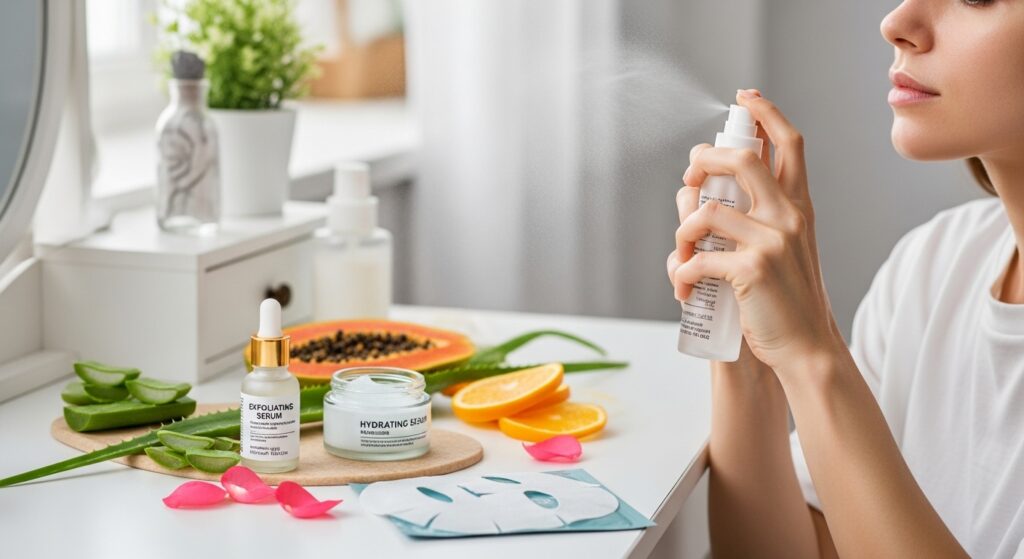
- A cold splash or a chilled sheet mask. Cold water can temporarily reduce puffiness, and a chilled sheet mask adds hydration to the surface. The effect lasts hours, not days. A sheet mask is a treatment step, not a routine — it does not replace cleansing, moisturising and sunscreen.
- A chilled roller or gua sha stone. These feel pleasant and can be a comfort aid. There is no good evidence they drain lymph, improve circulation or firm skin, and rubbing and tugging can make lines look worse. Use light pressure, and stop if skin reddens.
- A face mist. A mist with glycerin can add surface moisture during the day. It does not hydrate skin deeply, and it does not replace moisturiser.
- Makeup. A silicone blurring primer can temporarily fill fine lines and pores and prepare a smoother surface for foundation. A serum foundation or skin tint usually suits textured skin better than a heavy matte foundation, which highlights irregularities. Apply foundation in thin layers with a damp sponge and press it on — do not wipe. Use translucent setting powder only on the T-zone; powder over textured skin accentuates texture. Makeup is a cosmetic fix, not a skin treatment.
Professional treatments, honestly
Chemical peels, microneedling, laser resurfacing, HydraFacial and dermal fillers are medical procedures with real risks, costs and recovery times. They can help some people, but they are not shortcuts and they are not a way to “speed up results”. This guide gives no prices and no fixed timelines or outcomes — those depend on the procedure, the person and the clinician.
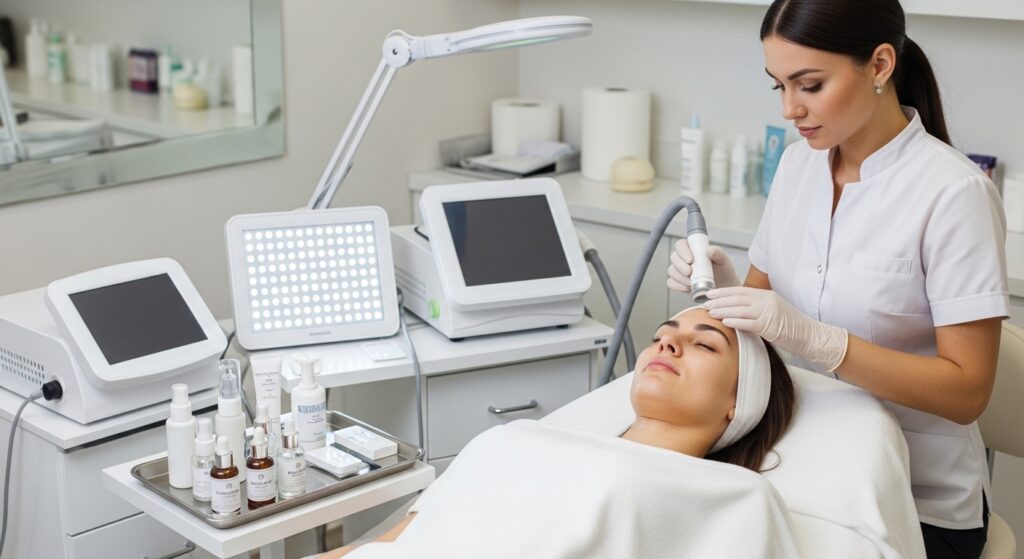
- Chemical peels remove the surface layer of dead skin with an acid solution. Deeper peels are professional treatments only, not home treatments, and they carry a real risk of irritation and pigmentation changes, especially for darker skin.
- Microneedling uses fine needles to create controlled micro-injuries in the skin. It is a medical procedure, not a cosmetic one, and radiofrequency microneedling is a medical procedure too — the FDA issued a safety communication about it in October 2025.
- Laser resurfacing removes the top layer of skin and stimulates collagen underneath. Ablative lasers have the longest downtime; non-ablative lasers need several sessions. Both carry risks, including pigmentation changes.
- HydraFacial is a multi-step clinic facial (cleansing, exfoliation, extraction, serum application). It can make skin look brighter for a short time. It is not the “best” treatment for anyone — there is no single best treatment — and its effects are temporary.
- Dermal fillers add volume under the skin. They are injections performed by a clinician, with real risks, and they do not change skin texture itself.
Discuss any procedure with a dermatologist first, and be wary of anyone who promises a specific outcome, a fixed number of sessions, or a fixed recovery time.
Habits, honestly
- Sleep. Adults need 7 or more hours a night (CDC). Poor sleep makes puffiness and dark circles look worse. Sleep does not directly repair skin on a schedule, and no hour of the night is a peak repair window.
- Food. A balanced diet with enough protein, healthy fats and a variety of fruit and vegetables supports general health. No food directly produces collagen in the skin, and no food can be presented as a treatment for dull texture. Eating antioxidant-rich foods is good for general health, not a skin treatment.
- Water. Drinking water is good for general health, but it does not directly hydrate skin. Topical moisture is what hydrates skin.
- Do not smoke. Smoking speeds skin ageing, according to the American Academy of Dermatology.
- Alcohol. Alcohol dehydrates skin tissue and disrupts sleep. Cutting back helps general health; it does not refresh skin on a fixed schedule.
What to skip
- Starting several strong actives in the same week.
- Exfoliating daily, or exfoliating and using a retinoid on the same night when starting out.
- Buying a product because it promises to “refresh”, “rejuvenate” or “restore youth” in a set number of weeks.
- Skipping sunscreen because a moisturiser claims to contain SPF — unless it is a broad-spectrum sunscreen with SPF 30 or higher, it is not a substitute.
- Harsh scrubs and strong acids on the face — they irritate mature or sensitive skin and make texture worse, not better.
- Changing products every few days, so you never learn what helps.
Patch test
Before using a new product on your face, patch test it: apply a quarter-sized amount to the underside of your arm or the bend of your elbow, twice a day, for 7 to 10 days. If you get redness, itching, swelling or a rash, stop using it. A 24-hour test can miss an allergic reaction, which often takes several days to appear — that is why this guide uses the AAD 7–10 day patch-test method. This is the American Academy of Dermatology’s patch-test method.
When to get help
Ask a dermatologist or pharmacist if: skin stays dull and grey despite a steady routine for several weeks; dark spots or wrinkles do not improve after several months of a steady routine; skin is persistently red, sore, flaking or swollen; a product keeps stinging or causing breakouts; or you have a skin condition such as eczema, rosacea or acne that is getting worse. See a doctor promptly if dull skin comes with unusual tiredness, hair loss, or other symptoms that do not fit a skincare problem.
Frequently asked questions
Q1: What is the difference between dull skin and dehydrated skin?
Dull skin lacks brightness and has an uneven texture caused by dead-cell buildup, ageing or sun exposure. Dehydrated skin lacks water content and feels tight, appears sunken and shows exaggerated fine lines. They often occur together, but each has a distinct cause: dull skin responds to gentle exfoliation and brightening ingredients over weeks; dehydrated skin responds to hydration and moisturiser.
Q2: How often should I exfoliate?
Once or twice a week with a gentle chemical exfoliant. Sensitive skin should exfoliate once a week at most. Over-exfoliating strips the skin barrier and produces increased sensitivity, redness and paradoxically worse texture.
Q3: Can face masks replace moisturisers?
No. A face mask delivers concentrated ingredients in a short treatment window, but it does not provide the sustained moisture barrier a daily moisturiser creates. Use masks as a weekly addition to, not a replacement for, daily moisturiser.
Q4: What foods improve skin radiance?
No food directly improves skin radiance as a treatment. A balanced diet with berries, leafy greens, orange vegetables, fatty fish and green tea supports general health. Diet is not a skin treatment, and no food can be presented as one.
Q5: How soon will I see results from a brightening routine?
Hydration can feel better within days. Surface texture from steady exfoliation takes weeks. Deeper pigmentation and fine-line changes from vitamin C or a retinoid take months of daily use. There is no fixed schedule, and professional treatments do not produce results on a fixed timetable either.
Summary
Tired-looking skin is usually dull, rough or dehydrated skin, sometimes with sun damage or a medical cause behind it. The routine with real evidence behind it is short: gentle cleanser, hydration on damp skin, moisturiser, and broad-spectrum SPF 30+ every morning, with gentle exfoliation once or twice a week and a retinoid started slowly for those who want one. Quick fixes — a cold splash, a chilled mask, makeup — can make skin look fresher for a few hours. Professional treatments are medical procedures to discuss with a dermatologist, not shortcuts. Patch test new products for 7 to 10 days, and see a doctor if dull skin does not improve with a steady routine or comes with other symptoms.
Sources: American Academy of Dermatology, 7 Rosacea skin care tips (patch-test method: apply a new product to a quarter-sized patch of skin on the inside of the arm for 7–10 days); American Academy of Dermatology, How to select anti-aging skin care products (broad-spectrum sunscreen, SPF 30 or higher every morning, reapply every two hours outdoors). This is a researched overview, not a hands-on review.