Researched overview. This guide is based on published dermatology guidance and general sleep and wellbeing guidance, not on hands-on testing by BeautyKob. No product, supplement or brand is recommended, and no dose is given.
Table Of Content
- Quick answer
- Relaxation and skin, honestly
- Preparing for a relaxing skincare ritual
- Gentle cleansing for calm skin
- Warm compress or steam
- Facial massage, honestly
- Masking moments for mindful skin care
- Layering hydration and nourishment
- Facial oil pressing technique
- Tailoring rituals for different skin types
- Morning vs evening relaxing rituals
- Tools that enhance relaxing rituals, honestly
- Weekly deep relaxation ritual
- Patch test before you commit
- Common mistakes to avoid
- What to expect, honestly
- When relaxing rituals alone may not be enough
- Frequently asked questions
- Summary
Quick answer
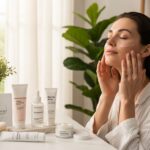
A relaxing skincare ritual for the face is a calming practice, not a treatment. Done slowly — gentle cleansing, a warm compress, a few minutes of light massage, a mask, and hydration layered one step at a time — it can make your evening calmer and your routine easier to keep. It does not repair skin, reduce inflammation, improve circulation, drain lymph, lift the face, or make products absorb better. Those claims appear in the original article; none of them has good evidence behind it, and this guide does not repeat them. What the ritual honestly does is help you slow down — and a routine you keep is what helps skin over time. This guide is general information, not medical advice.
Contents: Relaxation and skin, honestly · Preparing for a ritual · Gentle cleansing · Warm compress or steam · Facial massage, honestly · Masking moments · Layering hydration · Facial oil pressing · Rituals by skin type · Morning vs evening · Tools, honestly · Weekly deep relaxation ritual · Patch test · Common mistakes · What to expect, honestly · When rituals alone are not enough · FAQ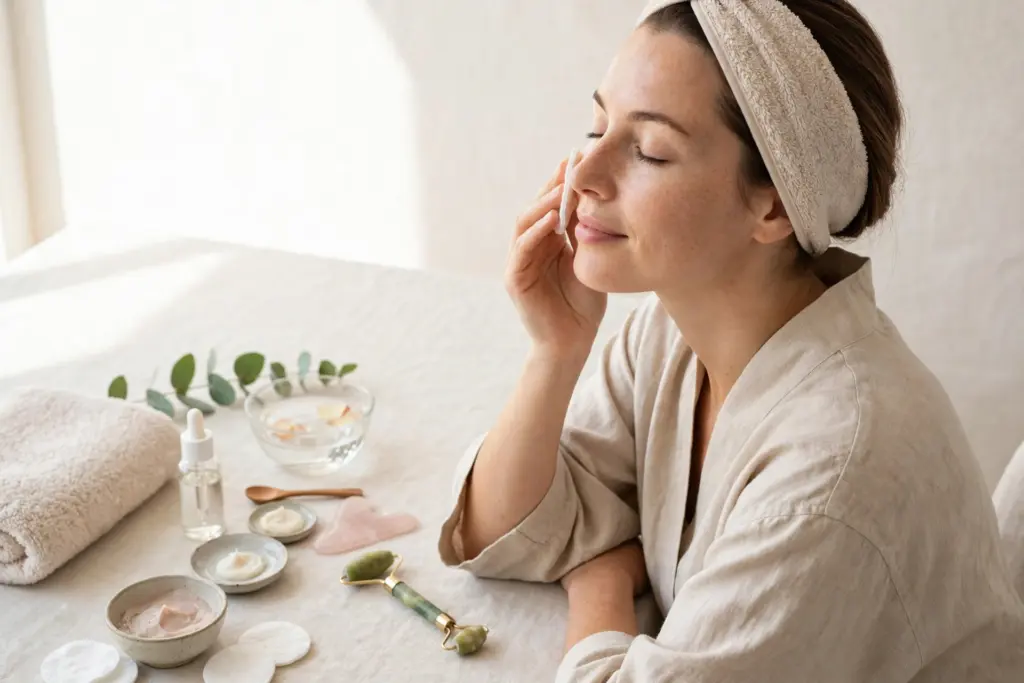
Relaxation and skin, honestly
Stress affects skin more than most people assume. The stress hormone cortisol can increase oil production, which may lead to breakouts and congestion, and chronic stress can make skin feel duller and more reactive. That link is real, and it is also modest — stress is one factor among many, not the cause of skin problems.
What a relaxing ritual does not do is switch the body into a healing mode. The original article claimed that a ritual “activates the parasympathetic nervous system, which promotes skin repair, reduces inflammation, and encourages natural radiance”. There is no good evidence that a few calm minutes during skincare directly repairs skin or reduces inflammation. The honest benefit is indirect: a calmer evening makes it easier to fall asleep, and better sleep and a routine you actually keep are what help skin over time. Poor sleep is linked to worse-looking skin in observational studies — for example, one small study of 60 women (Oyetakin-White et al. 2015) found poor sleepers had roughly double the intrinsic ageing score and about 30% slower barrier recovery at 72 hours — but it was small, observational and funded by a cosmetics company, so it shows an association, not proof.
So the claim in this guide is modest: the ritual makes skincare calmer and more pleasant, which makes you more likely to keep it. The routine does the skin work; the calm does the relaxing.
Preparing for a relaxing skincare ritual
The setting matters. A peaceful environment, free of clutter, turns a routine into something you look forward to. Dim lighting, silence or quiet music in the background can help. The point is softness, not stimulation — the space should invite you to slow down.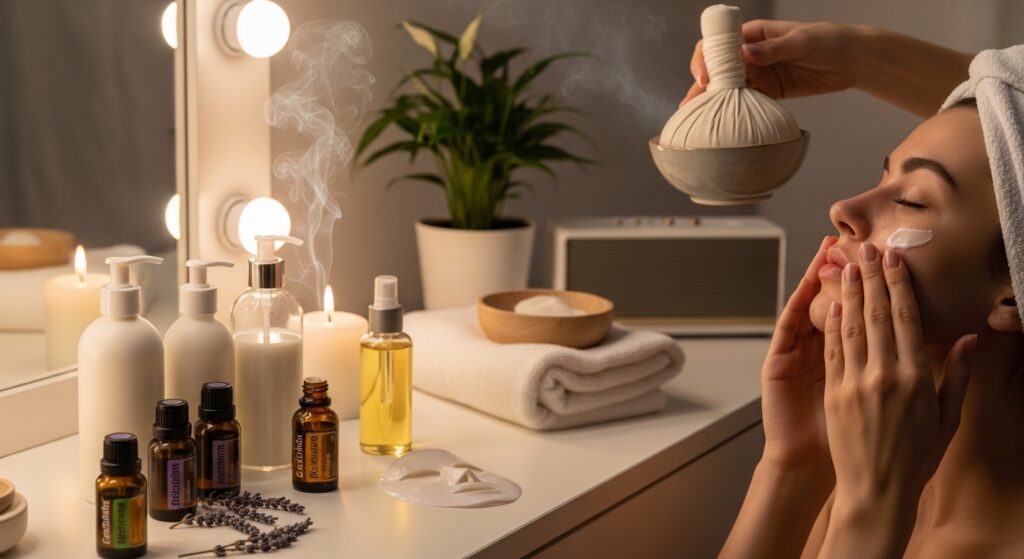
Essential oils such as lavender or chamomile are often suggested for aromatherapy. Be careful with them: essential oils are common irritants, especially on sensitive skin. If you use them, use them sparingly, never apply them undiluted to skin, and patch test first (see the patch-test section below). A scented candle or a diffuser is a safer way to enjoy a scent than putting essential oil on your face.
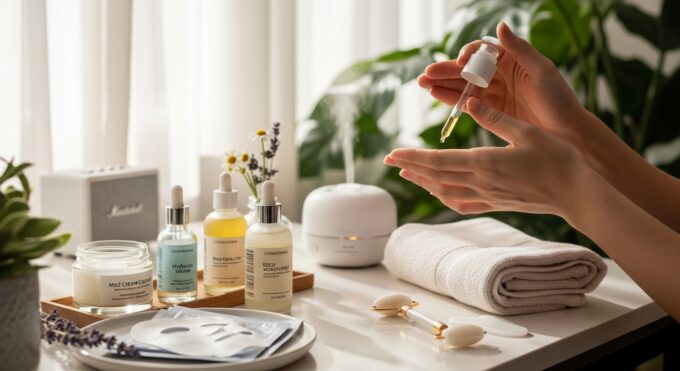
Before you start, wash your hands, put distractions aside, and take a couple of slow breaths. Choose soft, calming products suited to your skin type: a milky cleanser, a moisturising toner, a facial oil and a gentle mask are good companions for a relaxing routine. Keep the product list short — fewer products mean fewer chances of a reaction.
Gentle cleansing for calm skin
Cleansing is not just about removing dirt; it sets the tone for the whole ritual. Use a gentle, non-stripping cleanser to protect the barrier. Use lukewarm water — not hot water, which strips the skin’s natural oils and makes sensitivity worse. Apply the product with slow, circular movements using your fingertips, without pulling or scratching.
Slow cleansing feels calming, and that is enough of a claim: it does not boost blood flow or give a “healthy glow” beyond clean, comfortable skin. A double cleanse can work for people who wear makeup: start with an oil-based cleanser to remove makeup and sunscreen, then follow with a mild cream or gel cleanser. Cleansing should be a mindful experience, not a job — take your time with each step.
Warm compress or steam
A warm compress or a short facial steam can add to the relaxation. A warm compress can ease tension in the jaw, temples and forehead, which often hold stress. That is a comfort effect, and it is the whole claim.
Two things steam does not do: it does not open pores — pores have no muscles and cannot open or close — and it does not help serums or masks absorb better. Nothing you do with your hands or with steam increases absorption, and this guide does not claim otherwise. Keep the temperature warm, not hot, so you do not harm the barrier, and steam for no more than 5–10 minutes.
Facial massage, honestly
Facial massage is a pleasant addition to a relaxing ritual. The simplest methods are upward and outward movements on the cheeks, circular movements along the jawline, and light tapping around the eyes. Focusing on pressure points — the temples, under the cheekbones, along the brow line — can relieve tension and feel relaxing. A nourishing facial oil or cream makes the movements smooth and adds hydration.
What massage does not do is activate blood circulation, promote lymphatic drainage, distribute products more evenly, improve texture, reduce puffiness in any lasting way, or produce a lifting effect over time. Those claims appear in the original article; none of them has good evidence. Massage is a comfort aid. If it feels good, do it for two or three minutes with light pressure. If it does not, skip it — it is optional, not a step your skin needs.
Masking moments for mindful skin care
A mask is not only about skin concerns; it gives you a natural break in the ritual. Choose one that fits your skin type:
- Clay masks for oily and congested skin.
- Cream masks for dry skin.
- Sheet masks for quick hydration and soothing.
While the mask is on, breathe slowly or close your eyes to deepen the relaxation. A mask does not push active ingredients deeper into the skin — it sits on the surface, and that is fine. Depending on your skin’s needs, masks can be used 1–3 times a week. More often than that, especially with clay or exfoliating masks, can irritate the skin and disrupt the barrier.
Layering hydration and nourishment
Hydration matters for skin health and smooth texture. After cleansing and masking, apply hydrating products in order of consistency: essence or toner, serum, moisturiser, and lastly facial oil if needed.
Press products onto the skin gently rather than rubbing. Pressing feels calmer and spreads product evenly — it does not make each layer absorb better, and this guide does not claim it does. Hydration supports the barrier and makes fine lines look softer by plumping the surface; it does not increase elasticity or erase lines. Combined with the rest of the ritual, it leaves a soft surface that reflects light, which is what people mean by a natural glow.
Facial oil pressing technique
Facial oils are nourishing and calming. Warm a little oil between your palms first, then press it gently onto the skin — do not rub it in. Pressing avoids friction and feels soothing. It does not aid absorption or increase circulation.
Calming oils such as jojoba, rosehip or squalane are light options that many people find pleasant in a ritual. They seal in moisture and make the skin feel softer; they do not improve texture by themselves, and no oil is ranked or recommended here. Pressing gently on the temples, under the eyes and along the jawline can ease tension and help the face and mind feel relaxed. Regular use can make skin feel smoother and more supple — because it is moisturised, not because the oil changed the skin underneath.
Tailoring rituals for different skin types
Sensitive skin. Keep the ritual to a few steps, use soft PHAs or enzyme masks if you exfoliate at all, avoid fragrance and irritants, and focus on hydration. Skip massage on days your skin is reactive.
Oily or acne-prone skin. Balance oil with lightweight hydration and gentle cleansing. Non-comedogenic oils and clay masks can help without over-stripping. Do not exfoliate over active, inflamed breakouts.
Dry skin. Use rich creams and hydrating serums. Exfoliation can be used occasionally, but gently, so the barrier is not broken.
Combination skin. Treat oily areas separately from dry areas. Do not use full-face scrubs, which irritate the dry areas.
Mature skin. Focus on gentle massage for comfort, hydrating serums, rich moisturiser and strong sun protection. Collagen-supporting ingredients such as vitamin C can help modestly as a cofactor for collagen synthesis; peptides have thin evidence. “Lifting massage” is not a real effect — massage feels relaxing, it does not lift skin.
Personalising the ritual to your skin type keeps it both effective and pleasant.
Morning vs evening relaxing rituals
Morning. Short rituals focus on hydration and protection: gentle cleansing, a light moisturiser, and broad-spectrum sunscreen with SPF 30 or higher, reapplied every two hours when outdoors. Sunscreen is the most effective anti-ageing step (Hughes et al. 2013), and the original article’s morning ritual had no sunscreen step at all — this guide adds it. Light facial tapping is optional and is a comfort step, not a treatment.
Evening. Longer rituals include massage, masks and oil pressing. Evening is a practical time for a longer ritual and for treatments that make skin sun-sensitive, such as retinoids — but night is not a biological repair window, and active ingredients do not work harder overnight. They work the same; the evening is simply a convenient time to use them.
Tools that enhance relaxing rituals, honestly
- Facial rollers. Comfort aids. They feel cooling and relaxing; they do not improve circulation or drain lymph.
- Gua sha. A pleasant massage tool used with light pressure. It does not lift or contour the face.
- Warm towels. A warm towel before the ritual can relax the face and soften the skin’s surface. Keep it warm, not hot.
- LED masks (optional). LED is the best-evidenced home device (Wunsch & Matuschka), but the evidence is modest and gradual — it does not “facilitate collagen synthesis and skin healing” in the way the original article claimed. Treat it as an optional extra with limited evidence, not as a treatment.
Clean tools frequently to prevent irritation and bacterial build-up, and never share tools that touch broken skin.
Weekly deep relaxation ritual
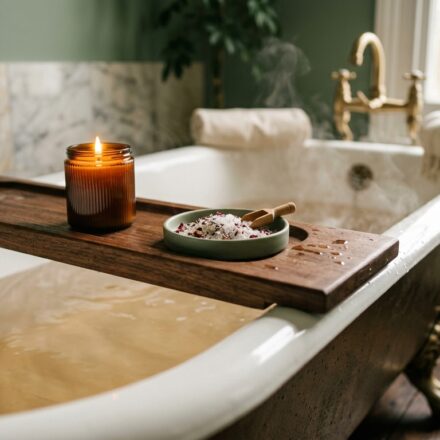
A full facial ritual once a week, for 20–30 minutes, can be the anchor of the routine. Include an extended massage, a hydrating or soothing mask, a scalp or neck massage, and quiet music or a scented candle. This deeper ritual improves how your skin feels — hydrated, comfortable, calm — and it can lower stress in the moment. It does not reduce stress hormones in any measurable way, and it does not change skin texture by itself. The value is the pause, not the promise.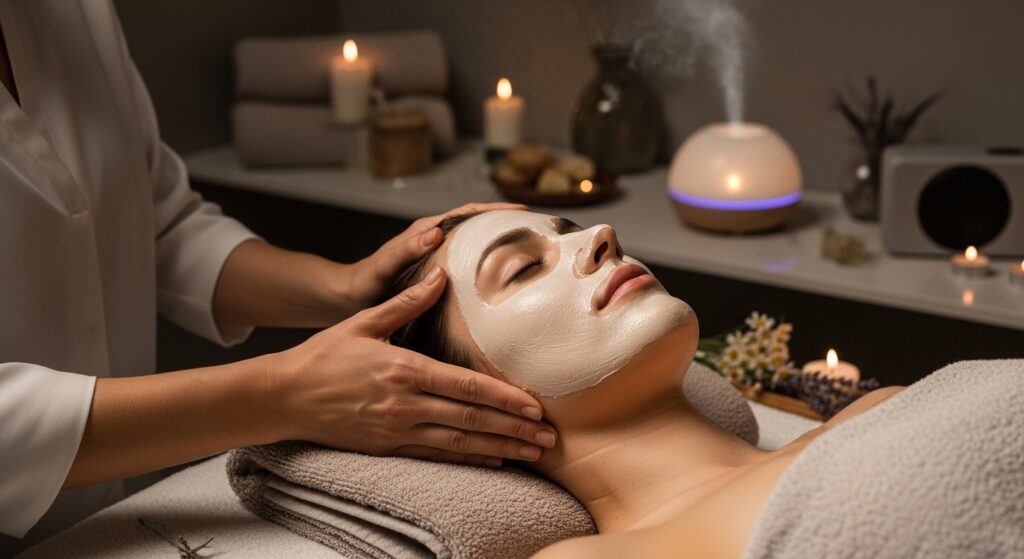
Patch test before you commit
The American Academy of Dermatology recommends testing a new product before using it on your face — and a relaxing ritual is exactly where new oils, masks and essential oils appear, so this step matters here more than most. Apply the product to a quarter-sized patch of skin where it will not be rubbed or washed away — the underside of your arm or the bend of your elbow — twice a day for 7 to 10 days. For a rinse-off product such as a cleanser, leave it on for about five minutes, or as long as the label says, then rinse it off. If the test area becomes red, itchy, swollen or painful, stop using the product. If the area stays clear for the full 7 to 10 days, the product is less likely to cause a reaction on your face — but a patch test cannot guarantee it.
A 24-hour test can miss an allergic reaction, which often takes several days to appear — that is why this guide uses the AAD 7–10 day patch-test method.
Common mistakes to avoid
- Rushing through the steps — the ritual only works if it is slow.
- Over-exfoliating or using harsh products in the name of relaxation.
- Ignoring hydration.
- Using too many active ingredients at once.
- Checking your phone during the ritual.
- Expecting the ritual to treat a skin condition. Relaxation supports wellbeing; it does not treat eczema, rosacea, acne or any other condition.
Positive changes need patience, consistency and attention — not more products.
What to expect, honestly
- Immediately: Skin that feels warm, soft and comfortable, and a calmer mood. That is the real result.
- After a week or two: Less dryness, because hydration and barrier care are consistent.
- After a few weeks: Skin that feels smoother, mostly from steady hydration and a stronger barrier.
- Long-term: Healthier-looking skin and a routine you actually keep.
What will not happen: no lifting effect, no lasting reduction in puffiness, no fewer fine lines from massage, and no fixed timeline for any of it. Consistency, barrier health, hydration and relaxation are what skin responds to over time.
When relaxing rituals alone may not be enough
Some skin concerns need professional care: acne or chronic breakouts, deep scars or textural damage, and hyperpigmentation. In these cases, a relaxing ritual still helps — it supports barrier repair and hydration, which is useful alongside professional care — but it does not make professional treatments more effective, and it does not replace them. If a concern is getting worse, or a rash does not settle, ask a dermatologist.
Frequently asked questions
Q1: How often should I perform relaxing skincare rituals for my face?
A 10–15 minute ritual in the morning or evening is enough for daily benefit. A longer, 20–30 minute deep ritual once a week adds to the relaxation.
Q2: Can relaxing skincare rituals help reduce signs of aging?
Only modestly, and not in the way it is usually claimed. Hydration and daily sunscreen help the appearance of fine lines over time. Gentle massage does not improve circulation, promote elasticity or support collagen, and it does not reduce fine lines. Sunscreen is the step that matters most.
Q3: Are facial oils necessary in a relaxing skincare routine?
No. Facial oils are optional. Pressing a light oil into the skin can improve hydration and make the ritual feel more relaxing, without causing irritation when used correctly — but a moisturiser alone is enough.
Q4: Can I use masks every day in my ritual?
No. Most masks should be used 1–3 times per week depending on skin type. Overusing masks, especially clay or exfoliating types, can irritate the skin and disrupt the barrier.
Q5: Do relaxing skincare rituals work for all skin types?
Yes, but the products and techniques should be adapted to your skin type. Sensitive skin needs gentler ingredients, oily skin benefits from lightweight hydration, dry skin needs richer creams, and mature skin benefits from hydrating serums and strong sun protection — not from “lifting” massage.
Summary
A relaxing face ritual is a calming practice: gentle cleansing with lukewarm water, a warm compress, a few minutes of light massage, a mask once or twice a week, hydration layered gently, and broad-spectrum SPF 30+ every morning. It does not repair skin, reduce inflammation, improve circulation, drain lymph, lift the face or make products absorb better — and this guide says so plainly instead of repeating those claims. Patch test any new oil or mask for 7 to 10 days. What the ritual honestly gives you is a slower evening, a routine you keep, and skin that is hydrated and comfortable.
Sources: American Academy of Dermatology, 7 Rosacea skin care tips (patch-test method: apply a new product to a quarter-sized patch of skin on the inside of the arm for 7–10 days); American Academy of Dermatology, How to select anti-aging skin care products (broad-spectrum sunscreen, SPF 30 or higher, reapply every two hours outdoors). This is a researched overview, not a hands-on review.