Researched overview. This guide is based on published dermatology guidance, not on hands-on testing by BeautyKob. No product, supplement or brand is recommended, and no dose is given.
Table Of Content
- Quick answer
- What skin renewal is
- Why aggressive exfoliation backfires
- Three kinds of gentle renewal
- Physical gentle renewal methods
- Chemical gentle renewal methods
- Non-exfoliating renewal boosters
- Sleep and renewal
- Building a gentle renewal routine
- Frequency guidelines
- Gentle renewal for different skin types
- Patch test before you commit
- Common mistakes to avoid
- When to seek professional help
- Frequently asked questions
- Summary
Quick answer
Skin renewal is the slow, continuous process of old surface cells shedding and new cells taking their place. Gentle renewal means helping that process along — a mild exfoliant once or twice a week, steady hydration, barrier repair, and sunscreen every morning — instead of forcing it with high-strength acids, daily scrubs or several actives at once. Aggressive resurfacing usually backfires: it irritates the barrier, and irritated skin renews more slowly, not faster. This guide is general information, not medical advice.
Contents: What skin renewal is · Why aggressive exfoliation backfires · Three kinds of gentle renewal · Physical methods · Chemical methods · Non-exfoliating renewal boosters · Sleep and renewal · Building a gentle renewal routine · Frequency guidelines · Renewal by skin type · Patch test · Common mistakes · When to seek professional help · FAQ

What skin renewal is
Your skin keeps renewing itself. The topmost layer, the stratum corneum, is made of dead skin cells that shed naturally and are replaced by new cells made in the deeper layers. That turnover slows as you age, and it can also slow with UV exposure, poor sleep, dehydration and a weakened barrier.
How fast turnover happens is often quoted as “28 days”, but that number is a rounded rule of thumb, not a measurement that applies to everyone. One careful calculation put the average closer to 47–48 days (Weinstein 1984), and the real figure varies by age, body site and skin condition. The useful point is simpler: turnover slows with age, and no product can reset it to a fixed number of days.
When dead cells build up on the surface faster than they shed, skin can look dull and feel rough, pores can look clogged, tone can look uneven, and fine lines can look deeper. But the fix is not to strip the surface harder. The skin cannot shed faster than its barrier allows — pushing it only damages the layer you are trying to renew.
Why aggressive exfoliation backfires
It is easy to mistake tingling for effectiveness. It is not. Tingling is irritation, and irritation is a sign to stop, not a sign that a product is working.
Over-exfoliation can cause redness that does not fade, stinging, flaking, tight shiny skin, more breakouts, and greater sensitivity to sunlight. It can also weaken the barrier so the skin loses water faster. Once the barrier is damaged, the skin spends its energy on repair instead of renewal — which is why aggressive routines often leave skin looking worse after a few weeks, not better.
Whether over-exfoliation makes skin oilier is disputed, not proven. Some people find their skin feels oilier after harsh washing, but there is no good evidence that the skin compensates by producing more oil. This guide does not claim it either way. What is established is that harsh exfoliation irritates the barrier, and irritation slows renewal down.
Three kinds of gentle renewal
There are three kinds of gentle renewal, and they work together:
- Physical renewal — a soft washcloth, an enzyme mask or a microfiber pad that lifts loose surface cells.
- Chemical renewal — a low-strength acid that loosens the bonds between dead cells so they shed more easily.
- Non-exfoliating support — hydration and barrier repair, which let the skin shed on its own. This is the most overlooked kind, and often the most useful.
No kind is better than the others on its own. The plan that works is the one your skin tolerates week after week.
Physical gentle renewal methods
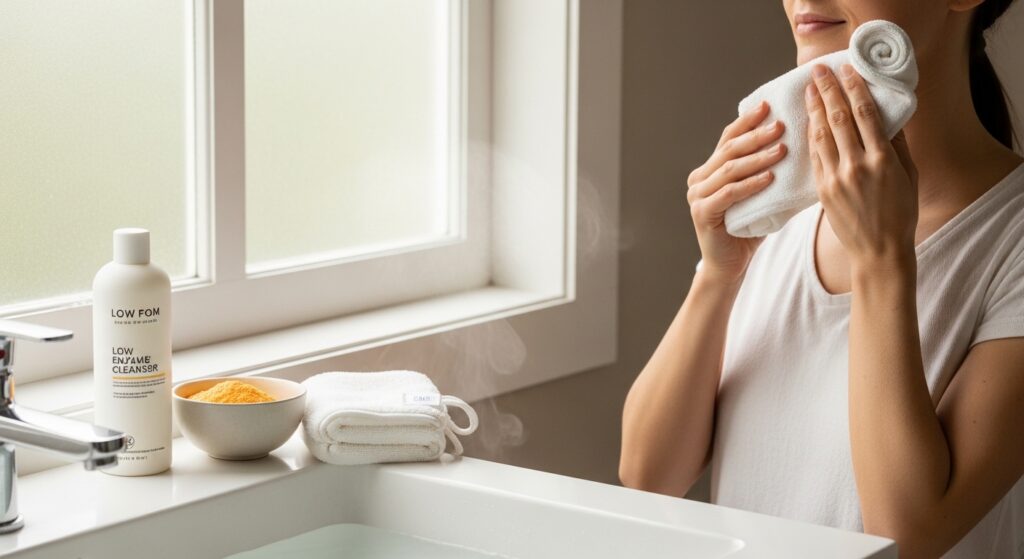
Physical exfoliation is safe in its mild form, used gently and infrequently. It removes loose cells from the surface; it does not go deep, and it should not hurt.
Soft washcloth method. A clean, soft cotton washcloth used with a low-foaming cleanser and lukewarm water — never hot water — can clear surface build-up. Move it in small circles with light pressure, once or twice a week. Do not use thick scrubs with large particles such as crushed walnut shells or salt crystals; they cause uneven abrasion and inflammation.
Enzyme-based exfoliation. Fruit enzymes such as papain from papaya or bromelain from pineapple dissolve dead surface cells instead of scrubbing them off. They are generally gentle and suitable for beginners, used about once a week with a contact time of around 5–10 minutes. The evidence that enzyme masks do anything useful is limited, so treat them as a gentle option, not a proven treatment — and patch test first, because they can still irritate.
Microfiber cleansing pads. Soft microfiber cloths used with cleanser remove dead surface cells with light pressure only. Replace cloths frequently, and do not use them on the same day as a chemical exfoliant.
The rule for all three is moderation: light pressure, short contact, and never on skin that is already red, stinging or peeling.
Chemical gentle renewal methods
Chemical exfoliation sounds intimidating, but at low strength and sensible frequency it is one of the most useful renewal tools. Start with one product, once a week, and build up only if your skin stays comfortable.
Low-strength AHAs. Alpha hydroxy acids such as glycolic or lactic acid dissolve the bonds between dead cells. For gentle use, choose a low-strength product, start once a week, apply at night, and follow with moisturiser. Lactic acid is often better tolerated than glycolic acid, partly because its molecule is larger and it penetrates more slowly. This guide does not recommend a specific percentage — formulation matters more than the number on the bottle, and a low-strength product from a brand you trust is the safer starting point. AHAs can be especially useful on dry or sun-damaged skin.
PHAs: the most beginner-friendly option. Polyhydroxy acids have larger molecules than AHAs, so they penetrate more slowly and are usually less irritating. They also have hydrating properties. PHAs are often a gentler option for reactive skin, and their smoothing effect is gradual — which is the point.
Azelaic acid. Azelaic acid gives mild renewal while calming redness, and it is useful for acne-prone skin and for post-inflammatory dark marks. It is usually used a few times a week alongside a barrier-repair moisturiser.
Retinol — introduced slowly. Retinol speeds up cell turnover and should be introduced gradually: a low concentration, one or two nights a week to start, with moisturiser applied before and after (the “sandwich” method). Do not use it together with strong acids on the same night. Retinoids are the strongest topical for fine lines, judged over 3–6 months — but they are not suitable in pregnancy, so do not use them if you are pregnant or trying to conceive, and ask a clinician first if you are unsure. Gradual introduction avoids most irritation.
Do not combine several of these at once. One renewal active, introduced slowly, is the whole method.
Non-exfoliating renewal boosters
The most overlooked renewal methods do not exfoliate at all. They improve hydration and barrier health, and hydrated, well-supported skin sheds on its own.
Hydration improves natural shedding. When skin is dehydrated, dead cells cling to the surface. Moist skin sheds more effectively. Look for glycerin, hyaluronic acid, beta-glucan and aloe vera, and apply hydrating products to slightly damp skin. Hydration makes skin look plumper and feel smoother — it does not change the skin underneath, and it is not a substitute for exfoliation when dead cells have genuinely built up.
Barrier repair supports renewal. Ceramides, cholesterol and fatty acids rebuild the lipid layer that holds the barrier together. A healthy barrier lets the skin renew at its own pace. Often, working on repair instead of exfoliating more will give smoother texture on its own.
Facial massage. Light massage with moisturiser can feel relaxing, and it can help you notice where your skin is tight or tender. That is the honest extent of the claim. Massage does not increase blood circulation or drain lymph in any meaningful way, and it does not deliver nutrients to the skin. Rollers and gua sha tools are comfort aids for the same reason. If massage feels good, do it for that reason — for two or three minutes, with light pressure and upward strokes.
Sleep and renewal
Sleep matters for skin, but not in the way it is usually described. Night is a practical time for renewal: you are not wearing sunscreen or makeup, and treatments that make skin sun-sensitive, such as retinoids, are easier to use at night. It is not a biological repair window — the skin does not switch into a special regeneration mode after dark, and this guide does not claim it does.
The often-repeated claim that growth hormone rises during deep sleep and rebuilds collagen has no good source behind it, and this guide does not repeat it. What is true is that poor sleep is linked to worse-looking skin in observational studies — for example, one small study of 60 women (Oyetakin-White et al. 2015) found poor sleepers had roughly double the intrinsic ageing score and about 30% slower barrier recovery at 72 hours — but it was small, observational and funded by a cosmetics company, so it shows an association, not proof that bad sleep ages skin. Adults need 7 or more hours of sleep a night (CDC). The honest claim is modest: rested skin looks better, and a routine you can keep is what helps over time.
Building a gentle renewal routine
A balanced week alternates renewal nights with recovery nights. A simple structure:
Morning routine
1. Gentle cleanse or rinse with lukewarm water.
2. Hydrating serum on slightly damp skin.
3. Barrier-supporting moisturiser.
4. Broad-spectrum sunscreen, SPF 30 or higher, reapplied every two hours when outdoors. Sunscreen matters more, not less, after renewal — freshly renewed skin is more vulnerable to UV damage, and sunscreen is the most effective anti-ageing step (Hughes et al. 2013).
Evening routine (exfoliation night)
1. Gentle cleanse.
2. Apply one mild exfoliant.
3. Hydrating serum.
4. Barrier cream.
Evening routine (recovery night)
1. Cleanse.
2. Hydrate.
3. Richer moisturiser.
Alternate exfoliation with repair days, and never exfoliate on skin that is already red, stinging or peeling.
A 30-day plan, without fixed promises. Week 1: barrier reset — focus entirely on hydration and repair, no exfoliation. Week 2: introduce one renewal night, once a week. Week 3: monitor the skin’s response — if there is no irritation, a second weekly renewal night can be added. Week 4: maintain consistency and resist increasing strength. Brighter, smoother skin takes weeks to months, and the timeline varies from person to person. No routine can promise a visible change by a fixed week.
Frequency guidelines
- Sensitive skin: 1–2 times weekly.
- Normal skin: 2–3 times weekly.
- Combination skin: 2–3 times weekly, targeted at the oily areas.
- Oily skin: 2–3 times weekly.
Daily exfoliation is rarely necessary. Reduce frequency — or stop entirely — if you notice stinging, peeling, persistent redness or tightness. Those are signs to pause and repair, not to push through.
Gentle renewal for different skin types
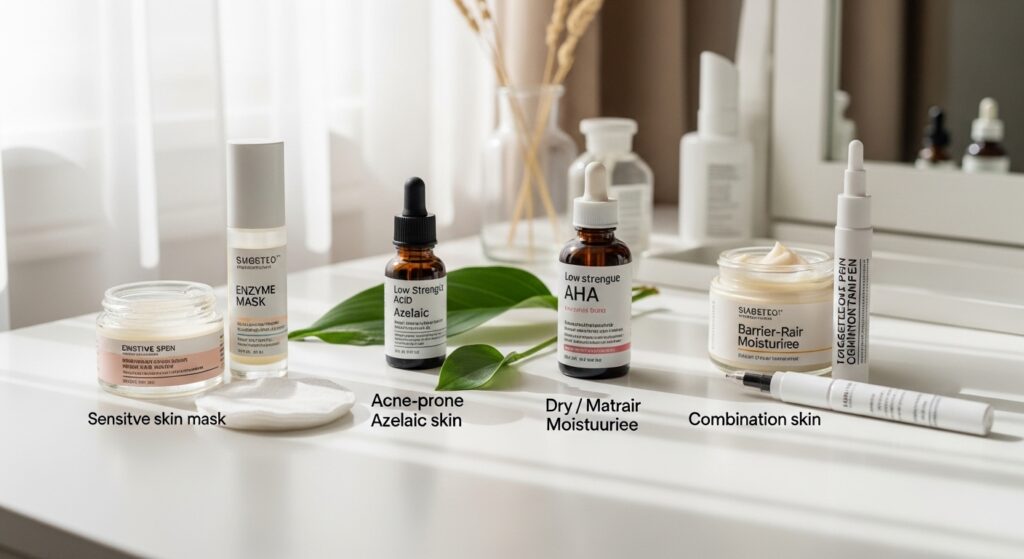
Sensitive skin. Use PHAs or enzyme masks, and avoid fragrance-heavy products. Keep the routine short and patch test everything new.
Acne-prone skin. Combine azelaic acid with light exfoliation, and pay attention to managing inflammation rather than scrubbing harder. Do not exfoliate over active, inflamed breakouts. For post-acne dark marks, remember that marks respond first to sun protection and gentle topicals; deeper scars need professional care.
Dry or mature skin. Blend a low-strength AHA with rich barrier creams. Mature skin renews more slowly, so patience matters more than strength — and sunscreen matters most of all, because UV damage is what ages skin fastest.
Combination skin. Spot-treat the oily areas rather than exfoliating the whole face. Use a lighter moisturiser on the oily areas and a richer one where skin is dry.
Patch test before you commit
The American Academy of Dermatology recommends testing a new product before using it on your face. Apply the product to a quarter-sized patch of skin where it will not be rubbed or washed away — the underside of your arm or the bend of your elbow — twice a day for 7 to 10 days. For a rinse-off product such as a cleanser, leave it on for about five minutes, or as long as the label says, then rinse it off. If the test area becomes red, itchy, swollen or painful, stop using the product. If the area stays clear for the full 7 to 10 days, the product is less likely to cause a reaction on your face — but a patch test cannot guarantee it.
A 24-hour test can miss an allergic reaction, which often takes several days to appear — that is why this guide uses the AAD 7–10 day patch-test method.
Common mistakes to avoid
- Mixing multiple acids in one routine.
- Using exfoliating acids and retinol on the same night when starting out.
- Skipping sunscreen, especially after a renewal night.
- Using hot water, which strips the skin’s natural oils.
- Changing products frequently — give each change weeks, not days, before judging it.
- Increasing strength because the first week felt fine. Irritation from over-exfoliation often appears in week two or three, not on day one.
Patience is the whole method. Renewal is slow, gradual and non-irritating — or it is not working.
When to seek professional help
Consult a dermatologist if you experience severe cystic acne, rosacea flare-ups, persistent hyperpigmentation, or ongoing barrier damage that does not settle with a simplified routine. Professional treatments may be needed for deeper concerns, and a dermatologist can also advise on whether a prescription retinoid or a professional peel is appropriate. A home routine supports professional care; it does not replace it.
Frequently asked questions
Q1: What are gentle skin renewal methods?
Skincare approaches that support natural cell turnover without causing irritation or damaging the skin barrier: mild exfoliation, hydrating ingredients, barrier-repair products, and gradual introduction of active ingredients instead of aggressive resurfacing.
Q2: How often should I exfoliate for safe skin renewal?
For most people, sensitive skin 1–2 times per week, normal or combination skin 2–3 times per week, oily skin 2–3 times per week. Daily exfoliation is rarely necessary and may lead to irritation or barrier damage.
Q3: Can I use retinol with gentle renewal methods?
Yes, but introduce it slowly. Start with a low concentration one or two times per week and avoid combining it with strong acids on the same night. Support it with hydration and barrier-repair ingredients. Do not use retinoids if you are pregnant or trying to conceive.
Q4: What are signs I’m over-exfoliating?
Redness that doesn’t fade, burning or stinging, increased breakouts, tight shiny skin, flaking and sensitivity. If these occur, pause exfoliation and focus on barrier repair for at least one to two weeks.
Q5: Is exfoliation necessary for glowing skin?
Not always. Sometimes dullness is caused by dehydration rather than dead skin buildup. Improving hydration and barrier health alone can enhance brightness without increasing exfoliation.
Summary
Gentle skin renewal means supporting your skin’s own turnover — mild exfoliation once or twice a week, steady hydration, barrier repair, and broad-spectrum SPF 30+ every morning — instead of forcing it with strong acids or daily scrubs. Turnover has no fixed number of days, massage does not improve circulation, and night is a practical time for treatments, not a biological repair window. Patch test any new product for 7 to 10 days, alternate renewal nights with recovery nights, and let patience do the work.
Sources: American Academy of Dermatology, 7 Rosacea skin care tips (patch-test method: apply a new product to a quarter-sized patch of skin on the inside of the arm for 7–10 days); American Academy of Dermatology, How to select anti-aging skin care products (broad-spectrum sunscreen, SPF 30 or higher, reapply every two hours outdoors). This is a researched overview, not a hands-on review.