Researched overview. This guide is based on published dermatology guidance and general sleep and wellbeing guidance, not on hands-on testing by BeautyKob. No product, supplement or brand is recommended, and no dose is given.
Table Of Content
- Quick answer
- Why evenings matter
- What relaxation really means
- How stress builds up during the day
- The power of ritual over random self-care
- Principles of relaxing evening self-care
- A 30–60 minute relaxing evening ritual
- Step 1: Transition out of the day
- Step 2: Physical unwinding
- Step 3: Mental decompression
- Step 4: Emotional comfort
- Step 5: Skincare as part of the ritual
- Short evening rituals for busy days
- Evening care at home
- Adapting to your energy
- Evening care and sleep
- Evening care for different lifestyles
- What to avoid in the evening
- How long before you notice a difference
- Building your own ritual
- When routines are not enough
- FAQ
- Summary
Quick answer
Evening self-care is not about adding more tasks to an already long day. It is about closing the day properly: a clear transition out of work mode, a little physical unwinding, letting the loud thoughts out, and some comfort before bed. This guide covers the whole evening — the bath, the skincare, the wind-down — not just the last half hour before sleep. It does not treat anxiety, burnout or any medical condition, and it does not “detox” or repair your skin overnight. What it does is help you slow down, sleep more easily, and start the next day steadier. This guide is general information, not medical advice.
Contents: Why evenings matter · What relaxation means · How stress builds up · Ritual over random · Principles · The 30–60 minute evening ritual · Short rituals for busy days · Evening care at home · Adapting to your energy · Sleep · Evening care for different lifestyles · What to avoid · How long before you notice a difference · Building your own ritual · When routines are not enough · FAQ
Why evenings matter
Most people think stress happens during the day and fixes itself at night. In reality, the evening sits in between. When evenings are hectic, overstimulated or emotionally loaded, you do not fully switch to rest mode even if you get to bed on time. Stress hormones stay high, thoughts keep racing, and sleep becomes shallow or delayed.
Evening self-care is not about productivity or self-improvement. It is about transition. Your nervous system needs a definite signal that the day is finished and it is time to relax. Without that signal, the stress of the day follows you into the night. That is why evening routines tend to matter more than morning ones: they shape not only your sleep, but how rested you feel the next day.
What relaxation really means
Relaxing in the evening does not mean doing nothing, and it does not mean distracting yourself until you are too tired to stay awake. Endless scrolling, binge-watching and late-night work feel soothing at first, but they overstimulate the brain — they keep it alert while pretending to rest it.
Real evening relaxation means four things: reducing stimulation, releasing physical tension, creating emotional safety, and letting the body shift into rest. It is a gentle invitation to calm, not a forced one. When those four things happen, muscles relax, breathing slows, and the mind gets quieter. Night is a practical time to rest, not a biological repair window — the evening does not “repair” you, it simply gives rest a chance to happen.
How stress builds up during the day
Stress does not fade when work ends. It accumulates in the body and the mind: shoulders tighten, the jaw clenches, thoughts repeat, feelings go unprocessed. Many people are too tired to work but too wired to rest in the evening. That wired-tired feeling is the sign that the day’s tension was never released.
Evening rituals work by gently releasing that build-up, a little at a time. They do not force calm. They make room for it.
The power of ritual over random self-care
A ritual is not the same as an activity. Watching a show one night and meditating the next is fine, but rituals work because they are predictable. When you do the same calming things most evenings, your brain starts to recognise them as a signal of safety and rest.
Over time, your body learns that this sequence means the day is over. That is why consistency matters more than length: a basic ten-minute ritual done most nights beats an elaborate one done once a week.
Principles of relaxing evening self-care
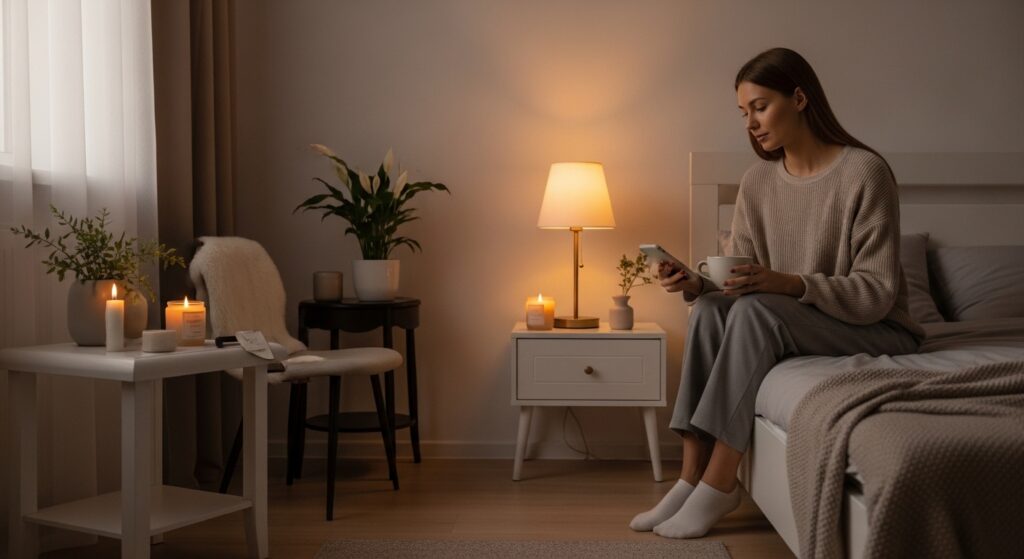
- Low effort, high comfort. Evenings are not for discipline. Choose rituals that feel easy, not demanding.
- Consistency over perfection. Missing a night does not spoil progress. Light repetition is what brings change.
- Comfort before correction. Evening self-care is not about fixing yourself. It is about supporting yourself.
- Sensory calm. Soft light, quiet sounds and gentle touch help the body relax faster than effort or willpower alone.
A 30–60 minute relaxing evening ritual
You do not need to be exact about this. Treat it as a loose structure you can change.
Step 1: Transition out of the day
First, announce that the day is over. Change your clothes, wash your face, or sit quietly for a few minutes. Do not go straight from work into entertainment — the brain needs a clear switch between the two. This transition creates emotional closure: the working day is done.
Step 2: Physical unwinding
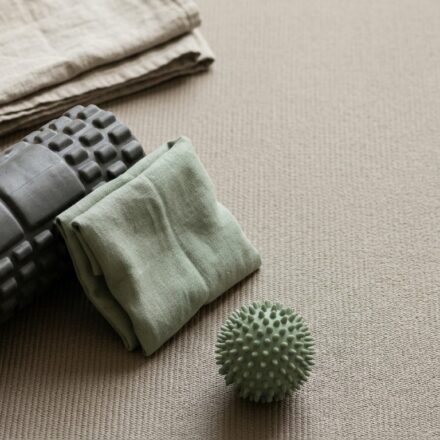
Stress lives in the body. Light movement, slow stretching or slow breathing helps release tension stored in the shoulders, hips and neck. This is not the time for intense exercise — the point is softness, not stimulation. Even a few slow stretches can make your body feel held and supported. Breathe out a little longer than you breathe in; long, slow breaths out are calming.
Step 3: Mental decompression
Evenings get loud in the mind because the distractions stop. Instead of solving problems, let the thoughts out: write down the tasks or worries still waiting for tomorrow. This helps the mind relax and keeps the thinking out of bed. A voice memo works the same way.
Step 4: Emotional comfort
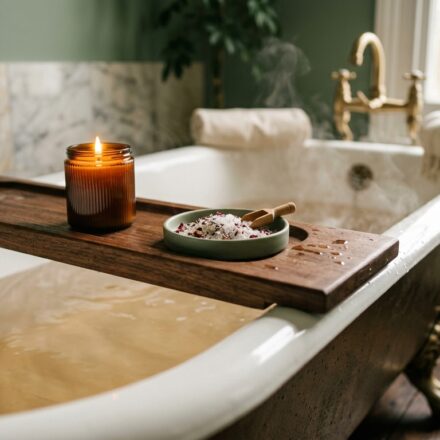
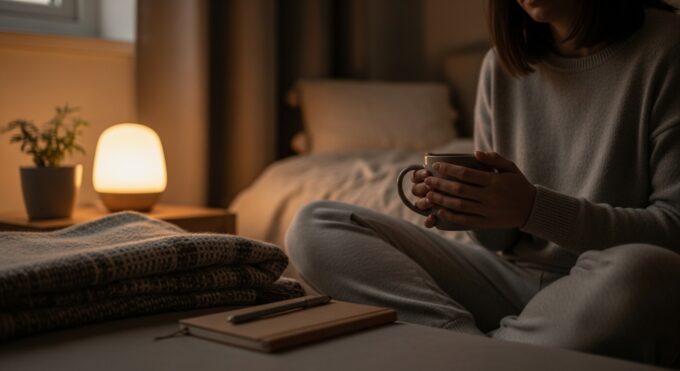
This is where evening self-care is most nourishing. Warm showers, soft blankets, a warm drink, a calming scent — comfort rituals make you feel safe, and feeling safe is what lets the body rest. Emotional rest matters as much as physical rest.
Step 5: Skincare as part of the ritual
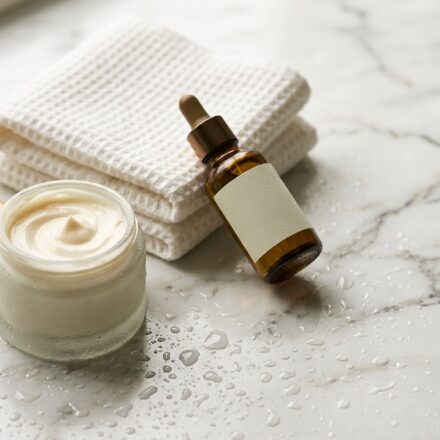
Washing your face is a natural part of the transition — it marks the end of the day on your skin as well as in your mind. Cleanse gently with lukewarm water and a mild, fragrance-free cleanser, using your fingertips, and pat dry. Moisturise with a plain, fragrance-free cream. Night is a practical time for treatments such as a retinoid, but only if your skin already tolerates them — retinoids are the strongest topical for fine lines, used slowly (start 2–3 nights a week, pea-sized, 3–6 months to judge), with a pregnancy warning. Do not start a strong active on a stressful evening.
Patch test before you commit. The American Academy of Dermatology recommends testing a new product before using it on your face. Apply the product to a quarter-sized patch of skin where it will not be rubbed or washed away — the underside of your arm or the bend of your elbow — twice a day for 7 to 10 days. For a rinse-off product such as a cleanser, leave it on for about five minutes, or as long as the label says, then rinse it off. If the test area becomes red, itchy, swollen or painful, stop using the product. If the area stays clear for the full 7 to 10 days, the product is less likely to cause a reaction on your face — but a patch test cannot guarantee it.
A 24-hour test can miss an allergic reaction, which often takes several days to appear — that is why this guide uses the AAD 7–10 day patch-test method.
In the morning, the routine is short: gentle cleanse, moisturiser, and broad-spectrum sunscreen with SPF 30 or higher, reapplied every two hours when outdoors. Sunscreen is the most effective anti-ageing step (Hughes et al. 2013).
Short evening rituals for busy days
Not every evening has time for a long routine. Even ten minutes helps on a hectic or tiring day:
- Washing your face slowly.
- Sitting quietly with a warm drink.
- Breathing slowly while lying down.
- Applying body lotion with attention.
These small rituals remind your body that it is allowed to slow down, even when the day was hard.
Evening care at home
The good thing about evening self-care is that it costs nothing and needs no special place. Home rituals work best because they are easy to repeat. Dim the lights, lower the noise, and choose comfort over style. A clean, organised space helps too — a crowded shelf makes the ritual feel like work.
Adapting to your energy
Some evenings you are physically tired. Other evenings your body is fine but your mind is overloaded. Your rituals should match how you are, not how you think you ought to be. When your body is tired, rest. When you are mentally exhausted, choose sensory calm — soft light, quiet, gentle touch. When you feel emotionally heavy, grounding helps: name five things you can see, feel the weight of your body on the chair, breathe slowly. Learning to read your own tiredness is part of self-care.
Evening care and sleep
Sleep does not begin when you get into bed — it begins in the evening. A calm evening makes falling asleep easier, because the body has already started to slow down. Bright screens late at night can delay sleepiness, so choose low-stimulation material in the last hour, or switch to audio, a book or stretching instead. A regular bedtime helps too: when the same steps repeat every night, the brain starts to associate them with rest.
Adults need 7 or more hours of sleep a night (CDC). Poor sleep is linked to worse skin in observational studies — for example, one small study of 60 women (Oyetakin-White et al. 2015) found poor sleepers had roughly double the intrinsic ageing score and about 30% slower barrier recovery at 72 hours — but it was small, observational and funded by a cosmetics company, so it shows an association, not proof that bad sleep ages skin.
Evening care for different lifestyles
For working professionals, an evening ritual is useful for getting out of work mode and keeping the working day from swallowing the night. For parents and caregivers, self-care may come in small pieces — a slow face wash, five quiet minutes — and that still counts. If you live alone, evening rituals can turn solitude into something restful rather than lonely. It is not the amount of time that matters, but the intention.
What to avoid in the evening
Some habits undo the good of the ritual:
- Doomscrolling or comparing yourself on social media. It keeps the brain on alert while distracting the mind.
- Alcohol as a relaxation tool. It may feel relaxing at first, but it disturbs sleep and often leaves the next day worse.
- Working late into the night. Without a defined end point, the brain never gets the safety signal.
- Harsh self-talk. An evening spent criticising yourself is not rest, whatever the routine around it.
How long before you notice a difference
Change starts quietly. In the first few days you may feel a little calmer in the evening. Sleep may feel a little deeper after a couple of weeks. Over a month or so, winding down usually gets easier and the routine starts to feel automatic. There is no fixed timeline and no dramatic transformation; the change is steadiness, not a sudden fix. Long-term, the gains are modest but real: steadier evenings, easier sleep, less tension carried into the next day. Evening routines support wellbeing — they do not prevent burnout, and they do not treat anxiety as a medical condition.
Building your own ritual
Choose two or three calming actions you can repeat most nights without effort: washing your face slowly, stretching for a few minutes, writing down a couple of thoughts, sipping a warm drink, sitting quietly and focusing on your breath. Let the ritual change with your life — shorter and softer in busy or demanding periods, more structured in calmer seasons. There is no right version, only what feels supportive now. Above all, the routine should feel like care, not control. If it starts to feel like another task on your to-do list, simplify it.
When routines are not enough
Sometimes tiredness does not lift no matter what you try. If emotional numbness, persistent anxiety, irritability or hopelessness continue for weeks, or you feel withdrawn from things that used to matter, that is more than ordinary tiredness. Therapy, medical advice or stress counselling can offer tools a self-directed routine cannot. Seeking help is not weakness — it is responsible self-care. Evening routines support wellbeing; they do not replace professional care when deeper help is needed.
FAQ
How long should an evening self-care ritual be?
Even 5–10 minutes is enough. The benefit comes from consistency, not length.
Can evening self-care improve sleep?
It can help. A calmer evening makes falling asleep easier, and better sleep supports steadier moods and energy. It is not a treatment for insomnia or any sleep disorder.
What if I do not have time for evening self-care?
Small moments count. Washing your face slowly, taking a few deep breaths, or sitting quietly for a few minutes can still help you unwind.
Is it okay to skip evening self-care some days?
Yes. It should never feel forced. Missing a day will not undo progress. Gentle consistency over time is what matters.
How is this different from a bedtime routine?
A bedtime routine covers the last 30–60 minutes before sleep. This guide covers the whole evening — the transition out of work, unwinding, comfort and skincare — so that by bedtime your body is already slowing down.
Summary
Evening self-care is about closing the day: a clear transition, gentle unwinding, letting thoughts out, and some comfort before bed. Keep it short, repeat it most evenings, and match it to how tired you are. Wash your face gently, moisturise, and patch test any new product for 7 to 10 days; in the morning, sunscreen SPF 30+ is the step that matters most. Avoid doomscrolling, alcohol and late work. If low mood, anxiety or numbness persist for weeks, ask a professional — routines support wellbeing, they do not replace care.
Sources: American Academy of Dermatology, 7 Rosacea skin care tips (patch-test method: apply a new product to a quarter-sized patch of skin on the inside of the arm for 7–10 days); American Academy of Dermatology, How to select anti-aging skin care products (broad-spectrum sunscreen, SPF 30 or higher, reapply every two hours outdoors). This is a researched overview, not a hands-on review.