Researched overview. This guide is based on published dermatology guidance and general sleep and wellbeing guidance, not on hands-on testing by BeautyKob. No product, supplement or brand is recommended, and no dose is given.
Table Of Content
- Quick answer
- What mindful beauty is
- The stress–skin link, honestly
- Principles of mindful beauty
- Setting up a calm space
- Mindful cleansing
- Applying products with intention
- Moisturising as a self-soothing ritual
- Mindful hair care
- Body care
- Face massage and touch
- Morning vs evening
- Adjusting by skin and energy
- Common mistakes
- Building your own routine
- When to get help
- FAQ
- Summary
Quick answer
Mindful beauty is not a new routine. It is the routine you already have, done slowly and with attention: feeling the water temperature while you cleanse, applying moisturiser without rushing, noticing how your skin feels today instead of running through steps on autopilot. It is not a meditation guide, and it is not a treatment. It does not clear acne, fade pigmentation or “repair” your skin overnight. What it can do is make skincare calmer and more consistent — and consistency is what actually helps skin. This guide is general information, not medical advice.
Contents: What mindful beauty is · The stress–skin link, honestly · Principles · Setting up a calm space · Mindful cleansing · Applying products with intention · Moisturising as a self-soothing ritual · Hair care · Body care · Face massage and touch · Morning vs evening · Adjusting by skin and energy · Common mistakes · Building your own routine · When to get help · FAQ
What mindful beauty is
Mindful beauty means paying attention while you care for your skin, instead of treating skincare as another item on a checklist. You notice the water temperature, the texture of the cleanser, the way your skin feels under your fingertips. You do one step at a time instead of rushing through five.
It is not about the outcome. Traditional routines focus on results — clearer skin, shinier hair. Mindful beauty focuses on the process: ten unhurried minutes that leave you calmer than when you started. The routine stays short and ordinary. What changes is the pace and the attention you bring to it.
It is also not about perfection. A two-minute cleanse done with attention counts. A long ritual done while worrying about everything you still have to do does not. Being present for whatever you are doing, even briefly, is the whole practice.
The stress–skin link, honestly
Stress and skin are genuinely connected. When you are under pressure, the body releases stress hormones such as cortisol, and cortisol can increase oil production, weaken the skin barrier, and make breakouts, sensitivity and dullness more likely. That is why stressful weeks often show on your face.
What mindfulness does not do is fix that link directly. Slowing down for ten minutes does not measurably lower your cortisol, reduce inflammation, improve circulation or “heal” your skin. No good study shows that. The honest benefit is indirect: a calmer evening makes it easier to fall asleep, and better sleep and a routine you actually keep are what help your skin over time. Poor sleep is linked to worse skin in observational studies — for example, one small study of 60 women (Oyetakin-White et al. 2015) found poor sleepers had roughly double the intrinsic ageing score and about 30% slower barrier recovery at 72 hours — but it was small, observational and funded by a cosmetics company, so it shows an association, not proof that bad sleep ages skin.
So the claim in this guide is modest: mindfulness makes the routine itself more pleasant, which makes you more likely to keep it. The routine does the skin work; the attention does the calming.
Principles of mindful beauty
- Slowness over speed. Hurrying through skincare usually means using too much product, rubbing too hard, and missing how your skin reacts. Moving slowly lets you notice tightness, stinging or redness before it becomes a problem.
- Presence over perfection. There is no perfect technique. Being there with whatever you are doing, even for two minutes, is what matters.
- Less but better. Fewer products, applied with intention, usually serve skin better than a long shelf of half-used bottles. Fewer products also mean fewer chances of a reaction.
- Listening to your skin daily. Skin changes with stress, weather, hormones and sleep. A mindful routine adjusts to the day instead of forcing the same steps at any cost. On a reactive day, simplify. On a good day, keep it the same.
Setting up a calm space
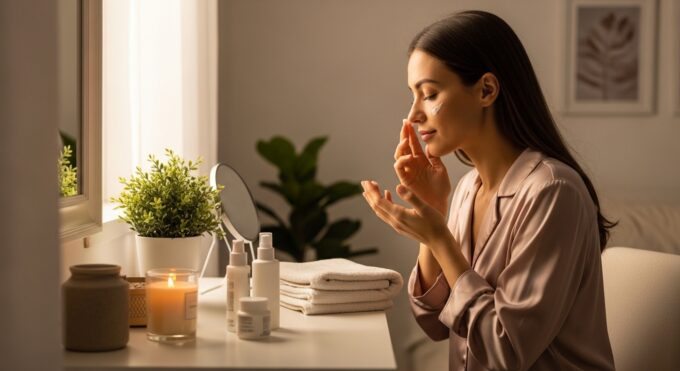
You do not need a spa-like bathroom. A few small changes are enough. Clear the clutter first: a crowded shelf is visual noise, and it makes the routine feel like work. Keep out only what you use every day.
Lighting matters, especially in the evening. Soft, warm light helps your body wind down; harsh overhead light does the opposite. A gentle scent, quiet music or silence can help too. The point is softness, not stimulation — the space should invite you to slow down, not impress anyone.
Mindful cleansing
Washing is usually the most rushed step, and it is also the one where attention pays off most. Take a moment to feel the water temperature — lukewarm, not hot, because hot water strips the skin’s natural oils and makes sensitivity worse. Use a mild, fragrance-free cleanser and move it over your skin slowly, in small circles, with your fingertips.
Notice where you hold tension — the jaw, between the eyebrows — and let the slow movement and slow breathing ease it. Rinse gently and pat dry with a soft towel. Do not rub. If your skin feels tight after washing, your cleanser is too strong.
This is the AAD face-washing position in practice: lukewarm water, a gentle cleanser, fingertips only, pat dry, twice a day and after sweating.
Applying products with intention
When you apply a serum or moisturiser, slow down instead of rubbing it in quickly. Warming a little product between your hands first is a pleasant sensory step — it feels calming and it helps you spread the product evenly. It does not make the product absorb better; nothing you do with your hands increases absorption, and this guide does not claim otherwise.
Use light, upward strokes and pay attention to how the product feels. If something stings, stop and note it. That attention is the practical value of mindfulness here: you catch a reaction on day one instead of day ten.
Patch test before you commit. The American Academy of Dermatology recommends testing a new product before using it on your face. Apply the product to a quarter-sized patch of skin where it will not be rubbed or washed away — the underside of your arm or the bend of your elbow — twice a day for 7 to 10 days. For a rinse-off product such as a cleanser, leave it on for about five minutes, or as long as the label says, then rinse it off. If the test area becomes red, itchy, swollen or painful, stop using the product. If the area stays clear for the full 7 to 10 days, the product is less likely to cause a reaction on your face — but a patch test cannot guarantee it.
A 24-hour test can miss an allergic reaction, which often takes several days to appear — that is why this guide uses the AAD 7–10 day patch-test method.
Moisturising as a self-soothing ritual
Moisturising is the step where touch matters most. Small, slow movements let you feel how your skin is today — dry in one place, oily in another, tender where it reacted yesterday. That information is useful: it tells you whether to use a lighter layer or a richer cream, and whether to skip an active tonight.
Use a plain, fragrance-free moisturiser with ingredients that support the barrier — glycerin and hyaluronic acid draw water in, ceramides help hold it there, squalane softens without feeling heavy. The touch itself is soothing, and that is enough of a claim: it feels calming. It does not “remove tension” from facial muscles, and it does not firm or lift skin.
Mindful hair care
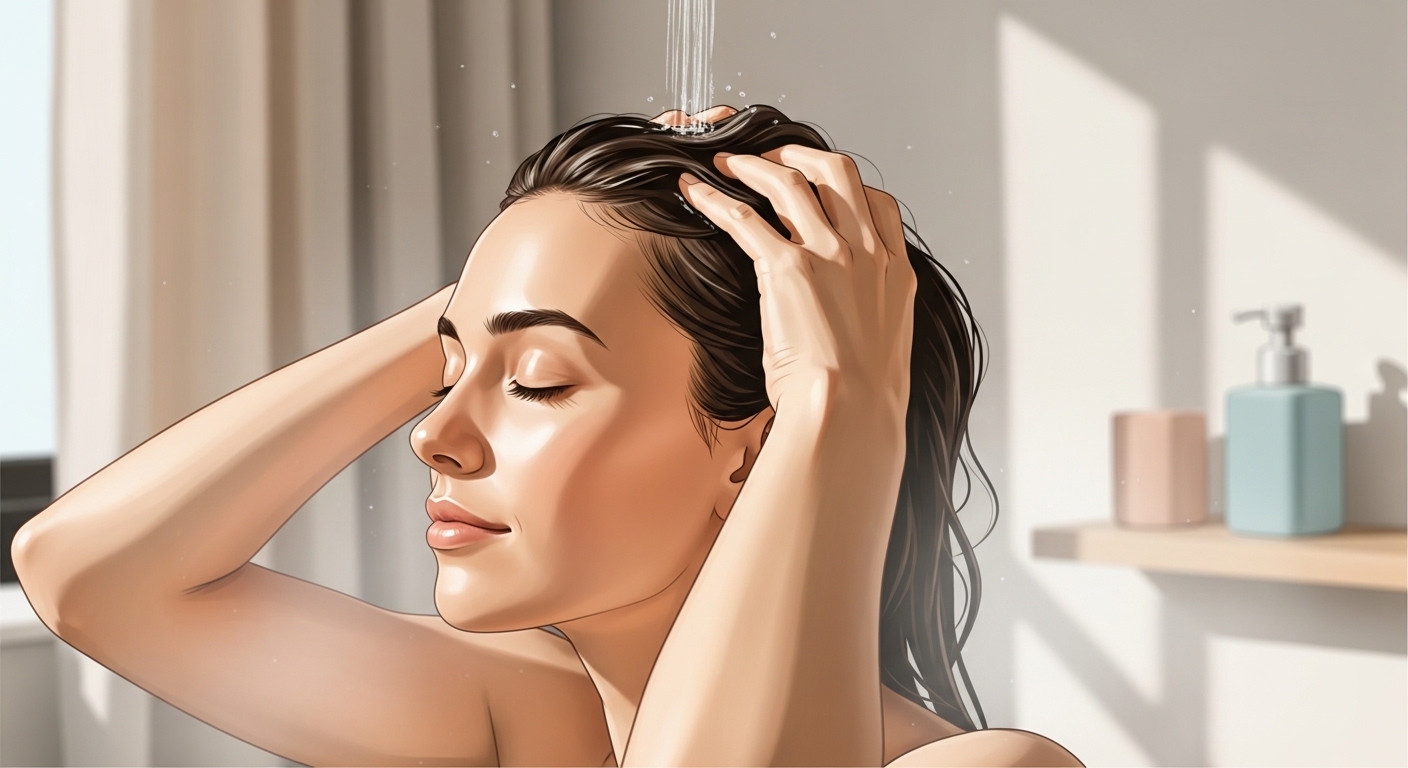
Hair washing can be soothing too, if you slow it down. Feel the water, the movement of your hands, the relaxation of your scalp as you massage gently. A slow scalp massage is pleasant and calming — and that is the honest extent of the claim. It does not improve circulation in a way that grows hair, and it does not improve hair health. The only study often cited for scalp massage and growth is Koyama 2016: 9 men, no control group — far too small to prove anything.
Wash as often as your scalp needs, with lukewarm water and a gentle shampoo. Detangle damp hair with conditioner, working from the ends first — wet hair is more fragile than dry hair, so never brush it dry or roughly. Damaged hair cannot be repaired; only trimming removes split ends, every 6 to 12 weeks.
Body care
Mindful beauty is not only for the face. Body care is grounding, especially after a stressful day. Applying body lotion slowly, noticing the texture and the warmth of your hands, reconnects you with your body in a gentle way. A shower can be a mindful ritual too: pay attention to how the water feels, how you breathe, and how your body feels as you wash — physically and mentally.
Keep it simple. A gentle wash and a plain moisturiser are enough. The slowness is the ritual, not the number of products.
Face massage and touch
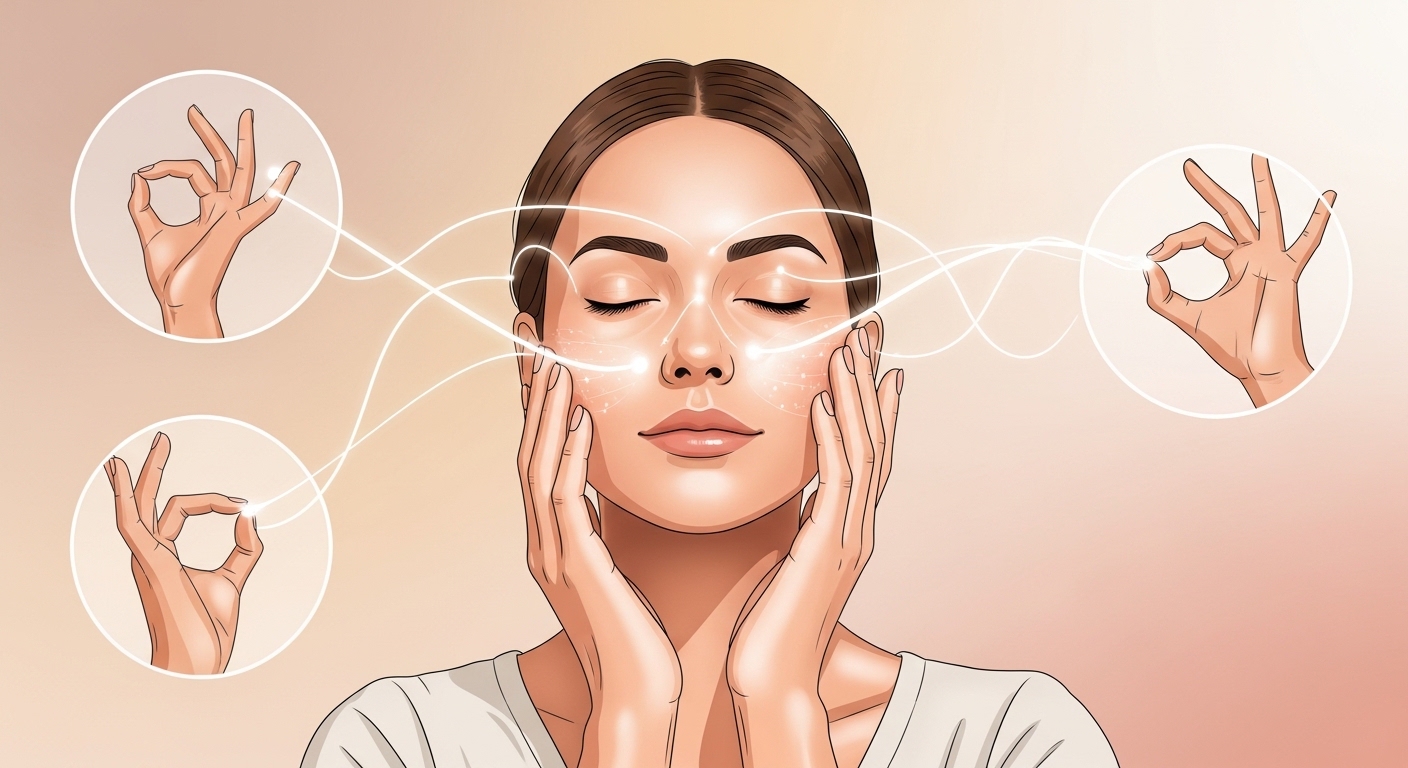
Light face massage can be relaxing, and it can help you notice where stress gathers — the jawline, the temples, the forehead. Use clean hands and light pressure, and keep it brief.
What it does not do is drain lymph, firm skin, or improve circulation in any meaningful way. Rollers and gua sha tools do not drain lymph or firm skin either; they are comfort aids, not treatments. If massage feels good, do it for that reason. If it does not, skip it — it is optional, not a step your skin needs.
Morning vs evening
Morning mindful beauty is about intention-setting: a few calm minutes before the day starts. Keep it plain and short — gentle cleanse, moisturiser, and broad-spectrum sunscreen with SPF 30 or higher, reapplied every two hours when outdoors. Sunscreen is the most effective anti-ageing step (Hughes et al. 2013). No morning routine replaces it.
Evening is about release: letting the day go, dimming the lights, slowing down. Night is a practical time for treatments such as a retinoid, but only if your skin already tolerates them — retinoids are the strongest topical for fine lines, used slowly (start 2–3 nights a week, pea-sized, 3–6 months to judge), with a pregnancy warning. Night is not a biological repair window; it is simply a convenient time to rest and to use treatments that make skin sun-sensitive.
Both routines support balance when practised consistently. Neither needs to be long.
Adjusting by skin and energy
Some days your skin is reactive and your energy is low. Mindful beauty means adjusting, not pushing through. If your skin is irritated, simplify: cleanser, moisturiser, sunscreen, nothing else. Use less product and a lighter touch. If you are mentally exhausted, a low-effort ritual is enough — a slow face wash and a layer of moisturiser count as the whole routine. When emotions are heavy, a quiet ritual can feel grounding without any need to talk or analyse.
The routine bends to the day. That flexibility is the point.

Common mistakes
- Multitasking through skincare. Checking your phone while you cleanse turns the ritual back into a task. Put the phone down for the few minutes the routine takes.
- Too many products. A long routine done in a hurry is worse than a short one done slowly. More products mean more chances of irritation and more decisions to make.
- Wanting an instant result. Mindfulness does not transform skin in a week. If the routine starts to feel like another thing to get right, it has stopped being mindful. Let it be imperfect and flexible.
- Treating calm as a treatment. A relaxing routine supports wellbeing. It does not treat eczema, rosacea, acne or any skin condition, and it does not replace care from a clinician.
Building your own routine
You do not need a long habit to practise mindful beauty. Pick two or three rituals that feel natural and sustaining — a slow cleanse, a gentle face massage, a leisurely application of body lotion. Let the routine change as your life changes: some weeks it will be longer, some weeks shorter. Mindful beauty is flexible by nature.
Start small. One slow step, done most days, is more useful than a perfect routine done once and abandoned.
When to get help
If your skin is persistently red, sore, swollen or blistering, or you have a rash that does not settle, ask a dermatologist or pharmacist — a routine cannot fix that. If low mood, anxiety or numbness persist for weeks, ask a professional: routines support wellbeing, they do not replace care.
FAQ
Does mindful beauty actually improve skin?
Not directly. It makes the routine calmer and easier to keep, and a routine you keep is what helps skin. It does not treat any skin condition.
How long does a mindful routine take?
Two to ten minutes is enough. Slowness is about attention, not duration.
Do I need special products or tools?
No. The products you already use are fine. Tools such as rollers are optional comfort aids, not treatments.
Can I practise mindful beauty if I am very busy?
Yes — a slow face wash and a layer of moisturiser count. One attentive step is better than a long routine done on autopilot.
Is face massage safe for sensitive skin?
Use clean hands, very light pressure, and stop if your skin stings or turns red. Skip it entirely on days your skin is reactive.
Summary
Mindful beauty is the routine you already have, done slowly and with attention: lukewarm water and a gentle cleanser, moisturiser applied without rushing, sunscreen SPF 30+ every morning. It does not treat skin conditions, detox skin, or repair it overnight — it makes skincare calmer and easier to keep, and that consistency is what helps. Patch test any new product for 7 to 10 days. Keep the routine short, let it bend to the day, and leave the phone out of it.
Sources: American Academy of Dermatology, 7 Rosacea skin care tips (patch-test method: apply a new product to a quarter-sized patch of skin on the inside of the arm for 7–10 days); American Academy of Dermatology, How to select anti-aging skin care products (broad-spectrum sunscreen, SPF 30 or higher, reapply every two hours outdoors). This is a researched overview, not a hands-on review.