Researched overview. This guide is based on published dermatology guidance, not on hands-on product testing by BeautyKob. No product in this guide was tested by us, and no product is recommended.
Table Of Content
Quick answer
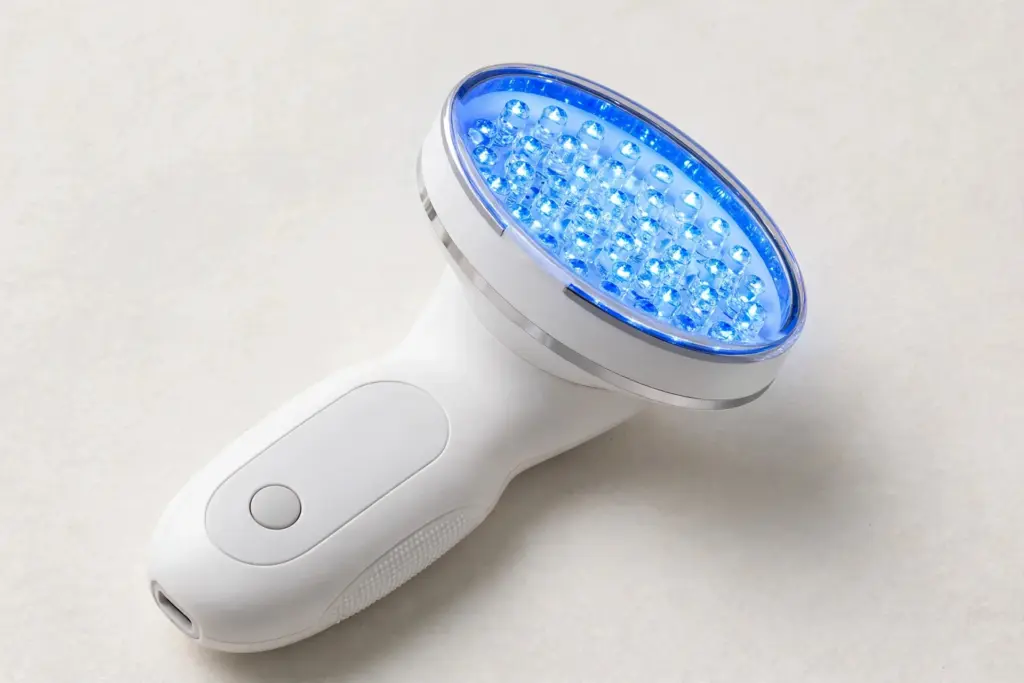
Neutrogena’s Light Therapy Acne Spot Treatment is a small handheld device that shines blue light (and, in some versions, red light) onto individual spots. Blue light acts on the acne-causing bacterium Cutibacterium acnes; red light has an anti-inflammatory effect. Clinical studies of this kind of light therapy show it can reduce acne lesions in mild-to-moderate acne over weeks of consistent use. It is not a cure, it does not work for every type of acne, and it does not clear spots fast — the “fast clearing” in the title is not supported by the evidence.
This is a different device from Neutrogena’s Light Therapy Acne Mask, which was voluntarily recalled in July 2019 over a theoretical risk of eye injury. The recall is explained below, because eye safety is the main safety issue with this kind of device.
If you have painful cysts or nodules, scarring acne, or acne that does not improve with ordinary treatment, see a dermatologist first. A device is not a substitute for medical care. This guide is general information, not medical advice.
Contents: What the device is · How blue and red light work · What the evidence shows · What it does not do · How to use it · Eye safety and the 2019 recall · Who should not use it · When to see a dermatologist · A decision framework
What the device is
The Neutrogena Light Therapy Acne Spot Treatment is a pen-sized handheld device that you hold against individual spots. It uses light-emitting diodes (LEDs) — blue light to target acne bacteria, and red light in some versions to calm inflammation. It is a spot treatment, not a full-face mask, and it is used on clean, bare skin for the session length given in the instructions supplied with the device.
Do not confuse it with Neutrogena’s Light Therapy Acne Mask, a full-face mask that used red and blue light. That mask was voluntarily recalled in 2019 (see “Eye safety” below). The spot treatment is a separate product, but it belongs to the same product family and the same eye-safety cautions apply.
How blue and red light work
- Blue light reaches the surface layers of the skin. The acne bacterium Cutibacterium acnes (formerly called Propionibacterium acnes) produces substances called porphyrins. When blue light reaches those porphyrins, it creates free radicals that damage the bacteria. This is the mechanism behind blue-light acne treatment.
- Red light reaches deeper into the skin and has an anti-inflammatory effect, partly by changing how skin cells release inflammatory signals. It does not kill bacteria the way blue light does.
Neither light is ultraviolet light. LED acne devices do not use UV, so they do not carry the sunburn and skin-cancer risks of UV exposure. That does not mean they are risk-free — see the eye-safety section.
What the evidence shows
A 12-week, multicentre, evaluator-blinded clinical study published in the Journal of the American Academy of Dermatology tested a low-level blue and red light device used at home once a day for 10 minutes, in people aged 12–40 with mild-to-moderate acne. The light treatment significantly reduced total acne lesion counts over 12 weeks compared with baseline, and was well tolerated. (JAAD study)
The American Academy of Dermatology’s position, as summarised in its patient guidance, is that light therapies show promise for acne, but they are not a guarantee of a cure, results vary from person to person, and results take time over a series of treatments. Acne does not usually clear up completely with light therapy alone.
What that means in plain words:
- Light therapy is a reasonable option to consider for mild-to-moderate inflammatory acne, as an add-on to ordinary skincare — not as a replacement for it.
- Expect weeks of consistent use before judging it, not days. No fixed number of days can be promised.
- It is not effective for blackheads, whiteheads, cysts or nodules on its own. Deep, painful lumps under the skin need a dermatologist, not a light pen.
- There is no published clinical study of this specific Neutrogena spot device that was found in this review. The evidence above is for blue and red light therapy in general. No claim is made here about this specific device’s results.
What it does not do
- It does not “permanently reduce inflammation” or prevent scarring. There is no evidence a home light device prevents ice-pick scars.
- It does not fade dark marks on a fixed schedule. Marks left after spots heal (post-inflammatory redness or pigmentation) fade over months, and light therapy has no proven timetable for that.
- It does not change how much oil your skin makes in any lasting way. Claims that it “calms sebaceous glands” or “thins sebum” are not established for a home device.
- It does not replace moisturiser, sunscreen or acne medicine. Used on its own, with no basic skincare, it will not keep skin clear.
- Diet, sleep and water do not make the device work better or worse in any way that has been measured. Eating less sugar or drinking more water is general health advice, not part of this treatment.
How to use it
- Start with clean, bare skin. Wash your face with a gentle cleanser and pat it dry. Makeup, sunscreen and thick creams sit on the surface and block the light, so the session should be done before any of those go on.
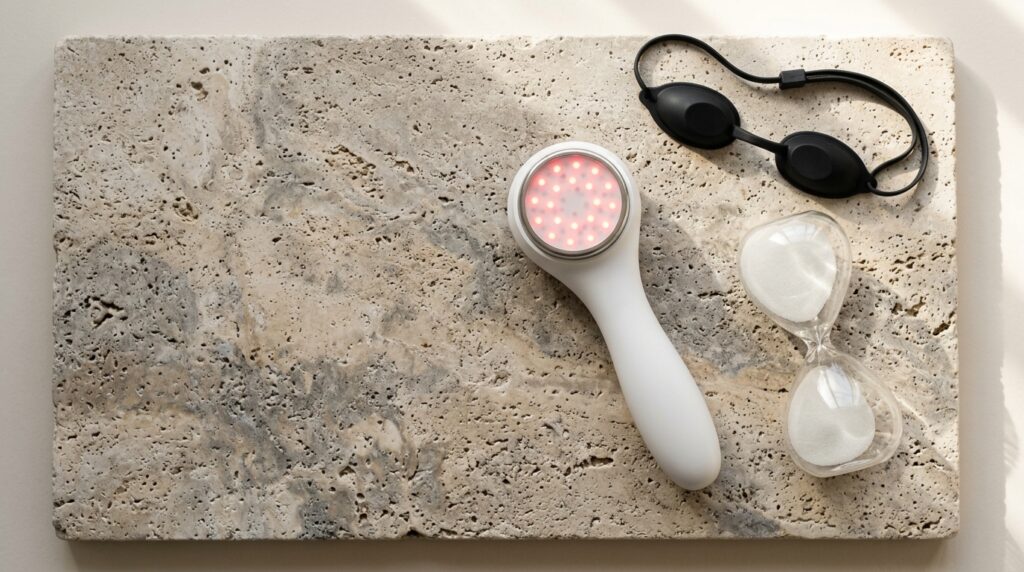
- Use the session length in the instructions. The manufacturer’s instructions for this pen say 2 minutes per treatment area, three times a day — the device switches itself off after 2 minutes. Do not guess, and do not extend the session because a spot looks stubborn. Longer sessions do not kill bacteria faster; they add heat and irritation. Use the device only as often as the instructions say.
- Hold it against the spot as directed. A gap between the device and the skin reduces the light reaching the spot.
- Moisturise afterwards. Apply your usual moisturiser once the session is finished.
- Wear sunscreen in the morning. Use a broad-spectrum sunscreen with SPF 30 or higher every day. The American Academy of Dermatology recommends this daily, including on cloudy days, and reapplying every two hours when outdoors. (AAD sunscreen guidance)
Do not combine it with strong actives in the same session. Do not apply a retinoid, a strong acid exfoliant or benzoyl peroxide immediately before using the device. Those products can make skin more sensitive and more likely to sting or peel. Use them at a different time of day, or on different days, and stop them if your skin becomes irritated.
Stop and simplify if your skin reacts. If you get persistent redness, stinging, warmth or flaking, stop using the device and go back to a gentle cleanser, moisturiser and sunscreen until your skin settles. If the reaction does not settle in a few days, ask a pharmacist or dermatologist.
Eye safety and the 2019 recall
This is the most important safety fact about this product family.
In July 2019, Neutrogena (Johnson & Johnson) voluntarily recalled its Light Therapy Acne Mask worldwide. The company said that for a small subset of people with certain underlying eye conditions, and for people taking medicines that can increase sensitivity to light, there was a theoretical risk of eye injury. The decision was made out of an abundance of caution. Reported reactions were rare — complaints on roughly 0.02% of masks sold — and were generally mild and transient: temporary eye pain or irritation, tearing, blurry vision, seeing spots, or changes in colour vision, which resolved after people stopped using the mask. (C&EN recall report)
The recall was for the mask, not for the spot treatment pen. But the reason for it matters for any bright blue-light device used on the face:
- Never look directly into the light. Do not use the device near your eyes, and do not stare at it while it is on.
- Stop immediately and seek medical advice if you notice any change in your vision — eye pain, tearing, blurring, spots or flashes, or changes in colour vision.
- Be extra careful if you have an eye condition such as retinitis pigmentosa or ocular albinism, or if you take a medicine that increases light sensitivity (for example the antibiotic doxycycline, which is also prescribed for acne). Ask your doctor or eye specialist before using any light device.
- Buy from a reputable seller. Unbranded devices sold without a stated wavelength, instructions or safety information may not deliver the light they claim. A cheap coloured light is not the same as a calibrated LED device.
Who should not use it
Ask a doctor or dermatologist first — or skip the device — if you:
- Have an eye condition, or take a medicine that makes you more sensitive to light.
- Have lupus or another condition that causes photosensitivity.
- Have very dark skin and are worried about marks after treatment — ask a dermatologist, because any irritation can leave pigmentation.
- Are pregnant or breastfeeding and unsure whether a light device is suitable for you.
- Have severe, painful, cystic or scarring acne. A device will not treat this, and waiting while it gets worse risks permanent scars.
When to see a dermatologist
See a dermatologist promptly if: your acne is painful, deep or cystic; it is leaving scars or dark marks; it is getting worse despite weeks of consistent care; it appeared suddenly in adulthood; or it comes with other symptoms such as irregular periods or excess hair growth, which can point to a hormonal cause. A dermatologist can prescribe treatments that a device cannot replace — including topical retinoids, benzoyl peroxide, antibiotics, hormonal treatment or isotretinoin where appropriate.
As a rough guide, if a spot treatment has made no difference after about 8–12 weeks of consistent use, it is time to change approach and get professional advice rather than keep going.
A decision framework (not a recommendation)
No recommendation is made here, because there is no published study of this specific device and the general evidence is modest.
- It may be worth considering if you have mild-to-moderate inflammatory acne, you already have a simple routine (gentle cleanser, moisturiser, sunscreen), and you want an add-on you can use consistently — with realistic expectations and the eye-safety rules above.
- It is probably not worth it if you have mainly blackheads and whiteheads, deep cysts, scarring acne, or an eye condition or photosensitising medicine. In those cases the money and time are better spent on a dermatologist visit.
- Before buying, check whether this device is still sold and supported by Neutrogena, and read the current instructions and safety warnings that come with it. At least one UK pharmacy lists it as discontinued, and availability varies by country. The light-therapy line has changed since 2019, and an old device bought second-hand may have no instructions, no warranty and no support.
Summary
Blue and red light can help mild-to-moderate acne over weeks of consistent use, but they are not a fast cure and they do not work for every kind of acne. Use the device on clean, bare skin, only for the session length in its instructions, and never look into the light. Remember the 2019 mask recall: eye safety is the real risk with this product family. If your acne is painful, deep or scarring, or it is not improving after a few months, see a dermatologist.
Sources: JAAD 12-week blue and red light study; C&EN report on the July 2019 Neutrogena Light Therapy Acne Mask recall; AAD sunscreen guidance; AAD position on light therapy for acne (results vary, not a guaranteed cure, takes a series of treatments). This is a researched overview, not a hands-on review.