Researched overview. This guide is based on published dermatology guidance and general sleep and wellbeing guidance, not on hands-on testing by BeautyKob. No product, supplement or brand is recommended, and no dose is given.
Table Of Content
- Quick answer
- What happens at night
- Why bedtime rituals work better than sleep hacks
- Principles of effective calming rituals
- The 30–60 minute calming bedtime ritual
- Step 1: Digital wind-down
- Step 2: Body relaxation
- Step 3: Mental unloading
- Step 4: Sensory calm
- 10-minute calming rituals for busy nights
- Calming rituals for different sleep struggles
- Trouble falling asleep
- Waking up at night
- Anxiety at bedtime
- Bedtime rituals for different energy levels
- Calming rituals for different personalities
- Creating a sleep-friendly bedroom environment
- Common mistakes that ruin bedtime calm
- How long it takes for bedtime rituals to work
- Customising your personal bedtime ritual
- The morning after
- When bedtime rituals aren’t enough
- FAQ
- Summary
Quick answer
Calming rituals before bedtime are one of the simplest ways to fall asleep more easily and sleep better over time. If you lie in bed tired in body but wide awake in mind, the problem is usually not tiredness — it is that your nervous system has not switched from alert mode to rest mode. A short, repeatable ritual — the same steps, in the same order, every night — gives your brain a clear message: the day is over and it is safe to rest. It does not treat insomnia, anxiety or any sleep disorder, and no pillow, supplement or single trick replaces it. What it does is make falling asleep easier, night after night. This guide is general information, not medical advice.
Contents: What happens at night · Why rituals work better than sleep hacks · Principles · The 30–60 minute bedtime ritual · 10-minute version for busy nights · Rituals for different sleep struggles · By energy level · By personality · Sleep-friendly bedroom · Common mistakes · How long it takes · Customise your ritual · The morning after · When rituals are not enough · FAQ
What happens at night
Your body has two main modes: alert during the day, relaxed at night. The alert system keeps you active and focused. The relaxed system should take over at night, slowing the body down and preparing it for rest. Cortisol, the stress hormone, naturally falls in the evening, while melatonin rises to signal sleep.
Stress, bright lights and overstimulation delay that shift. A late email, endless scrolling, or worrying about something undone keeps the brain in daytime mode. When the wind-down is delayed, falling asleep gets harder — not because anything is broken, but because the body has not yet received the signal to rest. Night-time habits directly affect sleep quality, and a calm, predictable evening helps the shift happen.
Why bedtime rituals work better than sleep hacks
Sleep tricks promise fast fixes: a special pillow, a new supplement, a single method. None of them is recommended here — no supplement is a treatment for poor sleep, and no product guarantees rest. Rituals work differently: they rely on repetition. Doing the same calming activities every night teaches the brain to associate them with safety and rest. Over time the cues become automatic — the body starts to slow down as soon as the ritual begins.
Rituals also reduce uncertainty. The brain relaxes more when it knows what is coming next. Small steps done every night beat drastic changes done occasionally. A simple 20-minute wind-down every evening does more than a dramatic new routine tried once a week.
Principles of effective calming rituals
- Gentle, low-effort activities. Night is not the time for hard work. Choose low-stimulation activities that reduce intensity rather than raising it.
- Predictability and consistency. The same order every night trains the nervous system. Consistency builds an inner sense of safety.
- Sensory calming. Soft light, gentle sounds, comfortable textures — these are signals of rest, and sensory input directly affects stress levels.
- Personalisation over perfection. Your ritual must fit your life. There is no single ideal ritual. Comfort matters more than style.
The 30–60 minute calming bedtime ritual
Step 1: Digital wind-down
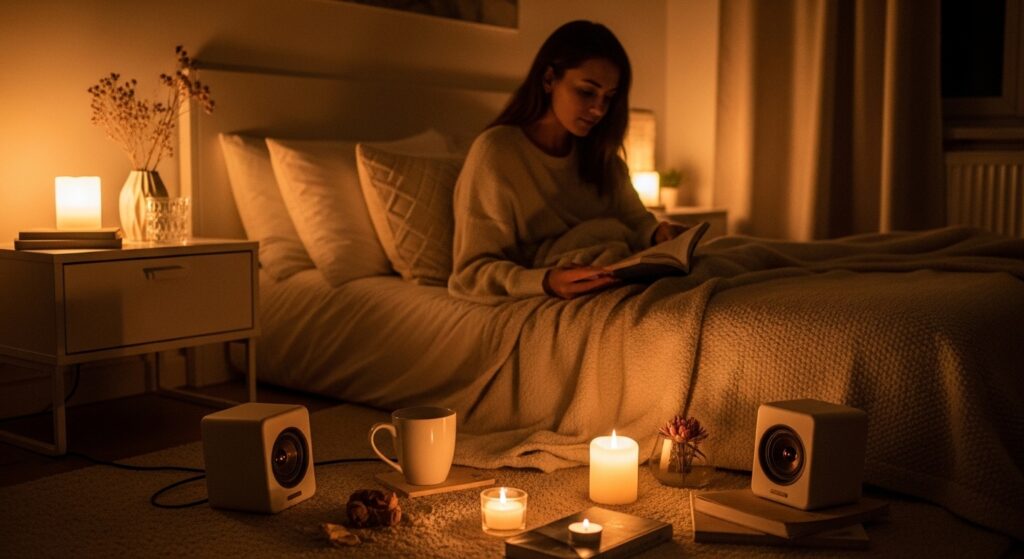
Screens keep the brain alert with bright light and endless content. Bright screens late at night can delay sleepiness, and scrolling keeps the mind active. Reduce screen time by dimming screens, setting a time when screens go off, or switching to audio instead of video. Read a calming book, stretch gently, or listen to soft music instead. These lower mental stimulation while still feeling enjoyable.
Step 2: Body relaxation
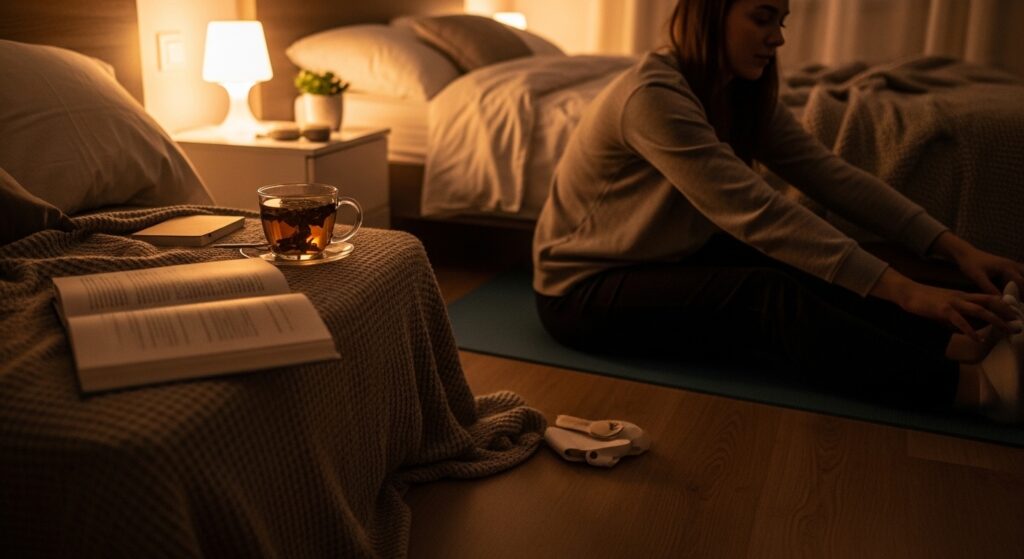
Stress shows up in the shoulders, jaw and hips. Light stretching or slow movement helps release the tension built up during the day. Focus on slow breathing: breathe in slowly through your nose for about four counts, and out for about six. Breathing out a little longer than breathing in is calming. Do not do hard exercise in the evening — intense exercise raises alertness and delays sleep.
Step 3: Mental unloading
Racing thoughts are common at bedtime. When distractions stop, the mind gets noisy. Write down pending tasks or worries and leave them on paper. That alone eases the mental pressure. You can also try thought labelling: when a thought appears, notice it, then gently return to your breath. The aim is release, not solving anything — it is time to sleep, not to make decisions at night.
Step 4: Sensory calm
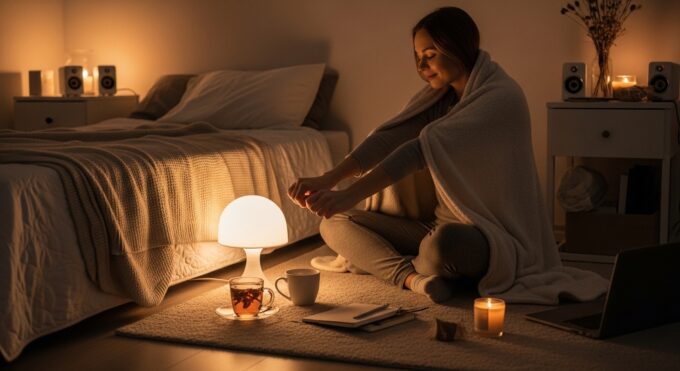
Keep the lighting low and warm — bright overhead lights keep the brain alert. Choose soft instrumental music, white noise, or silence, whichever relaxes you most. Comfort rituals build grounding cues: wrapping in a warm blanket, applying lotion slowly, a cup of hot herbal tea. These small signals support relaxation and build consistency night after night.
If you use a new lotion or skincare product as part of your ritual, patch test it first. The American Academy of Dermatology recommends testing a new product before using it on your face. Apply the product to a quarter-sized patch of skin where it will not be rubbed or washed away — the underside of your arm or the bend of your elbow — twice a day for 7 to 10 days. If the test area becomes red, itchy, swollen or painful, stop using the product. If the area stays clear for the full 7 to 10 days, the product is less likely to cause a reaction on your face — but a patch test cannot guarantee it.
A 24-hour test can miss an allergic reaction, which often takes several days to appear — that is why this guide uses the AAD 7–10 day patch-test method.
10-minute calming rituals for busy nights
Not every evening has an hour to spare, and micro-rituals still help. Switch screens off ten minutes before bed. Stretch lightly. Take five slow breaths. Dim the lights. For parents or shift workers, attach calming habits to things you already do — a shower, brushing your teeth. Consistency matters more than duration: even short evening relaxation supports better sleep over time.
Calming rituals for different sleep struggles
Sleep problems are not all the same, and the right approach depends on what is actually keeping you awake:
Trouble falling asleep
Lying awake for a long time keeps the nervous system in alert mode, usually because mental stimulation ran too late into the evening. Heavy discussions, intense shows, work emails or emotionally charged conversations switch the brain on. Instead, move to low-demand activities in the last hour: read slowly in warm light, choosing calm material rather than engaging or emotional content. Gentle breathing helps — in for about four counts, out for about six. When thoughts race, do not try to solve them; problem-solving keeps the brain busy. Accept the thought and return to your breath. Over time, the ritual retrains the brain to associate night-time with slowing down, not thinking harder.
Waking up at night
Night awakenings are common, especially when stress is high. The worst thing to do is pick up your phone — bright light signals morning to the brain, and notifications or news can raise stress. Stay in the dark. Avoid checking the time; clock-watching adds pressure. Breathe slowly and notice the weight of your body on the mattress. Relax your jaw and shoulders. You can repeat a calming phrase silently, such as “I am resting.” The aim is not to force sleep, but to return to a relaxed state. Sleep follows naturally when the body feels safe again.
Anxiety at bedtime
For some people, night is when anxiety rises — the silence lets in feelings that were pushed aside during the day. Grounding rituals help here. Put one hand on your chest and the other on your abdomen, and breathe slowly, feeling your hands move. The physical touch reassures the nervous system. Sensory cues help too: a soft blanket, low light, white noise — the enclosed, cosy feeling tells the body it is safe. Write anxious thoughts down before bed, so they stop looping in your mind. Repetition builds predictability, and predictability eases fear responses over time. If anxiety at bedtime persists, ask a clinician — rituals support wellbeing, they do not treat anxiety.
Bedtime rituals for different energy levels
- Physically exhausted. Keep rituals minimal. A warm shower or bath and slow breathing in dim light are enough. No stimulating content, no intense stretching. When you are overtired, simplicity works best.
- Mentally overstimulated. A racing mind needs less input, not more. Turn the lights down earlier than usual. Play soft instrumental music or nature sounds at low volume. Write thoughts down before bed so the mind stops looping.
Calming rituals for different personalities
There is no single ideal ritual — personality decides what is relaxing:
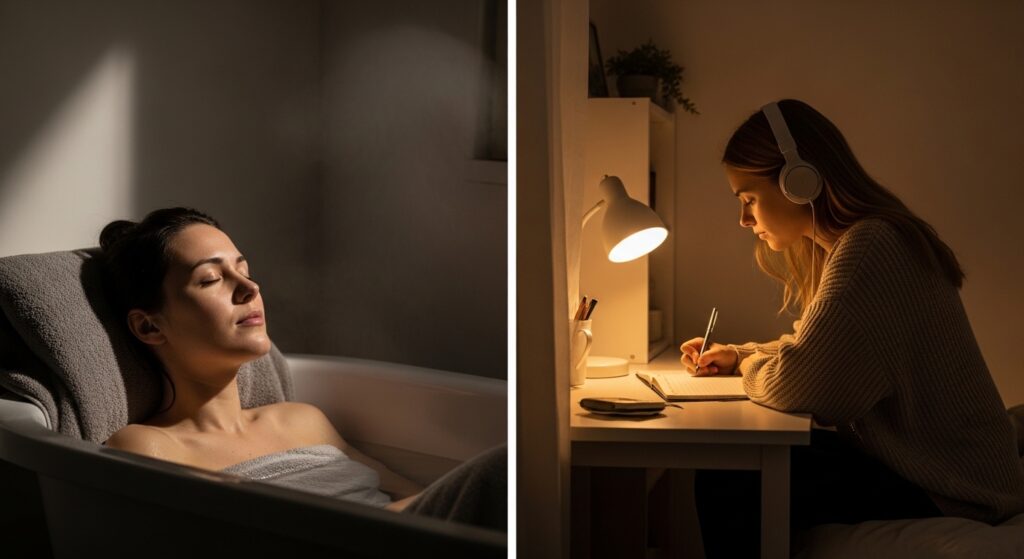
- If you dislike stillness, movement-based relaxation works: light stretching, slow yoga, quiet reading.
- If you overthink, structured journaling helps: write three things that concern you and one positive thought. Writing reduces rumination.
- If you are creative, light sketching, poetry or journalling can release emotion through expression.
- If you are very sensitive, less sensory input is better: dimmer light, softer clothes, less noise. The cosy, enclosed feeling of a blanket and a quiet room is calming.
A ritual that is forced will not last. Personalisation is what makes a night routine sustainable.
Creating a sleep-friendly bedroom environment
Your ritual should not have to fight your bedroom. Warm, dim lighting supports sleepiness; bright overhead lights should be avoided before bed. Temperature matters: a cooler room helps sleep, since coolness signals night. Comfort is essential — pillows and bedding that let the body relax. Noise control matters too: white noise machines, fans or earplugs can soften sudden sounds. Ritual and environment work together. When your bedroom always means relaxation, your body responds faster, and over time just being in the space helps you unwind.
Common mistakes that ruin bedtime calm
- Forcing relaxation. Calm cannot be demanded. Trying too hard to fall asleep creates anxiety.
- Over-stimulating activities. Exercise, heated conversations or exciting media keep stress hormones up.
- Alcohol. It may feel calming at first, but it disturbs deep sleep and causes more awakenings during the night.
- Irregular schedules. Poor sleep habits disrupt the body’s rhythms. Perfection is not required, but overall regularity supports steadier sleep. Protecting your routine makes it more effective. Occasional interruptions are normal; regular practice builds resilience.
How long it takes for bedtime rituals to work
The first couple of nights will feel strange — your brain is learning a new pattern. Within one to two weeks, falling asleep usually gets easier, sleep onset shortens, and night awakenings may reduce. Over time, mood steadies, energy feels more even, and baseline anxiety tends to ease. Patience matters: calming rituals build gradually through repetition, not instant transformation. There is no fixed timeline, and the change is steadiness rather than a sudden fix.
Customising your personal bedtime ritual
Choose two or three calming anchors — dim lights, gentle stretching, reading — instead of building an intricate system. Fit the ritual to your life: on busy evenings, keep it short; when you have more time, let the wind-down grow gradually. Adapt when life changes — travel, shift work or family demands may call for flexibility. Give up the idea of perfect sleep patterns. Consistency matters more than precision, and even incomplete rituals help the nervous system settle.
The morning after
A good night makes the morning easier. Start it gently: wash your face with lukewarm water and a gentle cleanser, using your fingertips, and pat dry. Moisturise, then apply broad-spectrum sunscreen with SPF 30 or higher, reapplied every two hours when outdoors. Sunscreen is the most effective anti-ageing step (Hughes et al. 2013). The bedtime ritual and the morning routine work together — one helps you rest, the other protects the day.
When bedtime rituals aren’t enough
If insomnia persists for weeks despite a steady routine, professional help is worth seeking. Sleep problems that last can be a sign of anxiety disorders, hormonal problems, burnout or other health issues. Calming rituals support healthy sleep patterns, but they do not replace medical care when deeper help is needed. Seeking help is not failure — it is a step towards long-term wellbeing.
FAQ
How long should bedtime rituals last?
Twenty to thirty minutes is ideal, but even ten minutes can help.
Can rituals work without strict sleep times?
Yes. Consistent patterns matter more than exact timing.
Is it okay to skip nights?
Occasional flexibility is fine. Return gently the next evening.
Why does relaxation feel uncomfortable at first?
Your body may be used to constant stimulation. Stillness can feel unfamiliar before it feels safe.
Do rituals help with anxiety long term?
Regular relaxation can help you feel steadier and less tense over time. It does not treat anxiety as a medical condition — if anxiety persists, ask a clinician.
Summary
Sleep is a skill, not a switch. It cannot be forced, but it can be helped. Calming rituals before bedtime teach your nervous system that night-time is safe: screens off, body relaxed, thoughts unloaded, senses calmed. Keep the ritual simple, repeat it most nights, and match it to your energy and personality. Patch test any new lotion or skincare product for 7 to 10 days. In the morning, gentle cleansing and SPF 30+ protect the day. If sleep problems persist for weeks, ask a professional — rituals support healthy sleep, they do not replace care.
Sources: American Academy of Dermatology, 7 Rosacea skin care tips (patch-test method: apply a new product to a quarter-sized patch of skin on the inside of the arm for 7–10 days); American Academy of Dermatology, How to select anti-aging skin care products (broad-spectrum sunscreen, SPF 30 or higher, reapply every two hours outdoors). This is a researched overview, not a hands-on review.