Researched overview. This guide is based on published dermatology guidance, not on hands-on product testing by BeautyKob. No product in this guide was tested by us, and no product is recommended.
Table Of Content
Quick answer
Fine lines around the eyes form because the skin there is thinner than anywhere else on the face and has fewer oil glands, so it dries out and creases more easily. Sun exposure, repeated expressions such as squinting and smiling, and the normal loss of collagen with age add to them.
Nothing removes fine lines. The honest goal is two things: make the lines you have look softer, and slow down new damage. The steps with real evidence are daily sunscreen and UV-protective sunglasses, a plain moisturiser, and — for some people — a retinoid used carefully and kept away from the eyes themselves. Oils, cucumber slices, massage, DIY serums and facial exercises do not reduce fine lines. Cold compresses can temporarily reduce puffiness, which is a different problem from fine lines.
Keep everything out of your eyes. If a product gets into your eye, rinse it with clean water. If you have pain, redness that does not settle, swelling that lasts more than a day or two, discharge, or any change in your vision, see a doctor or eye care professional promptly. This guide is general information, not medical advice.
Contents: Why lines form around the eyes · What actually helps · What does not help · Daily eye care routine · What to avoid near the eyes · Patch test · Habits · When to see a doctor · FAQ
Why lines form around the eyes
The skin around the eyes is thinner than the rest of the face and contains fewer oil glands, so it loses moisture faster and creases more easily. Collagen and elastin — the proteins that keep skin firm and springy — decline with age, so the skin becomes less able to bounce back after expressions. Sun exposure speeds up collagen breakdown. Squinting and smiling create expression lines that, over years, become visible even at rest. Dehydrated skin also makes fine lines look deeper, because dry skin creases and looks rough.
None of this is a defect to be fixed in a week. It is slow change, and the routine that helps is a slow, steady one.
What actually helps — and what does not

| Step or ingredient | Evidence | What it can do |
|---|---|---|
| Daily broad-spectrum sunscreen, SPF 30+, plus UV sunglasses | Strong | The best-proven way to slow new lines and spots from sun exposure. In a 4.5-year randomised trial (Hughes et al. 2013), people who used broad-spectrum sunscreen daily had 24% less skin ageing than people who used it only when they chose. Sunglasses also stop squinting, which deepens expression lines. |
| Plain moisturiser (ceramides, glycerin, hyaluronic acid) | Good for hydration | Makes dehydration lines look softer within days by hydrating the outer layer of skin. It does not remove lines or change the skin underneath. The AAD names sunscreen and moisturiser the two most effective anti-ageing products most people can use. |
| Retinoids (retinol; prescription tretinoin) | Strong for tretinoin, moderate for retinol | The most-studied topical for fine lines and texture, but they take 3–6 months to show a difference. Use a low strength, start slowly, and keep it away from the eyes themselves — apply it around the orbital bone, never on the eyelids or lash line. Not suitable in pregnancy. |
| Vitamin C | Supporting | An antioxidant and a cofactor for collagen synthesis in the body. It can help the look of uneven tone over time. It does not erase eye lines. |
| Peptides | Thin | Popular, and a reasonable addition, but the evidence is thin. No published evidence that peptide eye creams lift or smooth fine lines. |
| Natural oils (rosehip, almond, jojoba) | Moisture only | Oils seal in moisture and make skin feel softer. They do not reduce fine lines, renew cells, or stimulate collagen. Rosehip oil does not contain vitamin C, and its vitamin A is carotenoids, not retinoic acid — it is not a natural retinol. |
| Cold compresses, cucumber slices | Temporary, for puffiness only | Cold narrows blood vessels and can temporarily reduce puffiness (Cleveland Clinic). It does not soften expression lines or reduce fine lines. |
| Massage, lymphatic drainage | No good evidence | No published evidence that massaging the eye area improves firmness, drains lymph, or prevents creases from deepening. Rubbing and tugging can make lines worse. |
| DIY serums and homemade masks (honey, avocado, aloe) | No good evidence | No evidence these reduce fine lines. Homemade mixtures near the eyes carry a real risk of irritation or infection, and vitamin C serum mixed at home can sting badly. |
| Facial and eye exercises | Very weak | One small study (Alam et al., JAMA Dermatology 2018) followed 16 middle-aged women doing 30 minutes of facial exercises a day for 20 weeks. It found improved cheek fullness only, had no control group, and said nothing about eye lines. There is no good evidence eye exercises reduce wrinkles. |
Daily eye care routine
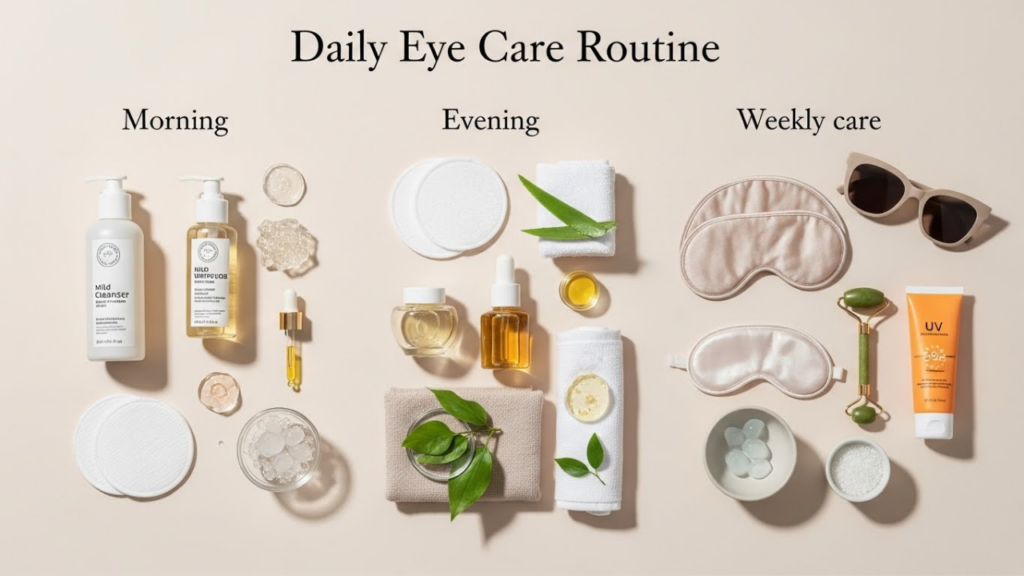
Keep it short. The eye area needs less, not more.
Morning:
1. Cleanse gently. Lukewarm water and a mild cleanser. Pat dry — do not rub.
2. Moisturiser. A pea-sized amount of plain moisturiser, patted gently around the orbital bone with your ring finger. A separate eye cream is optional, not essential; a plain moisturiser is usually enough.
3. Sunscreen — every morning, last step. Broad-spectrum SPF 30 or higher, applied carefully around the eyes but not into them. A mineral sunscreen is often less likely to sting the eyes. Wear UV-protective sunglasses outdoors — they protect the skin and stop squinting.
Evening:
1. Remove makeup gently. Use a mild cleanser or micellar water on a soft cloth. Do not scrub or pull at the skin.
2. Moisturiser. The same plain moisturiser, patted on gently.
3. Retinoid (optional, and only if your skin tolerates it). If you use a retinoid, apply a pea-sized amount for the whole face, keeping it well away from the eyes themselves — around the orbital bone only, never on the eyelids or lash line. Start two or three nights a week and increase only if your skin stays comfortable. Give it three to six months before judging fine lines. Do not use a retinoid if you are pregnant, planning pregnancy, or breastfeeding — ask a healthcare professional first.
Weekly: nothing extra is needed for the eye area. Do not exfoliate around the eyes — the skin is too thin, and scrubs or chemical exfoliants can irritate it badly.
What to avoid near the eyes
- Homemade serums and masks. Honey, avocado, aloe and DIY oil-and-vitamin-C mixtures have no proven benefit for fine lines, and anything that gets into the eye can sting, irritate, or cause infection. Keep them away from the eye area entirely.
- Essential oils and strong fragrances. These are common irritants on thin eye skin.
- Scrubbing and exfoliating. Never use a scrub, a strong acid, or a retinoid on the eyelids or lash line.
- Rubbing and tugging. Rubbing your eyes stretches thin skin and can make lines look worse. Pat products on; do not drag them.
- Overloading products. Several oils, serums and creams layered on the eye area increase the chance of irritation and milia (small white bumps). One moisturiser is usually enough.
- Skipping sunscreen. Sunscreen is the single most effective step, and the eye area is often missed. Sunglasses help too.
Patch test
Before using any new product around the eyes, patch test it first: apply a quarter-sized amount to the underside of your arm or the bend of your elbow, twice a day, for 7–10 days. Stop if you get redness, itching or swelling. If the product passes the patch test, try a tiny amount around one eye for a few days before using it on both eyes. If it stings, waters your eyes, or makes the skin red, stop using it.
Habits that help
- Sun protection beyond sunscreen: a hat and shade on bright days, and sunglasses whenever you are outdoors.
- Sleep: poor sleep does not directly cause fine lines, but it makes puffiness and dark circles look worse, and it makes it harder to stick to a routine. Aim for regular sleep.
- Do not smoke. Smoking speeds skin ageing, according to the American Academy of Dermatology.
- Food: a balanced diet with enough protein, healthy fats and a variety of fruit and vegetables supports general health. No food directly produces collagen in the skin, and no food can be presented as a treatment for fine lines.
- Screen breaks: regular breaks from screens reduce squinting and eye strain, which is good for your eyes. They do not erase fine lines.
When to see a doctor or dermatologist
See a doctor or eye care professional promptly if: swelling around the eyes lasts longer than 24–48 hours; the swelling is painful, hot, or one-sided; there is discharge, fever, or light sensitivity; or you have any change in your vision or cannot open your eye. These can be signs of something more serious than tired skin.
Ask a dermatologist or pharmacist if: the skin around your eyes is persistently red, sore, flaking or swollen; a product keeps stinging or watering your eyes; or you are considering a procedure such as a chemical peel or laser treatment near the eyes. Procedures near the eyes carry real risks and must be discussed with a clinician first — never as a way to “speed up results”.
FAQ
Can fine lines around the eyes disappear completely?
No. Moisturiser and sun protection can make them look softer, and a retinoid used carefully over months can improve their appearance, but no cream, oil or natural remedy erases them.
Which natural oil is best for eye wrinkles?
No oil has been shown to reduce eye wrinkles. Rosehip, almond and jojoba oils are reasonable moisturisers — they make skin feel softer and seal in moisture. That is all they do.
Do cold compresses or cucumber slices help?
They can temporarily reduce puffiness, because cold narrows blood vessels. They do not reduce fine lines, and they are not a treatment.
Do facial or eye exercises reduce wrinkles?
There is no good evidence for this. One small study of 16 women found improved cheek fullness after 20 weeks of daily facial exercises, but it had no control group and said nothing about eye lines.
How often should I apply products around the eyes?
Once or twice a day is enough — moisturiser in the morning and evening, sunscreen in the morning. More products do not mean better results, and overloading the eye area increases irritation.
Does sleep affect fine lines around the eyes?
Poor sleep makes puffiness and dark circles look worse, but sleep does not directly create or remove fine lines. Regular sleep is good for your health and for sticking to a routine.
Summary
Fine lines around the eyes are normal: thin skin, sun exposure, expressions and age. The steps with real evidence are daily sunscreen and sunglasses, a plain moisturiser, and — for some people — a retinoid kept well away from the eyes themselves. Oils, cucumber, massage, DIY serums and facial exercises do not reduce fine lines. Keep products out of your eyes, patch test anything new, and see a doctor promptly for swelling that lasts more than a day or two, pain, or any change in vision.
Sources: AAD sunscreen guidance and AAD guidance on reducing premature skin ageing; Hughes et al. 2013 (daily sunscreen and skin ageing, Annals of Internal Medicine); AAD cosmeceuticals review on vitamin C; NHS 111 Wales guidance on topical retinoids in pregnancy; AAD patch-test method; Cleveland Clinic guidance on eye bags and cool compresses; Alam et al. 2018, JAMA Dermatology (facial exercise pilot study). This is a researched overview, not a hands-on review.