Researched overview. This guide is based on published dermatology guidance, not on hands-on product testing by BeautyKob. No product in this guide was tested by us, and no product or brand is recommended.
Table Of Content
- Quick answer
- What hydration really is
- Dry skin vs dehydrated skin
- Why skin loses water
- The three layers
- Morning routine
- Evening routine
- Weekly habits
- Hydration by skin type
- Climate and seasons
- Inside vs outside
- Drinking water
- Diet and skin moisture
- Sleep and stress
- Mistakes that keep skin dehydrated
- How long it takes
- Patch testing
- When to see a dermatologist
- FAQ
- Summary
Quick answer
Hydrated skin is skin with enough water in it: comfortable, smooth, supple, and less prone to fine lines looking worse. Keeping skin hydrated is not about using more cream. It is about three things working together: adding water, supporting the barrier that holds water in, and not stripping the barrier away.
The short version: cleanse gently with lukewarm water, apply hydrating products to slightly damp skin, seal with a moisturiser suited to your skin type, and wear broad-spectrum SPF 30+ every morning. That is the whole system. Everything else in this guide is detail.
If your skin is red, sore, flaking badly, or you have a rash or open sores, skip the active products and ask a dermatologist or pharmacist first. This guide is general information, not medical advice.
Contents: What hydration really is · Dry skin vs dehydrated skin · Why skin loses water · The three layers · Morning routine · Evening routine · Weekly habits · Hydration by skin type · Climate and seasons · Inside vs outside · Mistakes · How long it takes · Patch testing · When to see a dermatologist · FAQ
What hydration really is
Hydration is the amount of water in the skin, mainly in the outermost layer, the stratum corneum. Water keeps skin plump, soft and flexible. When skin is well hydrated, it feels comfortable, reflects light evenly, shows fewer fine lines, and stays flexible. When it is dehydrated, it feels tight, looks dull, shows fine lines more clearly, and becomes more sensitive.
Hydration is about water. Oil is different. Dry skin lacks oil; dehydrated skin lacks water. That distinction decides what helps.
Dry skin vs dehydrated skin
| Dry skin | Dehydrated skin | |
|---|---|---|
| What it is | A skin type — produces less natural oil | A temporary state — lacks water |
| Who gets it | People whose skin makes less oil | Anyone, including oily skin |
| Feels like | Rough, flaky, tight | Tight, dull, sometimes oily on the surface and dry underneath |
| Main fix | Barrier repair and richer moisturisers | Adding water, then sealing it in |
| Duration | Ongoing, managed rather than cured | Improves as water and barrier recover |
Oily skin can be dehydrated. That is why tightness can appear on an oily face: the skin has oil but not enough water underneath. Drying oily skin out further makes dehydration worse, not better.
Why skin loses water
Most water loss is caused by everyday habits, not by a missing product:
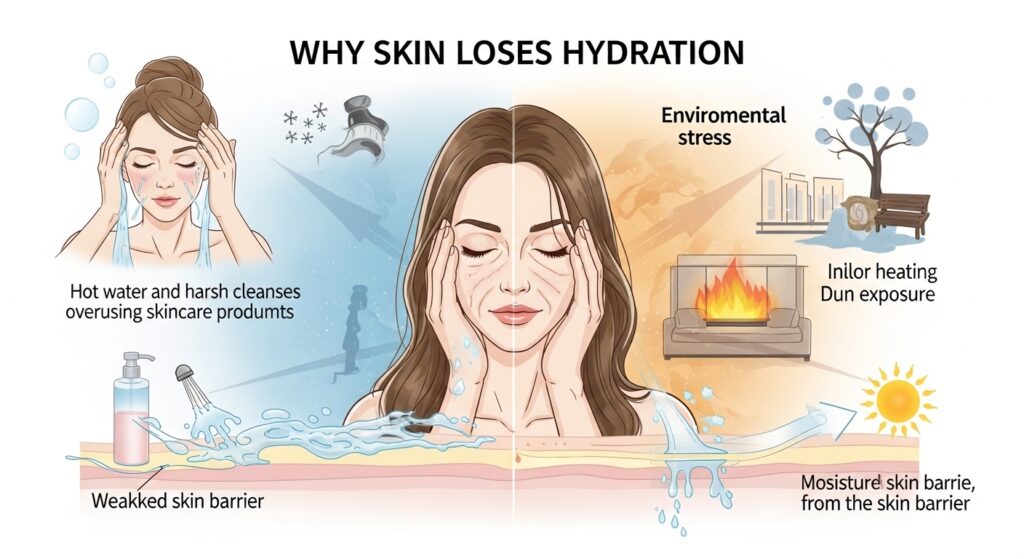
- Over-washing and harsh cleansers. Washing too often, or with a strong cleanser, strips the natural lipids that hold water in. Hot water makes it worse — it breaks down protective lipids and leaves skin tighter.
- Overuse of active ingredients. Exfoliating acids, retinoids and strong treatments can improve texture, but overused they damage the barrier. Once the barrier is broken, water escapes faster and hydration becomes impossible.
- Sun exposure. UV radiation damages the barrier and reduces the skin’s ability to hold moisture over time.
- Environment. Cold air holds less moisture and draws water out of skin; indoor heating and air conditioning do the same. Low humidity is a drying factor in any season.
- Ageing. With age, skin makes fewer natural lipids and less collagen, and holds water less well. Hydration habits need to change with skin.
The pattern is consistent: anything that weakens the barrier lets water out. Hydration care is mostly barrier care.
The three layers
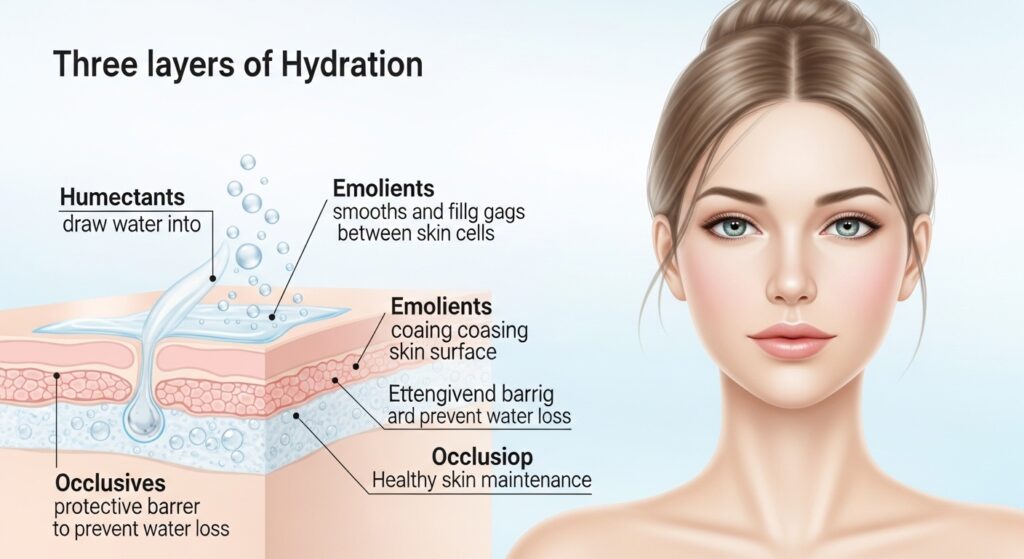
Water stays in skin when three kinds of ingredients work together. No single one is enough on its own.
| Layer | What it does | Examples | What to know |
|---|---|---|---|
| Humectants | Draw water into the skin | Hyaluronic acid, glycerin | Work best on slightly damp skin, under moisturiser; hydration, not a treatment on its own |
| Emollients | Fill the small gaps between skin cells, smoothing texture | Ceramides, squalane | Support the barrier and improve comfort; particularly useful for tight or rough skin |
| Occlusives | Form a layer on the surface that slows water loss | Petrolatum, shea butter, heavier creams | Do not add water — they keep the water that is already there; most useful at night or in harsh weather |
The order matters: hydrating product on damp skin first, then moisturiser to seal. A heavy cream without hydration underneath may not fix dehydration, and a hydrating serum without a moisturiser on top lets the
water evaporate. Balanced layering is the system.
Morning routine
- Cleanse gently — or just rinse. Not everyone needs a morning cleanse. For dry or dehydrated skin, rinsing with lukewarm water is often enough. If you cleanse, use a mild, non-stripping cleanser. The aim is clean skin, not tight skin.
- Apply hydration to damp skin. Apply hydrating products to slightly damp skin. Damp skin helps water-binding ingredients work better.
- Moisturise for your skin type. Light lotions suit oily or combination skin; creams suit dry skin. The key is comfort: if skin feels tight by midday, the moisturiser is not sealing well enough.
- Sunscreen — every morning. Broad-spectrum SPF 30 or higher, as the last step, reapplied every two hours when outdoors. Sun exposure increases moisture loss and damages the barrier over time, so sunscreen protects hydration as well as preventing ageing.
Evening routine
Evening care is the practical time for richer care — not because skin has a special repair window at night, but because the evening is when you have time for it, and because treatments that increase sun sensitivity belong at night.
- Cleanse without stripping. Remove makeup and sunscreen gently. Avoid over-cleansing; clean skin should not feel squeaky.
- Hydrate and seal. The same three layers as the morning, with a slightly richer moisturiser at night if your skin is dry. Sealing hydration at night helps prevent morning tightness.
- Recovery, not repair. A slightly richer cream at night improves comfort the next day. It does not “regenerate” skin overnight — repair is gradual, and steady care is what produces it.
Weekly habits
- Balanced exfoliation — once or twice a week at most. Light exfoliation helps shed dead cells. Over-exfoliation destroys the barrier and makes dehydration worse. If skin feels less comfortable after exfoliating, it is too frequent or too strong.
- Recovery days. Days with only cleansing, moisturising and protection — no actives. Recovery days let the barrier rebuild. Hydrated skin is never achieved without them.
- Do not change products constantly. Frequent routine changes do not let skin stabilise. A simple, regular routine hydrates better than a new product every week.
Hydration by skin type
- Dry skin. The barrier needs repair first. Gentle cleansing, a hydrating serum followed by a richer moisturiser, and a slightly heavier texture at night to reduce moisture loss overnight. When hydration and lipids are replenished together, dry skin recovers fastest.
- Oily skin. Oily skin needs hydration in light forms. Gel or water-based products give water without heaviness. Skipping moisturiser is one of the most common reasons oily skin stays dehydrated — well-hydrated oily skin usually produces more balanced oil and shows fewer breakouts and less midday shine.
- Sensitive skin. Fewer products work better. Light, fragrance-free formulas reduce irritation and moisture loss. Actives should not be used excessively, because they worsen dehydration. Barrier repair comes first; treatments are introduced later.
- Ageing skin. Layered hydration and constant barrier support help ageing skin most. Night hydration matters because water loss continues while you sleep. Well-hydrated ageing skin looks plumper and smoother, and fine lines look less harsh — but hydration does not remove wrinkles.
Climate and seasons
- Cold, dry weather. Use a richer moisturiser, not a lighter one. Cold air and indoor heating pull water out of skin, and a heavier cream slows that loss. A humidifier can help in a dry indoor climate.
- Hot, humid weather. Lighter products usually work; heavy creams can feel uncomfortable and clogged. Hydration is still needed — heat and air conditioning both dehydrate skin.
- Sun in any season. UV damages the barrier and increases moisture loss over time. Sunscreen is a hydration step, not only an anti-ageing step.
Change the routine with the season, and listen to skin rather than following a fixed calendar. If skin feels tight, the routine needs more sealing; if it feels heavy or clogged, it needs lighter layers.
Inside vs outside
Drinking water
Water supports general body hydration, and regular water intake supports circulation. But drinking more water does not directly hydrate skin beyond the body’s general needs — after basic hydration is met, extra water does not show in skin. Skin hydration comes mainly from the barrier and from topical care. Drink enough water for your health; do not expect it to fix dry skin.
Diet and skin moisture
Healthy fats support the barrier, and foods rich in antioxidants help protect collagen and reduce the inflammation that undermines the barrier. A very low-fat diet is associated with dry, tight skin. But no food is a hydration treatment, and no diet replaces topical care. Food and water hydrate better together than water alone, and both work indirectly.
Sleep and stress
Adults need 7 or more hours of sleep a night (CDC). Sleep deprivation raises inflammation and slows repair; chronic stress affects the hormones that control barrier function. Rest is part of hydration care, not a separate topic.
Mistakes that keep skin dehydrated
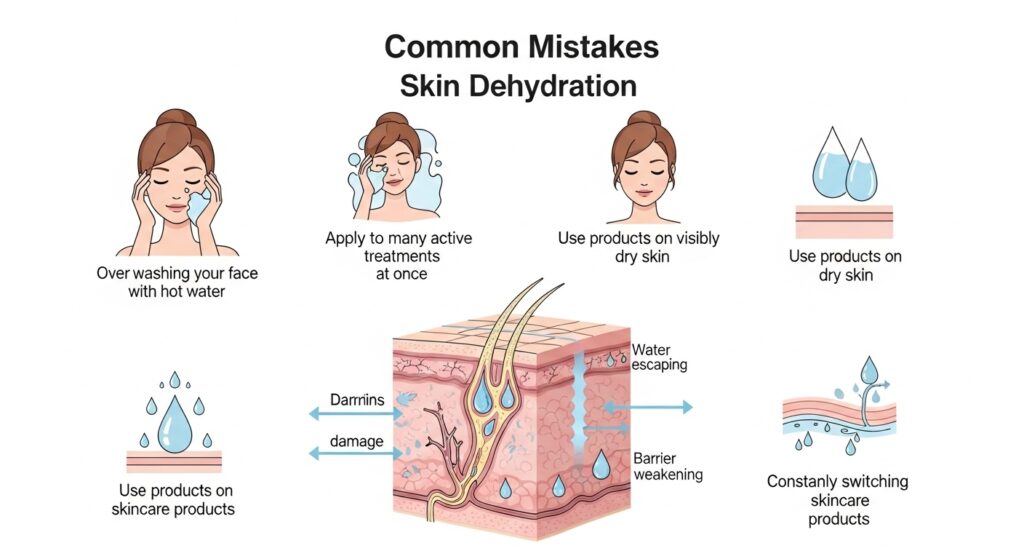
- Washing too often, or with hot water and harsh cleansers.
- Applying products to visibly dry skin instead of slightly damp skin.
- Using active treatments in excess of what the barrier can handle.
- Skipping moisturiser — especially on oily skin.
- Skipping sunscreen.
- Changing products constantly, so skin never stabilises.
- Expecting a single product, or a single week, to fix dehydration.
How long it takes
There is no fixed schedule. Mild dehydration can feel better within days of gentle care, but a damaged barrier takes weeks to recover — and the timing varies from person to person. Anyone who gives a fixed number of weeks for “complete” barrier repair is guessing. Steady, simple care is what restores hydration; intensity and frequent changes slow it down.
Patch testing
Patch test any new product before using it on your face. The AAD’s method is: apply the product to a quarter-sized patch of skin on the inside of your arm or the bend of your elbow, twice a day for 7 to 10 days. The AAD recommends this length because allergic reactions can take several days to appear, and a 24-hour test can miss them. If the patch becomes red, itchy, swollen or blistered, do not use the product on your face.
When to see a dermatologist
See a dermatologist if: skin stays tight, flaky or irritated despite weeks of gentle care; you have a rash that does not settle; you have eczema, rosacea or another skin condition that is getting worse; or you are unsure whether a product is safe for you.
FAQ
How do I know whether my skin is dehydrated?
Dehydrated skin feels tight and dull, and fine lines look more noticeable. It can be oily and dry at the same time. Pinching your cheek is not a reliable test — skin turgor is a rough clinical check for body dehydration, not a way to judge skin hydration. Judge by how skin feels and behaves over days, not by a pinch.
Is dry skin the same as dehydrated skin?
No. Dry skin lacks oil; dehydrated skin lacks water. Oily skin can be dehydrated. Treatment depends on which one you have — and many people have both.
How long does it take to repair dehydrated skin?
Mild dehydration can feel better within days. A damaged barrier takes weeks of steady, gentle care. There is no fixed number of weeks, and anyone who promises one is guessing.
Will drinking more water instantly hydrate my skin?
No. Water supports general hydration, but visible skin improvement also depends on the barrier, the routine and lifestyle. Drinking water alone will not fix dehydrated skin.
Does oily skin need moisturiser?
Yes. Skipping moisturiser is one of the most common reasons oily skin stays dehydrated. Use a light gel or lotion texture.
Summary
Hydration is water in the skin, held there by a healthy barrier. Dry skin lacks oil; dehydrated skin lacks water; oily skin can be dehydrated too. The system is three layers — humectant, emollient, occlusive — applied to slightly damp skin and sealed with a moisturiser suited to your skin type, plus broad-spectrum SPF 30+ every morning. Cleanse gently with lukewarm water, exfoliate once or twice a week at most, give the barrier recovery days, and do not change products constantly. Drinking water supports general hydration but does not fix skin on its own. Patch test new products for 7 to 10 days. If skin stays tight, flaky or irritated despite weeks of gentle care, see a dermatologist.
Sources: American Academy of Dermatology, 7 Rosacea skin care tips (patch-test method: apply a new product to a quarter-sized patch of skin on the inside of the arm for 7–10 days); American Academy of Dermatology, How to select anti-aging skin care products (broad-spectrum sunscreen, SPF 30 or higher, reapply every two hours outdoors). This is a researched overview, not a hands-on review.