Researched overview. This guide is based on published dermatology guidance, not on hands-on product testing by BeautyKob. No product in this guide was tested by us, and no product or brand is recommended.
Table Of Content
- Quick answer
- What “targeted” means
- Know your skin type
- The bare-face test
- Pick your one concern
- The foundation first
- First signs the foundation is working
- Adding one active
- How long to judge
- Tracking progress
- When to stop an active
- A short routine for busy days
- Budget
- When to see a dermatologist
- FAQ
- Summary
Quick answer
A targeted routine means picking one skin concern and building a routine around it — instead of trying to fix everything at once. Most beginners fail because they treat glow, acne, texture, pores and tone in the same week, with five new products. Skin does not work that way. It responds to clarity and consistency.
The method is short: know your skin type, pick one main concern, build a simple foundation first (cleanse, moisturise, sunscreen), keep it for three to four weeks, then add one active for your concern — and judge it over weeks, not days. That is the whole system.
If your skin is red, sore, blistering, or you have a rash that does not settle, skip the new products and ask a dermatologist or pharmacist first. This guide is general information, not medical advice.
Contents: What “targeted” means · Know your skin type · Pick your one concern · The foundation first · Adding one active · How long to judge · Tracking progress · When to stop an active · A short routine for busy days · Budget · When to see a dermatologist · FAQ
What “targeted” means
A targeted routine answers one question: what does your skin need most right now? It does not chase trends, and it is not a copy of someone else’s routine. It picks the products that serve one or two objectives, and leaves the rest out.
Treating everything at once causes the problems beginners blame on their skin: redness, breakouts, tightness. Those are usually signs of a stressed barrier, not signs that a product is “working”. A focused routine reduces mistakes, saves time and money, and makes it possible to tell what actually helps — because only one thing changes at a time.
Know your skin type
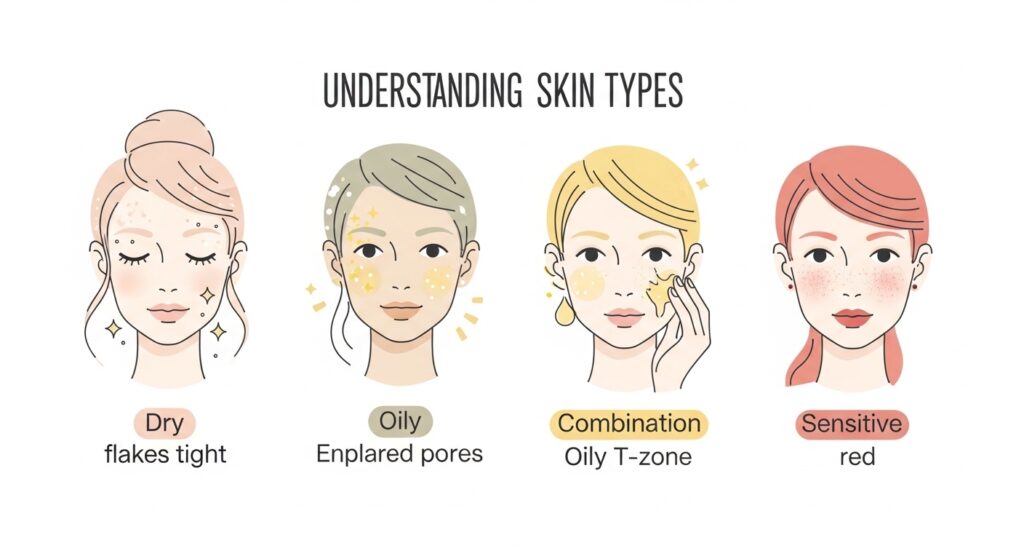
Skin type is a starting point, not a fixed label. Skin changes with weather, stress, sleep and food. Begin with the basics:
- Dry skin feels tight and flaky after washing, and makeup may crack. It lacks oil and water, and needs gentle cleansing and steady hydration.
- Oily skin looks shiny within a few hours, pores look larger, and breakouts appear often. It has excess oil but may still be dehydrated. Strong washes make it worse — stripping oil usually leads to more oil and more irritation.
- Combination skin is dry on the cheeks and oily on the nose or forehead. The mistake is treating the whole face as one zone.
- Sensitive skin reacts with burning, itching or redness, after products or from the environment. It needs the shortest routine, fragrance-free products, and one new product at a time.
The bare-face test
You do not need tools. Cleanse your face with a gentle cleanser, apply nothing, and wait 30 to 60 minutes:
- Tight all over — likely dry.
- Shiny all over — likely oily.
- Shiny only in some areas — likely combination.
- Burning or itching — likely sensitive.
This test gives direction. It does not lock you into a type permanently — skin changes, and the routine can change with it.
Pick your one concern
Once you know your skin type, pick your main concern. This is the step beginners most often skip: they buy products based on trends or testimonials, which causes confusion and clutter. A concern is one thing you want to improve — acne, dark marks, dullness, or dehydration. You can have a second, smaller concern, but that is all.
| Concern | What a routine can do | What it cannot do |
|---|---|---|
| Acne | Reduce the conditions that favour breakouts; support treatment | Cure acne — moderate or severe acne needs a dermatologist |
| Dark marks | Fade them gradually with steady care and sunscreen | Remove them by a fixed date |
| Dullness | Improve hydration and even shedding, which softens the look | Create glow on demand |
| Dehydration | Restore water and barrier comfort | Fix dry skin with water alone — lipids are needed too |
| Fine lines | Soften the look over months with retinoids and sunscreen | Erase wrinkles or restore lost volume |
Skin is more receptive to focus. When you address one problem, you can measure improvement, and irritation is easy to trace to its cause.
The foundation first
The foundation comes before any treatment. It has three steps, and it suits every skin type and every concern:
- Cleanse gently. Lukewarm water and a mild cleanser, once or twice a day depending on skin type. Dry and sensitive skin can often manage with one cleanse at night; oily skin usually needs morning and evening. Do not scrub, and avoid hot water — both undermine the barrier.
- Moisturise. A moisturiser supports the barrier and reduces water loss. A good one combines a humectant (draws in water, for example glycerin or hyaluronic acid), an emollient (softens, for example ceramides or squalane) and, for dry skin, an occlusive (seals water in, for example petrolatum or shea butter). Oily skin still needs moisturiser — skipping it can leave skin dehydrated and reactive.
- Sunscreen — every morning. Broad-spectrum SPF 30 or higher, as the last step, reapplied every two hours when outdoors. Sun exposure causes dark marks, premature ageing and barrier damage. Sunscreen protects everything the rest of the routine is trying to build. It is needed on cloudy days too, and when you will be near windows for long periods — glass blocks UVB but not all UVA. Ordinary indoor lighting does not meaningfully affect skin.
Keep the foundation alone for at least three to four weeks. That rest period lets the barrier settle and shows you how your skin actually behaves. Many beginners change products after one week and reset their progress. Time is not wasted here — it is the test.
First signs the foundation is working
Skin feels calm. Redness reduces. Breakouts slow. Texture feels smoother. If skin stings or burns every day, or tightness increases, the routine is not working — simplify back to cleanser, moisturiser and sunscreen, and check whether the cleanser is too strong.
Adding one active
Once the foundation is steady, add one active for your one concern. One product, not five.
| Concern | Active with the most evidence | How to start |
|---|---|---|
| Acne | Benzoyl peroxide (start low, 2.5%) or salicylic acid | One product, once a day or every other day at first; patch test first |
| Dark marks | Vitamin C or niacinamide | One product, once a day; sunscreen is essential or marks will not fade |
| Dullness / uneven texture | A gentle exfoliant, once or twice a week at most | Start once a week; stop if you get redness, stinging or flaking |
| Fine lines | Retinol (over the counter) | Night only, one or two nights a week at first, pea-sized; do not use during pregnancy |
| Dehydration | Hyaluronic acid or glycerin on damp skin, under moisturiser | Daily; hydration, not a treatment on its own |
Rules for adding an active:
- One at a time. Use it on clean, dry skin, then moisturiser. Wait at least two weeks before increasing frequency.
- Do not combine strong actives when starting out. Exfoliating acids and retinoids should not be used together at first.
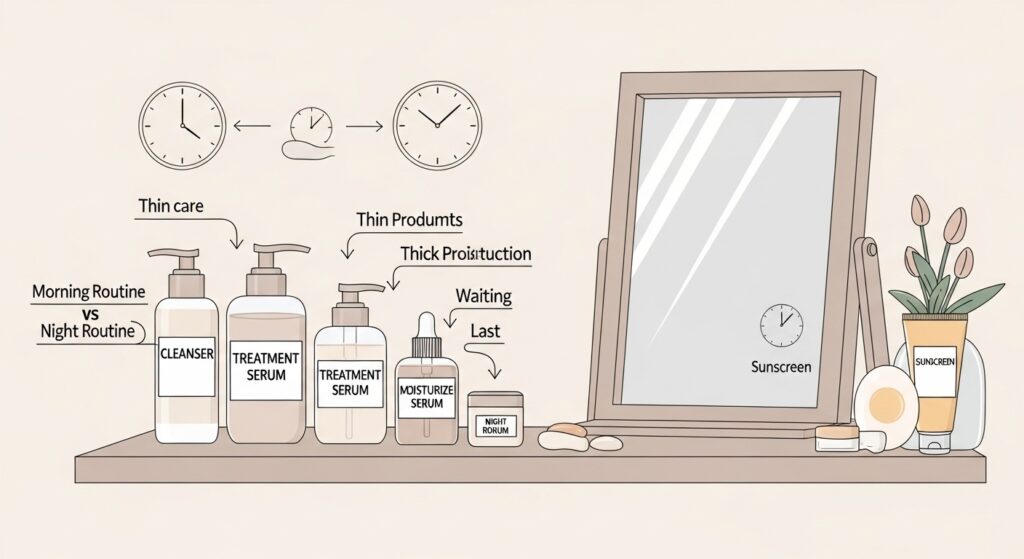
- Layer thinnest to thickest. Morning: cleanser, treatment if needed, moisturiser, sunscreen. Night: cleanser, treatment, moisturiser. Let each layer settle briefly.
- If redness lasts more than a few days, reduce frequency. If burning continues, stop. A strong reaction does not mean fast results — it means barrier stress.
Patch test any new product before using it on your face. The AAD’s method is: apply the product to a quarter-sized patch of skin on the inside of your arm or the bend of your elbow, twice a day for 7 to 10 days. The AAD recommends this length because allergic reactions can take several days to appear, and a 24-hour test can miss them. If the patch becomes red, itchy, swollen or blistered, do not use the product on your face.
How long to judge
There is no fixed schedule, and anyone who gives one is guessing. As rough guides, with steady use:
- Acne: the AAD advises giving an acne treatment 6 to 8 weeks before judging it.
- Dark marks: fading is gradual; eight to twelve weeks is a common guide, but the timing varies and sunscreen decides whether marks fade at all.
- Retinol and texture: three to six months of consistent use before the look of texture changes.
These are rough guides, not promises. They assume consistency. Buying a new product every two weeks means starting over each time, and impatience is not rewarded by skin. Judge one change at a time, over weeks.
Tracking progress
Progress is gradual and easy to miss day to day. Compare photographs every month, not daily mirror checks. Look for: skin looks calmer, breakouts are less frequent, tone looks more even, texture feels smoother to the touch. If some irritation appears, re-evaluate frequency first, not the whole routine — most problems come from too much, too fast, not from the wrong product.
When to stop an active
Stop and go back to the foundation for one to two weeks if you get:
- Intense peeling
- Intense burning
- Swelling
- A weakened barrier — skin that stings from mild products
Then reintroduce the active gradually, less often than before. Recovery builds strength; pressure does not.
A short routine for busy days
When time is short, start simple:
- Night: wash and moisturise. On treatment nights, apply the active before moisturiser.
- Morning: rinse or wash if needed, moisturise, sunscreen.
Uniformity beats elaboration. A plain routine used daily does more than a luxury routine used twice a week.
Budget
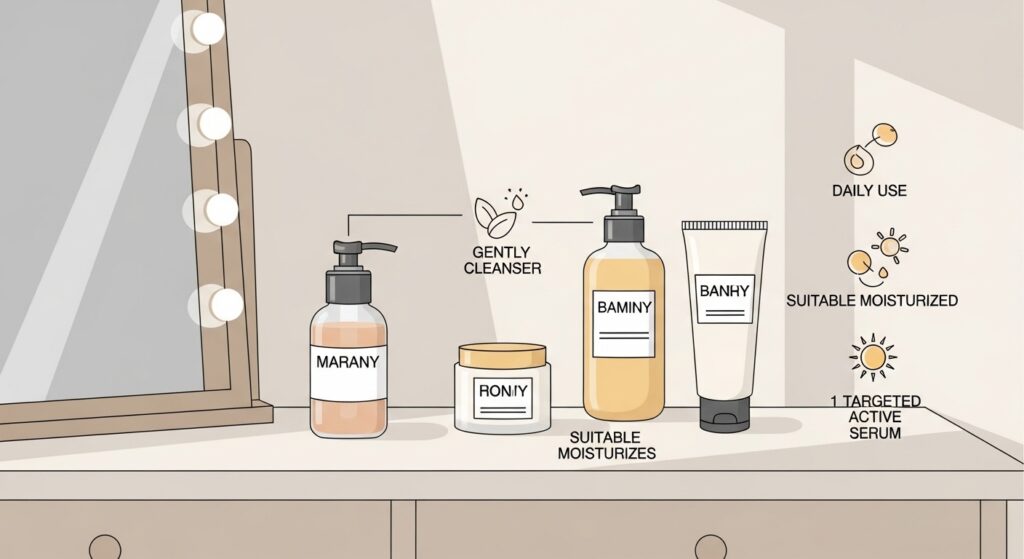
Expensive brands are not necessary. What matters is formulation and consistent use:
- Invest in a gentle cleanser.
- Use a moisturiser suited to your skin type.
- Invest in sunscreen.
- Choose one targeted active.
Ignore packaging. Ignore hype. Read ingredient lists. A plain routine used daily beats an expensive routine used twice a week.
When to see a dermatologist
- Acne that leaves scars, or is deep and painful.
- Pigmentation that spreads quickly.
- A rash that does not settle, or skin that keeps reacting to products.
- No improvement after 8 to 12 weeks of consistent care.
- Before any in-clinic treatment — these are medical decisions for a doctor, not choices from a skincare article.
Skincare handles mild to moderate issues. Healthcare handles the more severe ones. Knowing when to seek help is part of the routine.
FAQ
What is the ideal skincare routine for a beginner?
A mild cleanser, a moisturiser suited to your skin type, daily sunscreen, and one active for your biggest concern — used daily and kept simple.
How long should a beginner wait before adding an active?
At least three to four weeks on the foundation alone, so the barrier stabilises first.
Can a beginner use retinol?
Yes, but start slowly: a low strength, one or two nights a week at night, increasing frequency only if there is no irritation. Do not use retinoids during pregnancy.
Should oily skin skip moisturiser?
No. Oily skin still needs moisture. Skipping moisturiser can leave skin dehydrated and reactive. Use a light gel or lotion texture.
Should I wear sunscreen even when I am at home?
Sunscreen is needed when you will be outdoors, and near windows for long periods — glass blocks UVB but not all UVA. Ordinary indoor lighting does not meaningfully affect skin. Make sunscreen a daily habit for the times you are exposed.
Summary
A targeted routine picks one concern and builds around it. Know your skin type with the bare-face test, pick one main concern, and build the foundation first — gentle cleanse, moisturise, broad-spectrum SPF 30+ every morning — for three to four weeks. Then add one active for your concern, patch test it for 7 to 10 days first, and judge it over weeks, not days. Do not combine strong actives when starting out, do not change products every week, and do not expect a result by a fixed date. If acne is deep, painful or scarring, pigmentation spreads quickly, or there is no improvement after 8 to 12 weeks, see a dermatologist.
Sources: American Academy of Dermatology, 7 Rosacea skin care tips (patch-test method: apply a new product to a quarter-sized patch of skin on the inside of the arm for 7–10 days); American Academy of Dermatology, How to select anti-aging skin care products (broad-spectrum sunscreen, SPF 30 or higher, reapply every two hours outdoors). This is a researched overview, not a hands-on review.