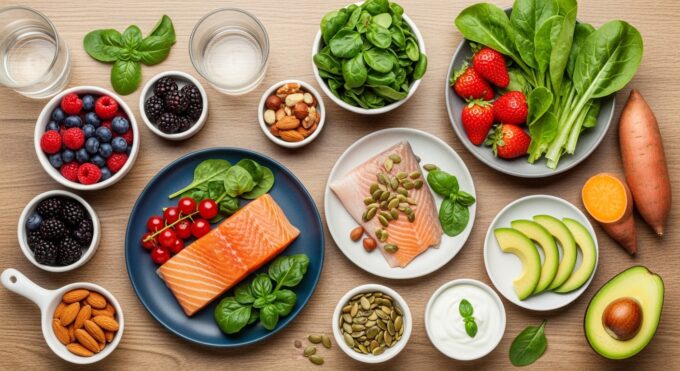
Researched overview. This guide is based on published dermatology and nutrition guidance, not on hands-on product testing by BeautyKob. No product in this guide was tested by us, and no food, supplement or brand is recommended.
Table Of Content
- Quick answer
- What diet can and cannot do
- How food reaches skin
- The evidence, honestly
- High-glycaemic foods and acne
- Dairy and acne
- Gut health and skin
- Omega-3 and other supplements
- Drinking water
- Sugar, glycation and ageing
- Nutrients and the foods that contain them
- Foods by concern
- Acne-prone skin
- Dry and dehydrated skin
- Dull skin
- Ageing skin
- What to limit
- A skin-supporting eating pattern
- How long to judge a change
- The skincare foundation
- When to get help
- FAQ
- Summary
Quick answer
Food matters for skin, but it is not a treatment. No food cures acne, clears dark marks, or prevents ageing. What diet does is supply the raw materials your body uses to maintain skin: amino acids from protein, fats that form part of the skin barrier, vitamins that support collagen and repair, and water. A poor diet can make skin problems worse; a good diet supports the skin’s normal function. It does not replace skincare.
The honest order is this: daily sunscreen, gentle cleansing and moisturiser do the surface work. Diet supports the background. Anyone who tells you a food, a juice or a supplement will fix your skin is selling something, not describing evidence.
If your skin is red, sore, blistering, or you have a rash that does not settle, ask a dermatologist or pharmacist first. This guide is general information, not medical advice.
Contents: What diet can and cannot do · How food reaches skin · The evidence, honestly · Nutrients and the foods that contain them · Foods by concern · What to limit · A skin-supporting eating pattern · How long to judge a change · The skincare foundation · When to get help
What diet can and cannot do
| Diet can | Diet cannot |
|---|---|
| Supply the nutrients skin needs to maintain itself | Cure acne, eczema, rosacea or any skin condition |
| Support the skin barrier through fats and protein | Replace sunscreen, moisturiser or treatment |
| Reduce the conditions that favour breakouts (for example, frequent blood-sugar spikes) | Clear dark marks, scars or wrinkles |
| Support general health, which shows in skin over time | Produce a visible result by a fixed date |
| Help you notice patterns (for example, breakouts after sugary drinks) | Prove a food caused your breakout — associations are not proof |
That distinction is the whole guide. Everything below is written inside it.
How food reaches skin
Skin is built and maintained from what you eat, but the route is indirect. Food is digested, nutrients enter the blood, and the body distributes them where they are needed. Skin is not first in line. That is why eating well supports skin slowly, over weeks and months, and why no single meal changes how skin looks.
The parts that matter:
- Protein provides amino acids, the building blocks of collagen and elastin — the fibres that give skin structure and firmness. Without enough protein, repair slows.
- Fats provide the lipids that form part of the skin barrier — the outer layer that keeps water in and irritants out. Very low-fat diets are associated with dry, tight skin.
- Vitamin C is a cofactor for the enzymes that build collagen. In the body it is needed for collagen synthesis; that biochemical role does not mean eating oranges visibly changes your skin.
- Vitamin A supports normal skin cell turnover. The body converts beta-carotene from plant foods into vitamin A as needed. Very high doses of vitamin A from supplements can be harmful — the NHS advises staying below 1.5 mg a day long term — which is one reason this guide recommends food, not supplements.
- Water supports general hydration. Drinking water does not directly hydrate skin beyond the body’s general needs; skin hydration comes mainly from the barrier and from topical care.
None of this is a treatment claim. It is the background biology that explains why a varied diet is worth having, and why it is not a substitute for skincare.
The evidence, honestly
High-glycaemic foods and acne
This is the dietary link with the best evidence, and it is still modest. High-glycaemic foods — white bread, sugary drinks, sweets, chips — raise blood sugar quickly. The resulting insulin and hormone changes may increase oil production and the shedding of cells inside pores.
The best trial is a small one: in Australia in 2007, 43 young men with acne were randomised to either their usual diet or a low-glycaemic-load diet for 12 weeks. The low-glycaemic group had significantly less acne. The 2024 American Academy of Dermatology guideline notes that three out of four randomised trials showed benefit from low-glycaemic diets — but the evidence was not strong enough for an official recommendation. A 2022 systematic review (published in the Journal of the American Academy of Dermatology) concluded that high glycaemic index and glycaemic load have a modest yet significant pro-acne effect, and that more randomised trials are needed.
What that means in practice: if your breakouts seem to follow sugary drinks and refined carbohydrates, eating fewer of them is a reasonable experiment. It is not a cure, and it does not replace acne treatment. Give any change at least 10 to 12 weeks before judging it — that is how long the trials ran.
Dairy and acne
The dairy link is weaker and often overstated. Observational studies find an association between milk drinking and acne, strongest for skim milk and for higher intakes (two or more cups a day). A 2018 meta-analysis of 14 studies covering 78,529 people found any dairy raised the odds of acne by about 25%, and skim milk by about 32%. But these were observational studies — they identify associations, not causation. The AAD notes that no studies have found yogurt or cheese to lead to more breakouts, and states that evidence remains insufficient to recommend avoiding dairy for acne treatment.
What that means in practice: if you drink a lot of milk and your breakouts seem to follow it, a trial without milk is reasonable. Cutting out all dairy, or blaming cheese and yogurt, is not supported by the evidence.
Gut health and skin
The gut-skin axis is real biology: gut bacteria influence inflammation and immune signals, which can show in skin. The pathways run through insulin and a growth hormone called IGF-1, which rise after sugary meals and certain dairy products, and through inflammation, which a disrupted gut microbiome can amplify.
What is not proven is the fix. Probiotics are the part of this story with the most marketing and the least settled evidence. Two meta-analyses reached different conclusions, and a 2023 systematic review in JAMA Dermatology rated the trials very small. The 2024 AAD guideline says there is insufficient evidence to recommend probiotics as a treatment. Fermented foods such as plain yogurt are reasonable foods to eat; they are not a skin treatment, and no probiotic strain, dose or duration is established. No supplement is recommended in this guide.
Omega-3 and other supplements
Omega-3 fats are often presented as anti-inflammatory skin treatment. The evidence does not support that claim: a 2023 systematic review of 42 studies found the trials small and varied, and omega-3 is not proven to improve skin. The same applies to zinc supplements (zinc is involved in wound healing, but taking extra zinc has not been shown to clear acne, and high doses can cause harm — the safe upper limit is 25 mg a day) and to vitamin D, vitamin E and collagen supplements. Eat the foods; do not buy the supplement for your skin.
Drinking water
Water helps the body stay hydrated, and regular water intake supports circulation and nutrient delivery. But drinking more water does not directly hydrate skin beyond the body’s general needs, and it will not fix dry or dehydrated skin on its own. Skin hydration comes from the barrier and from topical care — humectants, emollients and occlusives applied to damp skin, sealed with moisturiser. Water-rich foods help in the same indirect way as water itself.
Sugar, glycation and ageing
Sugar is sometimes said to age skin through glycation — sugar molecules attaching to collagen and stiffening it. Glycation is a real biochemical process, and a diet very high in sugar is not good for skin or for health generally. But no study has shown that cutting sugar visibly slows skin ageing in a person, and the effect of normal dietary sugar on skin ageing is not established. Eat less sugar because it is good for your health, not because it is an anti-ageing treatment.
Nutrients and the foods that contain them
| Nutrient | What it does in skin | Foods that contain it | What to know |
|---|---|---|---|
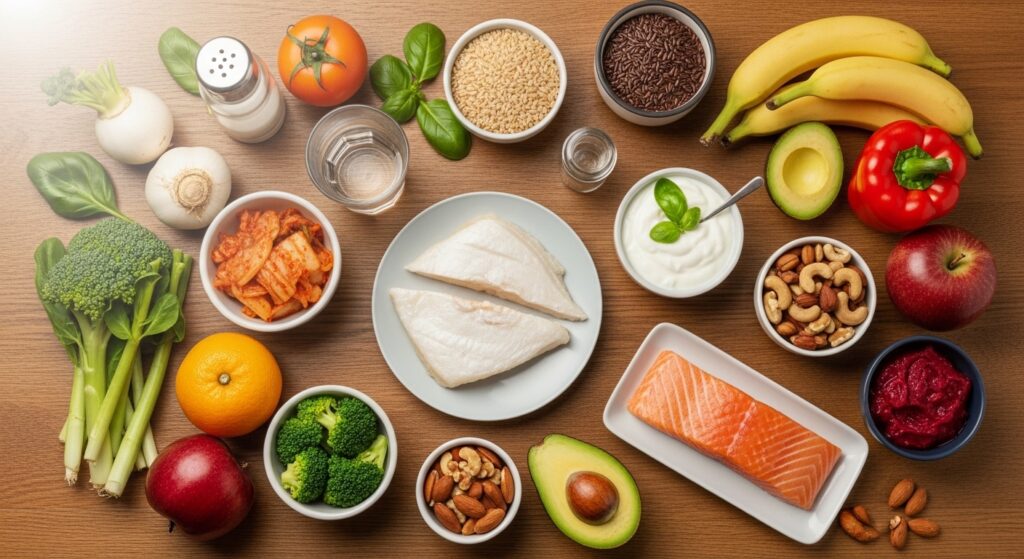
| Vitamin C | Cofactor for the enzymes that build collagen; antioxidant | Citrus fruit, berries, kiwi, peppers, broccoli, tomatoes | Needed for collagen synthesis; eating it does not visibly change skin on its own |
| Vitamin A / beta-carotene | Supports normal skin cell turnover | Sweet potatoes, carrots, leafy greens, eggs, liver | Beta-carotene from plants is converted as the body needs it; very high supplement doses can be harmful |
| Vitamin E | Antioxidant; helps protect skin surface fats | Nuts, seeds, avocado, olive oil, leafy greens | Works alongside vitamin C; no evidence that extra vitamin E improves skin |
| Omega-3 fats | Part of cell membranes; involved in inflammation signalling | Oily fish (salmon, sardines, mackerel), flaxseed, walnuts | Not proven to treat any skin condition |
| Zinc | Involved in wound healing and oil-gland function | Meat, shellfish, chickpeas, lentils, pumpkin seeds, nuts | Low zinc is associated with persistent acne, not proven to cause it; do not supplement for skin |
| Protein | Provides amino acids for collagen and elastin | Meat, fish, eggs, dairy, beans, lentils, tofu | Without enough protein, repair slows; more protein than you need does not make skin firmer |
No food in this table is a treatment. The table describes what nutrients do in the body, not what eating a food will do to your skin.
Foods by concern
Acne-prone skin
The most useful dietary change is the one with the best evidence: fewer high-glycaemic foods and sugary drinks. Whole grains, vegetables, lean protein and healthy fats steady blood sugar and reduce the conditions that favour breakouts. If you drink a lot of milk, a trial without it is reasonable. Do not cut out whole food groups, do not fast, and do not replace acne treatment with diet. If acne is deep, painful or scarring, see a dermatologist — diet will not treat it.
Dry and dehydrated skin
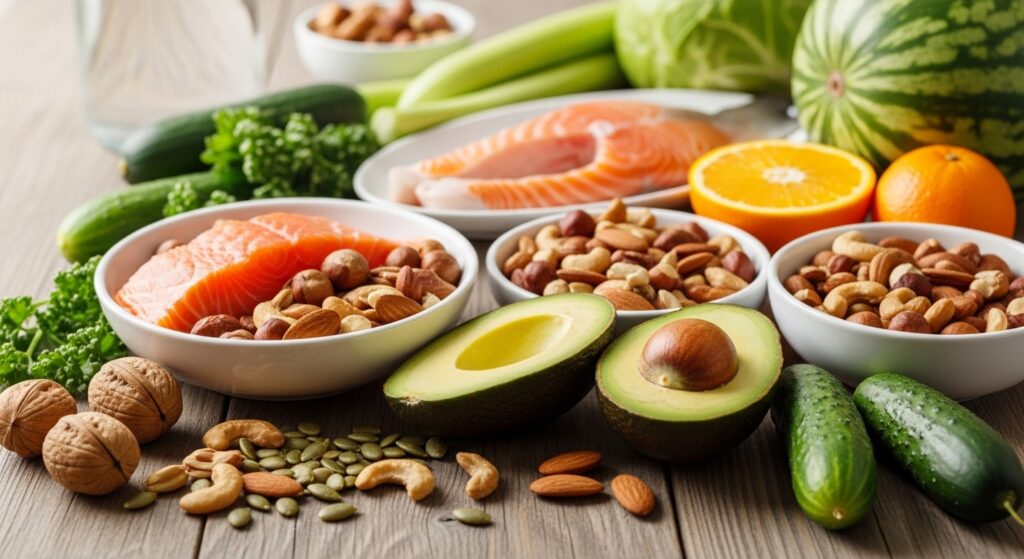
Dry skin needs lipids, not just water. Healthy fats — oily fish, avocado, nuts, seeds, olive oil — support the barrier, and water-rich fruit and vegetables support general hydration. But food alone will not fix dry skin: the barrier needs topical care too — gentle cleansing, a moisturiser that combines a humectant, an emollient and an occlusive, and daily sunscreen. If skin stays tight and flaky despite good topical care, talk to a pharmacist or dermatologist rather than eating more fat.
Dull skin
Dullness usually comes from dehydration, uneven shedding of dead cells, or sun damage — not from a missing food. A varied diet with fruit, vegetables and healthy fats supports the background, but the visible change comes from hydration, gentle exfoliation once or twice a week at most, and daily sunscreen. No food brightens skin.
Ageing skin
Ageing is driven by genetics, sun exposure and time. Diet supports the background: protein for repair, antioxidants from fruit and vegetables, healthy fats for the barrier. Sunscreen is the single most effective step against further visible ageing, and retinoids have the most evidence of any topical active for fine lines. No food slows ageing visibly, and no food restores lost firmness.
What to limit
- Sugary drinks and refined carbohydrates. The best-evidenced dietary link to acne; also the least useful calories in a diet.
- Heavily processed foods. Often high in sugar, salt and unhealthy fats, and low in the nutrients above. The link to skin is through overall diet quality, not a single ingredient.
- Excess alcohol. Alcohol dries the skin, disrupts sleep and nutrient intake, and shows over time as dryness, redness and earlier wrinkling. The effect is dose-dependent; occasional drinking is not the issue.
- Very low-fat diets. Fat is part of the skin barrier. A diet with almost no fat is associated with dry, tight skin.
Limiting means eating less, not banning. Restrictive diets and food fear do more harm than the foods they remove.
A skin-supporting eating pattern
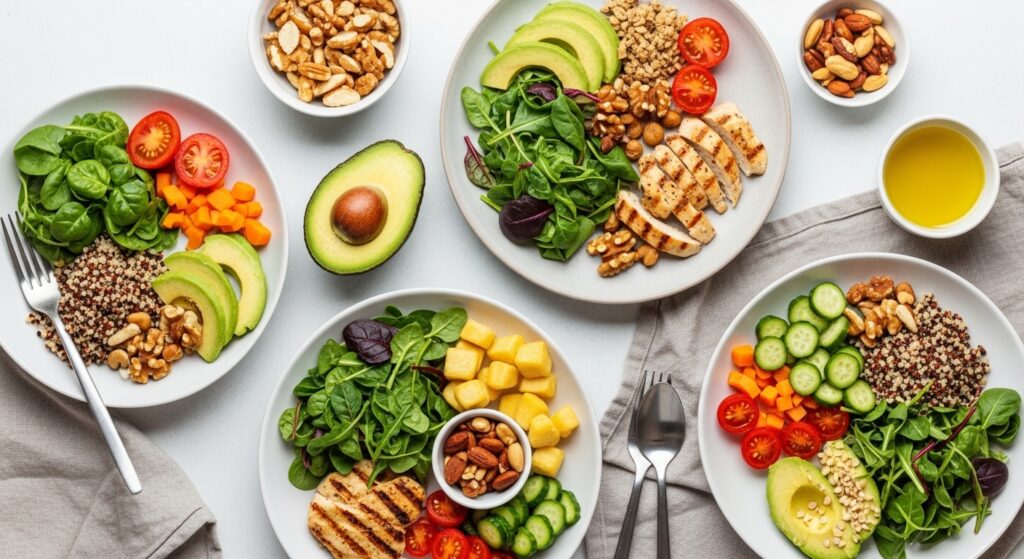
There is no rigid meal plan for skin, and this guide does not give one. The pattern that supports skin is the same pattern that supports general health:
- Each meal: some protein, some healthy fat, and fibre from vegetables, fruit or whole grains. That combination steadies blood sugar and supports repair.
- Across the day: a variety of colours — leafy greens, orange vegetables, berries, citrus — because different colours carry different nutrients.
- Snacks: combinations of fat and protein (nuts, yogurt, an egg) rather than sugary snacks, which spike blood sugar.
- Drinks: water as the main drink; sugary drinks kept occasional.
Consistency matters more than perfection. A varied diet eaten steadily for months supports skin more than a perfect week followed by a return to old habits.
How long to judge a change
Skin renews slowly. The old “28 days” figure is a rounded rule of thumb — the underlying calculation (Weinstein 1984) put epidermal turnover at about 47–48 days, and the timing varies by age and body site. Dietary trials ran 10 to 12 weeks. Give any dietary change at least that long before judging it, and judge it by one thing at a time: if you change five things at once, you will not know which one mattered. Do not expect a visible result by a fixed date, and do not promise yourself one.
The skincare foundation
Food does not replace skincare. The foundation that does the surface work is short:
- Cleanse gently. Lukewarm water and a mild cleanser, twice a day at most. Do not scrub.
- Moisturise. A moisturiser that combines a humectant (draws in water, for example glycerin or hyaluronic acid), an emollient (softens, for example ceramides or squalane) and, for dry skin, an occlusive (seals water in, for example petrolatum or shea butter).
- Sunscreen — every morning. Broad-spectrum SPF 30 or higher, as the last step, reapplied every two hours when outdoors. Sunscreen is the single most effective step against further visible ageing.
Patch test any new product before using it on your face. The AAD’s method is: apply the product to a quarter-sized patch of skin on the inside of your arm or the bend of your elbow, twice a day for 7 to 10 days. The AAD recommends this length because allergic reactions can take several days to appear, and a 24-hour test can miss them. If the patch becomes red, itchy, swollen or blistered, do not use the product on your face.
When to get help
See a dermatologist if: acne is deep, painful or scarring; a rash does not settle; skin keeps reacting to products; or dark marks spread quickly. See a doctor if: you suspect a nutrient deficiency; you have a medical condition that affects what you can eat; or eating patterns feel hard to control. A dietitian can help with a medical diet; a skincare article cannot.
FAQ
Can food cure my acne?
No. Diet can reduce the conditions that favour breakouts — mainly by steadying blood sugar — but acne is a medical condition that needs skincare and, when it is moderate or severe, a dermatologist. No food has been shown to cure acne.
Should I cut out dairy?
Not on the current evidence. The association is mainly with milk, especially skim milk, and the AAD says evidence is insufficient to recommend avoiding dairy. If you drink a lot of milk and breakouts seem to follow it, a trial without milk is reasonable.
Do I need collagen supplements or probiotics for my skin?
No. Collagen supplements have not been shown to improve skin, and the 2024 AAD guideline says there is insufficient evidence to recommend probiotics as a treatment. Eat the foods; do not buy the supplement for your skin.
Will drinking more water hydrate my skin?
Not directly. Water supports general hydration, but skin hydration comes from the barrier and from topical care. If your skin is dry, moisturiser and barrier care matter more than extra glasses of water.
How long before diet changes show in skin?
There is no fixed date. Dietary trials ran 10 to 12 weeks. Give any change at least that long, change one thing at a time, and do not expect a visible result by a specific week.
Summary
Food supports skin health but is not a treatment. The evidence is modest and specific: fewer high-glycaemic foods may help acne-prone skin; the dairy link is mainly with milk and is association, not proof; gut health is real biology but probiotics are not an established skin treatment; no supplement is proven to improve skin. Eat a varied diet — protein, healthy fats, fibre, a range of fruit and vegetables — steadily, and let skincare do the surface work: cleanse gently, moisturise, wear broad-spectrum SPF 30+ every morning, and patch test new products for 7 to 10 days. If acne is deep, painful or scarring, or a rash does not settle, see a dermatologist.
Sources: American Academy of Dermatology, 7 Rosacea skin care tips (patch-test method: apply a new product to a quarter-sized patch of skin on the inside of the arm for 7–10 days); American Academy of Dermatology, How to select anti-aging skin care products (broad-spectrum sunscreen, SPF 30 or higher, reapply every two hours outdoors). This is a researched overview, not a hands-on review.