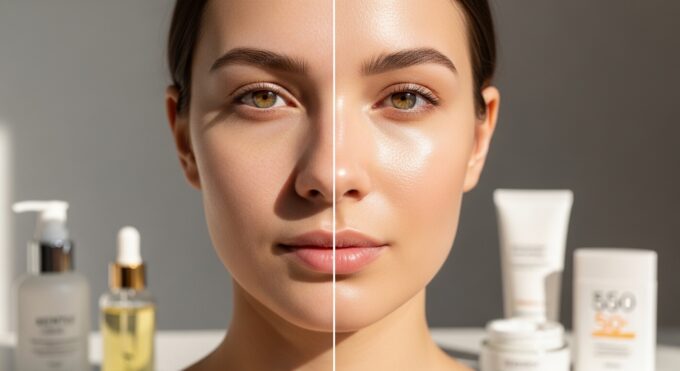
Researched overview. This guide is based on published dermatology guidance, not on hands-on product testing by BeautyKob. No product in this guide was tested by us, and no product or brand is recommended.
Table Of Content
- Quick answer
- Dry vs dull: tell them apart first
- What makes skin dry and dull
- The routine, step by step
- Step 1: Cleanse without stripping
- Step 2: Rehydrate as soon as possible
- Step 3: Choose one serum
- Step 4: Moisturise
- Step 5: Sunscreen, every morning
- Weekly exfoliation
- Night: a practical time, not a magic window
- Retinoids: the strongest brightening step, used slowly
- Food, water, sleep and stress — honestly
- Massage and tools — honestly
- Adjusting to the seasons
- When to add professional treatments
- Makeup that suits dry dull skin
- Timelines as rough guides
- When to simplify again
- Patch test before you commit
- When to get help
- FAQ
- Summary
Quick answer
Dry and dull are two different problems that often appear together, and they need different fixes. Dry skin lacks oil: it feels tight, flakes, and is easily irritated. Dull skin reflects light poorly: dead skin cells build up on the surface, hydration drops, and the skin looks flat and tired instead of even and bright. You can have oily dull skin or dry dull skin — when both are present, the skin looks lifeless, rough and uneven.
The routine that works is short and gentle: a creamy cleanser that does not strip, hydrating products applied to damp skin, a moisturiser that seals water in, one brightening active at a time, and broad-spectrum sunscreen with SPF 30 or higher every morning. No expensive products are needed, and no fixed timeline is promised — hydration can feel better in days, texture takes weeks, and retinoids take months. This guide is general information, not medical advice.
Contents: Dry vs dull · What makes skin dry and dull · The routine, step by step · Weekly exfoliation · Night · Retinoids · Food, water, sleep and stress — honestly · Massage and tools — honestly · Seasons · Professional treatments · Makeup that suits dry dull skin · Timelines as rough guides · When to simplify · When to get help · FAQ
Dry vs dull: tell them apart first
| Dry skin | Dull skin | |
|---|---|---|
| What it is | Skin that lacks oil, so it cannot hold water in | Skin whose surface is uneven, so it reflects light poorly |
| What it feels like | Tight after washing, flaky patches, rough texture, easily irritated | Not necessarily tight — it looks flat, tired and uneven |
| What it looks like | Flaking, rough patches, sometimes cracked around the mouth or nose | Flat, greyish or tired-looking, uneven tone, no natural brightness |
| Main fix | Oil and barrier support: a richer moisturiser with ceramides and glycerin | Gentle exfoliation and hydration, so the surface is smoother and more even |
The two overlap: dry skin often looks dull because a damaged barrier and a rough surface go together. Fix the dryness first — a calm, hydrated barrier is the base everything else is built on — then add gentle brightening.
What makes skin dry and dull
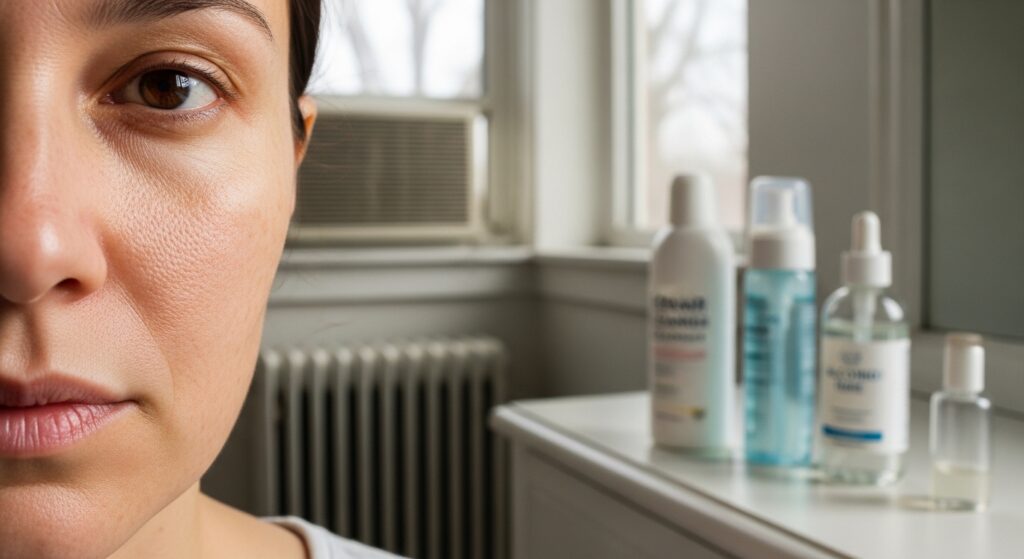
- A damaged skin barrier. The barrier is the outer layer that keeps water in and irritants out. Harsh cleansers, over-exfoliation and skipping moisturiser weaken it. Once it is weakened, water escapes from the skin — this is called transepidermal water loss — and the skin becomes dry, rough and easily irritated.
- Climate and environment. Cold air, indoor heating, air conditioning and pollution all take moisture from the skin. Dry climates and heated rooms are the hardest on dry skin.
- Wrong products. Foaming cleansers made for oily skin, toners with a lot of alcohol, and skipping moisturiser because the skin “seems light in summer” all dry the skin out over time.
- Lack of gentle exfoliation. Dead skin cells build up and block the glow. The common mistake is to exfoliate aggressively in response — that damages the barrier further. The balance matters: gentle, infrequent exfoliation, not scrubbing.
The routine, step by step
Step 1: Cleanse without stripping
Wash twice a day with lukewarm water and a gentle cleanser. Hot water strips natural oil and makes dryness worse. Your cleanser should remove dirt, sunscreen and impurities without leaving the skin feeling tight — if your face feels squeaky clean, the cleanser is too strong for you.
Use a creamy, hydrating cleanser with ingredients such as glycerin, ceramides or hyaluronic acid, and avoid high-foam formulas. At night, cleansing is not optional: pollution, sweat and oil build up during the day even without makeup, and sleeping without washing traps them against the skin. If you wear sunscreen or makeup, double cleansing — a soft oil-based cleanser followed by a moisturising cream cleanser — removes the build-up without irritation.
Step 2: Rehydrate as soon as possible
Moisture and hydration are not the same thing. Hydration means water in the skin; moisture means the oil that seals that water in. Dry dull skin needs both.
Do not wait long after cleansing. Apply hydrating products while the skin is still slightly damp, which helps trap water inside. Look for hydrating toners or essences with hyaluronic acid, panthenol, aloe vera or beta-glucan — these draw water to the skin. Layer light hydrating products instead of one thick product: a hydrating toner, then a serum, then moisturiser. This restores water content and then seals it.
Step 3: Choose one serum
Serums are concentrated treatments. For dry dull skin, they should focus on hydration and gentle brightening. Pick one to start with, not all three at once:
- Hyaluronic acid: attracts water to the skin, giving fullness and smoothing. Always pair it with a moisturiser, or the water it draws in can escape again.
- Vitamin C for radiance: an antioxidant that can help the look of uneven tone over time, and supports collagen. Use it in the morning. Start with a low concentration if your skin is sensitive.
- Niacinamide for barrier support: supports the skin barrier, improves texture and can reduce redness, without irritation. Per Draelos 2006, niacinamide is a well-studied barrier-supporting ingredient.
Step 4: Moisturise
A good moisturiser has three parts: humectants to attract water, emollients to smooth the surface, and occlusives to lock everything in. Ceramides matter most here, because they are lipids that occur naturally in the skin barrier.
- Day: a lighter, hydrating formula under sunscreen.
- Night: a richer cream. Night is a practical time for a richer product because you are not putting makeup or sunscreen over it — not because the skin has a special repair window at night.
If your skin feels tight in the afternoon, your moisturiser is probably not rich enough.
Step 5: Sunscreen, every morning
Sun damage worsens dullness and breaks down collagen, so no routine is complete without it. Use a broad-spectrum sunscreen with SPF 30 or higher every morning as the last step of your routine, and reapply every two hours when outdoors. Choose a moisturising sunscreen with water-retaining ingredients if your skin is dry — many people avoid sunscreen on dry skin because they think it adds weight, but a hydrating formula does not have to.
Weekly exfoliation
Exfoliation removes the dead cells that block radiance. Dry dull skin needs gentle exfoliation, once or twice a week at most:
- Use mild chemical exfoliants. Lactic acid once or twice a week hydrates while it exfoliates, and is gentler than a scrub. Polyhydroxy acids are another gentle option.
- Avoid harsh scrubs. They irritate and damage the barrier and increase dryness. They do not reliably “remove” dullness — they usually make the skin more reactive.
- Watch for over-exfoliation. Burning, increased redness, more dryness or breakouts after exfoliating are signs to stop. Discontinue exfoliating if these occur and focus on barrier repair — a gentle cleanser, moisturiser and sunscreen only — until the skin feels normal again.
Night: a practical time, not a magic window
Night is a useful time for richer products because you are not layering makeup and sunscreen over them. It is not a biological repair window — the skin does not heal best at night in any way that changes what you should use. Keep the night routine simple:
- A richer cream instead of the daytime lotion.
- A sleeping mask, once a week or occasionally. It works as a seal to prevent moisture loss overnight. It is not a treatment in itself.
- A few drops of facial oil, if moisturiser alone is not enough. Oil seals moisture in and adds softness by morning. Water moisturises and oil seals — oil on its own does not hydrate. Use lightweight oils, and skip them if your skin is acne-prone.
Retinoids: the strongest brightening step, used slowly
Retinoids are the strongest topical ingredients for fine lines and uneven texture, but they are also the easiest to overuse on dry skin:
- Start low, twice a week at night, buffered with moisturiser. Increase gradually only if the skin stays comfortable.
- Expect slow results. Texture and radiance improve over weeks, and retinoid effects on fine lines take 3 to 6 months. There is no fixed date by which results appear.
- Do not combine a retinoid with a strong exfoliant on the same night when starting out. If the skin stings, peels or turns red, stop the retinoid and go back to the basics until it settles.
- Pregnancy warning: do not use retinoids if you are pregnant or trying to become pregnant, and ask a doctor first if you are breastfeeding.
Food, water, sleep and stress — honestly
Skincare for dry dull skin is not only about products, but the honest version of the lifestyle advice is shorter than the original article made it:
- Food. Good fats, such as the fats in nuts, seeds and fish, are part of a healthy diet, and a balanced diet supports your health. But no food has been shown to treat dry or dull skin, and no diet is a skin treatment. The evidence on high-glycaemic foods and acne (Smith 2007; AAD 2024: three of four trials showed some benefit, not strong enough for a recommendation) is about acne, not dullness.
- Water. Drinking enough water is good for your health, but drinking water does not directly hydrate your skin. If your skin feels tight despite good topical care, the answer is a better moisturiser, not more water.
- Sleep and stress. Poor sleep is associated with worse-looking skin — one small study (Oyetakin-White et al. 2015, 60 women) found poor sleepers had roughly double the intrinsic ageing score and about 30% slower barrier recovery at 72 hours — but it was small, observational and funded by a cosmetics company, so it shows an association, not proof. Aim for 7 or more hours of sleep a night, as the CDC recommends for adults, because it is good for your health, not because sleep is a skin treatment.
- Supplements. No supplement or dose is recommended here. Omega-3, antioxidant and vitamin supplements have no good evidence as a treatment for dry or dull skin in people who are not deficient.
Massage and tools — honestly
- Massage. Gently applying oil or moisturiser with upward strokes feels pleasant, and it can help you apply products evenly. But massage does not increase the uptake of products — tools and massage do not make the skin absorb more — and a few minutes at night will not reliably “enhance radiance”.
- Gua sha and facial tools. There is no good evidence that facial tools drain lymph, firm skin or reduce puffiness in any lasting way. They are comfort aids, not treatments. Your hands are enough, and consistency matters more than complexity.
Adjusting to the seasons
Dry dull skin is very sensitive to weather:
- Winter: cold air and indoor heating strip moisture quickly. Use a richer moisturiser, add a facial oil on top in the evening, and exfoliate less often to avoid sensitivity.
- Summer: humidity can ease tightness, but sun exposure risks pigmentation. Focus on hydration and strict sunscreen application, and keep the routine flexible.
When to add professional treatments
At-home care is the foundation. In some cases, professional treatments can help — but they are a supplement to daily care, not a substitute, and no treatment lasts long without consistency at home:
- Hydrating facials. Water-based facials can restore hydration levels, and are particularly helpful in extreme weather.
- Mild chemical peels. A lactic acid peel done infrequently by a professional may polish safely. Do not have a peel at home, and do not have one on irritated or broken skin.
Ask a dermatologist before any professional treatment if you have a skin condition, take a prescription skin treatment, or have had a bad reaction to exfoliation before.
Makeup that suits dry dull skin
Once the skin has improved, avoid products that undo the gains:
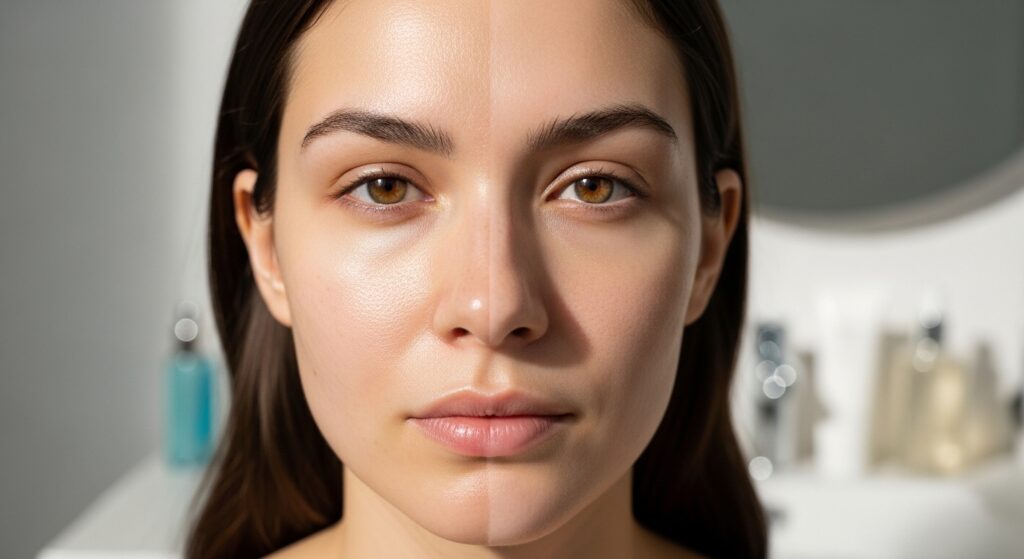
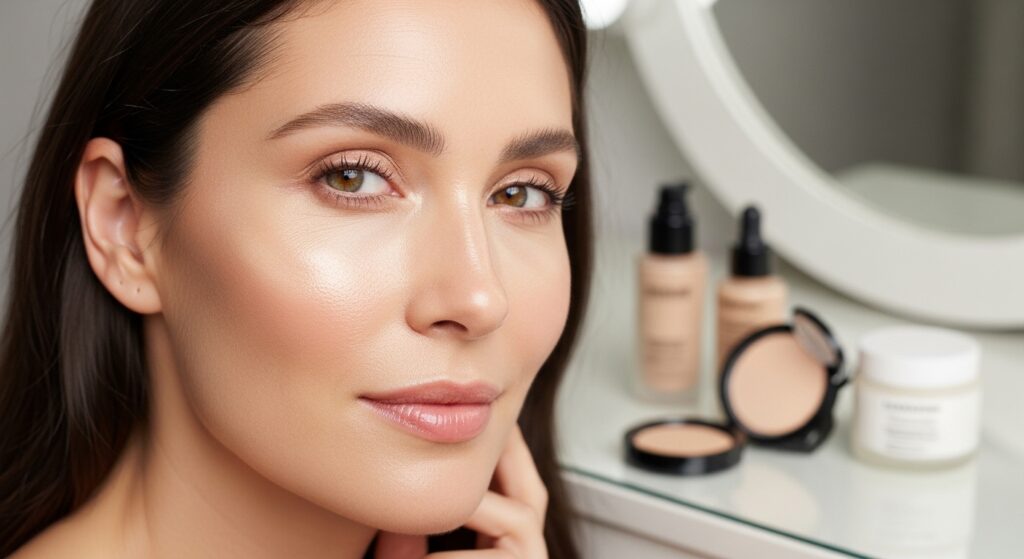
- Matte foundations enhance dryness — choose hydrating formulas.
- Apply cream-based highlighters instead of powders.
- Match makeup to skincare: a hydrating base under a hydrating foundation, and no powder on the driest areas.
Timelines as rough guides
- Surface hydration: can feel better in days.
- Texture refinement: weeks, not days.
- Retinoid and collagen support: around 3 to 6 months.
- Tone and radiance: gradual, over weeks to months.
These are rough guides, not promises. If a product promises a fixed result by a fixed date, that is a reason to distrust it.
When to simplify again
If irritation occurs:
- Decrease active ingredients.
- Return to simple hydration and barrier repair for two weeks.
- Gradually reintroduce treatments, one at a time.
Good skincare habits are flexible, not strict. A short routine you can keep is better than a long one you abandon.
Patch test before you commit
The American Academy of Dermatology recommends testing a new product before using it on your face. Apply the product to a quarter-sized patch of skin where it will not be rubbed or washed away — the underside of your arm or the bend of your elbow — twice a day for 7 to 10 days. For a rinse-off product such as a cleanser, leave it on for about five minutes, or as long as the label says, then rinse it off. If the test area becomes red, itchy, swollen or painful, stop using the product. If the area stays clear for the full 7 to 10 days, the product is less likely to cause a reaction on your face — but a patch test cannot guarantee it.
A 24-hour test can miss an allergic reaction, which often takes several days to appear — that is why this guide uses the AAD 7–10 day patch-test method.
When to get help
Ask a dermatologist or pharmacist if: your skin is persistently red, sore, swollen or blistering; you have a rash that does not settle; you have eczema, rosacea or acne that is getting worse; or a product you have used for a long time suddenly starts to sting. Bring the product with you, or a photo of its ingredient list — that is what a dermatologist needs to see.
FAQ
How often should dry dull skin be washed?
Once or twice a day with a mild, moisturising cleanser. Avoid hot water, which strips oils.
Can retinol be applied to dry dull skin?
Yes. Start with a low concentration, two times per week at night, buffered with moisturiser, and increase gradually. Do not use retinoids if you are pregnant or trying to become pregnant.
How frequently should dry dull skin be exfoliated?
Use a gentle chemical exfoliant such as lactic acid once or twice a week. Avoid harsh scrubs that damage the skin barrier.
Does diet affect dry dull skin?
Eating well supports your health, but no food or supplement has been shown to treat dry or dull skin. Hydration comes from topical care and a good moisturiser, not from drinking more water.
How soon will results be visible?
Hydration can feel better in days. Texture and radiance improve over weeks. Retinoid effects take 3 to 6 months. These are rough guides, not promises.
Summary
Dry skin lacks oil and dull skin reflects light poorly, and the two often appear together. The routine is short and gentle: a creamy cleanser that does not strip, hydrating products on damp skin, one serum at a time, a moisturiser with ceramides and glycerin, and broad-spectrum SPF 30+ every morning. Exfoliate gently once or twice a week with lactic acid, use retinoids slowly starting twice a week at night, and treat night as a practical time for richer products, not a repair window. Massage and tools are comfort aids, not treatments. Food, water, sleep and supplements support your health but are not skin treatments. Patch test every new product for 7 to 10 days, introduce one product at a time, and keep the routine short enough to keep.
Sources: American Academy of Dermatology, 7 Rosacea skin care tips (patch-test method: apply a new product to a quarter-sized patch of skin on the inside of the arm for 7–10 days); American Academy of Dermatology, How to select anti-aging skin care products (broad-spectrum sunscreen, SPF 30 or higher every morning, reapply every two hours outdoors). This is a researched overview, not a hands-on review.