
Researched overview. This guide is based on published dermatology guidance, not on hands-on product testing by BeautyKob. No product in this guide was tested by us, and no product or brand is recommended.
Table Of Content
- Quick answer
- What dry skin is
- How dry is your skin?
- The morning regimen
- Step 1: Cleanse without stripping
- Step 2: Hydrate on damp skin
- Step 3: One serum, not three
- Step 4: Moisturise
- Step 5: Sunscreen, every morning
- The night regimen
- Weekly care
- Gentle exfoliation
- Hydrating masks
- Adjusting by dryness severity
- Seasonal adjustments
- Common mistakes that worsen dry skin
- Food, water, sleep and stress — honestly
- Timelines as rough guides
- Patch test before you commit
- When to get help
- FAQ
- Summary
Quick answer
Dry skin lacks oil: it feels tight, flakes, and is easily irritated. The regimen that works is short and gentle: a creamy cleanser that does not strip, hydrating products applied to damp skin, a moisturiser that seals water in, one active at a time, and broad-spectrum sunscreen with SPF 30 or higher every morning. No expensive products are needed, and no fixed timeline is promised — hydration can feel better in days, texture takes weeks, and retinoids take months. This guide is general information, not medical advice.
Contents: What dry skin is · How dry is your skin? · The morning regimen · The night regimen · Weekly care · By dryness severity · Seasons · Common mistakes · Food, water, sleep and stress — honestly · Timelines as rough guides · When to get help · FAQ
What dry skin is
Dry skin produces less sebum (natural oil) than average, so it cannot hold water in as well. This is different from dehydrated skin, which lacks water but can still produce oil. The skin barrier — the outer layer that keeps water in and irritants out — is often weaker in dry skin, which is why gentle cleansing and moisturising matter more than any single active ingredient.
Common signs are: tightness after washing, flaky or rough patches, makeup settling into dry spots, and skin that stings after new products. Genetics play a large part — some people are simply born with skin that produces less oil. Cold weather, low humidity, indoor heating, pollution, harsh soaps and alcohol-heavy products all make dryness worse. Oil production also falls with age.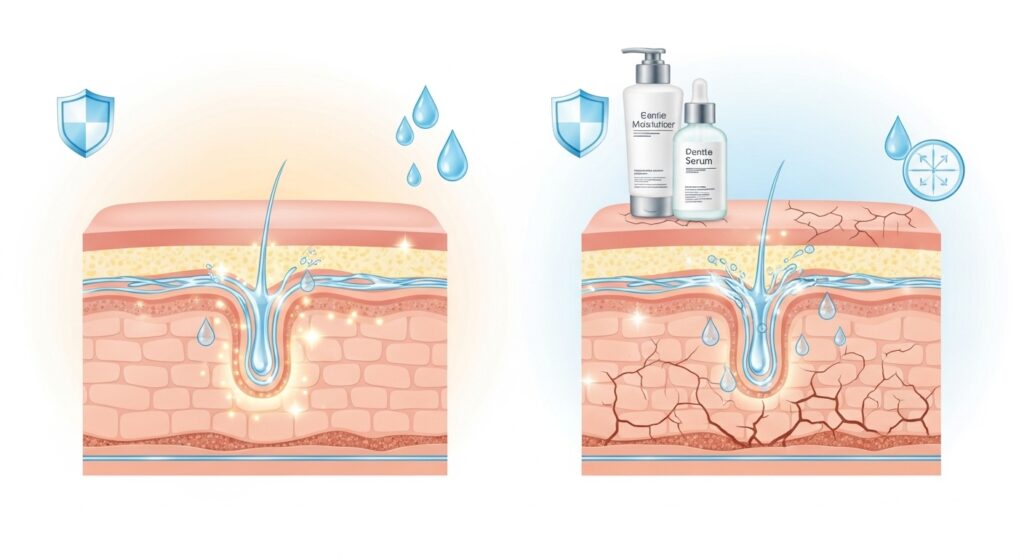
How dry is your skin?
Not all dry skin needs the same care. Work out where you sit before choosing products:
| Severity | What it feels like | What to prioritise |
|---|---|---|
| Mildly dry | Tight after washing, comfortable once moisturised | A gentle cleanser and a light-to-medium moisturiser; no heavy creams needed |
| Very dry or flaky | Flaking, rough patches, skin feels tight most of the day | A richer cream with ceramides and glycerin; fewer actives; gentle exfoliation once a week at most |
| Sensitive dry | Stings easily, turns red after new products, reacts to fragrance | The shortest routine you can manage — cleanser, moisturiser, sunscreen; fragrance-free everything; patch test every new product |
If your skin is persistently red, sore, cracked, blistering, or you have a diagnosed condition such as eczema that is getting worse, ask a dermatologist or pharmacist before trying new products.
The morning regimen
Step 1: Cleanse without stripping
Wash with lukewarm water and a gentle cleanser. Harsh cleansers strip the little oil dry skin has and leave it tighter. Creamy or lotion-based formulas suit dry skin best because they do not disturb the barrier. After cleansing, the skin should feel comfortable, not tight — if it feels squeaky clean, the cleanser is too strong for you.
Step 2: Hydrate on damp skin
Apply hydrating products while the skin is still slightly damp, which helps trap water inside. Look for hydrating toners or essences with hyaluronic acid, panthenol or glycerin — these draw water to the skin. Layer light hydrating products instead of one thick product: a hydrating toner, then a serum, then moisturiser.
Step 3: One serum, not three
Serums are concentrated treatments. For dry skin, pick one to start with:
- Hyaluronic acid: attracts water to the skin, giving fullness and smoothing. Always pair it with a moisturiser, or the water it draws in can escape again.
- Niacinamide for barrier support: supports the skin barrier and can reduce redness, without irritation. Per Draelos 2006, niacinamide is a well-studied barrier-supporting ingredient.
- Vitamin C for uneven tone: an antioxidant that can help the look of uneven tone over time. Use it in the morning. Start with a low concentration if your skin is sensitive.
Step 4: Moisturise
Hydration means water in the skin; moisture means the oil that seals that water in. Dry skin needs both. A good moisturiser has three parts: humectants to attract water, emollients to smooth the surface, and occlusives to lock everything in. Ceramides matter most here, because they are lipids that occur naturally in the skin barrier. In the morning, a lighter hydrating formula under sunscreen is usually enough.
Step 5: Sunscreen, every morning
Sun damage breaks down collagen and worsens uneven tone, so no routine is complete without it. Use a broad-spectrum sunscreen with SPF 30 or higher every morning as the last step of your routine, and reapply every two hours when outdoors. Choose a moisturising sunscreen if your skin is dry — a hydrating formula does not have to feel heavy. Sunscreen protects against UV damage; it does not by itself prevent moisture loss.
The night regimen
Night is a practical time for richer products because you are not putting makeup or sunscreen over them — not because the skin has a special repair window at night.
- Cleanse gently. Evening cleansing removes the day’s sunscreen, pollution and sweat. Use the same gentle cleanser as the morning; do not use a foaming or alcohol-based wash that leaves the skin tight.
- One repair-focused serum, if you use one. A hydrating or barrier-supporting serum is enough. Do not add several actives at once.
- A richer cream. Night creams are richer because they do not have to sit under makeup. Occlusive ingredients lock moisture in overnight, so you wake up with softer skin. If your skin feels tight in the morning, your night cream is probably not rich enough.
- Retinoids, used slowly. Retinoids are the strongest topical ingredients for fine lines and uneven texture, but they are also the easiest to overuse on dry skin. Start low, twice a week at night, buffered with moisturiser. Increase gradually only if the skin stays comfortable. Texture improves over weeks, and retinoid effects on fine lines take 3 to 6 months. Do not combine a retinoid with a strong exfoliant on the same night when starting out. Do not use retinoids if you are pregnant or trying to become pregnant, and ask a doctor first if you are breastfeeding.

Weekly care
Gentle exfoliation
Dry skin still needs exfoliation, but less often and more gently. Dead skin cells build up and block radiance, but aggressive scrubbing damages the barrier further. Once a week is usually enough:
- Use a mild chemical exfoliant. Lactic acid once a week hydrates while it exfoliates, and is gentler than a scrub. Polyhydroxy acids are another gentle option.
- Avoid harsh scrubs. They irritate and damage the barrier and increase dryness.
- Watch for over-exfoliation. Burning, increased redness, more dryness or breakouts after exfoliating are signs to stop. Go back to a gentle cleanser, moisturiser and sunscreen only until the skin feels normal again.
Exfoliation removes dead cells from the surface. It does not make the skin absorb other products better — that claim has no good evidence behind it.
Hydrating masks
Moisture-filled masks restore dry skin and are particularly useful when the seasons change or the skin is stressed. Use them once a week or when needed. They add comfort and hydration; they are not a treatment in themselves.
Adjusting by dryness severity
- Mildly dry: a balanced routine is enough — gentle cleanser, hydrating layers, a light-to-medium moisturiser, sunscreen. No heavy creams needed.
- Very dry or flaky: prioritise barrier repair. Use richer creams, keep actives to a minimum, and exfoliate once a week at most. If cracking or irritation does not settle, ask a dermatologist.
- Sensitive dry: keep the routine as short as possible — cleanser, moisturiser, sunscreen. Avoid fragrance and strong ingredients, and focus on calming hydration. Introduce one new product at a time, and patch test it first (see below).
Seasonal adjustments
- Winter: cold air and indoor heating strip moisture quickly. Use a richer moisturiser, exfoliate less often, and add a few drops of facial oil on top of moisturiser in the evening if needed. Oil seals moisture in; water moisturises and oil seals — oil on its own does not hydrate.
- Summer: humidity can ease tightness, but sun exposure risks pigmentation. Use lighter textures, keep hydration up, and be strict about sunscreen.
Common mistakes that worsen dry skin
- Over-cleansing and over-exfoliating. Too much washing or scrubbing breaks the barrier down and makes skin more sensitive, not cleaner.
- Skipping sunscreen. UV damage worsens uneven tone and breaks down collagen, and it undermines an otherwise good routine.
- Using products meant for oily skin. Foaming washes and oil-control products strip the little oil dry skin has. Regular use leaves dry skin tender and weak.
- Switching products every few days. You never learn what helps and what harms. Introduce one product at a time.
- Skipping moisturiser because the skin “seems fine in summer.” Dry skin still needs barrier support year-round.
Food, water, sleep and stress — honestly
- Food. A balanced diet supports your health, but no food has been shown to treat dry skin, and no diet is a skin treatment.
- Water. Drinking enough water is good for your health, but drinking water does not directly hydrate your skin. If your skin feels tight despite good topical care, the answer is a better moisturiser, not more water.
- Sleep and stress. Poor sleep is associated with worse-looking skin — one small study (Oyetakin-White et al. 2015, 60 women) found poor sleepers had roughly double the intrinsic ageing score and about 30% slower barrier recovery at 72 hours — but it was small, observational and funded by a cosmetics company, so it shows an association, not proof. Aim for 7 or more hours of sleep a night, as the CDC recommends for adults, because it is good for your health, not because sleep is a skin treatment.

Timelines as rough guides
- Less tightness and flaking: can feel better in days to a couple of weeks.
- Texture: improves over weeks.
- Retinoid effects on fine lines: around 3 to 6 months.
- Tone and radiance: gradual, over weeks to months.
These are rough guides, not promises. If a product promises a fixed result by a fixed date, that is a reason to distrust it. Dry skin does not speed up ageing — but dry skin makes fine lines look more visible, which is why hydration and sunscreen matter.
Patch test before you commit
The American Academy of Dermatology recommends testing a new product before using it on your face. Apply the product to a quarter-sized patch of skin where it will not be rubbed or washed away — the underside of your arm or the bend of your elbow — twice a day for 7 to 10 days. For a rinse-off product such as a cleanser, leave it on for about five minutes, or as long as the label says, then rinse it off. If the test area becomes red, itchy, swollen or painful, stop using the product. If the area stays clear for the full 7 to 10 days, the product is less likely to cause a reaction on your face — but a patch test cannot guarantee it.
A 24-hour test can miss an allergic reaction, which often takes several days to appear — that is why this guide uses the AAD 7–10 day patch-test method.
When to get help
Ask a dermatologist or pharmacist if: your skin is persistently red, sore, swollen or blistering; you have a rash that does not settle; you have eczema, rosacea or acne that is getting worse; or a product you have used for a long time suddenly starts to sting. Bring the product with you, or a photo of its ingredient list — that is what a dermatologist needs to see.
FAQ
What is the best daily face regimen for dry skin?
A routine focused on gentle cleansing, hydration, moisturisation, and daily sun protection works best when followed consistently. There is no single “best” regimen — the right one depends on how dry and how sensitive your skin is.
Can dry skin become oily if over-moisturised?
Dry skin does not turn oily, but overly heavy products can feel greasy. Choosing the right textures prevents discomfort.
How often should dry skin be exfoliated?
Once a week with a gentle chemical exfoliant such as lactic acid is usually enough. Avoid harsh scrubs that damage the skin barrier.
Is facial oil necessary for dry skin?
Facial oils can help seal in moisture, but they are optional and work best layered over hydration. Oil seals; water moisturises.
Can dry skin improve?
Yes. Dry skin is a skin type, but its condition can improve significantly with consistent, supportive care. It is not a promise of a permanent change — it needs ongoing care.
Summary
Dry skin lacks oil and needs barrier-focused care: a creamy cleanser that does not strip, hydrating products on damp skin, one serum at a time, a moisturiser with ceramides and glycerin, and broad-spectrum SPF 30+ every morning. At night, use a richer cream and introduce retinoids slowly, twice a week, buffered with moisturiser. Exfoliate gently once a week with lactic acid. Match the routine to how dry your skin is — mild, very dry, or sensitive dry — and adjust for the seasons. Food, water and sleep support your health but are not skin treatments. Patch test every new product for 7 to 10 days, introduce one product at a time, and keep the routine short enough to keep.
Sources: American Academy of Dermatology, 7 Rosacea skin care tips (patch-test method: apply a new product to a quarter-sized patch of skin on the inside of the arm for 7–10 days); American Academy of Dermatology, How to select anti-aging skin care products (broad-spectrum sunscreen, SPF 30 or higher every morning, reapply every two hours outdoors). This is a researched overview, not a hands-on review.