Researched overview. This guide is based on published dermatology guidance, not on hands-on product testing by BeautyKob. No product in this guide was tested by us, and no brand is recommended.
Table Of Content
Quick answer
Dry skin shows fine lines more than well-hydrated skin does, because dehydrated skin looks less plump and reflects light less evenly. A good serum can make skin look and feel better — softer, smoother, more comfortable — but no serum removes wrinkles, rebuilds collagen on a schedule, or turns back ageing.
What helps most, in order:
- Sunscreen, every day. Daily broad-spectrum SPF 30+ is the single most effective step against new visible ageing. In one long trial, people who used sunscreen daily had 24% less skin ageing over 4.5 years than people who used it only when they thought of it (Hughes et al. 2013).
- Barrier repair first. For dry skin, a serum that hydrates and supports the skin barrier is worth more than a strong active used on a damaged barrier.
- One active at a time. A retinoid is the strongest topical option for fine lines, but it takes 3–6 months of steady use, and it can irritate dry skin badly if introduced too fast.
- Realistic expectations. Peptides and most “firming” ingredients have thin evidence. A serum that promises to lift, firm or erase lines is promising more than the evidence supports.
If your skin is red, sore, or has open sores or a rash, ask a dermatologist or pharmacist before using any active. This guide is general information, not medical advice.
Contents: Why dry skin shows lines more · What actually helps · How to choose a serum · How to use it · Starting a retinoid safely · Mistakes · Environment · Lifestyle · FAQ
Why dry skin shows lines more
Skin has a barrier — a layer of skin cells held together by lipids (fats) including ceramides — that keeps water in and irritants out. With age, the skin makes less oil and fewer ceramides, and the barrier holds water less well. Water escapes from the skin (transepidermal water loss), the surface dries out, and fine lines look deeper than they are.
That is why hydration matters so much for dry skin. It does not mean most wrinkles are “just dehydration” — real collagen loss happens with age and sun exposure, and no moisturiser reverses it. But a well-hydrated surface looks smoother and more comfortable, and a repaired barrier tolerates active ingredients better.
What actually helps
| Ingredient | What it does | What the evidence says |
|---|---|---|
| Hyaluronic acid | Humectant — draws water into the outer skin | Well established for temporary hydration. It sits mainly in the outer layers, which is where it does its work. It is not a moisturiser on its own. |
| Glycerin | Humectant — draws and holds water in the outer skin | Well established (Fluhr et al. 2008). Glycerin and hyaluronic acid are complementary, not competing — most good moisturisers contain both. |
| Ceramides | Lipids that support the skin barrier | Support barrier repair and help skin hold water. No published evidence for a specific percentage a product must contain. |
| Squalane | Lightweight oil that softens and seals in moisture | A reasonable occlusive for dry skin; light enough that it does not usually feel heavy. |
| Retinol / retinaldehyde | Vitamin A forms that speed cell turnover | The strongest topical option for fine lines, but slow — 3–6 months of steady use — and irritating if introduced too fast. Retinaldehyde converts to retinoic acid in one step, so it is often described as gentler than retinol; it can still irritate. |
| Peptides | Short chains of amino acids | Thin evidence. No published evidence that a peptide serum raises collagen or prevents sagging. |
| Vitamin C | Antioxidant | A cofactor for the enzymes that build collagen, and an antioxidant (AAD cosmeceuticals review). That biochemical role does not mean a given serum will visibly change your skin. |
| Lactic acid | Gentle exfoliant and humectant | Can smooth rough texture and draw in water. Use sparingly on dry skin — once or twice a week at most. |
 No ingredient in this table is “the best” for everyone. For dry skin, the combination that matters is a humectant plus a barrier lipid plus an occlusive, used consistently — not a single hero ingredient.
How to choose a serum
Check the label, not the marketing:
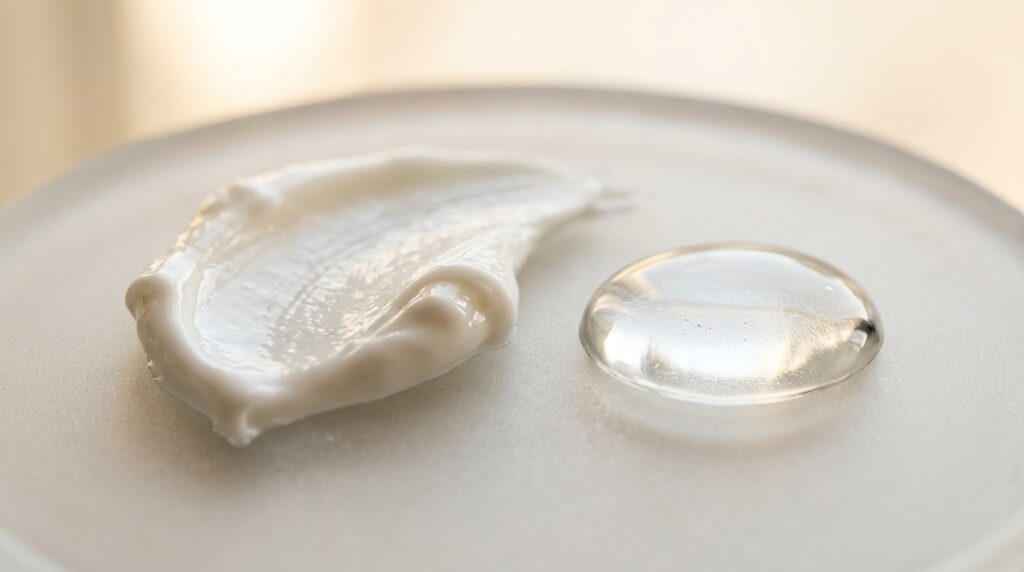
- Texture. Milky emulsions and lightweight oil-serum hybrids usually feel better on dry skin than thin watery fluids, because they contain lipids as well as water. Texture is a preference, not a rule — what matters is that you will use it every day.
- One active, not five. A serum with one well-chosen active (for example a low-strength retinoid, or vitamin C) is easier to tolerate than a product that combines several strong actives.
- Fragrance. Strong fragrance and drying alcohols can irritate dry, mature skin. Fragrance-free is the safer choice.
- Packaging. Vitamin C and retinoids break down in air, light and heat. Opaque or airless packaging helps; a product that has turned dark brown should be replaced.
- Price. Price alone does not tell you whether a serum is well formulated. A simple, well-made serum can cost less than a heavily marketed one.
Do not buy a serum because of a percentage on the front of the bottle, a “clinical wear time”, or a “best of” list. No ranking in this guide is based on testing, and no brand is recommended.
How to use it
Morning:
- Cleanse gently with lukewarm water and a mild, creamy cleanser. Avoid alcohol-based toners and strong astringents — they strip the barrier dry skin can least afford to lose.
- Serum on slightly damp skin. Wash, pat lightly so the skin is still slightly damp, then apply the serum. Hydrating ingredients absorb better on damp skin than on a completely dry face. (There is no verified percentage for how much better — it is a technique, not a measured result.)
- Moisturise. A serum is not a moisturiser. Seal it in with a cream that contains ceramides, glycerin or squalane.
- Sunscreen — always. Broad-spectrum SPF 30 or higher, every morning, including on cloudy days. The AAD recommends reapplying every two hours when outdoors.
Evening: the same steps, without sunscreen. If you use a retinoid, use it at night — see the section below.
Layering order: thinnest to thickest — cleanser, water-based serum, moisturiser, then a heavier cream or a drop of oil if your skin still feels tight. Do not put a thick occlusive on before a water-based serum; it will block it.
Starting a retinoid safely
Retinoids are the strongest topical option for fine lines, and the most likely to irritate dry skin. Start slowly:
- Patch test first. Apply a small amount to a quarter-sized area on the underside of your arm or the bend of your elbow, twice a day, for 7–10 days. If there is redness, itching or swelling, do not use it on your face. (AAD patch-test method.)
- Start low and slow. A low-strength retinol, two or three nights a week, a pea-sized amount for the whole face. Build up only if your skin stays comfortable.
- Sandwich it. Apply moisturiser first, then the retinoid, then moisturiser again — this reduces irritation.
- Expect 3–6 months before judging fine lines. Hydration improves in days to weeks; fine lines take months, and the change is usually subtle.
- Do not use retinoids if you are pregnant or trying to become pregnant. Topical retinoids are not suitable in pregnancy (NHS guidance). Ask a clinician first.
- Stop and simplify if your skin becomes red, flaky or sore. Pushing through severe irritation works against you.
Do not combine a retinoid with a strong exfoliant on the same night when you are starting out.
Mistakes to avoid
- Starting with the strongest product available. Strength is not the same as effectiveness, and it is the fastest route to a damaged barrier.
- Using several strong actives at once. Retinol, a strong acid exfoliant and vitamin C together are a common cause of irritation. Introduce one thing at a time, weeks apart.
- Exfoliating too often. Removing dead skin can help serums absorb, but scrubbing or using strong acids several times a week strips the barrier. Once or twice a week of gentle chemical exfoliation is usually enough for dry skin. Physical scrubs should be gentle and infrequent.
- Using hyaluronic acid alone in dry air. A humectant without a moisturiser on top can leave skin feeling tight, because there is nothing to seal the water in. Always follow with a cream.
- Skipping sunscreen. UV light undoes the work of every other step.
- Storing serums in a warm, steamy bathroom. Heat and light break down vitamin C and retinoids. Keep them in a cool, dark place.
Environment
Indoor heating and cold, dry air make dry skin worse. A small bedside humidifier is a reasonable practical option in winter, and a heavier occlusive cream is usually needed in cold months. These help comfort and hydration; they do not repair skin on their own.
Lifestyle, honestly
Diet and sleep support general health, and healthy skin depends on general health — but neither is a treatment for dry or ageing skin. Eating foods rich in healthy fats and drinking enough water are sensible habits; they do not “manufacture sebum from the inside out” or cure a dry face. Aim for 7 or more hours of sleep a night, which is the usual adult recommendation, and do not expect a pillowcase — silk or otherwise — to change your skin.
Smoking and heavy alcohol use work against skin health and against every product in a routine.
FAQ
Can I use hyaluronic acid alone?
It will hydrate the surface, but on dry skin it usually feels better with a moisturiser on top to seal the water in. Without that step, skin can feel tight, especially in dry air.
How long until I see fewer wrinkles?
Hydration can make fine lines look softer within days to weeks. Real change in fine lines from a retinoid takes 3–6 months of steady use, and the change is usually subtle. No serum removes wrinkles.
What serum texture works best for dry skin?
Milky emulsions and lightweight oil-serum hybrids are usually the most comfortable, because they combine water and lipids. But texture is personal — the best serum is the one you will use every day without irritation.
Does drinking water cure a dry face?
No. Drinking enough water supports basic body functions, but very little of it reaches the outer skin directly. Topical humectants and moisturisers are what fix surface dryness.
Why does my serum pill under makeup?
Pilling usually happens when a thick water-based serum has not fully absorbed before foundation, or when a silicone-based primer clashes with it. Wait a few minutes between skincare and makeup.
Summary
For dry, ageing skin: repair the barrier first, use one active at a time, wear sunscreen every day, and judge a retinoid after 3–6 months — not after two weeks. No serum in this guide was tested by us, no brand is recommended, and no result is promised.
Sources: AAD sunscreen guidance; AAD cosmeceuticals review on vitamin C; Hughes et al. 2013 (daily sunscreen, 24% less skin ageing over 4.5 years); Fluhr et al. 2008, British Journal of Dermatology (glycerol and skin); NHS guidance on topical retinoids in pregnancy; AAD patch-test method. This is a researched overview, not a hands-on review.