Researched overview. This guide is based on published dermatology guidance, not on hands-on product testing by BeautyKob. No product in this guide was tested by us, and no product or brand is recommended.
Table Of Content
- Quick answer
- What smooth skin really is
- Why skin gets rough
- Find your kind of roughness
- Why random products fail
- The skin barrier first
- Three principles
- Morning routine
- Evening routine
- Weekly habits
- Ingredients that help
- Layering without damaging texture
- Texture issues by type
- Lifestyle — what actually helps
- How long it takes
- When skin care is not enough
- Patch testing
- When to see a dermatologist
- FAQ
- Summary
Quick answer
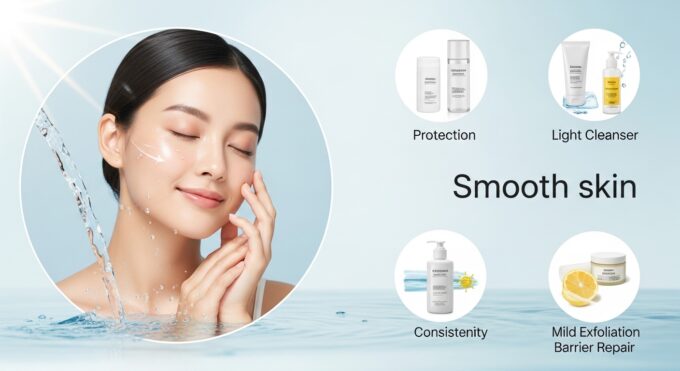
Smooth skin is not poreless skin, and it is not shiny skin. Smooth skin feels even, looks balanced in different lighting, and recovers quickly after stress. It comes from three things working together: hydration, steady cell turnover, and a strong skin barrier. When one of them is missing, texture shows.
The fix is not more products. Most people who struggle with rough skin are already using too much — harsh scrubs, strong actives layered together, a new routine every few weeks. That combination irritates the skin, weakens the barrier, and makes texture worse. A short, gentle, steady routine does more: cleanse softly, hydrate, moisturise, protect with sunscreen every morning, and exfoliate once or twice a week at most. Improvement is gradual — hydration can feel better within days, but visible texture change takes weeks to months of steady care, and the timing varies from person to person. This guide is general information, not medical advice.
Contents: What smooth skin really is · Why skin gets rough · Find your kind of roughness · Why random products fail · The skin barrier first · Three principles · Morning routine · Evening routine · Weekly habits · Ingredients that help · Layering without damaging texture · Texture issues by type · Lifestyle · How long it takes · When skin care is not enough · Patch testing · When to see a dermatologist · FAQ
What smooth skin really is
Smooth skin does not mean skin with no pores and no lines. Pores are normal, and so are fine lines with age. Healthy smooth skin feels even to the touch, reflects light evenly, and does not sting or flake when you use a mild product.
Texture is not only how skin looks — it is also how skin behaves. Skin that is well hydrated and has a strong barrier sheds dead cells evenly and holds moisture. Skin that is dry, irritated or over-treated sheds unevenly, and the surface feels rough and looks dull. That is why the same product can seem to work for one person and fail for another: the background condition of the skin decides the result.
Why skin gets rough
Roughness has several causes, and they are not your fault. The common ones are:
- Build-up of dead skin cells. Skin sheds old cells naturally. When shedding slows, dead cells stay on the surface, and skin feels rough and looks dull.
- Dehydration. Without water in the skin, there is no flexibility. Dry skin scatters light unevenly, which makes texture and fine lines look worse.
- A weak skin barrier. When the barrier is damaged, skin loses moisture faster and becomes more sensitive. The result is irritation, peeling and roughness.
- Clogged pores. Oil, dead cells and debris collecting in pores make the surface bumpy, even without acne.
- Past acne. Post-acne texture changes and acne scars interfere with smoothness and need time to improve.
- Sun exposure. Ultraviolet damage destroys collagen and thickens the surface layer of the skin, which makes texture more noticeable.
- Age. Ageing naturally reduces collagen and slows cell turnover. That is normal, but it means skin needs more support over time.
Most people have a combination of these. That is normal. The aim is not to remove every flaw, but to make the overall surface smoother and more comfortable.
Find your kind of roughness
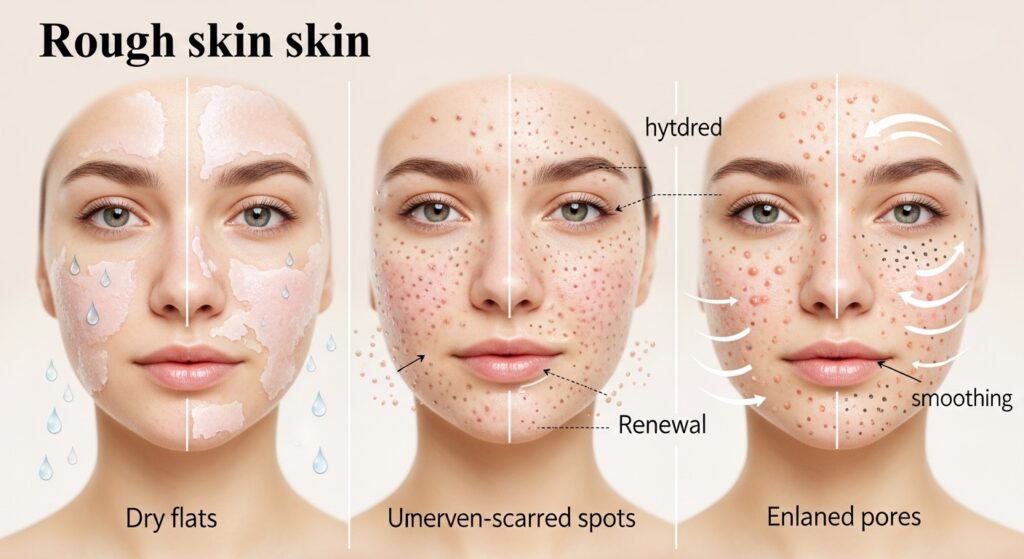
Do not treat all roughness the same way. Work out which kind you have first:
- Dry roughness. Skin feels tight, flaky and uncomfortable. This kind often improves quickly once hydration and barrier repair are in place.
- Bumpy texture. Small bumps, usually on the cheeks or forehead. This is normally linked to clogged pores or uneven shedding of cells.
- Acne scars. Uneven texture that feels different in different places — shallow in one spot, deeper in another. This kind needs time and gentle care; a routine alone will not remove deep structural damage.
- Large pores. An uneven appearance, particularly in the T-zone. This kind tends to improve with oil balance and regular care, not with harsh scrubbing.
A combination of these is common. Knowing the kind matters, because the wrong choice wastes months — brightening products alone on a deep dip will disappoint, and strong exfoliation on weak skin causes irritation that slows healing.
Why random products fail
Many people try to fix rough skin by adding more products: a stronger scrub, a potent active, a new routine every few weeks. That usually backfires.
Skin needs time to adjust. Constant changes confuse the skin and weaken the barrier. Exfoliation can feel effective at first, but overused it provokes inflammation, and inflammation increases texture over time. A simple, regular routine beats a complex one, because balanced skin is what becomes smooth.
The skin barrier first
The skin barrier is the outer layer that holds moisture in and keeps irritants out. When it is healthy, skin is soft, supple and resilient. When it is damaged, texture is rough and unpredictable.
The signs of a weak barrier are stinging from mild products, redness, tightness and flaking. When you see them, smoothing treatments will not work until the barrier is fixed. Repair the barrier first — gentle cleansing, hydration, moisturiser, sunscreen — then add anything else. Barrier repair improves smoothness indirectly, by letting the skin hold water and shed dead cells evenly.
Three principles
Three principles sit under everything that follows:
- Gentleness. Harsh treatment causes inflammation, and inflammation increases texture. Light, steady care lets skin recover.
- Consistency. A few simple things done daily work better than vigorous treatments done occasionally.
- Protection. Sun exposure, pollution and friction all affect texture. Protecting the skin protects the gains.
When these guide the routine, smoothness becomes possible.
Morning routine
Morning care sets up the day. It should maintain hydration, comfort and protection.
- Cleanse gently. Lukewarm water and a mild cleanser. Do not use a cleanser that leaves skin tight or squeaky — if skin feels dry right after washing, the cleanser is too strong.
- Hydrate. Apply light hydrating products to slightly damp skin. Hydrated skin looks plumper and reflects light more evenly, which softens the look of roughness.
- Moisturise. Moisturiser traps hydration and reinforces the barrier. This step matters even for oily skin — without moisturiser, skin can react by producing more oil or becoming irritated. Choose a daytime moisturiser that feels comfortable: skin should feel smooth, neither greasy nor tight.
- Sunscreen — every morning. Use a broad-spectrum sunscreen with SPF 30 or higher as the last step, and reapply every two hours when outdoors, or after swimming or sweating. Sun exposure is one of the largest enemies of smooth skin: UV damage thickens the surface layer and destroys collagen. You cannot skip this step if you want lasting smoothness.
Evening routine
Evening care is about removing build-up and supporting renewal — not because the skin has a special repair window at night, but because the evening is the practical time for it, and because treatments that increase sun sensitivity belong at night.
- Cleanse gently. Remove sunscreen, pollution and dirt completely but lightly. Excessive scrubbing damages the barrier and makes the surface rougher. When skin feels calm after cleansing, you are doing it right.
- Treatment, if you use one. One active at a time, introduced slowly. Gentle renewal products refine texture over time; they are not used aggressively. If skin stings, flakes or feels sensitive, reduce the frequency.
- Moisturise. Seal in moisture. A slightly richer cream at night is fine.
There is no need for powerful treatments every night to improve texture. Repair happens gradually, and steady care is what produces it.
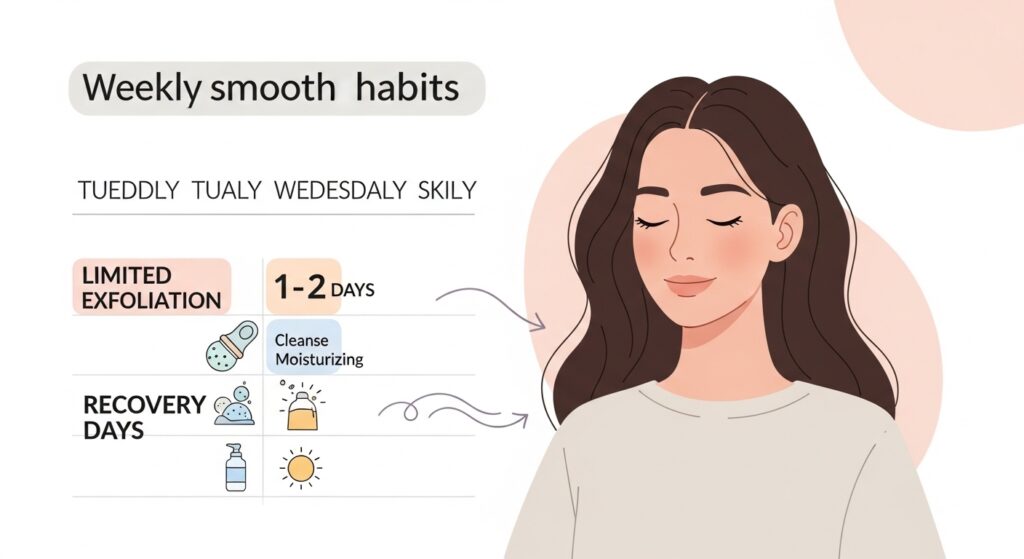
Weekly habits
Daily habits matter most, but weekly habits sharpen texture:
- Controlled exfoliation — once or twice a week at most. Exfoliation should be supportive, not painful. Most skin types need no more than once or twice a week. Beyond that, irritation is more likely than improvement. If skin feels less coarse one day and coarse the next, exfoliation is probably too frequent or too strong.
- Recovery days. Days with only cleansing, moisturising and protection — no actives. Recovery days let the barrier rebuild. Smooth skin is never achieved without them.
- Facial massage (optional). Light, gentle massage can feel relaxing and reduce the look of puffiness. It does not drain lymph, firm skin, or deliver nutrients to the skin — those claims have no good evidence. Keep pressure light; aggressive pulling stretches skin and worsens texture over time.
Ingredients that help
Ingredients matter only when the background is right. Strong ingredients on swollen or dry skin hardly give a smooth effect — they tend to make things rougher. With calm, hydrated skin, they can work as expected.
| Ingredient | What it does | What to know |
|---|---|---|
| Sunscreen (SPF 30+, broad-spectrum) | Stops UV damage that thickens skin and destroys collagen | The most important step for texture; reapply every two hours outdoors |
| Retinoids (retinol over the counter; stronger retinoids by prescription) | Speed up skin cell turnover and support collagen; can help mild texture change and uneven tone | Strongest topical for texture; start slow (2–3 nights a week, pea-sized), expect dryness at first, use at night, wear sunscreen daily; do not use during pregnancy |
| Vitamin C | Antioxidant; can help the look of uneven tone over time | Formulation and stability matter; store away from light and heat; replace if it turns dark brown |
| Niacinamide | Supports the skin barrier; can help the look of redness and uneven texture | Usually well tolerated; a good first active for sensitive skin (Draelos 2006, PMID 16766489) |
| Hyaluronic acid and glycerin | Humectants — draw water into the skin so it looks plump and smooth | Use on damp skin, under moisturiser. Hydration, not a treatment on its own |
| Ceramides and squalane | Support the barrier and help hold moisture in | Common, well-tolerated ingredients in moisturisers |
| Peptides | Marketed as supporting collagen and firmness | The evidence for peptide products improving skin is limited and mostly comes from small or manufacturer-funded studies. Not a proven substitute for retinoids or sunscreen |
No ingredient is named as a recommendation for any individual here. Ingredients that support collagen are slow-acting: they do not give overnight smoothness, but after regular use over months the skin can become firmer and more even.
Layering without damaging texture
Layering is where many routines fail. Too many products, or products used in the wrong order, can block pores, irritate the skin and make it rougher.
- Apply products from thinnest to thickest texture. Let one layer settle before the next.
- Do not rush — uneven absorption and surface build-up follow.
- Keep active treatments mostly at night. Morning routines should focus on hydration and protection.
- Do not combine several strong actives in one routine. Skin responds better to one clear step at a time.
Texture issues by type
- Dry skin. Hydration first. Do not exfoliate dry skin aggressively — it makes it rougher. Focus on moisture, barrier recovery and gentle renewal. As soon as hydration improves, texture softens.
- Oily skin. Oily skin still needs water. Without it, oil production increases, pores block and bumps form. A balance of water and light cleansing flattens oily skin over time.
- Bumpy forehead or cheeks. Bumps usually come from blocked pores or irregular cell turnover. Light shedding and hydration work better than rough scrubs. Do not use heavy products that sit on the surface and cover the pores.
- Acne-scarred skin. Scars take time. Gentle renewal, hydration, collagen support and sun protection improve their look slowly. Do not resort to aggressive treatment without specialist advice — even a slow improvement is an improvement.
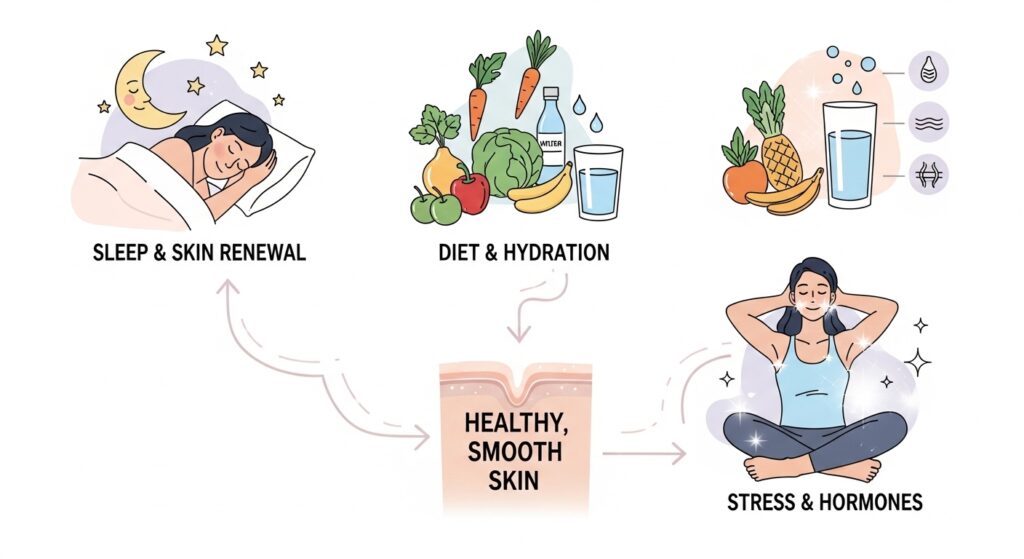
Lifestyle — what actually helps
- Sleep. Skin heals while you sleep, and lack of sleep heightens inflammation and slows healing. Adults need 7 or more hours a night (CDC). Regular sleep patterns help more than occasional long rests.
- Diet and hydration. Drinking enough water helps skin elasticity, but moderation matters more than abundance. A varied diet supports repair, but no specific food has been shown to make skin smooth, and no food or supplement is a treatment for texture.
- Stress. Stress causes inflammation and can lead to breakouts, which create new texture problems. Managing stress helps skin indirectly.
How long it takes
There is no fixed schedule, and anyone who gives one is guessing. As a rough guide, with a steady routine:
- First weeks: better hydration and softer-feeling skin.
- Months: texture starts to look more even, and shallow roughness softens. The timing varies from person to person.
- Six months and beyond: gradual, small improvements in firmness and resilience.
That timeline is normal. Anyone who promises smooth skin instantly is not being honest about how skin works.
When skin care is not enough
Sometimes texture problems are deep or long-standing. If there is little change after six to nine months of consistent care, it may be worth discussing professional treatments with a dermatologist. Even then, skin care still matters — a good routine prepares the skin for treatment and helps maintain the results afterwards.
A dermatologist can discuss options matched to the problem, such as chemical peels, microneedling, laser resurfacing or other procedures. These are medical decisions for a doctor, not choices from a skincare article, and they carry their own risks — especially for darker skin, where heat-based treatments raise the chance of post-inflammatory hyperpigmentation.
Patch testing
Patch test any new product before using it on your face. The AAD’s method is: apply the product to a quarter-sized patch of skin on the inside of your arm or the bend of your elbow, twice a day for 7 to 10 days. The AAD recommends this length because allergic reactions can take several days to appear, and a 24-hour test can miss them. If the patch becomes red, itchy, swollen or blistered, do not use the product on your face.
When to see a dermatologist
See a dermatologist if: texture does not improve after six to nine months of consistent care; skin keeps reacting to products; breakouts are deep, painful or scarring; or you are considering any in-clinic treatment. A dermatologist can check whether what you have is a texture problem at all, and can discuss prescription options and procedures that are not available over the counter.
FAQ
How long does it take to make skin smooth?
Hydration and softness can improve within one to two weeks. Visible texture improvement usually takes months of steady care, and deeper change takes six months or more. There is no fixed date by which any skin will be smooth.
Can rough skin become smooth naturally?
Yes. Smoother skin can come from proper hydration, light exfoliation, barrier repair and sun protection, without harsh treatments. No routine can prevent ageing or erase deep texture change.
My skin is still rough when I moisturise it.
This usually happens where skin is dry underneath the surface, or where dead cells are not shedding as they should. Gentle renewal and barrier support are needed alongside moisturising — moisturiser alone cannot fix either problem.
Does it need exfoliation to get skin smooth?
Exfoliation helps shed dead cells, but it must be moderate. Over-exfoliation damages the barrier and can worsen texture. Most people need no more than once or twice a week.
Can oily skin also feel rough?
Yes. Even oily skin can be dehydrated, which clogs pores and makes texture bumpy. Cleansing and hydration are what smooth oily skin — not drying it out further.
Summary
Smooth skin is even texture, hydration and a strong barrier — not poreless skin. Find your kind of roughness first, repair the barrier, then add one gentle active at a time. Cleanse softly, hydrate, moisturise, wear broad-spectrum SPF 30+ every morning, and exfoliate once or twice a week at most. Do not chase quick fixes or fixed dates: hydration can feel better within days, but visible texture change takes months. Patch test new products for 7 to 10 days. If texture does not improve after six to nine months, or if skin keeps reacting, see a dermatologist.
Sources: American Academy of Dermatology, 7 Rosacea skin care tips (patch-test method: apply a new product to a quarter-sized patch of skin on the inside of the arm for 7–10 days); American Academy of Dermatology, How to select anti-aging skin care products (broad-spectrum sunscreen, SPF 30 or higher, reapply every two hours outdoors). This is a researched overview, not a hands-on review.