
Researched overview. This guide is based on published dermatology guidance, not on hands-on product testing by BeautyKob. No product in this guide was tested by us, and no product or brand is recommended.
Table Of Content
- Quick answer
- What problem-based skincare is
- Step 1: name the problem
- Step 2: find the cause
- Step 3: prioritise
- Step 4: build the smallest routine
- Step 5: add one treatment
- Step 6: judge it over weeks
- Overload: what to do
- Tracking
- Weekly and seasonal changes
- Lifestyle: honest limits
- Mistakes
- When to see a dermatologist
- FAQ
- Summary
Quick answer
A problem-based routine starts with one question: what is the main problem your skin has right now? Not “which products should I buy”, but “what needs fixing, and what is causing it?” Once you can name the problem and its likely cause, the routine almost builds itself: a simple foundation (cleanse, moisturise, sunscreen), then one treatment aimed at that one problem, judged over weeks — not days.
Most routines fail for the same reason: they treat the symptom instead of the cause. Drying out oily skin that is actually dehydrated, piling heavy cream on flaking skin whose barrier is broken, or chasing dark marks while active acne is still creating new ones. This guide shows the method — name it, find the cause, prioritise, build small, judge slowly.
If your skin is red, sore, blistering, or you have a rash that does not settle, skip the new products and ask a dermatologist or pharmacist first. This guide is general information, not medical advice.
Contents: What problem-based skincare is · Step 1: name the problem · Step 2: find the cause · Step 3: prioritise · Step 4: build the smallest routine · Step 5: add one treatment · Step 6: judge it over weeks · Overload: what to do · Tracking · Weekly and seasonal changes · Lifestyle: honest limits · Mistakes · When to see a dermatologist · FAQ
What problem-based skincare is
Most routines are product-based: a list of products, bought because they were popular, and applied in the hope that something helps. A problem-based routine reverses the order. It starts with the problem, asks what is causing it, and only then chooses products — as few as possible.
The difference matters because the same visible sign can have different causes, and the wrong treatment makes it worse:
- Oily-looking skin can be dehydrated skin, or a damaged barrier — drying it out further does not fix it.
- Flaking can mean dryness, or it can mean a barrier broken by over-exfoliation — heavy cream alone does not fix the second one.
- Dark marks can be the aftermath of acne that is still active — brightening products do not stop new marks forming.
A problem-based routine does not fight the skin. It works with it: one problem at a time, a solid base, treatments added slowly, and the barrier protected throughout.
Step 1: name the problem
Start by observing your skin for a few days before buying anything. Cleanse with a gentle cleanser, apply nothing, and wait about 30 minutes. Then notice:
- Tightness or discomfort after washing — suggests dryness or a stressed barrier.
- Shine appearing quickly, especially in the T-zone — suggests oiliness.
- Stinging, burning or itching after products — suggests sensitivity or barrier stress.
- Breakouts that keep appearing in the same areas.
- Dark marks or uneven tone that remain after spots heal.
- Rough or uneven texture.
Write down the one problem that is most active or most disruptive right now. “Most active” means the one that is flaring, spreading or causing the most trouble today — not the one you have had longest, and not the one you dislike most in the mirror. You can have a second, smaller concern, but the routine is built around the first.

Step 2: find the cause
A visible sign is not a diagnosis. Before choosing a treatment, ask what is behind it. The common misreadings:
| What you see | What it may actually be | What makes it worse |
|---|---|---|
| Oily, shiny skin | Dehydrated skin, or a barrier stressed by harsh washing | Strong cleansers and drying products, which strip the barrier further |
| Flaking or peeling | A barrier broken by over-exfoliation or strong actives | More exfoliation, or heavy cream without stopping the cause |
| Redness and stinging | Sensitivity, or irritation from too many actives at once | Adding another active, or a fragranced product |
| Breakouts that will not stop | Clogged pores plus inflammation — sometimes made worse by over-washing | Scrubbing, picking, or drying treatments used too often |
| Dark marks that will not fade | Post-acne marks, or sun-darkened spots — still being created by active acne or UV | Skipping sunscreen, or treating marks while acne is still active |
| Rough texture | Dryness, or a build-up of dead skin — sometimes both | Daily exfoliation, which thins the barrier instead of smoothing it |
This step is the whole method. If the cause is a broken barrier, the treatment is rest and barrier support — not another active. If the cause is active acne, the treatment is acne care first — brightening comes later. Guessing at the symptom wastes weeks and usually adds irritation.
Step 3: prioritise
When several problems are present, the order matters. Treat in this order:
- Barrier and sensitivity first. If the skin is red, stinging, tight or flaking from over-treatment, stop the actives and repair the barrier first. No treatment works well on a damaged barrier, and strong actives on broken skin make it worse.
- Active acne next. Acne that is still breaking out creates new marks and new scars. Treat the acne before chasing the marks it leaves behind. (The original article had this backwards — it said to treat pigmentation before active acne. That order does not work: new breakouts keep creating new marks.)
- Pigmentation and dark marks after that. Once acne is controlled, brightening products have something stable to work on.
- Texture and fine lines last. These change slowest, and the treatments for them — retinoids, exfoliating acids — are the most irritating. They belong on calm, settled skin.
One problem at a time. When the first is stable, move to the next. Trying to treat all four at once is how routines overload the skin.
Step 4: build the smallest routine
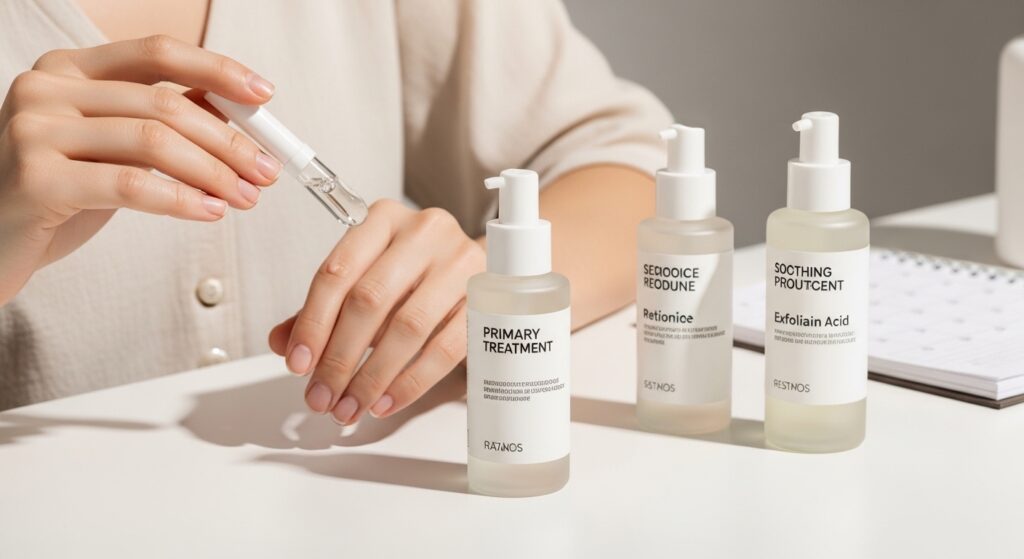
Every problem needs the same foundation before any treatment. Three steps, every day:
- Cleanse gently. Lukewarm water and a mild cleanser, once or twice a day depending on skin type. Dry and sensitive skin can often manage with one cleanse at night; oily skin usually needs morning and evening. Do not scrub, and avoid hot water — both undermine the barrier. If your skin feels tight after washing, your cleanser is too strong.
- Moisturise. A moisturiser supports the barrier and reduces water loss. A good one combines a humectant (draws in water, for example glycerin or hyaluronic acid), an emollient (softens, for example ceramides or squalane) and, for dry skin, an occlusive (seals water in, for example petrolatum or shea butter). Oily skin still needs moisturiser — skipping it can leave skin dehydrated and reactive. Whether hydration “balances oil production” is disputed, not proven — the AAD has said a harsh wash can irritate skin and trigger increased oil production, but that is not proof that moisturiser controls oil. Do not buy a moisturiser for oil control; buy it for barrier support.
- Sunscreen — every morning. Broad-spectrum SPF 30 or higher, as the last step, reapplied every two hours when outdoors. Sun exposure worsens nearly every problem: it darkens acne marks and dark spots, increases sensitivity, and speeds visible ageing. It is needed on cloudy days too, and when you will be near windows for long periods — glass blocks UVB but not all UVA. Ordinary indoor lighting does not meaningfully affect skin.
Keep the foundation alone for three to four weeks before adding any treatment. That rest period lets the barrier settle and shows you how your skin actually behaves. Many people change products after one week and reset their progress. Time is not wasted here — it is the test.
Step 5: add one treatment
Once the foundation is steady, add one treatment for your one problem. One product, not five.
| Problem | Treatment with the most evidence | How to start |
|---|---|---|
| Acne | Benzoyl peroxide (start low) or salicylic acid; adapalene is a prescription-strength retinoid in some countries and over the counter in others | One product, once a day or every other day at first; patch test first |
| Dark marks | Vitamin C or niacinamide | One product, once a day; sunscreen is essential or marks will not fade |
| Dryness | Ceramide moisturiser, hyaluronic acid or glycerin on damp skin, occlusives at night | Daily; hydration, not a treatment on its own |
| Redness or sensitivity | Barrier repair first — ceramides, fragrance-free moisturiser; no active until the skin is calm for weeks | Add an active only when the skin is settled |
| Fine lines | Retinol (over the counter) | Night only, one or two nights a week at first, pea-sized; do not use during pregnancy |
Rules for adding a treatment:
- One at a time. Wait at least two weeks before increasing frequency.
- Do not combine strong actives when starting out. Exfoliating acids and retinoids should not be used together at first.
- Patch test any new product before using it on your face. The AAD’s method is: apply the product to a quarter-sized patch of skin on the inside of your arm or the bend of your elbow, twice a day for 7 to 10 days. The AAD recommends this length because allergic reactions can take several days to appear, and a 24-hour test can miss them. If the patch becomes red, itchy, swollen or blistered, do not use the product on your face.
- If redness lasts more than a few days, reduce frequency. If burning continues, stop. A strong reaction does not mean fast results — it means barrier stress.
Step 6: judge it over weeks
Skin changes slowly, and judging too early is the most common reason routines get abandoned. As rough guides only — not promises, and assuming steady use:
- Hydration and comfort: often feels better in 1 to 2 weeks.
- Acne: the AAD advises giving a treatment 6 to 8 weeks before judging it.
- Dark marks: fade gradually over 8 to 12 weeks, with daily sunscreen.
- Texture and fine lines: change over 3 to 6 months with a retinoid.
These are guides, not deadlines. If nothing has changed after the guide period, the problem may have been misread — go back to Step 2 — or the problem may need a dermatologist rather than a product.
Overload: what to do
Signs of overload are redness, peeling, stinging, or breakouts getting worse after a new treatment. If that happens:
- Stop the treatment — do not push through.
- Go back to the foundation only: gentle cleanser, moisturiser, sunscreen.
- Wait until the skin is calm for at least a week.
- Reintroduce the treatment more slowly — fewer nights a week, or a lower strength — or try a gentler option.
Overload is information, not failure. It tells you the barrier was not ready, or the treatment was too strong, or two actives were combined too soon.
Tracking
A short record beats memory. Once a week, note three things: what you used, how your skin felt, and any reaction. A photo in the same light, once a week, gives objective feedback on texture, marks and breakouts — daily looking does not. Patterns appear over weeks: which product helped, which one stung, whether the skin is calmer on rest days. Change the routine from what you observe, not from what you hope.
Weekly and seasonal changes
Skin changes through the week and through the year. Use what you observe:
- Tight or dry after treatments: ease off the actives, add moisture, and give the skin rest days.
- Shiny or congested: check whether the cleanser is too strong or the moisturiser too heavy — do not add a drying product.
- Calm and steady: increase treatment frequency gradually, one step at a time.
- Winter: colder, drier air usually means a richer moisturiser and more barrier support.
- Summer: more oil and sweat, and more sun — lighter textures, and sunscreen matters even more.
Change one thing at a time, so you know what worked.
Lifestyle: honest limits
Sleep, stress, food and the environment all affect skin — but none of them is a treatment, and none of them replaces one.

- Sleep and stress. Poor sleep and high stress are associated with more inflammation and more breakouts, but the link is an association, not a mechanism you can fix with a routine. Aiming for 7 or more hours of sleep a night (the CDC’s figure for adults) is good for health generally; it is not a skin treatment.
- Food and water. Eating well supports health, and drinking water supports health — but no food has been shown to treat acne, pigmentation or sensitivity, and drinking water does not directly hydrate skin. Diet can influence skin (high-glycaemic foods and acne have some evidence; dairy has an association, mainly with milk), but the evidence is not strong enough for a dietary recommendation, and no diet replaces a treatment.
- Environment. Pollution and UV worsen most problems. Daily sunscreen, gentle cleansing and avoiding smoke exposure are the practical protections.
Mistakes
- Treating the symptom instead of the cause — drying oily skin that is actually dehydrated, or exfoliating flaking skin whose barrier is broken.
- Treating pigmentation while acne is still active — new breakouts keep creating new marks.
- Adding several actives at once, so you cannot tell which one caused a reaction.
- Changing products every few days, so you never learn what helps and what irritates.
- Skipping sunscreen — UV exposure darkens marks, worsens redness and slows recovery.
- Expecting a result by a fixed date. The timelines above are rough guides, not promises.
- Assuming a strong reaction means the product is working. Burning, peeling or persistent redness means barrier stress — slow down, do not push through.
When to see a dermatologist
- Acne that is deep, painful or cystic, or that leaves scars.
- Pigmentation that spreads quickly, or new dark patches that do not fade.
- A rash that does not settle, or skin that keeps reacting to products.
- No improvement after 8 to 12 weeks of consistent care.
- Before any in-clinic treatment — these are medical decisions for a doctor, not choices from a skincare article.
Skincare handles mild to moderate issues. Healthcare handles the more severe ones. Knowing when to seek help is part of the routine.
FAQ
Which problem should I treat first?
The most active or disruptive one — and if the barrier is damaged, the barrier first. Then active acne, then pigmentation, then texture. Treating pigmentation while acne is still active does not work, because new breakouts keep creating new marks.
Can I use more than one active treatment at once?
Not when starting out. Add one, judge it over weeks, and only then consider a second — on alternate nights, with rest days. Rotation is safer than layering several actives in one night.
How long before I see results?
As rough guides: hydration in 1 to 2 weeks, acne in 6 to 8 weeks, dark marks in 8 to 12 weeks, texture in 3 to 6 months. Consistency is what matters — there is no fixed date by which any problem will clear.
What should I do if my skin reacts to a treatment?
Stop the treatment, go back to the foundation only, and wait until the skin is calm for at least a week. Then reintroduce it more slowly, or try a gentler option. Redness, burning or peeling are signs to slow down — not to use the product more often.
Do lifestyle factors really affect skin?
Yes, but modestly. Sleep, stress, food and sun exposure all play a role, and they are worth attending to for health generally. None of them is a skin treatment, and none replaces one.
Summary
A problem-based routine starts with the problem, not the product. Name the one problem that is most active, find its cause — the same visible sign can have different causes — and treat in order: barrier first, then active acne, then pigmentation, then texture. Build the smallest routine that addresses it — gentle cleanse, moisturise, broad-spectrum SPF 30+ every morning — keep it alone for three to four weeks, then add one treatment, patch tested for 7 to 10 days, and judge it over weeks. If the skin overloads, stop, rest the barrier, and reintroduce slowly. If acne is deep, painful or scarring, pigmentation spreads quickly, or there is no improvement after 8 to 12 weeks, see a dermatologist.
Sources: American Academy of Dermatology, 7 Rosacea skin care tips (patch-test method: apply a new product to a quarter-sized patch of skin on the inside of the arm for 7–10 days); American Academy of Dermatology, How to select anti-aging skin care products (broad-spectrum sunscreen, SPF 30 or higher, reapply every two hours outdoors). This is a researched overview, not a hands-on review.