Researched overview. This guide is based on published dermatology and hair-science guidance, not on hands-on product testing by BeautyKob. No product in this guide was tested by us, and no product or brand is recommended.
Table Of Content
Quick answer
Frizz is a moisture problem, not a styling problem. When the hair’s outer layer — the cuticle — is raised or damaged, strands absorb water from the air unevenly, swell out of shape, and look rough and unmanageable. A hydrating shampoo and conditioner help by cleaning gently, adding water back into the hair, and smoothing the cuticle so it lies flat. But the products are only half the routine: how you wash, dry and handle the hair matters just as much, because rough handling raises the cuticle again.
This guide is about the wash day itself — choosing the shampoo and conditioner, the washing method, drying, and frequency — not a general guide to frizz. It does not recommend any product or brand, and it does not promise that any shampoo will permanently fix frizz. Damaged hair cannot be repaired; it can only be cared for, and split ends removed by trimming.
If you are losing hair in clumps, have bald patches, or a scalp that is sore, blistered or will not stop itching, skip the new products and ask a dermatologist or pharmacist first. This guide is general information, not medical advice.
Contents: What frizz is · How to tell your hair needs hydration · The wash routine, step by step · Choosing a hydrating shampoo · Choosing a conditioner · How often to wash · Drying and styling · Frizz by hair type · What does not fix frizz · Mistakes · When to get help · FAQ
What frizz is
Each hair strand is covered by the cuticle — overlapping scales that protect the inner cortex. When the cuticle lies flat, hair looks smooth and reflects light evenly. When it is raised or damaged, strands absorb moisture from the air unevenly and swell out of shape. That uneven swelling is frizz.
The main causes are the same ones that damage the cuticle: humidity, heat styling, chemical treatments such as colouring or bleaching, and friction — rough towel drying, vigorous brushing, tight tying. Hair type matters too: curly and wavy hair frizzes more easily because the cuticle is naturally less flat along a curl, and fine hair frizzes more easily because it has less mass to hold its shape.
The key point is that frizz is a sign of a moisture imbalance in the hair, not a lack of styling products. Serums and oils can smooth the surface for a day, but they do not fix the underlying dryness — water moisturises, oil seals. A shampoo and conditioner that hydrate properly are the base; everything else sits on top of that.
How to tell your hair needs hydration
Not all frizz is the same. Hair that needs hydration usually shows several of these signs:
- Dry, rough or coarse to the touch, even just after washing.
- Tangles easily and snaps when combed.
- Split ends, or ends that look lighter and thinner than the roots.
- Frizz that does not improve with serums or oils — the surface is smoothed for an hour, then the frizz returns.
- Hair that has had colour, bleach, perming or frequent heat styling.
Hair that is simply curly or wavy is not “damaged” — it frizzes because of its shape, and the same wash routine still helps, but it will never look straight and flat, and it does not need to. The goal is manageable, healthy-looking hair, not a different hair type.
The wash routine, step by step
The method matters as much as the products. A gentle wash keeps the cuticle flat; a rough one raises it.
- Wet with lukewarm water. Hot water strips moisture and roughens the cuticle. Lukewarm is enough to wet the hair through.
- Shampoo the scalp and roots. Apply shampoo to the scalp and roots and massage gently with your fingertips — not your nails. The suds running down the lengths are enough to clean them; scrubbing the lengths strips them and tangles them.
- Rinse thoroughly. Leftover shampoo residue weighs hair down and can irritate the scalp.
- Condition the mid-lengths and ends. Apply conditioner mostly where frizz and dryness are worst — the middle and the ends — not on the scalp, where it can weigh hair down and make roots look greasy. Leave it for a few minutes so it can coat the hair, then rinse.
- Blot, do not rub. Squeeze water out gently with a towel or an old cotton T-shirt. Rubbing with a towel raises the cuticle and creates frizz before the hair is even dry.
- Detangle damp, not dry and not soaking wet. Wet hair is more fragile than dry hair. Detangle while the hair is damp and has conditioner in it, or after washing with a little leave-in conditioner — start at the ends and work upward, with a wide-tooth comb. Never detangle dry, frizzy hair with a brush.
- Let it partly air-dry. If you blow-dry, let the hair air-dry part-way first, then finish on a low or medium heat with a heat-protectant product applied beforehand.
Choosing a hydrating shampoo
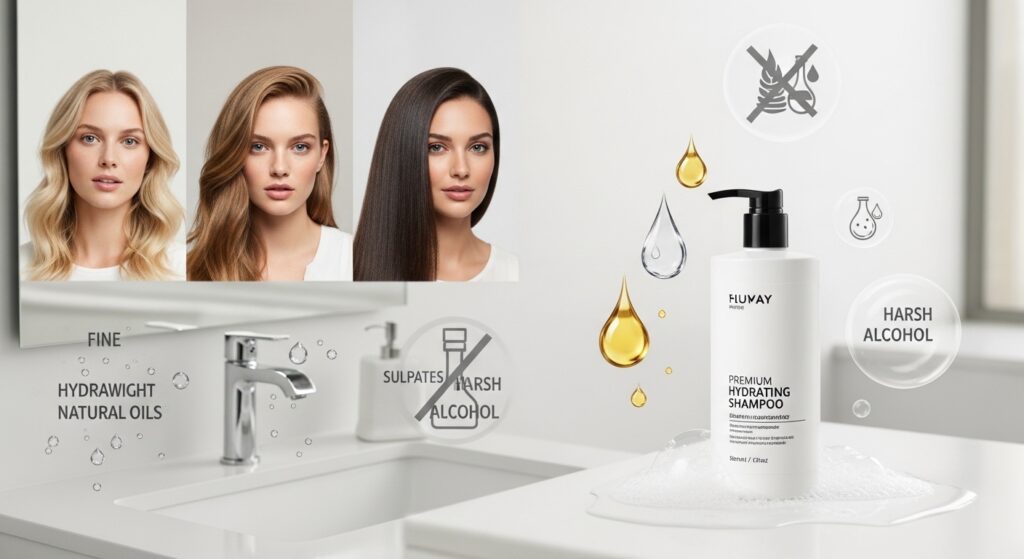
A hydrating shampoo should clean gently without stripping the hair’s natural oils. What to look for on the label:
- Gentle surfactants. The cleaning agents should be mild — look for words such as “gentle” or “sulfate-free” on the label, but do not treat “sulfate-free” as a guarantee: some sulfate-free shampoos are still harsh, and some shampoos with sulfates are mild. What matters is how your hair feels after washing — clean but not stripped or squeaky.
- Humectants. Ingredients such as glycerin or panthenol draw water into the hair. These are the ingredients that actually hydrate.
- Light oils or emollients. A small amount of oil in the formula can help the hair feel softer, but a shampoo heavy with oil can weigh fine hair down.
What to be cautious about:
- Harsh detergents and drying alcohols high on the ingredient list. These strip natural oils and leave hair drier and frizzier.
- Silicones. Silicones coat the hair shaft and can make it feel smooth at first. They can build up over time, especially if you wash infrequently, and that build-up can make hair look dull and heavy. They do not permanently block moisture, and they are removed by washing — they are not something to fear, and not something to avoid on principle. If your hair feels coated or heavy, a clarifying wash removes the build-up.
- Beware invented ingredients. The original article named a hydrating ingredient that does not exist. Real hydrating ingredients are humectants such as glycerin and panthenol — check the label for those, not for a made-up name.
No shampoo can be judged from the label alone. The test is how your hair feels after two or three weeks of use: softer and more manageable, or drier and more tangled.
Choosing a conditioner
Conditioner is what smooths the cuticle after shampooing. Two kinds matter:
- Everyday conditioner. Used after every wash, on the mid-lengths and ends, left for a few minutes and rinsed out. It coats the hair, reduces friction between strands, and makes detangling easier. This is the workhorse — most frizz control comes from using it consistently.
- Deep-conditioning mask. Used once a week or so, left on longer (10 to 20 minutes), for hair that is very dry, curly or chemically treated. A mask adds more conditioning than a daily conditioner, but it is a temporary patch, not a repair: damaged hair cannot be repaired, and no mask restores a broken cuticle. What a mask does is coat the hair more thickly, so it feels smoother and tangles less until the next wash.
Protein in conditioner. Some conditioners contain hydrolysed protein. Protein can temporarily patch the hair surface — hydrolysed peptides small enough (under about 1,000 Daltons) can enter the outer cortex, while larger molecules form a surface film. Either way the effect is temporary and washes out; protein does not rebuild hair. Egg or milk protein molecules are too large to enter the hair shaft at all. Use a protein conditioner occasionally if your hair feels weak or stretchy, not as a daily repair treatment — too much protein can make hair feel stiff and brittle.
Leave-in conditioner. A small amount applied to damp hair after washing can keep frizz down through the day, especially in humidity. Use a light formula for fine hair and a richer one for thick or coarse hair.
Test new leave-on products first. Before using a new leave-in conditioner, serum or styling product on your scalp and hair, patch test it: apply a small amount to a quarter-sized patch of skin on the inside of your arm or the bend of your elbow, twice a day for 7 to 10 days. Allergic reactions can take several days to appear, and a 24-hour test can miss them. If the patch becomes red, itchy, swollen or blistered, do not use the product. Rinse-off shampoo and conditioner need only a small-area check on first use.
How often to wash
Most people with frizzy hair do well washing two or three times a week, but the right frequency depends on hair type and lifestyle:
- Fine or oily hair: may need washing every other day — oil builds up faster and weighs fine hair down.
- Thick, coarse or curly hair: often does well with two washes a week — the hair is drier and the scalp’s oils take longer to travel down the strand.
- Very active or sweaty lifestyle: rinse with water between washes, or wash more often with a gentle shampoo, rather than scrubbing hard once a week.
Over-washing strips natural oils and makes frizz worse; under-washing lets oil and product build up, which weighs hair down and can irritate the scalp. If your hair feels stripped and dry after washing, wash less often or use a gentler shampoo. If your scalp feels itchy or coated, wash more often.
Drying and styling
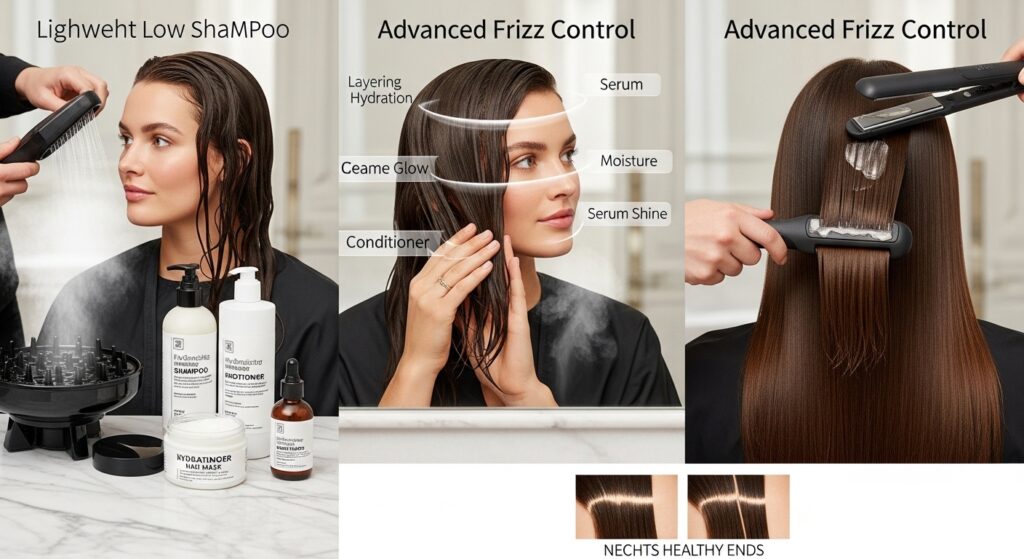
How hair dries sets how much it frizzes:
- Air-dry part-way first. Letting hair air-dry for 10 to 15 minutes before blow-drying reduces the total heat exposure.
- Heat protectant before heat. Apply a heat-protectant product before any blow-drying, straightening or curling. Heat without protection is one of the fastest ways to raise the cuticle.
- Dryer distance and motion. Hold a dryer about 15 cm from the hair and keep it moving — one study found that holding a dryer close and still caused more damage than holding it further away with continuous motion. Do not pass a flat iron over the same section repeatedly; one slow pass is less damaging than several fast ones.
- Silk or satin pillowcases. They create less friction than cotton while you sleep, so the cuticle stays flatter overnight. A loose braid or a soft scrunchie also reduces overnight tangling. Tight hairstyles pull on strands and cause breakage and split ends, which make frizz worse.
- Sun on the scalp. The scalp burns where hair parts, so use a broad-spectrum sunscreen with SPF 30 or higher on the exposed parting when you will be outdoors, and reapply every two hours. A hat works too — it also protects the hair itself from sun damage.
Frizz by hair type
| Hair type | Wash routine adjustment |
|---|---|
| Fine | Light, water-based formulas; conditioner on the ends only; avoid heavy oils and masks, which weigh hair down |
| Thick or coarse | Richer conditioner and occasional deep-conditioning mask; oil-infused formulas can help, used sparingly |
| Curly or wavy | Wash less often; detangle only when damp with conditioner in; leave-in conditioner helps hold the curl pattern |
| Colour-treated or chemically treated | Gentle, sulfate-free formulas to slow colour fading; deep-condition weekly; protein conditioner occasionally — as a temporary patch, not a repair |
| Oily scalp with dry ends | Shampoo the scalp well, condition only the mid-lengths and ends; do not skip conditioner because the roots are oily |
What does not fix frizz
- Oils alone. Oils seal moisture in, but they do not add water. An oil on dry hair smooths the surface for a few hours; it does not hydrate the hair. Use oils with a hydrating wash routine, not instead of one.
- Drinking more water. Drinking water is good for health, but it does not directly hydrate hair. Hair moisture comes from washing and conditioning, not from a glass of water.
- Supplements. Biotin, omega-3 and vitamin E are sometimes sold for hair health, but there is no good evidence that supplements improve frizz or hair quality in people who are not deficient. Biotin is vitamin B7, and high-dose biotin can interfere with some laboratory blood tests. No supplement, dose or brand is recommended here.
- Diet as a treatment. Eating well supports health generally, but no food has been shown to fix frizz, and no diet replaces a wash routine.
- “Repairing” products. Shampoos and masks that claim to repair damaged hair cannot do so — damaged hair cannot be repaired. What they do is coat the hair so it feels smoother until the next wash. Trimming is the only way to remove split ends: every 6 to 12 weeks, depending on how fast your hair splits.
Mistakes
- Over-washing, which strips natural oils and makes hair drier and frizzier.
- Over-conditioning, which builds up, weighs hair down and makes it look dull.
- Rubbing hair dry with a towel, or brushing dry hair — both raise the cuticle.
- Detangling soaking wet hair, or dry hair — both break more strands than detangling damp hair with conditioner in it.
- Heat styling without a protectant, or passing an iron over the same section repeatedly.
- Expecting a shampoo to permanently fix frizz. Hydration is maintenance, not a cure — stop the routine and the frizz returns.
When to get help
- Hair coming out in clumps, bald patches, or a sudden increase in shedding well above the usual 50 to 100 hairs a day.
- A scalp that is sore, blistered, bleeding, or itchy for more than a few weeks despite gentle washing.
- Hair that breaks off at the same length no matter what you do — this can be a sign of damage, but also of a medical cause worth checking.
- Before any chemical treatment if your scalp is already irritated or broken.
A dermatologist can check for medical causes of hair loss or scalp problems. A hairdresser can advise on cuts and styling for your hair type, but cannot diagnose a medical problem.
FAQ
Can a hydrating shampoo and conditioner permanently fix frizz?
No. They improve moisture and smoothness while you use them, but they do not change the structure of the hair. Frizz control is maintenance — stop the routine and the frizz returns.
How often should I wash frizzy hair?
Usually two to three times a week, depending on hair type and activity. Fine or oily hair may need more frequent washing; thick, coarse or curly hair often does well with less. If your hair feels stripped after washing, wash less often or use a gentler shampoo.
Can I use hydrating products on colour-treated hair?
Yes. Choose gentle formulas to slow colour fading, and deep-condition weekly. Protein conditioner can be used occasionally as a temporary patch, not as a repair.
Are natural oils enough to control frizz?
No, not on their own. Oils complement hydration — they seal moisture in — but they do not add water to the hair. They work with a hydrating shampoo and conditioner, not instead of them.
Can I use hydrating shampoo and conditioner with other treatments?
Yes, but do not overlap harsh treatments. If you use a chemical treatment, a protein mask and a strong exfoliating scalp product in the same week, the combined stress can make frizz and breakage worse. Space treatments out and keep the wash routine gentle.
Summary
Frizz is a moisture problem: a raised or damaged cuticle lets strands absorb water unevenly and swell out of shape. The fix is a wash routine, not a styling product. Wash with lukewarm water, shampoo the scalp and roots only, condition the mid-lengths and ends and leave it a few minutes, blot dry instead of rubbing, and detangle damp with conditioner in it, ends first, with a wide-tooth comb. Choose a gentle hydrating shampoo and an everyday conditioner, add a weekly deep-conditioning mask as a temporary patch — not a repair — and test new leave-on products on a small patch of skin for 7 to 10 days first. Wash two or three times a week as a starting point, protect hair from heat, wear SPF 30+ on the exposed parting when outdoors, and trim split ends every 6 to 12 weeks. Oils, supplements and drinking water do not fix frizz on their own. If hair is coming out in clumps, or the scalp is sore or blistered, see a dermatologist.
Sources: American Academy of Dermatology, 7 Rosacea skin care tips (patch-test method: apply a new product to a quarter-sized patch of skin on the inside of the arm for 7–10 days); American Academy of Dermatology, How to select anti-aging skin care products (broad-spectrum sunscreen, SPF 30 or higher on exposed skin when outdoors, reapply every two hours). This is a researched overview, not a hands-on review.