Researched overview. This guide is based on published research and dermatology guidance, not on hands-on product testing by BeautyKob. No product in this guide was tested by us.
Table Of Content
- Quick answer
- How stress shows up in the body
- What the evidence actually says
- Warm baths and sleep
- Time in nature
- Breathing and muscle relaxation
- Touch and warmth
- Scent
- Supplements: what the research actually shows
- A short daily ritual
- What deep relaxation actually changes
- When to seek professional support
- FAQ
- Summary
Quick answer
Body care can help you feel calmer, but not by “flushing stress hormones” or detoxing anything. Warmth, slow breathing, gentle touch and time outdoors work mainly by giving your nervous system a calmer signal: heart rate slows, breathing steadies, and tight muscles get a chance to let go. The effects are real but modest, and they build up through a short daily practice rather than one elaborate session.
What helps most:
- A warm bath or shower 1–2 hours before bed — the best-supported timing for sleep.
- Slow breathing with a longer exhale than inhale — a few minutes can steady a stress response.
- Progressive muscle relaxation — tensing and releasing one muscle group at a time.
- Time in nature, 20–30 minutes — one small study found the best return on time in this window.
- Gentle self-massage — a comfort aid for tight shoulders, jaw and neck, not a treatment.
What does not help: chasing a single “cortisol-lowering” product, supplement or ritual, or expecting one session to fix chronic stress. If stress is severe, persistent, or comes with symptoms like panic attacks or hopelessness lasting more than two weeks, talk to a doctor or mental health professional — self-care works alongside professional support, not instead of it. This guide is general information, not medical advice.
Contents: How stress shows up in the body · What the evidence actually says · Warmth and touch · Breathing and muscle relaxation · Time in nature · Supplements: what the research shows · A short daily ritual · Patch test · When to seek professional support · FAQ
How stress shows up in the body
When the brain registers a stressor, it activates the sympathetic nervous system — the “fight or flight” branch. The adrenal glands release adrenaline and cortisol, heart rate climbs, blood vessels narrow, and digestion slows as the body redirects resources toward immediate survival.
This response is useful in short bursts. The trouble starts when it does not switch off. Chronic activation keeps cortisol elevated for extended periods, and that is linked to disrupted sleep, blood sugar changes, suppressed immune function and increased strain on the heart and blood vessels. None of this means stress alone causes these problems — it means long-term stress is one factor among many.
The connection between mental and physical states runs in both directions. Psychological stress can raise markers of inflammation in the body, while physical sensations — muscle tension, digestive discomfort — feed back into mood. This is part of why chronic neck or jaw tension often accompanies anxiety rather than existing independently of it.
The gut and the brain also communicate in both directions, through nerves and through chemical signals. Most of the body’s serotonin is found in the gut, but that does not mean gut health directly controls mood — the relationship is complex and still being studied. What is clear is that body and mind are not separate systems, which is why physical practices can ease mental symptoms and not just physical ones.
What the evidence actually says
Relaxation research is a field of small studies and modest effects. That is worth saying plainly, because the live version of this article overstated how strong the evidence is. Here is the honest version, practice by practice.
Warm baths and sleep
A 2019 systematic review and meta-analysis in Sleep Medicine Reviews (Haghayegh et al.) pooled the trials of warm baths and showers before bed. It found that bathing about 1–2 hours before bedtime, in water around 40–42.5 °C (104–108.5 °F), was linked to better self-rated sleep quality and to falling asleep about 10 minutes sooner on average. The proposed mechanism is simple: warm water sends blood to the skin, and stepping out lets core body temperature fall — and that fall is one of the signals tied to sleep onset.
Ten minutes is a modest effect, and the trials were mostly small and done in generally healthy people. Read it as solid support for a low-risk habit, not as a treatment for a diagnosed sleep disorder.
Time in nature
One small study is behind the “20 minutes in nature” figure you may have seen. Hunter et al. (2019, Frontiers in Psychology) asked 36 people to spend time in a place that gave them a sense of contact with nature, at least three times a week for eight weeks, and measured cortisol in saliva before and after. The model estimated a 21.3% drop in cortisol per hour of nature time, beyond the hormone’s normal daily decline — which works out to roughly a 10% drop for a 30-minute session. The best return on time sat between 20 and 30 minutes.
That is one small study, not a rule. It is reasonable to say that spending 20–30 minutes in a park or garden can help you feel calmer, and that the effect has been measured in saliva samples. It is not reasonable to say that 20 minutes lowers cortisol by more than 20%.
Breathing and muscle relaxation
Controlled breathing — for example, breathing in for a count of four, holding for four, and breathing out for four — gives you voluntary control over part of a system that normally runs on its own. Slowing the breath this way can reduce the physical markers of a stress response within minutes. The four-four-four pattern is a commonly suggested pattern, not a prescription; any slow, steady breathing with a longer exhale than inhale works the same way.
Progressive muscle relaxation works from a different angle: deliberately tensing a muscle group for several seconds and then releasing it teaches the body to notice the difference between tension and release, which over time makes it easier to let go of tightness during ordinary stress. It is one of the more widely studied relaxation techniques, and it needs no equipment.
Touch and warmth
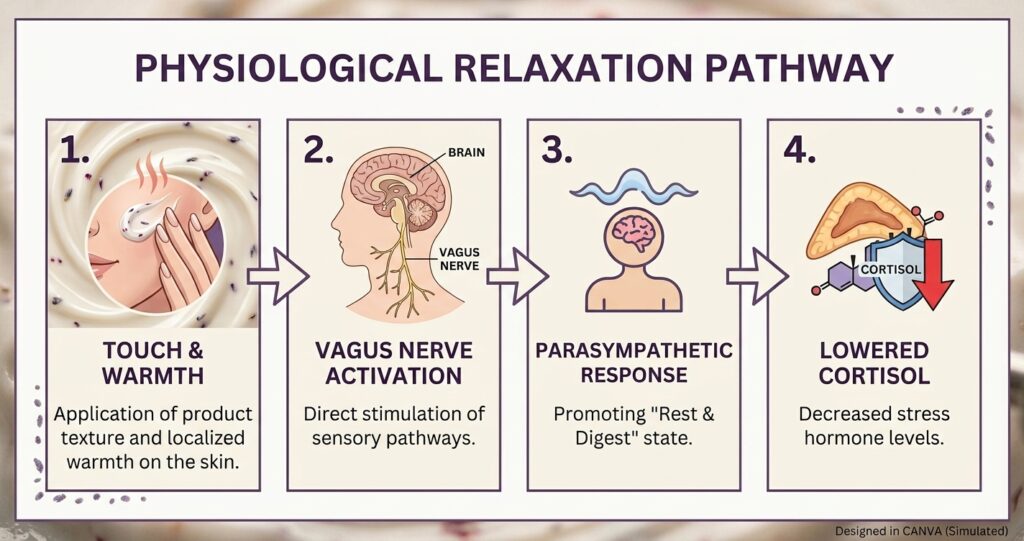
Warm water dilates blood vessels near the skin’s surface, and firm, slow touch can feel calming — but the exact mechanism is not settled. Some researchers propose that pressure receptors in the skin influence vagus nerve activity, the nerve most associated with shifting the body into a resting state. That is a proposed mechanism, not an established fact, so this guide does not present it as one.
Self-massage — for instance, applying firm, slow pressure to the base of the skull, the shoulders or the palms — is best understood as a comfort aid. It can ease the feeling of tightness that builds up during sustained stress, and it gives you something concrete to focus on. It is not a treatment for pain, and claims that massage increases blood flow, drains lymph or removes toxins are not supported by good evidence. Keep massage gentle: if it hurts, you are pressing too hard.
Scent
Lavender has a reputation as a calming scent, and the data is more modest than the reputation. A few small studies found that inhaling lavender was linked to calmer markers of nervous system activity during sleep, without much change in cortisol itself. In plain terms: lavender may help you feel calmer, but it does not work like a sedative, and the evidence is limited. If you use it, a candle or a diffuser is safer than putting essential oil on your skin — essential oils are common irritants, should never be used undiluted, and should be patch tested first (see below).
Supplements: what the research actually shows
Several supplements are commonly discussed for stress support. None of them replace professional care for significant or persistent anxiety, and no supplement or dose is recommended in this guide.
- Ashwagandha has the most studied record of the three. Small trials found lower morning cortisol on average over six to eight weeks of daily use, and a 2022 meta-analysis of 12 trials (1,002 participants) found lower stress and anxiety scores — but rated the certainty of the evidence as low. A 2025 meta-analysis found a significant cortisol drop but no significant effect on how stressed people actually rated themselves. The honest summary: the cortisol finding is the most consistent part; the subjective benefit is real in some trials and not dependable across all of them.
- Magnesium is involved in nervous system regulation, and some research links low magnesium status to increased stress sensitivity, though the evidence for supplementation as a stand-alone anxiety treatment is mixed.
- Omega-3 fatty acids have some evidence for supporting mood regulation, largely through anti-inflammatory pathways, but the evidence is not strong enough to recommend them for stress.
Because dosing, interactions and appropriateness vary by individual health history, supplements are an area to discuss with a doctor or pharmacist rather than self-prescribing from an article.
A short daily ritual
Consistency matters more than length. A short practice done daily tends to help more over time than an elaborate one done occasionally.
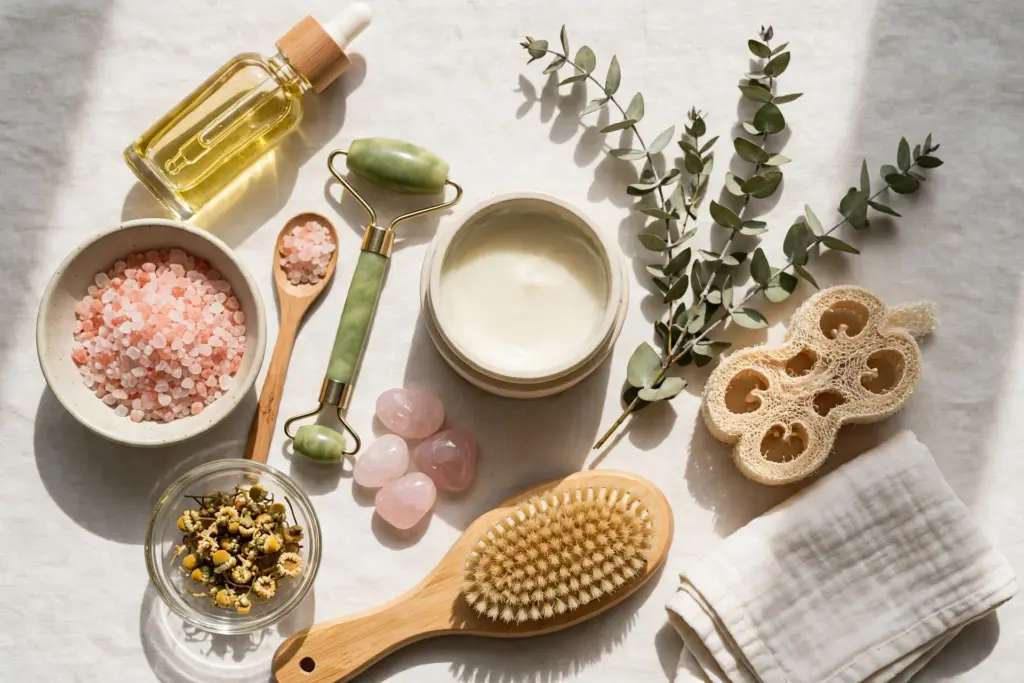
A five-minute reset after a stressful moment: sit down, breathe slowly with a longer exhale than inhale for a minute, then press firmly and slowly into the base of your skull or your palms for a minute or two. Wash your face with warm water or apply hand cream with deliberate pressure. The point is to interrupt the momentum of a stress response before it stretches into the rest of the day.
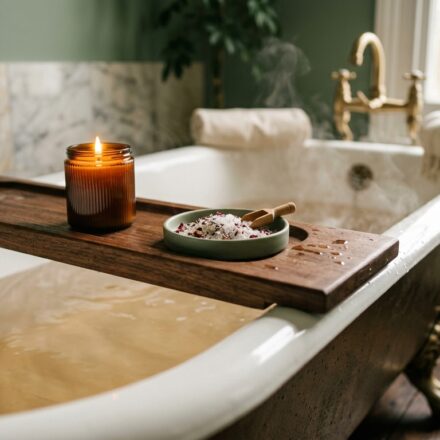
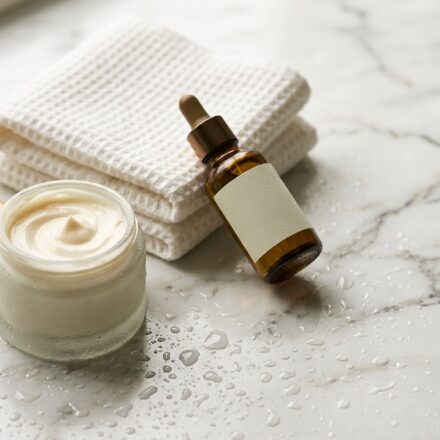
An evening wind-down, 60–90 minutes before bed: take a warm bath or shower for 10–20 minutes, then apply moisturiser to skin that is still slightly damp — the American Academy of Dermatology’s dry-skin guidance recommends moisturising while skin is still damp, because that is when it seals in moisture best. Keep the bathroom lights dim and the pace slow. If you go outside for the nature part of your day, use a broad-spectrum sunscreen with SPF 30 or higher and reapply every two hours outdoors.
Once or twice a week, a longer session: a 20–30 minute walk in a park or garden, or a longer warm bath followed by progressive muscle relaxation from feet to shoulders. No special products are needed for any of this.
Patch test: before using a new body product more widely, patch test it: apply a quarter-sized amount to the underside of your arm or the bend of your elbow, twice a day, for 7 to 10 days. If you get redness, itching, swelling or a rash, stop using it. A 24-hour test can miss an allergic reaction, which often takes several days to appear — that is why this guide uses the AAD 7–10 day patch-test method. This is the American Academy of Dermatology’s patch-test method.
What deep relaxation actually changes
Regular relaxation practice is linked to several outcomes beyond just “feeling calmer”: lower resting blood pressure, better sleep quality, reduced muscle tension and related pain, and improved focus. These are associations from mostly small studies, not guarantees — and none of them require intensity. They accumulate through consistent, moderate practice rather than occasional deep sessions.
What a body-care ritual cannot do is also worth stating: it cannot “detox” stress hormones, reset your nervous system in one session, or replace sleep, movement, or professional care. Diet plays a supporting role — steady blood sugar from regular meals helps avoid the energy crashes that can mimic or worsen anxiety symptoms — but no food or drink controls stress hormones, and eating well is not a treatment for anxiety.
When to seek professional support
Self-directed relaxation practices are a genuinely useful tool for everyday stress, but they are not a substitute for professional care when symptoms are severe or persistent. It is worth reaching out to a doctor or mental health professional if you experience:
- Sleep difficulty lasting several consecutive nights
- Panic attacks that occur without a clear trigger
- Physical pain that does not improve with rest or self-care
- Persistent hopelessness lasting more than two weeks
- Withdrawal from usual social activities
If any of these apply to you, please consider talking to a healthcare provider — self-care techniques work best alongside professional support when stress reaches this level, not as a replacement for it.
FAQ
Can a warm bath actually lower stress hormones, or is that just marketing?
Warm water dilates blood vessels and the cool-down afterwards lines up with the body’s natural pre-sleep temperature drop. A 2019 meta-analysis found people fell asleep about 10 minutes sooner on average when they bathed 1–2 hours before bed. That is a modest, measured effect — not a hormone reset.
Does self-massage really do anything, or is it just placebo?
Firm, slow pressure on areas like the base of the skull or the palms can ease the feeling of tension and give you something concrete to focus on. It is a comfort aid, not a treatment — and claims about blood flow, lymphatic drainage or toxin removal are not supported.
How long does it take to see benefits from a daily relaxation practice?
Some effects, like a slower heart rate during breathing exercises, happen within minutes. Others, like changes in cortisol from a supplement, were studied over six to eight weeks of consistent use in clinical trials — and even then the results were mixed.
Is spending time in nature really as effective as meditation for stress?
One small study of 36 people found that 20–30 minutes in nature gave the best return on time for lowering cortisol in saliva samples. It is a different mechanism from meditation, and both are legitimate tools — but one small study is not proof that nature beats meditation.
Why do I feel more anxious when my shoulders or jaw are tense?
Chronic muscle tension sends ongoing signals to the brain that can reinforce a sense of threat, even without a clear external stressor. This is one reason physical relaxation techniques can ease mental symptoms and not just physical discomfort.
Summary
Warmth, touch, slow breathing and time in nature all have real, measurable effects on the nervous system — modest ones, from mostly small studies. The techniques that work best are the ones you will actually repeat: a short daily practice tends to outperform an elaborate one you rarely get around to. None of this replaces professional care for serious or persistent symptoms, but as a daily tool for everyday stress, body care is backed by more solid evidence than it often gets credit for.
Sources: Hunter et al. 2019 (Front. Psychol. 10:722, doi:10.3389/fpsyg.2019.00722); Haghayegh et al. 2019 (Sleep Med. Rev. 46:124–135, doi:10.1016/j.smrv.2019.04.008); Lopresti et al. 2019 (Medicine 98(37):e17186); Akhgarjand et al. 2022 (Phytother. Res. 36(11):4115–4124); Albalawi 2025 (Nutr. Health); AAD sunscreen guidance; AAD dry-skin guidance (moisturise on damp skin); AAD patch-test method. This is a researched overview, not a hands-on review.