Researched overview. This guide is based on published dermatology guidance, not on hands-on product testing by BeautyKob. No product in this guide was tested by us, and no product or brand is recommended.
Table Of Content
- Quick answer
- Why several concerns are normal
- Know your skin type
- The bare-face test
- Prioritise: what to treat first
- The foundation first
- Morning
- Night
- Layering rules
- Rotation, not stacking
- Zone treatment
- Weekly support
- Tracking progress
- A short routine for busy days
- Honest expectations
- Lifestyle
- When to see a dermatologist
- FAQ
- Summary
Quick answer
Having several skin concerns at once is normal. Skin can be dry in one area and oily in another, break out in one place and have dark spots somewhere else. The mistake is trying to treat all of them at the same time, with a different product for each one, in the same week. That overloads the barrier, and the irritation that follows gets blamed on the skin instead of on the routine.
The method for several concerns is different from the method for one: prioritise, then rotate. Pick the concern that matters most, build the foundation, add one active for it — and only when that is settled, add the next. Treatments are rotated across nights and applied to zones, not layered all at once. That is how several concerns get handled without overwhelming the skin.
If your skin is red, sore, blistering, or you have a rash that does not settle, skip the new products and ask a dermatologist or pharmacist first. This guide is general information, not medical advice.
Contents: Why several concerns are normal · Know your skin type · Prioritise: what to treat first · The foundation first · Morning · Night · Layering rules · Rotation, not stacking · Zone treatment · Weekly support · Tracking progress · A short routine for busy days · Honest expectations · Lifestyle · When to see a dermatologist · FAQ

Why several concerns are normal
Beginners often assume skin has one concern. In reality, skin is complex. It may be dry on the cheeks and oily on the nose, break out on the chin and have dark spots on the forehead, and be reactive in some areas and calm in others.
Skin also responds differently to products when it has several problems. Treating it aggressively makes irritation or imbalance worse. The first step is therefore not a product — it is the order in which concerns are handled.
A routine for several concerns should:
- Secure the skin barrier first.
- Identify one main concern and one or two secondary ones.
- Add straightforward, routine steps.
- Avoid too many active ingredients at once.
Without this order, people change products weekly, which confuses the skin and slows progress.
Know your skin type
It is important to know what kind of skin you have. Even with several issues, your baseline type decides which product textures suit you.
- Dry skin: tight, flaky, dull. Needs hydration and barrier support.
- Oily skin: shiny in the T-zone, enlarged pores, often congested. Needs balance, not stripping.
- Combination skin: dry on the cheeks and oily in the T-zone. Needs zone-specific care.
- Sensitive skin: redness, irritation or burning reactions. Needs the shortest routine, fragrance-free products, and one new product at a time.
The bare-face test
Cleanse your face with a gentle cleanser, apply nothing, and wait 30 to 60 minutes:
- Tight all over — likely dry.
- Shiny all over — likely oily.
- Shiny only in some areas — likely combination.
- Burning or itching — likely sensitive.
This test gives direction. It does not lock you into a type permanently — skin changes with weather, stress, sleep and age.
Prioritise: what to treat first
When skin has several problems, treating everything at the same time is usually counterproductive. Ask three questions:
- Which concern is most visible, or most annoying?
- Which concern would harm skin health if left alone?
- Which concern is most likely to improve with regular care?
Then treat them in this order:
| Priority | Concern | Why first |
|---|---|---|
| 1 | Barrier damage and sensitivity | Nothing else works while the barrier is broken — actives on irritated skin add irritation, not results |
| 2 | Acne | Active breakouts cause new marks and scars if left alone; treating acne first stops new damage |
| 3 | Pigmentation and dark marks | Marks fade only once inflammation is low and sunscreen is daily; treating them while acne is active wastes effort |
| 4 | Texture and fine lines | The slowest concern; retinoids and exfoliation work best on calm, protected skin |
Address the first concern first and lessen the secondary concerns as your skin gets used to treatment. When the main issue is settled, the others become easier to handle.
The foundation first
Any good routine, whatever the skin type or issue, has the same centre: cleanse, moisturise, protect. These three steps support every concern and prepare the skin for targeted treatments later.
- Cleanse gently. Lukewarm water and a mild cleanser, once or twice a day depending on skin type. Do not scrub, and avoid hot water — both undermine the barrier.
- Moisturise. A moisturiser supports the barrier and reduces water loss. A good one combines a humectant (draws in water, for example glycerin or hyaluronic acid), an emollient (softens, for example ceramides or squalane) and, for dry skin, an occlusive (seals water in, for example petrolatum or shea butter). Oily skin still needs moisturiser — skipping it can leave skin dehydrated and reactive.
- Sunscreen — every morning. Broad-spectrum SPF 30 or higher, as the last step, reapplied every two hours when outdoors. Sunscreen matters for every concern: it stops dark spots darkening, slows early ageing, and shields sensitive or reactive skin from UV. It is needed on cloudy days too, and when you will be near windows for long periods — glass blocks UVB but not all UVA. Ordinary indoor lighting does not meaningfully affect skin.
Keep the foundation alone for at least three to four weeks before adding any active. That rest period lets the barrier settle and shows you how your skin actually behaves.
Morning
The morning routine prepares skin for the day. Keep it short — morning is for protection, not for treatment.
- Cleanse gently. Morning cleansing removes sweat, oil and residue from the night. Dry or sensitive skin can sometimes manage with water alone; oily or combination skin usually needs a gentle cleanser.
- Moisturise. Choose by texture: a light lotion for oily skin, a cream for dry skin.
- Sunscreen — every morning. Broad-spectrum SPF 30 or higher, as the last step.
Optional morning actives — only if your main concern needs a light morning step, add it after cleansing and before moisturiser:
- Niacinamide for uneven tone or redness.
- Vitamin C for pigmentation and antioxidant protection, always under sunscreen.
- A light acne treatment, if tolerated.
Add only one, and watch how your skin responds before adding another.
Night
Night is a practical time for treatments, because products stay on the skin undisturbed. It is not a biological repair window — skin does not repair itself only at night.
- Cleanse. Remove makeup, sunscreen, dirt and residue. If you wear heavy makeup or water-resistant sunscreen, remove it first with an oil-based cleanser, then wash with a gentle water-based cleanser.
- Targeted treatment. One active for the concern you are treating now — not several. Depending on the concern:
- Acne: salicylic acid or benzoyl peroxide, applied to the affected areas.
- Pigmentation: a mild acid or vitamin C, if tolerated.
- Early ageing and texture: retinol, started slowly.
- Moisturise. Follow treatment with moisturiser to seal in moisture and support the barrier. Ingredients such as ceramides, squalane or hyaluronic acid are useful here.
Introduce one active at a time, two or three nights a week at first. Check how your skin reacts, then increase frequency only if there is no irritation.
Layering rules
When several products are used, the order matters. These rules keep each treatment where it is needed most:
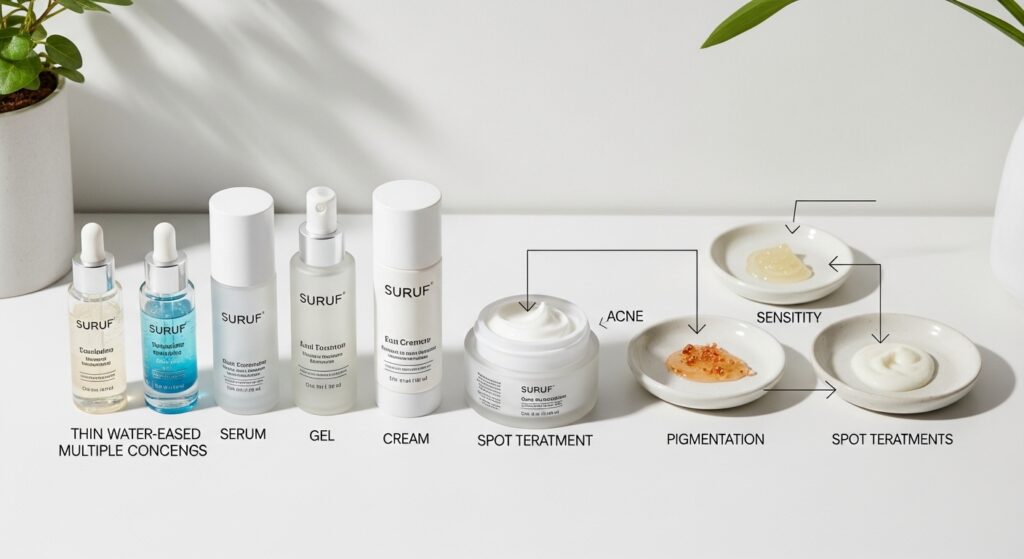
- Thinnest to thickest. Water-based products first, then serums and actives, then moisturiser and barrier repair.
- Spot treatments only where needed. Apply them to the affected areas, not the whole face.
- Do not mix strong actives in the same session. Strong acids should not be combined with retinol or benzoyl peroxide when starting out.
- Sunscreen last in the morning. It goes on after moisturiser, as the final step.
| Combination | Safe to use together? |
|---|---|
| Vitamin C (morning) + sunscreen | Yes — vitamin C goes under sunscreen |
| Niacinamide + most actives | Usually yes — niacinamide is well tolerated |
| Salicylic acid + benzoyl peroxide | Not when starting out — both are drying; use on different days |
| Exfoliating acid + retinol | Not when starting out — alternate nights instead |
| Retinol + moisturiser | Yes — moisturiser after retinol reduces dryness |
Rotation, not stacking
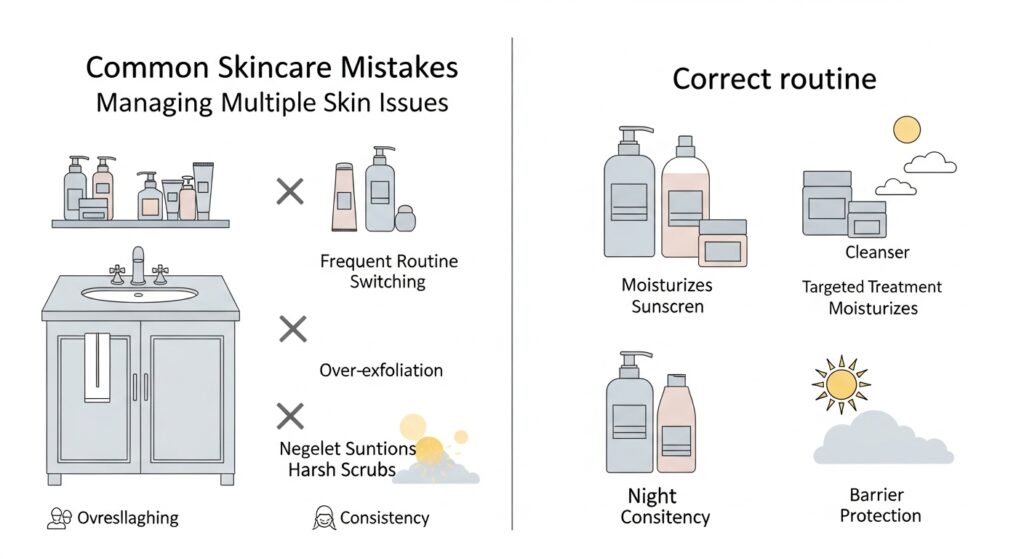
The most common error with several concerns is stacking every treatment into the same routine. Rotation is more effective: different treatments on different nights, with recovery nights in between.
A sample week for acne plus pigmentation:
| Night | Treatment |
|---|---|
| Monday | Acne treatment (salicylic acid or benzoyl peroxide) |
| Tuesday | Recovery — cleanser and moisturiser only |
| Wednesday | Pigmentation treatment (vitamin C or niacinamide) |
| Thursday | Recovery |
| Friday | Acne treatment |
| Saturday | Recovery |
| Sunday | Pigmentation treatment, or recovery if the skin feels stressed |
Recovery nights are not wasted nights. They let the barrier rest, and they make it possible to tell which treatment caused a reaction if one appears. If the skin is stressed, take more recovery nights, not fewer.
Zone treatment
Different areas of the face can have different concerns, and they do not all need the same product:
- T-zone (forehead, nose, chin): often oily and congested — a salicylic acid product here, if tolerated.
- Cheeks: often drier or more sensitive — moisturiser and barrier support, no strong actives unless needed.
- Dark marks: treat only the marked areas with a brightening product, not the whole face.
- Breakouts: spot-treat individual pimples; do not apply a strong acne product to the whole face.
Zone treatment keeps the total amount of active product low, which keeps irritation low.
Weekly support
A small weekly layer supports the daily routine:
- Light exfoliation: once or twice a week at most, if tolerated. Stop if you get redness, stinging, flaking or tightness.
- Masks, by need: a clay mask for oil control, a hydrating mask for dryness, a calming mask for sensitive skin. Masks are extras, not treatments.
- Recovery days: take breaks on days when your skin feels stressed.
Weekly add-ons support the routine; they are not substitutes for it. Consistency is still what matters.
Tracking progress
Tracking lets you change the routine without guessing:
- Take monthly photographs under the same lighting, and compare them — not daily mirror checks.
- Record changes in acne, pigmentation, dryness, oiliness and redness.
- Change the frequency of an active only when a trend is consistent over weeks.
- Do not change several products at the same time.
Progress is gradual and easy to miss day to day. Monthly photographs show what daily checks do not.
A short routine for busy days
Not everyone has time for a long routine. A short routine works well:
- Morning: cleanser, moisturiser, sunscreen.
- Night: cleanser, targeted treatment, moisturiser.
A small routine done every day yields results. Consistency and patience bring long-term outcomes even with the minimum number of steps.
Honest expectations
Skin improvement is gradual. As rough guides only, with steady use:
- Acne: the AAD advises giving an acne treatment 6 to 8 weeks before judging it.
- Pigmentation: fading is gradual; eight to twelve weeks is a common guide, but the timing varies and sunscreen decides whether marks fade at all.
- Texture and fine lines: three to six months of consistent use before the look of texture changes.
- Sensitivity: barrier strength increases slowly, with no fixed date.
Overnight changes are unrealistic. Reliable results come over months, not days. Do not rush the skin by increasing strength or frequency when results are slow — that usually adds irritation, not speed.
Patch test any new product before using it on your face. The AAD’s method is: apply the product to a quarter-sized patch of skin on the inside of your arm or the bend of your elbow, twice a day for 7 to 10 days. The AAD recommends this length because allergic reactions can take several days to appear, and a 24-hour test can miss them. If the patch becomes red, itchy, swollen or blistered, do not use the product on your face.
Lifestyle
Skin is not only about products. Stress, sleep, diet and hormones all affect how skin behaves, and feeling frustrated is natural when care is disorganised. A structured routine reduces that anxiety, because progress becomes visible.
- Sleep: adults need 7 or more hours a night (CDC). Poor sleep slows repair, but no number of hours of sleep will clear acne on its own.
- Diet: no specific food has been shown to cause or cure acne on its own. High-glycaemic foods have been linked with worse acne in some studies (Smith 2007; the AAD 2024 guideline found 3 of 4 trials showed benefit from a low-glycaemic diet, but not strong enough for a recommendation), and dairy — mainly milk, especially skim — has been associated with acne in observational studies, but the AAD found insufficient evidence to recommend avoiding dairy. Diet is not a treatment.
- Stress: stress can worsen breakouts, but managing stress does not replace skincare.
Praise small improvements: fewer breakouts, less redness, less roughness. Progress builds confidence, and confidence keeps the routine going.
When to see a dermatologist
- Acne that is deep, painful or cystic, or that leaves scars.
- Pigmentation that spreads quickly, or new dark patches that do not fade.
- A rash that does not settle, or skin that keeps reacting to products.
- No improvement after 8 to 12 weeks of consistent care.
- Before any in-clinic treatment — these are medical decisions for a doctor, not choices from a skincare article.
FAQ
Can I treat acne and pigmentation at the same time?
Yes, but not with both treatments every night. Rotate them on different nights, with recovery nights in between, and keep sunscreen daily — marks will not fade without it.
How many actives can I use at once?
One at a time when starting out. Add a second only when the first is settled and your skin is calm. Several actives in the same session usually add irritation, not results.
Should I use different products on different parts of my face?
Yes — that is zone treatment. Oily areas can take a salicylic acid product; dry or sensitive areas need moisturiser and barrier support, not strong actives.
How long before I see results?
As rough guides: acne 6 to 8 weeks, pigmentation 8 to 12 weeks, texture 3 to 6 months. Judge one change at a time, over weeks, and track with monthly photographs.
What if my skin gets worse when I add a treatment?
Stop the newest product first and go back to cleanser, moisturiser and sunscreen until the skin settles. A reaction is not a sign the product is working faster — it usually means barrier stress. Reintroduce it less often, or not at all.
Summary
Several skin concerns are normal, and they are handled by order, not by volume. Know your skin type with the bare-face test, then prioritise: barrier and sensitivity first, then acne, then pigmentation, then texture. Build the foundation — gentle cleanse, moisturise, broad-spectrum SPF 30+ every morning — for three to four weeks. Then add one active at a time, patch test it for 7 to 10 days first, rotate treatments across nights instead of stacking them, and treat zones differently where the skin differs. Track progress with monthly photographs and judge over weeks, not days. If acne is deep, painful or scarring, pigmentation spreads quickly, or there is no improvement after 8 to 12 weeks, see a dermatologist.
Sources: American Academy of Dermatology, 7 Rosacea skin care tips (patch-test method: apply a new product to a quarter-sized patch of skin on the inside of the arm for 7–10 days); American Academy of Dermatology, How to select anti-aging skin care products (broad-spectrum sunscreen, SPF 30 or higher, reapply every two hours outdoors). This is a researched overview, not a hands-on review.