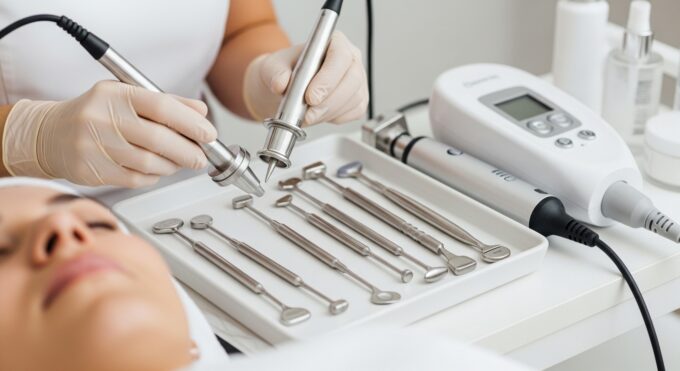
Researched overview. This guide is based on published dermatology and public-health guidance, not on hands-on product testing by BeautyKob. No product in this guide was tested by us, and no product is recommended.
Table Of Content
- Quick answer
- What makes a tool professional?
- Pro vs home tools
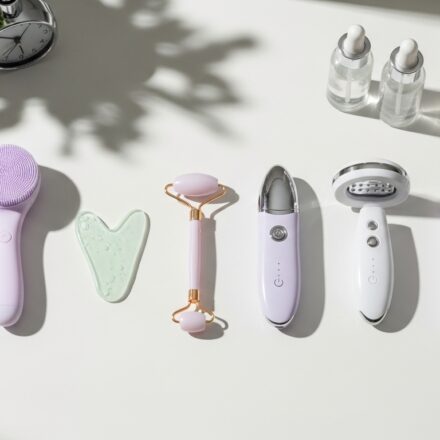
- The tools in brief
- Choosing tools
- By treatment goal
- By the client’s skin
- By experience level
- By quality, not price
- The session workflow
- Client communication
- Hygiene
- Common mistakes professionals make
- Building a kit
- Scope of practice
- Summary
Quick answer
A professional facial tool is not a home tool with a higher price. It is built to be used again and again on different clients, to be cleaned and disinfected between every one of them, and to give the same result every time in trained hands. The difference between an average facial and a memorable one is usually not the brand on the box — it is the practitioner’s training, the condition of the tools, and whether the right tool is used at the right moment.
This guide is about the professional side of facial tools: what makes a tool professional, how pro tools differ from home tools, how a session flows, how to talk to clients about tools, and how to build a kit as experience grows. It is written for readers who want to understand professional practice — whether they are choosing an esthetician, training as one, or running a treatment room. It is general information, not medical advice, and it is not a training manual: powered devices and extractions need proper training and should not be copied at home.
Contents: What makes a tool professional · Pro vs home · The tools in brief · Choosing tools · The session workflow · Client communication · Hygiene · Common mistakes · Building a kit · Scope of practice
What makes a tool professional?
Three things separate a professional tool from a home tool:
- Built for repetition. A professional tool is used on many clients, day after day. It must be solid, balanced, and able to survive repeated cleaning without corroding, shedding bristles, rusting or losing its shape. A tool that cannot survive cleaning cannot be used safely.
- Built for hygiene. Professional tools are made from materials that can be cleaned and disinfected reliably between clients — stainless steel, silicone, glass. Porous stone needs more careful cleaning. Anything that cannot be disinfected between clients should be single-use.
- Built for a trained operator. Professional tools assume the user knows skin anatomy, pressure, and the order of a treatment. They are not simplified for a beginner, and that is exactly why they need training. A tool in untrained hands is a liability, not an asset.
Cheap tools are expensive in the long run: they break, they cannot be cleaned properly, and they make the practitioner look careless. Quality is better than quantity, and a small kit of solid tools beats a drawer full of gadgets.
Pro vs home tools
| Professional tools | Home tools | |
|---|---|---|
| Made for | Repeated use on many clients | One person, occasional use |
| Strength | Stronger, clinic-grade power where applicable | Weaker, with safety limits built in |
| Hygiene | Cleaned and disinfected between every client; skin-breaking instruments sterilized | Cleaned after personal use |
| Training needed | Yes — settings, skin type and contraindications are not guesswork | Minimal — designed to be hard to misuse |
| What they cannot do | Diagnose or treat a medical condition | Diagnose or treat a medical condition |
The most important row is the last one. Neither kind of tool diagnoses a skin condition or treats a medical problem. A professional tool is stronger and more precise, but it is still a cosmetic tool.
Some professional tools should never be used without training: high-intensity and skin-piercing tools, electrically powered devices used at clinic strength, and any tool that breaks the skin. Professional ethics and the law both set limits here — an esthetician works within cosmetic practice and refers medical problems to a dermatologist.
The tools in brief
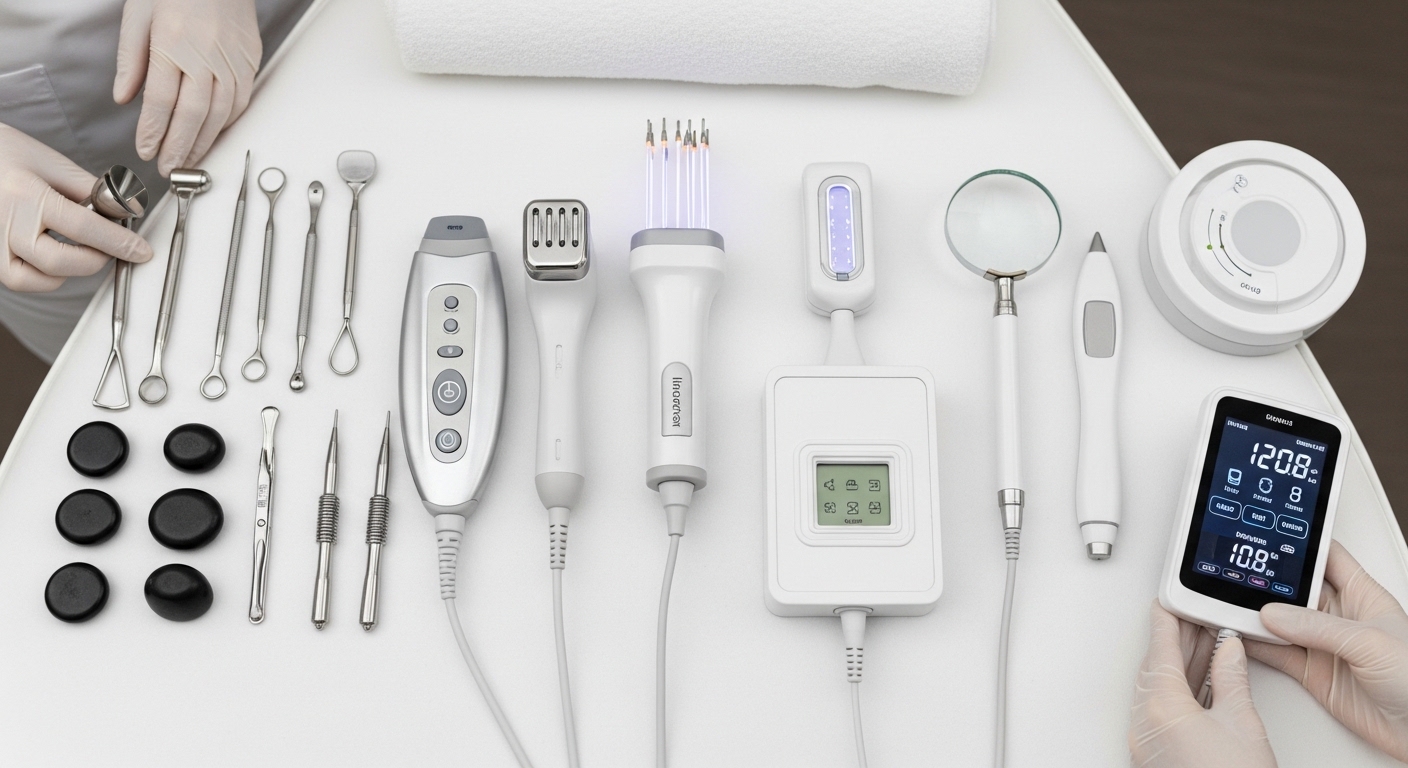
This section is deliberately short. Each tool type is covered in depth in the companion guide to facial tools for estheticians; here is what a practitioner needs to know about each one in the treatment room.
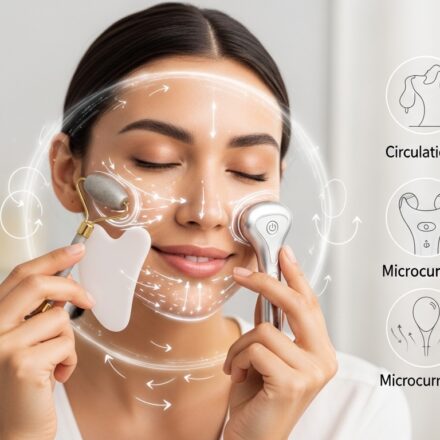
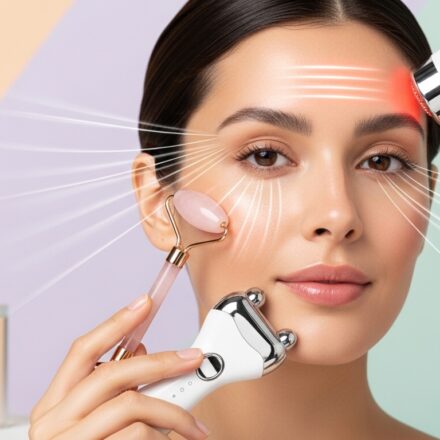
- Massage tools (rollers, gua sha stones, sculpting tools): comfort and even application. They do not drain lymph, improve circulation in a way that changes the skin, firm the skin, or increase how much product the skin absorbs. Use them with a serum or oil so they glide, with light pressure.
- Extraction tools (comedo extractors, lancets): controlled pressure on suitable, prepared skin only. Never on inflamed or swollen acne, open wounds, broken skin, sunburn, or during a rosacea or eczema flare. The American Academy of Dermatology’s guidance on pimples is clear: do not pop a pimple — squeezing can push bacteria deeper, cause scarring, and make the spot worse. An esthetician’s extraction is a trained procedure on suitable skin, not a stronger version of squeezing at home.
- Exfoliation tools (microdermabrasion machines, ultrasonic scrubbers): controlled surface exfoliation. Results are temporary and gradual. They do not remove wrinkles, deep scars or sun damage, and they do not push serums deeper into the skin.
- Powered devices (high-frequency wands, microcurrent machines, LED devices): modest add-ons, not treatments. High-frequency evidence is thin — one small pilot study found fewer inflammatory acne lesions after four weeks of twice-weekly treatment, and a 2022 scoping review of 47 high-frequency devices found no randomized trials supporting their use for facial rejuvenation. Microcurrent evidence is limited to small studies, and its benefits are modest and temporary. LED (red and near-infrared) has the best evidence of the group, and it is still modest and gradual.
- Diagnostic tools (magnifying lamps, skin analysers): they show the surface — blocked pores, dryness, fine lines — so the treatment can be matched to what the skin actually shows. They do not diagnose anything. A changing mole, a sore that does not heal, or a rash that keeps coming back is a reason to refer to a dermatologist, not to treat it in the salon.
- Application tools (spatulas, scoops, brushes): they keep fingers out of jars and products off hands, so bacteria from hands never reach the product. One tool per client, cleaned before the next use.
A device cleared by the regulator in your country has met safety standards for its stated intended use. Clearance is not proof that the marketing claims on the box are true.
Choosing tools
By treatment goal
Acne treatments need accuracy and strict hygiene. Anti-ageing treatments need gentle stimulation and realistic expectations. Sensitive-skin treatments need light touch, smooth surfaces and low pressure. Choose the tool that fits the treatment’s goal, and leave out every tool that does not serve it — extra steps do not add value, they add irritation.
By the client’s skin
Thin skin needs light tools and smooth edges. Thick or resilient skin tolerates stronger stimulation. Reactive skin needs the least pressure and the smoothest surfaces. Adjusting the tool to the client’s skin protects their barrier and improves long-term results.
By experience level
Beginners should learn with simple tools that build technique awareness — massage tools, spatulas, brushes, a magnifying lamp. Advanced practitioners can add specialised tools that need sophisticated control, one at a time, after proper training. Skipping the basics is how mistakes happen: a practitioner who cannot control a roller will not control a microdermabrasion machine.
By quality, not price
A tool’s price says nothing about its evidence. Check whether it is cleared by the regulator in your country, what its stated intended use is, and whether any independent study supports it. Buy solid, mid-range basics first and add powered devices as skill and client demand grow.
The session workflow
A tool should support the facial’s sequence, not interrupt it. Every tool has its moment in the session:
- Prepare the skin. Clean skin, no makeup or sunscreen on the area being treated. Preparation is not optional — tools used on unprepared skin cause friction and irritation.
- Work in order. Cleansing first, then exfoliation if it is planned, then extraction only where suitable, then massage and finishing products. Overloading a session with equipment confuses the skin and tires the client.
- Pressure, technique and direction. Technique outweighs force. Use deliberate, slow movements in the direction of the skin’s natural flow. Pressure should support the skin, not press it back. If the client is in pain, the pressure is wrong — clients rarely complain while they are in pain, so watch the skin: redness, flinching and tension are the signals.
- Timing. A tool used for too long is worse than a tool used briefly. Keep sessions within the manufacturer’s guidance and the client’s tolerance, and leave rest between stimulating steps.
- Finish and record. Note the settings used, the client’s reaction, and anything unusual — so the next session starts from knowledge, not guesswork.
Patch test any new product used with the tools before using it on a client’s face: apply a small amount to a quarter-sized patch of skin on the inside of the arm or the bend of the elbow, twice a day for 7 to 10 days. The American Academy of Dermatology recommends this length because allergic reactions can take several days to appear, and a 24-hour test can miss them.
Client communication
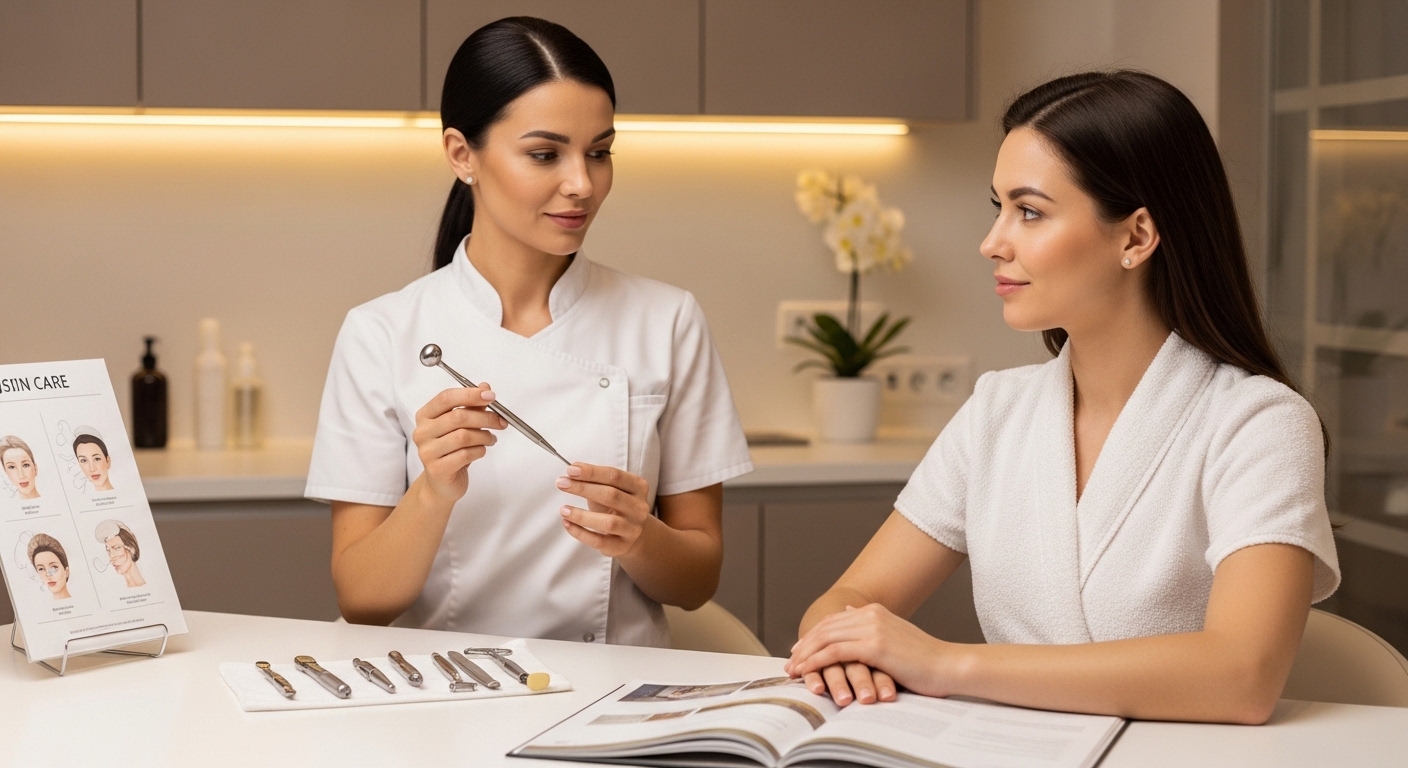
Clients relax when they understand what a tool does. A short, plain explanation before each step — what the tool is, what it will feel like, what it will not do — removes anxiety and builds cooperation. Transparency builds trust; clients are not passive, and they notice when a practitioner cannot explain their own tools.
Manage expectations honestly. Professional tools help gradually. They do not transform skin overnight, and saying so prevents frustration and protects the client relationship. If a client asks for a result a tool cannot give — removing wrinkles, curing acne, lifting the face — say so plainly and explain what can actually help, including a dermatologist referral where that is the honest answer.
Skin feedback during treatment is the practitioner’s real-time guide. Temperature, redness and texture tell you what the client will not say. Adjust pressure, skip a step, or stop — a flexible professional protects the outcome and the client.
Home care is part of the service. Teach clients the basic routine — gentle cleanser, moisturiser, and a broad-spectrum sunscreen with SPF 30 or higher every morning, reapplied every two hours when outdoors — and guide them to safe home tools only. Sunscreen is the single most effective anti-ageing step there is, more effective than any device in this guide. Good home care between visits protects the professional result.
Hygiene
Hygiene is what defines professionalism. It protects the client, the practitioner, and the business — and clients notice it even when they do not comment on it.
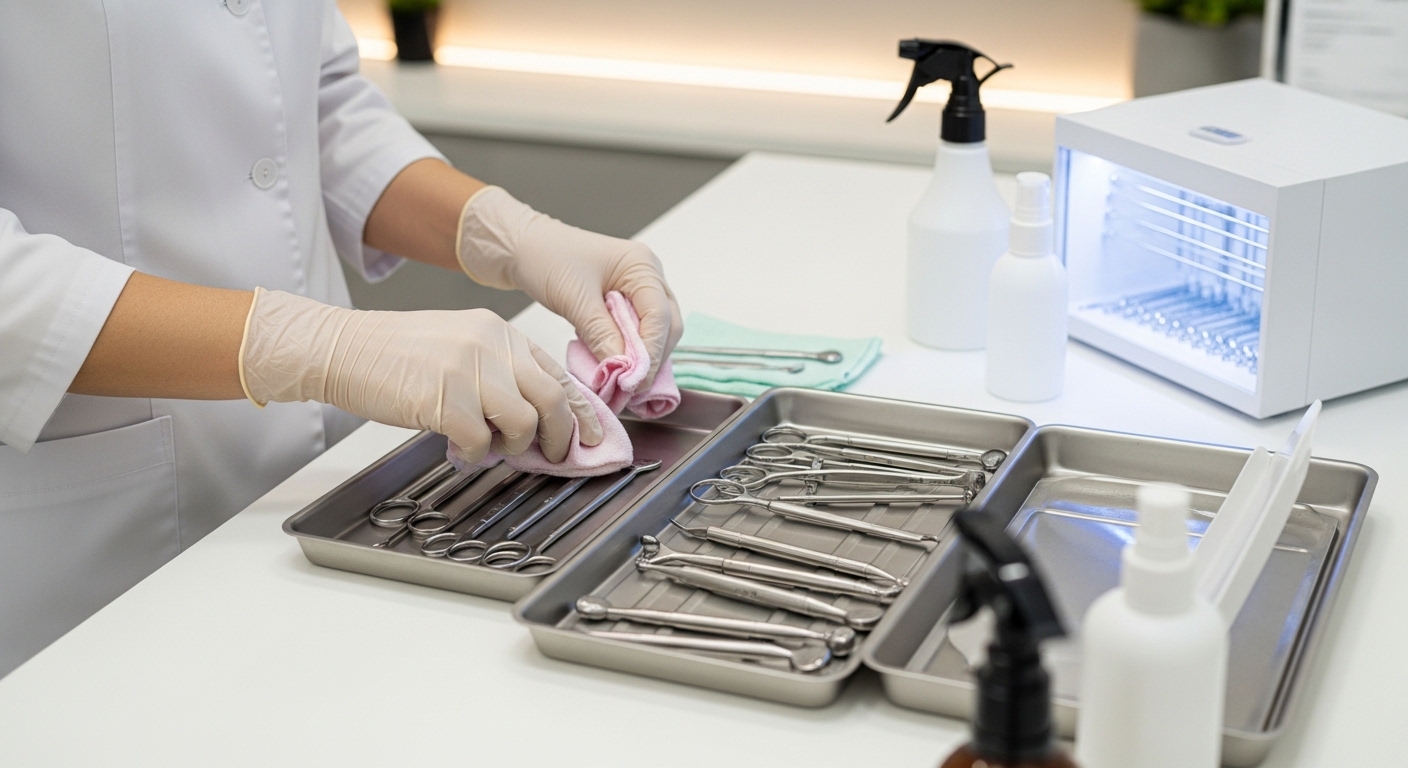
- Clean and disinfect between EVERY client. Not once a day, not once a week — between every client. Wash with mild soap and warm water to remove visible residue first, because disinfectant cannot reach germs hiding under makeup, oil or dead skin. Then disinfect with an EPA-registered disinfectant or 70% isopropyl alcohol, with the contact time the product states, and let the tool dry fully.
- Sterilize only what needs it, and do it properly. Instruments that break the skin — lancets, and any tool that has touched blood — must be sterilized, and sterilization means an autoclave. Steaming is not sterilization. A UV cabinet is not a sterilizer. Soaking in alcohol is disinfection, not sterilization.
- Vinegar and lemon are not disinfectants. Vinegar is a cleaner, not a registered disinfectant. Lemon juice is not a disinfectant at all, and lemon juice on skin is dangerous — it can cause a sun-triggered burn called phytophotodermatitis.
- Do not use household bleach on beauty tools. It corrodes metal, damages bristles and sponges, and irritates skin.
- Use single-use items where they apply. Disposable applicators, cotton, and anything that cannot be disinfected between clients should be used once and thrown away.
- Store tools clean and dry. Dry storage in a clean, dust-free place, in separate trays or pouches. Never store damp tools in closed containers, and never mix clean tools with used ones.
- Check tools daily and weekly. Daily care removes dirt and keeps surfaces safe. Weekly checks catch early wear, loose parts or damage before they cause a problem in a session. Replace tools that are worn, rusted, cracked or shedding — a worn tool cannot be made safe by cleaning it.
Common mistakes professionals make
- Using too many tools in one treatment. More tools do not mean better results. Too many tools in one session overstimulate the skin, and clients walk away red, sore or slow to heal. Every tool needs a definite purpose.
- Applying too much pressure. Effectiveness does not equal pressure. Over-pressure squeezes tissue, breaks capillaries and damages the skin barrier.
- Poor hygiene habits. Hurried cleaning between clients is one of the most common problems in treatment rooms. Residue builds up, surfaces deteriorate, performance drops — and the client’s skin pays for it.
- Operating tools without training. Buying advanced equipment before learning the fundamentals leads to misuse. Knowledge gaps cannot be covered with tools.
- Treating every skin problem with a tool. A tool cannot diagnose or treat a medical condition. Reaching for a device instead of a referral is the wrong call.
- Believing the marketing. “Lymphatic drainage”, “collagen boost”, “product penetration” — if a tool’s claim has no independent evidence behind it, treat it as a claim, not a fact.
Building a kit
A professional kit is built in stages, not bought all at once:
Starter kit (new practitioners): massage rollers or gua sha stones, extraction tools, spatulas and scoops, brushes, a magnifying lamp, and cleaning supplies. These cover most facials and teach the core skills. Simple tools that build control also build confidence.
Next stage (growing services): one powered device, chosen for the clients you actually see — an ultrasonic scrubber for congestion, or a microdermabrasion machine for texture. Learn it properly before adding another. Each addition should serve a specific service, not fill a shelf.
Advanced tools (experienced practitioners): high-frequency wands, LED devices, microcurrent machines and skin analysers, added as experience and client demand grow. Each one needs its own training and its own cleaning routine.
Budget for maintenance, not just purchase: replacement tips, filters, disinfectant, single-use supplies and repairs. A device you cannot maintain is a device you will stop using safely. Quality is better than quantity — it saves money and time in the long run.
Scope of practice
Estheticians do not diagnose skin conditions or treat medical problems. That boundary is not a limitation on the profession — it is what makes the profession trustworthy. Refer a client to a dermatologist promptly if you see: a mole that has changed shape, colour or size; a sore that does not heal; a rash, blister or open sore that keeps coming back; severe, painful or scarring acne; hair loss with scalp pain or sores; or any skin problem that is getting worse despite good care. A referral is good practice, not a failure — it protects the client and the practitioner.
Summary
A professional facial tool is built for repetition, for hygiene between every client, and for a trained operator. It differs from a home tool in strength, durability and the training it assumes — but neither kind diagnoses or treats a medical condition. Choose tools by treatment goal, client skin and experience level, not by marketing claims. Run the session in order, watch the skin rather than the clock, and talk to the client honestly about what each tool can and cannot do. Clean and disinfect between every client, sterilize properly with an autoclave where sterilization is needed, and never rely on vinegar, lemon or steaming as disinfectants. Build the kit in stages, replace worn tools, and refer anything medical to a dermatologist.
Sources: American Academy of Dermatology, 7 Rosacea skin care tips (patch-test method: apply a new product to a quarter-sized patch of skin on the inside of the arm for 7–10 days); American Academy of Dermatology, How to select anti-aging skin care products (broad-spectrum sunscreen, SPF 30 or higher every morning, reapply every two hours outdoors). This is a researched overview, not a hands-on review.