Researched overview. This guide is based on published dermatology guidance, not on hands-on product testing by BeautyKob. No product in this guide was tested by us, and no product or brand is recommended.
Table Of Content
- Quick answer
- What counts as a simple device
- The simple set
- Matching devices to skin type
- One device per day
- What devices do — and do not do
- Pressure control
- Combining devices and products
- Cleaning
- Signs of overuse — and when to stop
- Special cases
- Premium vs budget
- Measuring improvement without obsessing
- Travel and seasons
- Patch testing and sunscreen
- When to see a dermatologist
- FAQ
- Summary
Quick answer
A simple skin device is a low-intensity home tool you can use in a few minutes a day: a cleansing brush, a roller, a gua sha stone, a microcurrent device, or a low-power LED lamp. Simple means few tools, short sessions, and low effort — not a drawer full of gadgets.
The approach that works is minimalism: one device at a time, one device per day, with rest days built in. Most people fail not from lack of discipline but from buying too many devices and using them all at once, which overloads the skin. Start with one device for two weeks, watch how the skin responds, and add a second only if the first is working well.
No simple device produces radical change in a single session, and none replaces cleanser, moisturiser and sunscreen. What they offer is slow, incremental support — smoother feel, better hydration, less morning puffiness — over weeks of steady use. This guide is general information, not medical advice.
Contents: What counts as simple · The simple set · Matching to skin type · One device per day · What devices do — and do not do · Pressure control · Combining devices and products · Cleaning · Signs of overuse · Special cases · Premium vs budget · Measuring improvement · Travel and seasons · When to see a dermatologist · FAQ
What counts as a simple device
A simple device:
- Works at low intensity — vibration, light, microcurrent, suction, or gentle massage pressure.
- Is used in brief sessions, usually 10–15 minutes, once a day at most.
- Is easy to clean and easy to store where you can see it.
- Does not leave the skin swollen, burning or painful. If a device feels burning or sharp, it is too intense and should be avoided.
It is not a substitute for a dermatologist, and it does not produce radical change in one session. It supports slow, incremental improvement — and only when the rest of the routine (gentle cleansing, moisturiser, daily sunscreen) is already in place.
The simple set
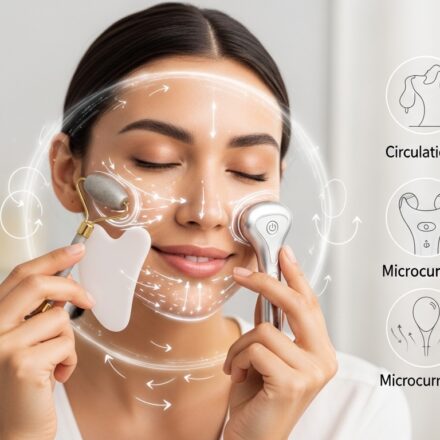
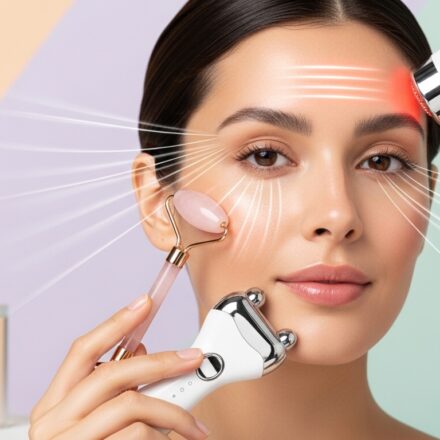
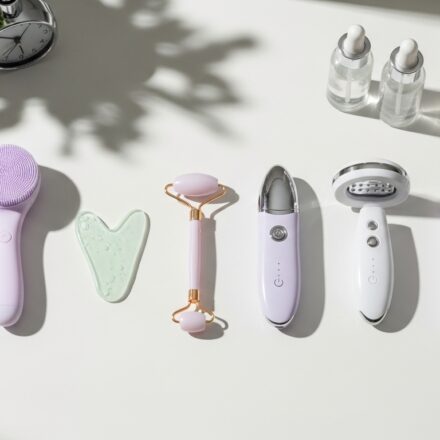
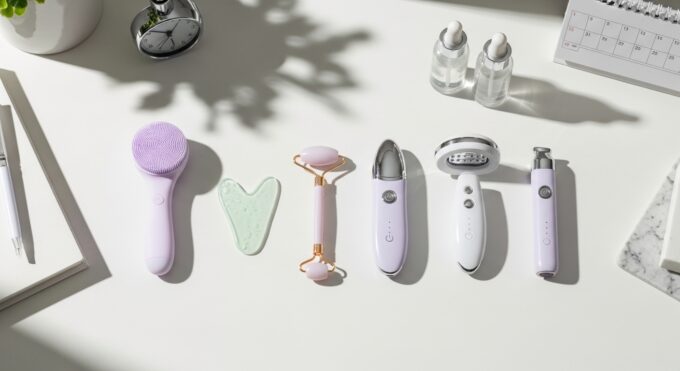
Five tools cover nearly everything a daily routine needs. Each one is described in one paragraph, with its limit stated plainly:
Facial cleansing device. A silicone brush with soft bristles and gentle vibration. It helps remove leftover sunscreen, makeup and daily grime. It suits oily and combination skin best; on dry or sensitive skin, use it at most twice a week, because overwashing removes natural oils and causes dryness.
Facial roller. A stone or metal roller used with light pressure and slow upward strokes. It can reduce morning puffiness briefly and feels pleasant. It does not drain lymph, firm skin, or slim the face — those claims have no good evidence. Avoid strong back-and-forth motion.
Gua sha tool. A flat, curved stone tool for facial massage. It needs technique: light pressure, minimal movement, and a slippery product so it glides. It helps relax muscles and reduce jaw tension. Mild redness afterwards is normal; scraping hard enough to bruise is not.
Microcurrent device. A low-level electrical current device meant to support muscle tone and the appearance of facial contour. The evidence is thin: small studies, modest and temporary effects. It is not suitable for people with pacemakers or certain medical conditions. The sensation should be mild tingling, never a sharp shock or pain.
Low-power LED device. Red light is the best-evidenced of the home devices (Wunsch & Matuschka), and even so the effects are modest and gradual. Blue light is used for acne-prone skin, but it is a support for a routine, not an acne treatment. Follow the manufacturer’s session length, wear any eye protection supplied, and do not expect visible change in a couple of weeks.
Matching devices to skin type
- Dry skin. Avoid harsh suction or scrubbing devices. Choose soft massage and red LED, apply a hydrating serum before using a device, and pause if flaking appears.
- Oily skin. Can tolerate a cleansing brush more often. Blue LED and light massage can help with congestion. Avoid over-suction — daily vacuuming may rupture capillaries.
- Sensitive skin. Extremely delicate; requires the gentlest care. Use a silicone brush once or twice a week, red LED at the lowest setting, and a gentle roller. Avoid daily exfoliation. Test any new device on a small area first.
- Mature skin. Microcurrent and red LED are the usual choices. Focus on consistency, not intensity. Apply light pressure and prioritise hydration.
One device per day
Many routines fail because several devices are bought and used simultaneously. Start with one device for two weeks and observe the skin before adding anything.
Morning example: light cleanser; light serum; roller or microcurrent device; moisturiser and sunscreen.
Evening example: thorough cleanse; treatment serum; LED device if needed; moisturiser.
A 7-day balance plan:
| Day | Device |
|---|---|
| 1 | Cleansing device |
| 2 | Massage or roller |
| 3 | LED |
| 4 | Rest |
| 5 | Microcurrent |
| 6 | Massage |
| 7 | Full rest |
Rest days are not wasted days. Skin recovers during rest, and recovery is when improvement happens. Two rest days a week is a reasonable pattern.
What devices do — and do not do
What they do:
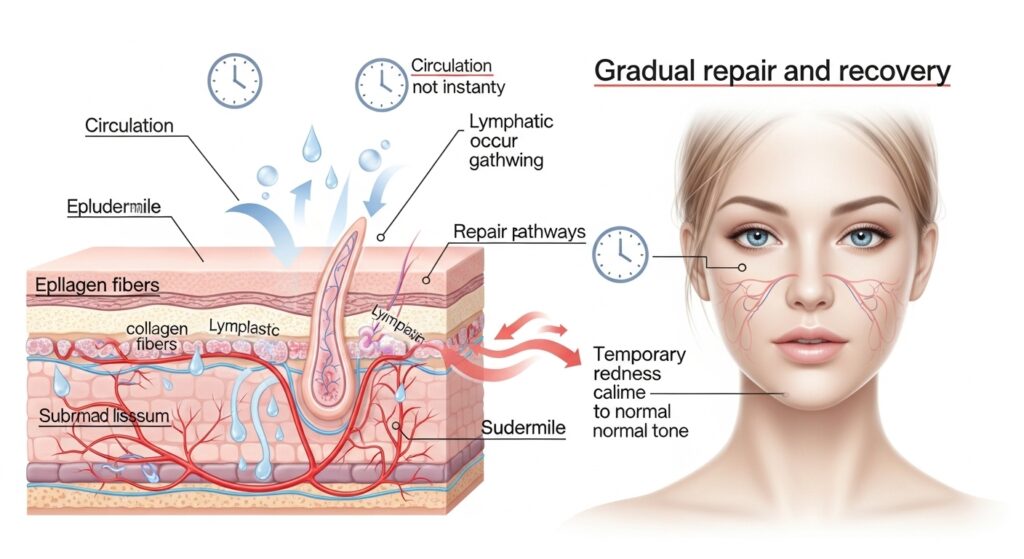
- Massage and warmth. Rollers and vibration tools increase blood flow to the surface briefly, which can make skin look brighter and feel less puffy for a short time.
- Muscle relaxation. Facial tension from jaw clenching or screen time contributes to expression lines. Massage devices relieve tension, which can soften their look over time.
- Routine support. A device used regularly makes a routine feel more complete, which helps consistency — and consistency is what produces any small benefit.
What they do not do:
- They do not make products absorb better. Devices spread serums and gels evenly across the surface, but they do not push products deeper into the skin. Any claim of “better absorption” is not supported.
- They do not drain lymph or firm skin. Rollers and gua sha do not drain lymph, and no home device firms skin structurally.
- They do not work to a fixed timeline. There is no reliable “LED clears acne in four weeks” or “visible change in three months” rule. Skin-cell turnover is often quoted as 28 days, but that is a rounded rule of thumb — Weinstein (1984) calculated 47–48 days, and the real figure varies with age and skin. Judge by how the skin feels over a month, not by a date on a calendar.
- They do not replace professional treatment. Home devices are much weaker than clinic machines. Daily devices maintain results and support the skin between professional treatments; they do not reset it the way a clinic treatment does.
Pressure control
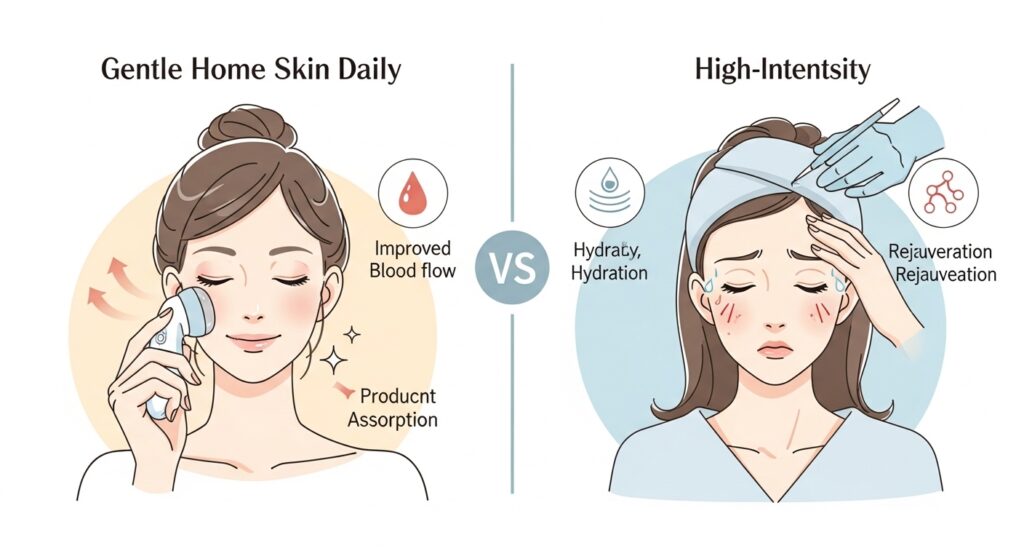
Pressure determines safety. Too much pressure stretches the skin and breaks capillaries; too little does nothing at all.
- A deep redness that lasts more than 30 minutes after a session means the pressure was too high.
- In gua sha or rolling, the tool should glide. If it drags, add a slippery product. Pressing harder on dry skin causes irritation, not better results.
- In microcurrent, the feeling should be mild tingling. A sharp jump or pain means the intensity is too high.
- If a tool pulls the skin violently, it stretches it over time. Light, even movement is the whole technique.
Combining devices and products
Devices need slip. Slip minimises friction and irritation — but thick creams block movement, so use water-based serums, hydrating gels, or a light microcurrent conducting gel. Do not run microcurrent through thick oils; oils reduce electrical flow.
- Use a retinoid after device use, not before it, because retinoids make skin more sensitive.
- Do not use acid exfoliants on the same day as suction or a hard cleansing tool. Space them out.
- After a device session, seal in hydration with a richer cream if the skin feels dry.
- Do not pair two stimulating devices in the same session — for example microcurrent plus suction, or an exfoliating brush plus a pore vacuum. Safe combinations are gentle ones: massage plus LED, or a roller plus a serum.
Cleaning
Hygiene makes or breaks progress with daily devices. Tools touch skin oils, sweat and environmental debris every day, and uncleaned tools grow bacteria. Breakouts after starting a device are more often a hygiene problem than a “purging” reaction — purging is associated with retinoids and acids, not with devices, and a spreading cluster of new breakouts points to contamination or overuse, not healing.
- After every use: blot or wash the tool with a mild cleanser and water. Wipe metal tools with an alcohol wipe where the material allows it. Let the tool dry fully before storing.
- Weekly: clean more thoroughly, including removable heads, following the manufacturer’s instructions.
- Storage: keep tools in a dry place. Closed humid containers encourage bacteria. Replace silicone brush heads when the manufacturer recommends it.
- Clean is not sterile. Washing and disinfecting a home tool is not sterilisation — no home method sterilises, and only an autoclave does that. Do not share tools between people.
Signs of overuse — and when to stop
Stop using a device and let the skin rest if you notice:
- Persistent redness or a burning sensation
- Increased breakouts in clusters
- Flaky patches or a tight feeling
- Broken capillaries on the nose or cheeks
- Sudden rash or unusual swelling
- Headache after microcurrent use
Take at least a week off if irritation is strong, then reintroduce one device slowly at the lowest setting. Do not push through pain — restraint is part of the routine, and a long-lasting symptom should be referred to a dermatologist.
Special cases
Do not use devices daily if you have:
- An active eczema flare
- Open wounds
- A recent chemical peel or laser treatment (wait until the professional who treated you says it is safe)
- Severe cystic acne
People who are pregnant should ask a doctor before using microcurrent devices. Safety always comes first, and a device is never urgent — the skin can wait.
Premium vs budget
An expensive price does not necessarily mean high performance. Check for clear instructions, adjustable intensity, safety certification marks, and warranty coverage. Avoid gadgets with vague claims.
A low-quality tool used correctly is better than an expensive tool used badly. What matters is not the price but whether the device is simple, cleanable, and used gently and regularly.
Measuring improvement without obsessing
Do not measure daily. Check once after 30 days, in the same lighting, and ask:
- Does my skin feel smoother?
- Do breakouts heal faster?
- Is morning puffiness less?
- Does my skin feel more hydrated?
If the answer is yes, the routine is working. Minor gains over a month are the realistic outcome; dramatic lifting is not.
Travel and seasons
- Winter: reduce harsh cleansing devices. Focus on hydration-based tools and red LED.
- Summer: oil production rises, so a cleansing brush may be useful more often — but sun sensitivity also rises, so do not over-exfoliate before sun exposure.
- Travel: simplify. Carry one device only.
Patch testing and sunscreen
Patch test any new product before using it on your face. The AAD’s method is: apply the product to a quarter-sized patch of skin on the inside of your arm or the bend of your elbow, twice a day for 7 to 10 days. The AAD recommends this length because allergic reactions can take several days to appear, and a 24-hour test can miss them. If the patch becomes red, itchy, swollen or blistered, do not use the product on your face. The same caution applies to a new device: try it on a small area first, at the lowest setting.
Sunscreen every morning. Use a broad-spectrum sunscreen with SPF 30 or higher as the last step of the morning routine, and reapply every two hours when outdoors, or after swimming or sweating. Sunscreen is the single most effective anti-ageing step (Hughes et al. 2013), and no device replaces it.
When to see a dermatologist
See a dermatologist if: breakouts keep increasing despite stopping the device; redness, rash or swelling does not settle after a week off; broken capillaries appear; you have a skin condition such as eczema, rosacea or acne and are unsure whether a device is safe; or you are pregnant and a device manual warns against use. A dermatologist can also advise on professional treatments that home devices cannot replace.
FAQ
How many devices do I need?
One, to start. Most daily routines need at most two or three, used on different days. A drawer full of devices is a sign the routine is too complicated, not too simple.
Which device should I start with?
The one that matches your main concern and is simplest to use — usually a cleansing brush or a roller. Use it for two weeks before deciding whether to add anything.
Do devices make my skincare products work better?
No. They spread products evenly on the surface. They do not push products deeper into the skin.
How long before I see results?
There is no fixed timeline. Some people notice smoother-feeling skin within a few weeks; visible change, if it comes, takes a month or more of steady use. Judge after 30 days, not after two.
Can I use a device every day?
Some gentle devices are designed for daily use, but rest days matter. Start less often than the manual suggests, watch the skin, and keep at least two rest days a week.
Is it normal for my skin to break out when I start a device?
A few new spots can happen, but a spreading cluster of breakouts usually means the tool was dirty, the pressure was too high, or the skin was overstimulated. Clean the tool, reduce frequency, and take a break. If breakouts keep increasing, stop and ask a dermatologist.
Summary
Simple skin devices work when they stay simple: one device at a time, one device per day, short sessions, light pressure, and rest days. The useful set is small — a cleansing brush, a roller, a gua sha stone, a microcurrent device, or a low-power LED lamp — and each one has modest, gradual effects, not fixed timelines or dramatic change. They do not make products absorb better, drain lymph, or firm skin. Keep tools clean, patch test new products for 7 to 10 days, wear SPF 30+ every morning, and stop if the skin stays red, breaks out, or hurts. If a symptom does not settle after a week off, see a dermatologist.
Sources: American Academy of Dermatology, 7 Rosacea skin care tips (patch-test method: apply a new product to a quarter-sized patch of skin on the inside of the arm for 7–10 days); American Academy of Dermatology, How to select anti-aging skin care products (broad-spectrum sunscreen, SPF 30 or higher, reapply every two hours outdoors). This is a researched overview, not a hands-on review.