Researched overview. This guide is based on published dermatology guidance, not on hands-on product testing by BeautyKob. No product in this guide was tested by us.
Table Of Content
Quick answer
Sensitive skin reacts easily — stinging, redness, dryness or itching after products that other people use without trouble. The fix is not a brand name. It is a short routine of gentle products, chosen by reading the ingredient list, and a patch test before anything new goes on your face.
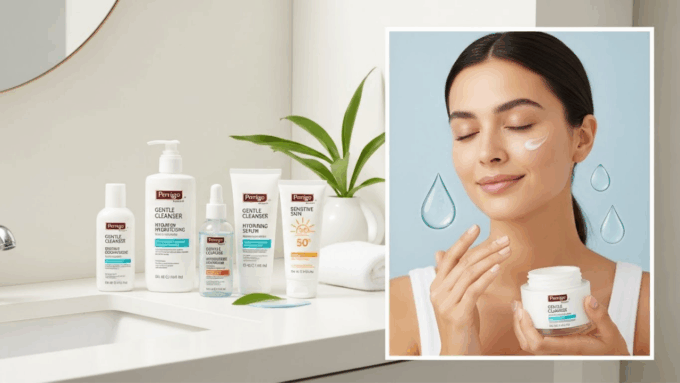
The three steps that matter most are: a mild cleanser, a simple moisturiser, and a broad-spectrum sunscreen with SPF 30 or higher every morning. Everything else is optional.
If your skin is persistently red, sore, blistering, or you have a rash that does not settle, skip the new products and ask a dermatologist or pharmacist first. This guide is general information, not medical advice.
Contents: What sensitive skin needs · What Perrigo actually is · How to read a label · A simple routine · Patch testing · Mistakes · When to get help
What sensitive skin needs
Sensitive skin usually has a weaker skin barrier — the outer layer that keeps water in and irritants out. When that barrier is weak, products, weather and friction cause reactions more easily.
What helps most is boring and consistent:
- Fewer products. Each new product is another chance of a reaction. A short routine is easier to troubleshoot.
- Fragrance-free products. Fragrance is one of the most common causes of reactions to skincare. “Fragrance-free” means no fragrance was added; “unscented” can still mean a masking fragrance was used, so check the ingredient list.
- Gentle cleansing. A mild, low-foaming cleanser and lukewarm water. Hot water and harsh scrubbing strip the barrier.
- Barrier support. Moisturisers that combine a humectant (draws in water, e.g. glycerin, hyaluronic acid), an emollient (softens, e.g. ceramides, squalane) and, for dry skin, an occlusive (seals water in, e.g. petrolatum, shea butter).
- Daily sunscreen. UV exposure worsens redness and sensitivity over time. A mineral sunscreen (zinc oxide or titanium dioxide) is often better tolerated by reactive skin than a chemical one.
What Perrigo actually is — and what it is not
Perrigo is a real company. It makes store-brand and over-the-counter products — the kind sold under a pharmacy’s own label — including benzoyl peroxide acne gels and ammonium lactate lotion sold under the Perrigo name.
It is not a single sensitive-skin skincare line, and it should not be presented as one:
- Some Perrigo products are not suitable for sensitive skin. Perrigo’s 10% benzoyl peroxide acne gel is described by retailers as not suitable for sensitive skin, because it may cause irritation, dryness or redness. A high-strength acne treatment is the opposite of a gentle sensitive-skin product.
- The “no parabens, no sulfates” claim is wrong. Published ingredient lists show Perrigo’s 2.5% benzoyl peroxide gel contains methylparaben, its 5% acne wash contains a sulfate surfactant, and its ammonium lactate lotion contains methylparaben and propylparaben. A brand name tells you nothing about what is in the tube — only the ingredient list does.
- No specific Perrigo product was ever named in the original article. A recommendation that names no product, no strength and no ingredient list is not a recommendation at all.
The honest rule is the same for Perrigo as for any brand: judge the product, not the name on the front. Read the back of the pack.
How to read a label
- Read the full ingredient list. Ingredients are listed in order of amount, highest first. If fragrance, drying alcohol (alcohol denat.) or a strong active is near the top, think twice.
- “Hypoallergenic” is not a guarantee. It means the maker considers the product less likely to cause a reaction. It does not mean it cannot cause one — and it is not a regulated standard. Patch test anyway.
- “Dermatologist tested” is not the same as “dermatologist recommended”. Tested means someone tried it under supervision; it does not mean it works for your skin.
- Check the active ingredient and its strength. For acne products, the active matters more than the brand — benzoyl peroxide at 2.5% is a common starting point, and higher strengths add irritation more than they add benefit for most people. Start low.
- Watch for your own triggers. If you know a product with fragrance, a particular preservative, or a strong acid caused a reaction before, check every new label for it. More than 15,000 substances can cause an allergic skin reaction, according to the American Academy of Dermatology (AAD).
A simple routine for sensitive skin
Morning
1. Cleanse gently. Lukewarm water and a mild cleanser. If your skin feels tight after washing, your cleanser is too strong.
2. Moisturise. A light lotion or cream, while the skin is still slightly damp.
3. Sunscreen — every morning. Broad-spectrum SPF 30 or higher, as the last step. The AAD recommends this daily, including on cloudy days, and reapplying every two hours when outdoors. (AAD sunscreen guidance)
Night
1. Cleanse. Remove sunscreen, makeup and the day’s build-up.
2. Moisturise. The same moisturiser, or a slightly richer cream if your skin is dry.
That is the whole routine. Add one thing at a time — never two new products in the same week — so you can tell what caused a reaction if one appears.
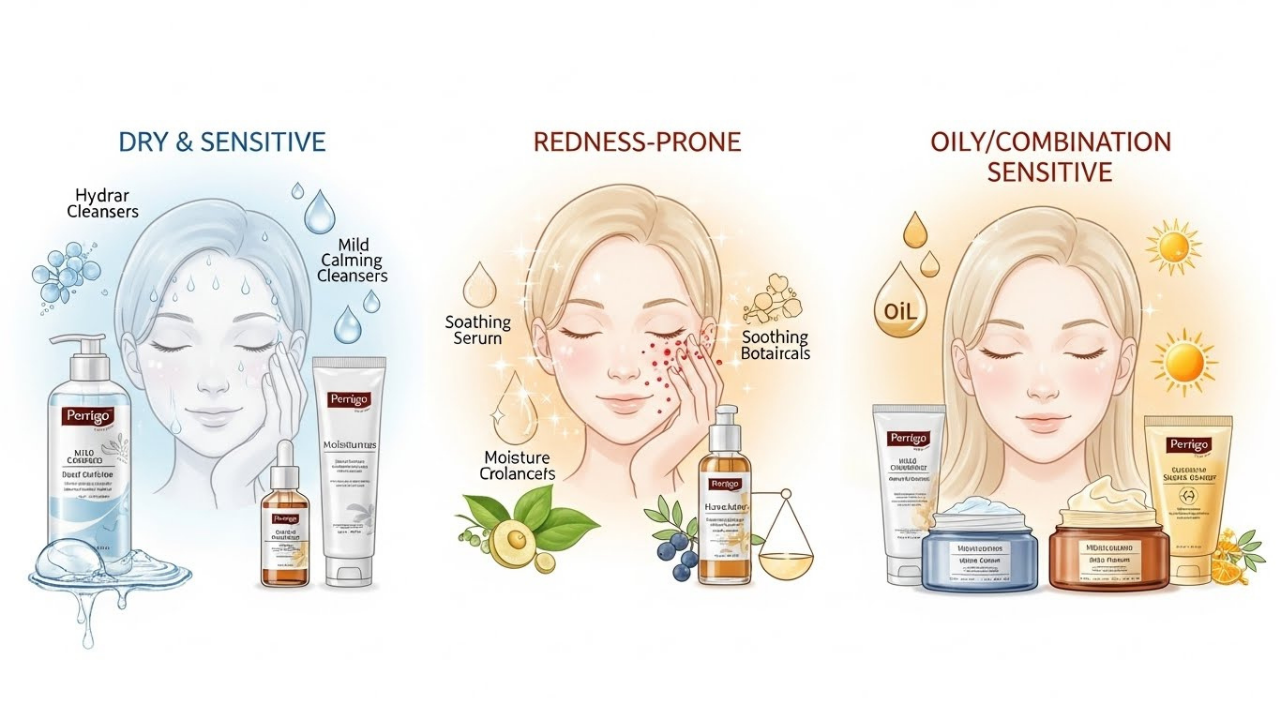
By skin type:
– Dry + sensitive: a richer cream, less cleansing, no foaming wash that leaves skin tight.
– Oily + sensitive: light gel or lotion textures; you still need moisturiser — skipping it can leave skin dehydrated and reactive.
– Redness-prone: keep the routine shortest of all. Fragrance-free everything, no scrubs, no strong actives until the skin is calm.
How to patch test a new product
Do this before any new product goes on your face. The AAD’s method, as summarised by Healthline from AAD guidance:
- Choose a test spot about the size of a quarter, somewhere the product will not be rubbed or washed off — the inside of your forearm or the bend of your elbow.
- Apply the product twice a day for 7 to 10 days, using the amount and thickness you would normally use. Leave it on for as long as you usually would with a similar product.
- Watch for a reaction. Redness, itching, burning, swelling, bumps or blisters mean stop — wash the product off and do not use it again.
- If the spot stays clear for the full 7 to 10 days, you can usually add the product to your routine.
A 24-hour test is not enough: allergic reactions can take 48 to 96 hours to appear, which is why the AAD recommends the longer period. A home patch test is a precaution, not a diagnosis — it cannot guarantee your face will never react, and facial skin is thinner and more reactive than the skin on your arm. (Healthline, summarising AAD guidance)
Mistakes that make sensitive skin worse
- Buying a brand instead of reading the ingredient list.
- Starting several new products at once, so you cannot tell which one caused the reaction.
- Using a strong acne treatment (like 10% benzoyl peroxide) on sensitive skin because the brand looked gentle.
- Skipping sunscreen — UV exposure adds redness and slows recovery.
- Scrubbing, hot water, or exfoliating daily.
- Changing products every few days, so your skin never settles.
- Assuming “natural” or “hypoallergenic” on the label means safe for you.
When to get help
Ask a dermatologist or pharmacist if: your skin is persistently red, sore, swollen or blistering; you have a rash that does not settle; you have eczema, rosacea or acne that is getting worse; a product causes a reaction even after patch testing; or you are unsure whether an active ingredient is safe for you.
Summary
Sensitive skin needs a short, gentle routine and products chosen from the ingredient list — not from a brand name. Perrigo is a manufacturer of store-brand products, not a sensitive-skin line, and some of its products are not suitable for sensitive skin at all. Cleanse gently, moisturise, wear broad-spectrum SPF 30+ every morning, patch test every new product for 7 to 10 days, and add only one new product at a time.
Sources: published ingredient lists for Perrigo benzoyl peroxide gels and ammonium lactate lotion; AAD sunscreen guidance; AAD patch-test guidance as summarised by Healthline. This is a researched overview, not a hands-on review.