Researched overview. This guide is based on published dermatology guidance, not on hands-on product testing by BeautyKob. No product in this guide was tested by us.
Table Of Content
- Quick answer
- What sensitive skin is
- The short routine
- Choosing a cleanser
- Moisturiser: keeping water in
- Sunscreen: daily, even indoors
- Patch test before you commit
- Exfoliation: less is more
- Soothing ingredients, honestly
- Lifestyle: what helps, and what does not
- Skin journal: keeping track
- Troubleshooting
- Sample routines
- When to get help
- Frequently asked questions
- Summary
Quick answer
Sensitive skin reacts easily — redness, stinging, itching or dryness after products that suit other people. The fix is not more products. It is a short, steady routine: cleanse gently, moisturise, and protect with sunscreen every morning. Everything else is optional, added one at a time, and only if your skin stays comfortable.
If your skin is persistently red, sore, swollen or blistering, or you have a rash that does not settle, skip the extras and ask a dermatologist or pharmacist first. This guide is general information, not medical advice.
Contents: What sensitive skin is · The short routine · Choosing a cleanser · Moisturiser · Sunscreen · Patch test · Exfoliation · Soothing ingredients, honestly · Lifestyle · Skin journal · Troubleshooting · Sample routines · When to get help
What sensitive skin is
Sensitive skin is skin whose barrier — the outer layer that keeps water in and irritants out — is easily disturbed. When the barrier is weakened, products, weather, pollution and friction are more likely to cause redness, stinging, itching or dryness. Sensitive skin is not a single diagnosis: it can come with eczema, rosacea or acne, or it can simply be skin that reacts more than average.
Common triggers are: alcohol and fragrance in products, strong acids and retinoids, harsh scrubs, hot water, cold wind, sun and pollution. Sleep and stress can also make skin feel worse in general, although no routine can promise that fixing sleep will fix your skin. The first step is knowing your own triggers — which products cause a reaction, and in which season your skin flares most.
The short routine
You need three kinds of step, not three of each kind:
- Gentle cleanser
- Moisturiser
- Sunscreen in the morning
That is the whole routine. A soothing serum is optional, and only one new product should be added at a time. Keeping the routine short makes reactions less likely, and makes it easier to work out what helps.
Choosing a cleanser
Wash morning and evening with lukewarm water — not hot water, which strips the skin’s natural oils and makes sensitivity worse. Use a mild, creamy or gel cleanser that is sulfate-free and fragrance-free. Look for glycerin, aloe or chamomile on the ingredient list, and for the words “fragrance-free” and “hypoallergenic” — remembering that “hypoallergenic” has no federal standard or definition (US FDA), so it is not a guarantee; the ingredient list matters more than the front of the bottle.
- Apply the cleanser with light, circular movements using your fingertips.
- Rinse thoroughly but gently. Do not rub or scrub with a rough cloth.
- Pat dry with a soft towel. Do not wipe hard.
- If your skin feels tight after washing, your cleanser is too strong.
Moisturiser: keeping water in
Dryness is a common problem in sensitive skin, even when it is also oily. A moisturiser helps the barrier hold water and feel comfortable. Use a light, fragrance-free, non-comedogenic moisturiser, and apply it while the skin is still slightly damp after washing.
Useful ingredients, and what they do:
- Hyaluronic acid and glycerin — humectants that draw water into the skin.
- Ceramides — fats that help replace the skin’s barrier and keep irritants out.
- Squalane — a light emollient that softens without feeling heavy.
- Aloe vera — commonly used to soothe, with limited evidence for calming redness.
On very dry patches you can use a slightly richer cream. Avoid heavy creams that block pores on the rest of the face.
Sunscreen: daily, even indoors
Sun is harsh on sensitive skin, causing redness, dryness and long-term damage. Sunscreen should be used every day, including on cloudy days. If you spend long periods near windows, UVA can pass through glass, so sunscreen matters there too — but ordinary indoor lighting does not meaningfully affect skin. Use a broad-spectrum sunscreen with SPF 30 or higher, as the last step of your morning routine, and reapply every two hours when outdoors.
Mineral sunscreens, with zinc oxide or titanium dioxide as the active ingredients, are often better tolerated by sensitive skin. They sit on the skin’s surface and help block UV, rather than being absorbed into it. If a new sunscreen stings, try it on a small patch of skin first (see patch test below) before using it on your whole face.
Patch test before you commit
The American Academy of Dermatology recommends testing a new product before using it on your face. Apply the product to a quarter-sized patch of skin where it will not be rubbed or washed away — the underside of your arm or the bend of your elbow — twice a day for 7 to 10 days. For a rinse-off product such as a cleanser, leave it on for about five minutes, or as long as the label says, then rinse it off. If the test area becomes red, itchy, swollen or painful, stop using the product. If the area stays clear for the full 7 to 10 days, the product is less likely to cause a reaction on your face — but a patch test cannot guarantee it.
A 24-hour test can miss an allergic reaction, which often takes several days to appear — that is why this guide uses the AAD 7–10 day patch-test method.
Exfoliation: less is more
Exfoliation removes dead skin from the surface, but on sensitive skin too much of it causes redness, stinging and barrier damage. Keep it gentle and infrequent:
- Use a mild chemical exfoliant — a low-strength lactic acid or a polyhydroxy acid (PHA) — once a week at most, and once every two weeks is enough for many people.
- Do not use coarse physical scrubs. They irritate sensitive skin.
- Stop if you get redness, stinging, flaking or tightness, and go back to cleanser, moisturiser and sunscreen until the skin settles.
- Do not exfoliate on the same night as a strong retinoid or another strong active unless a dermatologist has advised it.
Enzyme masks (papaya or pumpkin) are sometimes sold as gentle exfoliants. There is limited evidence they do anything useful for sensitive skin, and they can still irritate — patch test first, and treat them as optional.
Soothing ingredients, honestly
Sensitive skin often responds well to simple, calming ingredients — but none of them is a treatment or a cure, and none of them replaces a proper routine.
- Aloe vera. One of the most widely used soothing ingredients. It can feel cooling on irritated skin. The evidence that it calms redness is limited, and it is not a pain reliever. Choose a fragrance-free, alcohol-free gel.
- Colloidal oatmeal. Finely milled oats. The US FDA lists colloidal oatmeal as a skin protectant, and the American Academy of Dermatology recommends colloidal oatmeal baths as one option for relieving dry, itchy skin. Small trials of 1% colloidal oatmeal creams have shown improvements in dryness and itching in mild-to-moderate eczema. It can help with comfort — it does not cure redness, dryness or eczema, and it does not replace treatment a clinician has prescribed.
- Green tea and chamomile. Rich in antioxidants and widely described as anti-inflammatory. The evidence that they calm skin or strengthen the barrier is limited. Treat them as a nice-to-have in a moisturiser or toner, not as the reason a product works. Do not put ice, or an iced compress, directly on sensitive skin.
Lifestyle: what helps, and what does not
- Sleep and stress. Sleep matters for your skin in general, and stress can make skin feel more reactive. Simple stress-reduction habits — a short walk, meditation, journaling — help your wellbeing overall. No routine can promise that better sleep will clear your skin, and stress is not the cause of sensitive skin.
- Food and water. A balanced diet with fruit, vegetables and enough water is good for your health. No food has been shown to treat sensitive skin, and drinking water does not “remove toxins” from the body. Restricting foods on the basis of a skincare article is not good advice.
- Environment. Protect your skin from wind, extreme temperatures and pollution with hats and protective clothing, and keep using sunscreen. Avoid sudden temperature changes where you can.
Skin journal: keeping track
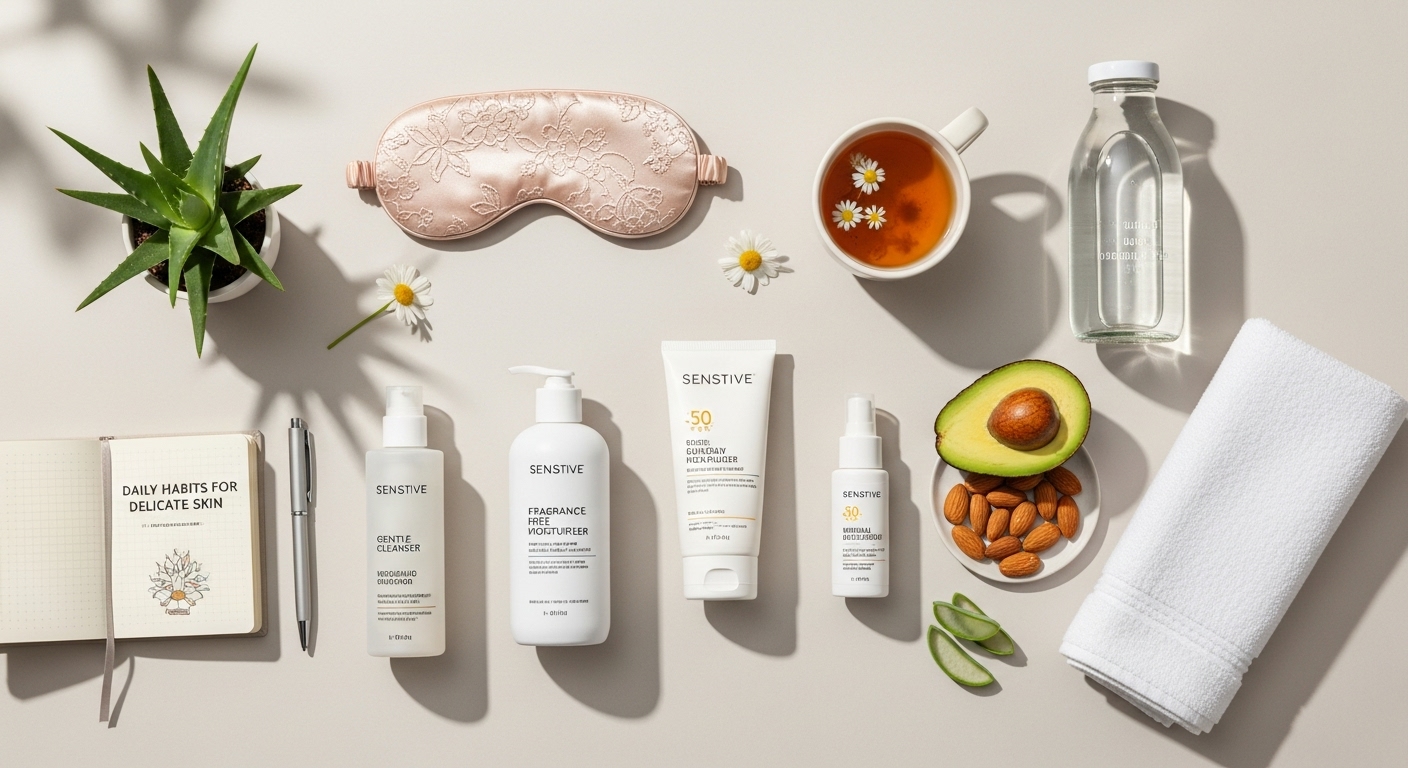
Sensitive skin varies from day to day, and a simple journal is one of the most useful habits in this guide. Note: what you used, any redness, dryness or reaction, how you slept, your stress level, and the weather. Over weeks, patterns appear — a product that always stings, a season when your skin flares, a habit that helps. Change one thing at a time, and give each change at least two to four weeks before judging it. If you change three products at once, you will not know which one mattered.
Troubleshooting
- Redness and irritation. Stop the suspected product. Go back to cleanser, moisturiser and sunscreen only. A cool compress with plain water can feel soothing. Avoid sun exposure until the skin settles. If redness does not settle in a few days, ask a dermatologist or pharmacist.
- Dryness and flaking. Reduce exfoliation, use a richer moisturiser, and wash with lukewarm rather than hot water. Barrier-repair ingredients such as ceramides or squalane can help.
- Breakouts. Do not use heavy, pore-blocking products. Use a light spot treatment with calming ingredients, and note in your journal what may have triggered it. Do not squeeze spots — that can worsen redness and scarring.
Sample routines
Morning:
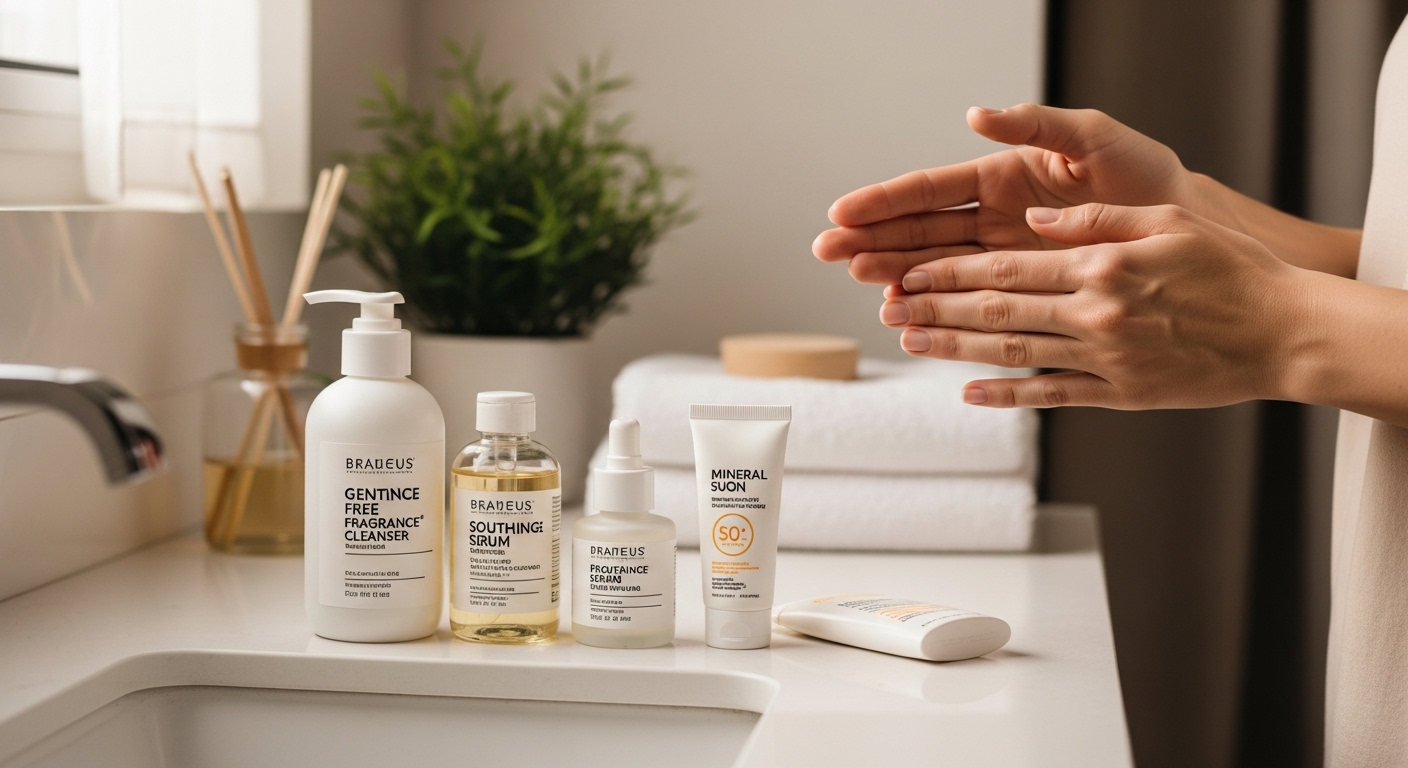
1. Gentle fragrance-free cleanser, lukewarm water.
2. Light moisturiser with ceramides or glycerin.
3. Mineral sunscreen, broad-spectrum SPF 30 or higher.
Evening:
1. Cleanser, to remove sunscreen, dirt and pollutants.
2. Optional soothing serum (aloe or ceramides).
3. Slightly richer moisturiser if your skin is dry.
Consistency matters more than complexity. A short routine used every day beats a long routine used for a week and abandoned.
When to get help
Ask a dermatologist or pharmacist if: your skin is persistently red, sore, swollen or blistering; you have a rash that does not settle; you have a skin condition such as eczema, rosacea or acne that is getting worse; or you are unsure whether a product is safe for you. Bring the products you use, or photos of their ingredient lists.
Frequently asked questions
Q1: What is the main cause of sensitive skin?
Usually a weakened skin barrier, which can come from harsh products, environmental exposure, lack of sleep, stress or a skin condition. Once the barrier is weakened, the skin reacts more easily to irritants.
Q2: Can sensitive skin become less sensitive over time?
It can become less reactive as the barrier improves with gentle care, trigger avoidance and time — but that is not guaranteed, and it varies from person to person. Some people find their skin stays sensitive and simply needs a gentler routine long-term.
Q3: How often should I exfoliate sensitive skin?
Once a week at most with a very mild exfoliant, or once every two weeks. Over-exfoliating damages the barrier and causes irritation.
Q4: Does fragrance always harm sensitive skin?
Fragrance is one of the most common irritants, and fragrance-free products are the safest choice for sensitive skin. But fragrance does not harm every person with sensitive skin, and natural fragrances can irritate just as synthetic ones can. Prefer fragrance-free; do not assume a product is safe because its fragrance is “natural”.
Q5: Do people with sensitive skin need fewer products?
Usually, yes. A short routine reduces the chance of a reaction and makes it easier to work out what helps. Fewer products is not a rule — it is a way of keeping the routine manageable.
Summary
Cleanse gently with lukewarm water, moisturise with a light fragrance-free cream, and wear broad-spectrum SPF 30+ every morning. Keep the routine to three steps, add new products one at a time, and patch test each one for 7 to 10 days. Avoid harsh scrubs, strong acids and fragrance where you can. If your skin stays red, sore or swollen, ask a dermatologist.
Sources: American Academy of Dermatology guidance on patch testing, sunscreen and colloidal oatmeal baths; US FDA, “Hypoallergenic” Cosmetics; US FDA skin-protectant monograph for colloidal oatmeal. This is a researched overview, not a hands-on review.