Researched overview. This guide is based on published dermatology guidance, not on hands-on product testing by BeautyKob. No product in this guide was tested by us, and no product is recommended.
Table Of Content
- Quick answer
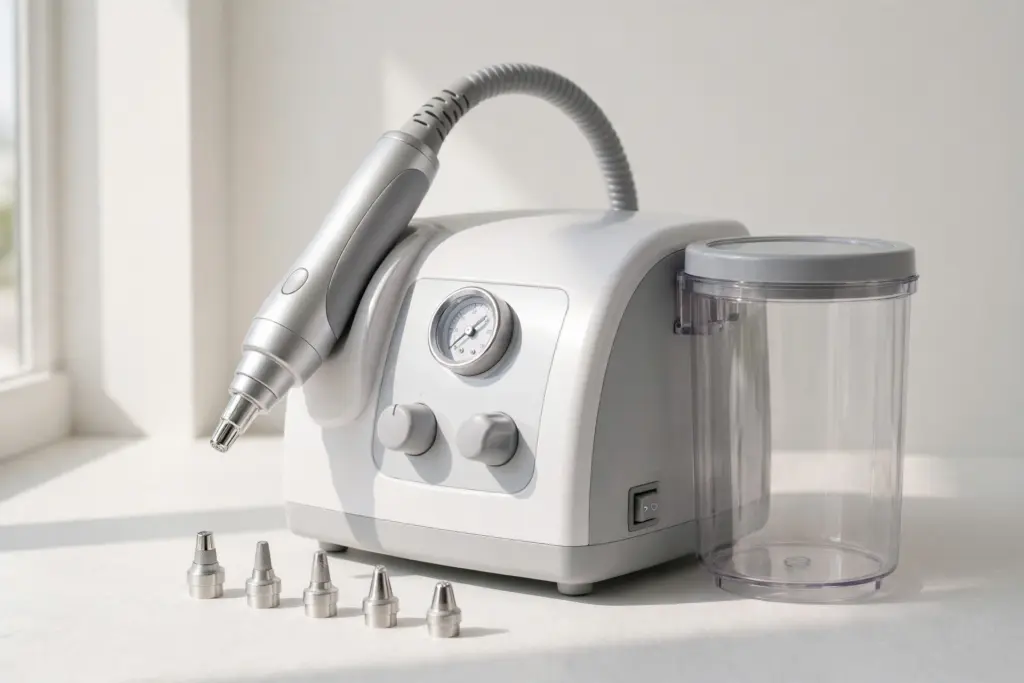
- What a diamond dermabrasion machine is
- How it works
- What it can and cannot do
- Home vs professional machines
- Who should not use one
- Before treatment
- Choosing the right tip
- How to operate it
- Aftercare
- Cleaning and storage
- Mistakes that cause most of the problems
- Compared with other exfoliation
- Choosing a machine
- Realistic expectations
- When to see a dermatologist
- FAQ
- Summary
Quick answer
A diamond dermabrasion machine is a skin-exfoliation device. A diamond-coated tip rubs away dead cells from the skin’s surface while suction lifts the debris away. It works on the surface only: it can make skin feel smoother and look less dull over weeks of steady use, but it cannot remove deep scars, erase wrinkles, or treat acne.
Home machines use much lower suction and abrasion than the machines in a clinic. They are maintenance tools, not a substitute for a professional treatment — treating them as equivalent leads to frustration and, if the settings are pushed too hard, to irritated skin.
Do not use one on active acne, a rosacea flare, eczema, broken or sunburnt skin, or an infection, and wait after isotretinoin treatment (see below). Start with the finest tip and the lowest suction, test on a small area first, and protect the skin with sunscreen afterwards. This guide is general information, not medical advice.
Contents: What it is · How it works · What it can and cannot do · Home vs professional · Who should not use one · Before treatment · Choosing a tip · How to operate it · Aftercare · Cleaning and storage · Mistakes · Compared with other exfoliation · Choosing a machine · Realistic expectations · When to see a dermatologist · FAQ
What a diamond dermabrasion machine is
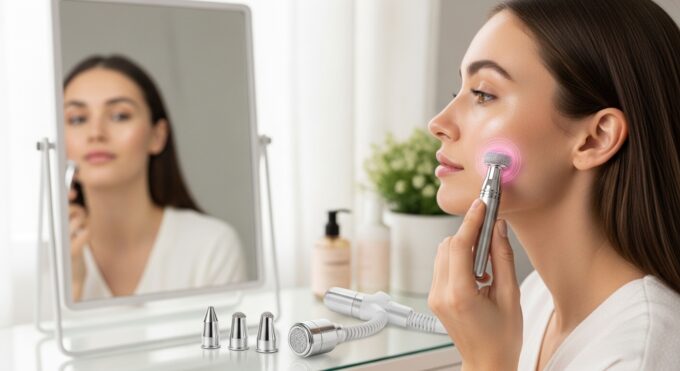
Microdermabrasion is a form of mechanical exfoliation: a device removes the outermost layer of dead skin cells. In a diamond dermabrasion machine, the exfoliating surface is a tip coated with fine diamond particles, and a vacuum provides suction.
The diamond tip is what makes this type different from crystal microdermabrasion. Crystal systems spray loose crystals onto the skin and vacuum them away; the crystals can scatter, and the treatment is harder to control. A diamond tip does not spray anything, so the exfoliation is more contained and the tip’s coarseness can be chosen for the area being treated. That control is the main practical advantage — it is not a difference in how deep the treatment goes. Both are surface treatments.
How it works
Two things happen at once:
- The diamond tip exfoliates. As the tip passes over the skin, its rough surface loosens and lifts dead cells from the outermost layer. The tip does not cut the skin; it abrades the surface. Which tip is fitted decides how rough that abrasion is.
- The suction lifts and clears. The vacuum raises the skin slightly so the tip makes even contact, and it draws away the loosened cells and surface oil. Suction is also what makes the treatment risky when it is too strong: too much suction pulls the skin hard into the tip, which can leave red marks or small broken vessels.
The skin may look pink and feel slightly warm straight after a session. The American Academy of Dermatology notes that this pinkness and mild swelling usually disappear within a day. That is the normal response to a gentle session — pain, lasting redness, or bruising is not.
Exfoliation does not make skincare products absorb better or work deeper. Removing surface build-up makes skin feel smoother and lets moisturiser sit more evenly on the surface, but no device pushes products into the skin. Any claim that a machine improves absorption is not supported.
What it can and cannot do
It can, with steady use over weeks:
- Make rough skin feel smoother, by removing surface build-up.
- Make dull skin look clearer, because dead cells scatter light unevenly and removing them gives a more even reflection.
- Help blackheads and congested pores look cleaner over time, by loosening surface debris. It cannot pull out deep blockages.
- Soften the look of fine surface lines caused by dryness, by smoothing the surface. It cannot change the skin’s structure underneath.
It cannot:
- Remove deep or pitted acne scars, or raised scars. A review of the evidence in Plastic and Reconstructive Surgery was explicit that microdermabrasion’s role in treating deeper scarring and significant pigment change is limited.
- Erase wrinkles. Deep lines are structural; a surface treatment does not reach them.
- Treat acne. It is an exfoliation step, not an acne treatment, and using it on inflamed acne can make things worse.
- Replace professional treatment. At-home devices use far lower suction and abrasion than clinic machines, so results take many more sessions to approach what a professional achieves — and some results are never approached at home.
Home vs professional machines
Home and professional machines work on the same principle, but they are not the same tool:
- Home machines use lower suction and gentler tips. They are built to be slow and forgiving, so a beginner is less likely to injure the skin. Their results are maintenance-level: smoother feel and gradual clarity.
- Professional machines use stronger suction and a wider range of tips, and they are operated by someone trained to judge skin, pressure and passes. The stronger settings are also why professional treatment carries more risk in untrained hands.
A professional-grade machine is not a better home purchase. Without training, stronger suction and coarser tips are more likely to cause redness, broken capillaries and irritation than to give better results. Beginners should start with a home-level machine, the finest tip, and the lowest suction.
Who should not use one
Do not use a diamond dermabrasion machine — or wait and ask a dermatologist first — if any of these apply:
- Active acne. Do not treat inflamed pimples, pustules or cysts directly. The mechanical action can spread bacteria across the surface, rupture pustules, and worsen both the breakout and the marks it leaves.
- Rosacea, especially a flare. Exfoliation and suction can trigger flushing and broken capillaries. People with rosacea are usually steered to gentler options entirely.
- Eczema, psoriasis, dermatitis, or any flaring rash on the area. Exfoliating an active flare makes it worse.
- Broken skin, open wounds, sunburn, cold sores, warts, or any skin infection. Abrasion can spread infection and delay healing.
- Recent isotretinoin (Accutane) use. Isotretinoin thins the skin and slows healing. The AAD advises waiting after isotretinoin because of a higher risk of complications including scarring; Mayo Clinic advises against resurfacing procedures within a year of the medicine. Ask the doctor who prescribed it when, if ever, exfoliation is safe again.
- A tendency to keloid or raised scarring. Any skin injury, including aggressive exfoliation, can trigger it.
- Recent professional treatment — a peel, laser treatment or microneedling — unless the professional who treated you says it is safe.
Darker skin needs extra care, not avoidance. The AAD is clear that microdermabrasion is safe for all skin tones when performed by a qualified professional. But medium-to-darker skin is slightly more prone to short-lived pigment changes after any skin injury, including post-inflammatory hyperpigmentation. If your skin tends to form dark marks after a pimple heals, use the gentlest settings, do not treat aggressively, and be strict about sun protection afterwards. If you are unsure, a session with a professional experienced in treating darker skin is safer than experimenting at home.
Before treatment
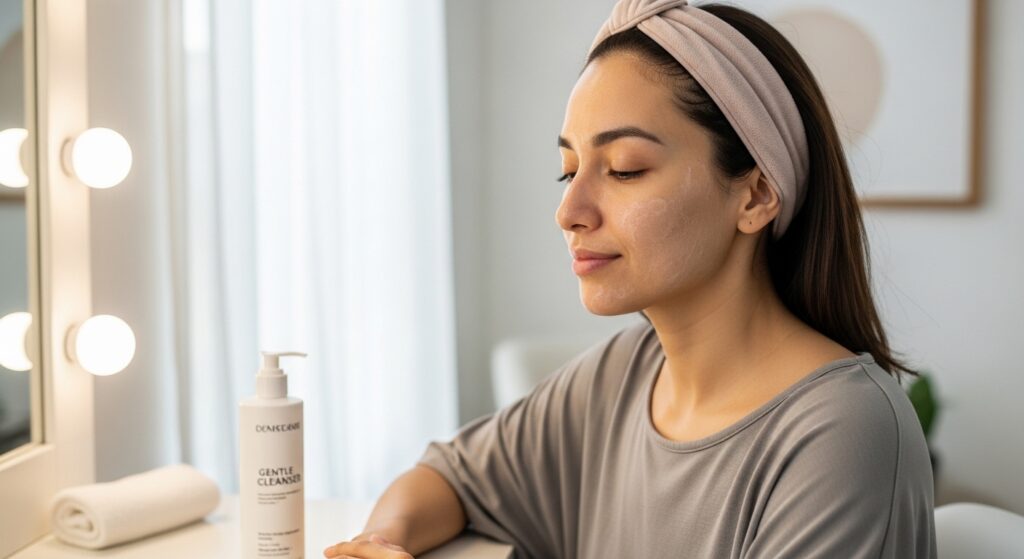
- Cleanse first. Treat clean, dry skin. Oil makes the tip slip and the suction uneven. Use a gentle, non-exfoliating cleanser and lukewarm water, and pat dry. Do not use the machine on wet skin — wetness reduces the tip’s grip.
- Pull hair back and wear loose clothing. Hair caught in suction is a nuisance and a barrier to even passes; tight clothing can catch on the handpiece.
- Test on a small area first. Before a full-face session, try the finest tip at the lowest suction on a small, less visible area (for example along the jawline) and wait a day. If the area is sore, very red, or broken out, do not proceed.
- Patch test any new product you plan to use with it. The AAD’s method for a new skincare product is: apply it to a quarter-sized patch of skin on the inside of your arm or the bend of your elbow, twice a day for 7 to 10 days. The AAD recommends this length because allergic reactions can take several days to appear, and a 24-hour test can miss them. If the patch becomes red, itchy, swollen or blistered, do not use the product on your face.
- Do not combine it with a chemical exfoliant the same day. Acids and mechanical exfoliation on the same day compound irritation. Use them on different days, or skip the acid that week.
Choosing the right tip
Tips come in grades, and the grade should match the skin and the area:
- Fine tips — for sensitive areas and sensitive skin, and for a first session. They give the gentlest exfoliation.
- Medium tips — for normal skin and rougher areas such as the nose and chin.
- Coarse tips — for thick skin only, such as the forehead in some people. Never use a coarse tip on thin or sensitive areas, and never under the eyes.
Match the tip to the area, not to the whole face: a medium tip on the nose and a fine tip on the cheeks is normal. Avoid the skin directly under the eyes entirely — it is too thin for this kind of exfoliation.
How to operate it
Follow the manufacturer’s instructions for your own machine. The technique below is the general safe pattern:
- Move slowly, in straight lines. Slow, steady, linear passes work better than fast circular ones. Do not overlap passes on the same area — one or two passes per area is enough. Repeating the same spot again and again is how skin gets injured.
- Let the machine do the work. Do not press hard. Pressing harder does not exfoliate better; it damages the barrier. If the skin is sore during the session, the pressure or suction is too high.
- Keep sessions short. Each area needs only a few passes, and a full-face session should not be long. Longer sessions raise irritation without adding benefit.
- Use it once every one to two weeks. Most skin does well at that frequency. Daily or very frequent use thins the barrier and makes skin tender and reactive. Let your skin’s response set the pace — if it is still pink or tight after a week, wait longer.
- Stop if it hurts. Tingling or mild warmth is normal. Sharp pain, burning, or skin that looks bruised means stop immediately.
Aftercare
- Moisturise. After treatment, use a light moisturiser. The skin has just lost its outer layer and needs barrier support.
- Sunscreen is not optional. Freshly exfoliated skin is more sensitive to UV, and unprotected sun exposure in the days afterwards is the main trigger for uneven tone. Use a broad-spectrum sunscreen with SPF 30 or higher every morning, and reapply every two hours when outdoors, or after swimming or sweating. Avoid direct sun exposure for a few days after a session.
- Avoid strong actives for a day or two. Do not use retinoids, strong acid exfoliants or vitamin C on the treated area immediately afterwards. Reintroduce them only once the skin feels calm.
- Do not pick or scrub. Let the skin settle. Mild redness that fades within a day is expected; redness, swelling or pain that lasts longer is a reason to stop using the machine and, if it does not settle, to ask a dermatologist.
Cleaning and storage
A dermabrasion machine touches the skin directly, so hygiene decides whether it helps or harms:
- Wash the tips after every session. Rinse with lukewarm water and a mild cleanser to remove dead skin, oil and debris. Harsh chemicals and stiff brushes damage the diamond coating — follow the manufacturer’s cleaning instructions.
- Let everything dry fully before storing. Moisture left in a case or on a tip encourages bacteria and dulls the surface.
- Deep clean once a week. A weekly clean with a disinfecting solution made for cosmetic tools clears the build-up that daily rinsing misses. Check suction tubing and filters too — a blockage makes suction uneven.
- Do not immerse the machine body in water. Wipe it with a clean, slightly damp cloth. Keep suction ports free of debris, and wash or replace filters when suction weakens.
- Store in a clean, dry place. Humid bathrooms are a poor choice. Store tips separately so they are not scratched or contaminated.
- Clean is not sterile. Washing and disinfecting a home tool is not sterilisation — no home method sterilises, and only an autoclave does that. Do not share tips between people, and replace a tip if it is damaged or cannot be cleaned properly.
Mistakes that cause most of the problems
- Over-exfoliating. Exfoliation feels satisfying, so people use the machine too often. More sessions do not mean faster results — they mean a thinner, more reactive barrier.
- Using the wrong tip. A coarse tip on the cheeks or forehead risks broken capillaries and inflammation.
- Too much suction. High suction does not exfoliate better. When the skin bulges deep into the tip, the suction is too strong. Light suction with slow movement gives better results.
- Repeating passes on the same area. One or two passes is enough. Extra strokes injure the skin.
- Skipping aftercare. No moisturiser and no sunscreen after exfoliation undoes the benefit and invites uneven tone.
- Using it on active acne or broken skin. This spreads bacteria and worsens inflammation.
- Combining it with a chemical exfoliant the same day. Two forms of exfoliation at once is a common cause of irritation.
- Buying a professional machine without training. Stronger settings in untrained hands cause more harm than a home machine ever would.
Compared with other exfoliation
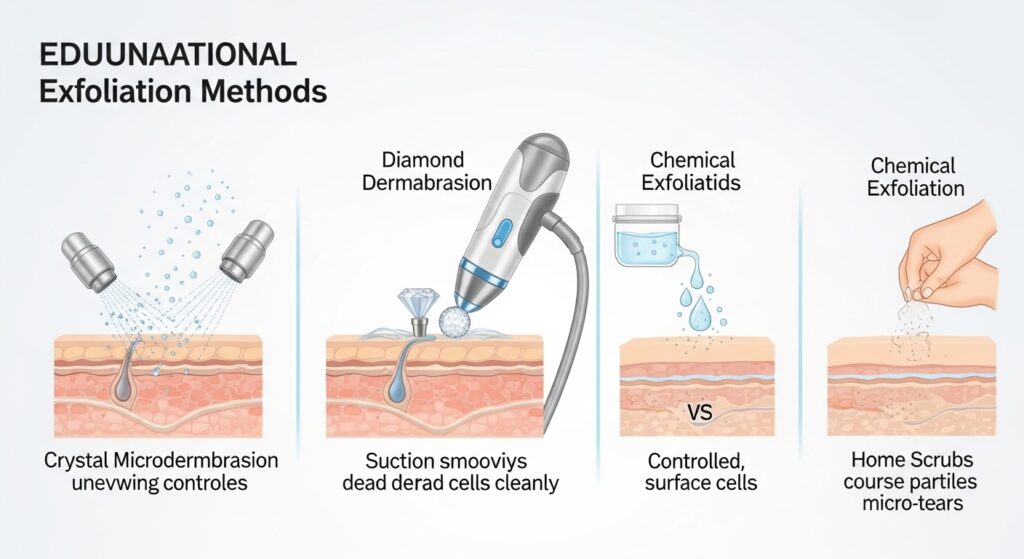
- Crystal microdermabrasion sprays loose crystals onto the skin and vacuums them away. It is messier and harder to control than a diamond tip, and cleaning is more involved. Both are surface treatments.
- Chemical exfoliants (acids and enzymes) dissolve the bonds between dead cells rather than rubbing them off. They reach slightly deeper than diamond dermabrasion in effect, and they are easier to overdo in a different way — by leaving them on too long or using too high a strength. Do not use both on the same day.
- Home scrubs work by hand and by particles, so the result depends on technique and pressure. They are not inherently worse than a machine, and they are not inherently safer — both can irritate if used too hard or too often. Scrubs do not cause “micro-tears” as a proven fact; the real risk with any physical exfoliation is the same: too much pressure, too often, on skin that is already irritated.
Choosing a machine
No brand is recommended here. When comparing machines, look for:
- Variable suction with a genuinely low lowest setting, so you can start gently.
- A range of diamond tips (fine, medium, coarse) so the tip can match the area.
- A cleaning-friendly design — tips and filters that come apart and can be washed and dried properly.
- Clear instructions and a warranty, and safety certification marks. Avoid machines with vague claims or no instructions.
- A stable motor. A machine that loses suction or runs unevenly is harder to control, and uneven suction is what causes patchy results.
The cheapest machine is not the best value, and the most expensive is not the best either. A machine that lasts, has spare tips and filters available, and is used gently and regularly is worth more than a powerful one used badly.
Realistic expectations
- First: skin feels softer and smoother, and makeup sits more evenly. That is the surface effect, and it is the most reliable result.
- Over weeks: texture becomes more even and dullness reduces, with regular sessions every one to two weeks and strict sun protection.
- What will not change: deep scars, deep wrinkles, and skin structure. The machine supports surface health; it does not remodel the skin underneath.
Consistency matters more than intensity. A gentle session every two weeks for two months will do more than one aggressive session.
When to see a dermatologist
See a dermatologist if: the skin blisters, swells, or bruises after use; redness or pain lasts more than a day or two; dark marks appear after treatment and do not fade; you have a skin condition such as rosacea, eczema or acne that keeps flaring; or you are unsure whether exfoliation is safe for your skin at all. A dermatologist can also advise on professional microdermabrasion, which uses stronger settings under trained supervision, and on prescription options for scars or pigmentation that a home device cannot treat.
FAQ
What does a diamond dermabrasion machine do?
It removes dead cells from the skin’s surface with a diamond-coated tip and suction. It smooths texture gradually; it does not treat deep scars, wrinkles or acne.
Is home diamond dermabrasion safe?
A home-grade machine used gently — fine tip, low suction, once every one to two weeks, on calm intact skin — is low risk for most people. It is not safe on active acne, rosacea flares, eczema, broken or sunburnt skin, or after recent isotretinoin use.
How often can I use it?
Once every one to two weeks suits most skin. More often than that usually thins the barrier and makes skin tender.
Can it remove acne scars?
It can gradually improve the look of very shallow surface marks. Deep or pitted scars need a dermatologist, not a home device.
Is there downtime?
There is usually no real downtime, but the skin may be pink for a few hours and is more sensitive to sun for a few days. Sunscreen and gentle care are needed afterwards.
Summary
A diamond dermabrasion machine is a surface exfoliation tool: a diamond tip plus suction, used gently and infrequently, can make skin feel smoother and look less dull over weeks. It cannot remove deep scars or wrinkles, treat acne, or replace professional treatment, and home machines are much weaker than clinic machines. Use the finest tip and lowest suction, one or two passes per area, once every one to two weeks, on calm intact skin — never on active acne, a rosacea flare, eczema, broken skin, or after recent isotretinoin. Clean the tips after every session, store the machine dry, and wear SPF 30+ every morning. If the skin blisters, bruises, or darkens after use, stop and see a dermatologist.
Sources: American Academy of Dermatology, 7 Rosacea skin care tips (patch-test method: apply a new product to a quarter-sized patch of skin on the inside of the arm for 7–10 days); American Academy of Dermatology, How to select anti-aging skin care products (broad-spectrum sunscreen, SPF 30 or higher every morning, reapply every two hours outdoors). This is a researched overview, not a hands-on review.