Researched overview. This guide is based on published dermatology guidance, not on hands-on product testing by BeautyKob. No product in this guide was tested by us, and no product is recommended.
Table Of Content
Quick answer
A chemical peel is an acid applied to the skin to loosen the bonds between dead surface cells, so they shed and fresher skin shows underneath. A gentle, low-strength peel used at home can gradually help surface dark spots fade — over weeks, not days, and only with strict sun protection afterwards.
It can also make dark spots worse. A peel is a controlled inflammatory event, and inflammation is exactly what makes skin produce more pigment. That risk is highest in darker skin, in skin that has darkened after acne or injury before, and in melasma. A peel that is too strong, left on too long, or used on irritated skin can leave dark patches that take months to fade.
This guide is written with safety first: what dark spots are, what a peel can and cannot do, which gentle acids are used at home, who should not peel at home at all, and when to see a dermatologist instead. It does not recommend a specific peel strength or brand. It is general information, not medical advice.
Contents: What dark spots are · What a peel is · What a peel cannot do · Gentle acids at home · Who should not peel at home · Preparation · Patch testing · Step by step · Aftercare · Mistakes · When to see a dermatologist
What dark spots really are
Dark spots form when the skin makes too much melanin in one area. Melanin is the pigment that gives skin its colour, and its job is protection. When the skin is injured — by acne, sun exposure or irritation — it defends itself by making more melanin in that spot. The marks can last months or years if the skin keeps getting the signals that trigger pigment production.
There are three common kinds, and they do not all respond the same way:
- Post-acne marks form after inflammation. They sit close to the surface and respond best to gentle peels.
- Sun spots form from years of UV exposure. They are usually flat and light in colour, on areas that get regular sun — cheeks, forehead, hands.
- Melasma is different. It is driven by hormones and sun, it is darker and more widespread, and it is sensitive to irritation. A home peel can darken melasma. Melasma is a reason not to peel at home — see a dermatologist instead.
Dark spots are stubborn because they are reactions, not just surface stains. Once skin becomes irritated, hot or damaged, pigment production increases again. That is why aggressive treatments usually fail: the irritation that was supposed to remove the spot creates the next one.
What a chemical peel is
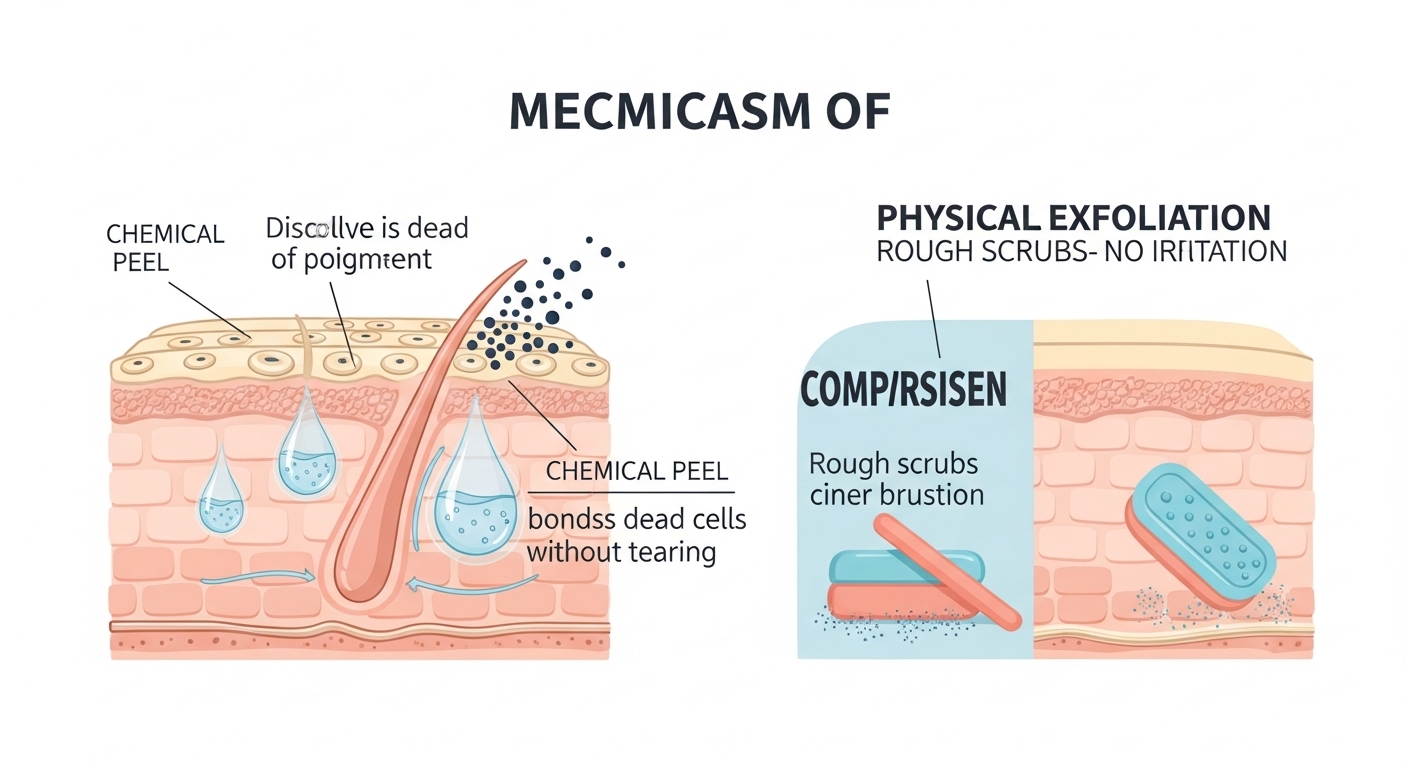
A chemical peel applies an acid to loosen the connection between dead cells on the skin’s surface. The acids do not tear the skin. They dissolve the glue that holds old cells together. When those cells are released, new skin shows underneath, and pigment sitting in the surface layers sheds with them. Repeated gentle peels encourage the skin to renew, slowly.
A peel is different from physical exfoliation. Scrubs and brushes work by friction, which can be uneven and harsh on irritated areas. A peel works chemically and evenly across the area — when it is used properly. Used improperly, it is more dangerous than a scrub, because the acid keeps working until it is rinsed or neutralized.
What a peel cannot do
- It cannot remove dark spots in one session. Surface pigment fades gradually, over a series of gentle peels and weeks of care.
- It cannot stop pigmentation from coming back. If the sun, acne or irritation that caused the spot continues, new pigment will form.
- It cannot replace sunscreen or skin protection. Without sun protection after a peel, the improvement is lost.
- It cannot treat deep pigmentation, severe melasma, or widespread post-inflammatory pigmentation. Those need a dermatologist.
- It cannot reduce fine lines or acne scarring on its own. A peel is an exfoliation step, not a treatment for lines or scars.
Gentle acids used at home
Only gentle, low-strength acids belong in a home peel. No strength is recommended here — read the product’s own label, start with the lowest strength available, and follow the manufacturer’s instructions exactly. If a product does not state its strength clearly, do not buy it.
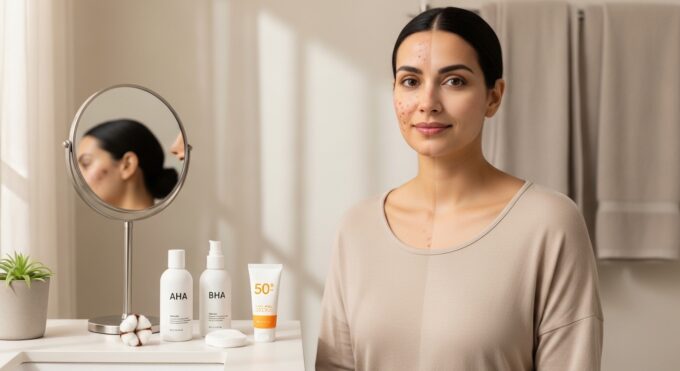
- Lactic acid (an alpha hydroxy acid, or AHA): gentle and hydrating. A reasonable first choice for dry or sensitive skin, and for darker skin, because it works slowly and evenly.
- Mandelic acid (an AHA): a larger molecule, so it penetrates slowly and evenly. Often favoured for darker skin and for beginners for the same reason.
- Glycolic acid (an AHA): the smallest AHA molecule, so it penetrates fastest. It works well for surface spots but is the most irritating of the three, and it is the easiest to misuse.
- Salicylic acid (a beta hydroxy acid, or BHA): oil-soluble, so it works inside pores. It suits oily, acne-prone skin and post-acne marks. It is less useful for sun spots, and it should not be overused.
- Polyhydroxy acids (PHAs): the gentlest of the group, with very low irritation. Results are slower, but they suit sensitive skin and skin that has never used an acid before.
What does not belong at home: TCA and deeper peels. Trichloroacetic acid (TCA) penetrates deeper than the acids above, and even at low strength it can burn and scar when used without training. Medium and deep peels, including TCA and phenol peels, are professional treatments. Do not buy them online, and do not use them at home. The US Food and Drug Administration warns against purchasing or using chemical peel products without professional supervision, especially products found online or without clear labelling.
Who should not peel at home
Do not use a home peel if any of these apply:
- You have melasma. Melasma is already prone to darkening, and a peel adds the inflammatory stimulus that makes it worse.
- Your skin darkens easily after acne, injury or treatment. If you have had post-inflammatory darkening before, your skin has already shown it reacts to injury by making more pigment.
- Your skin is darker and you have never used an acid before. Darker skin carries a higher risk of rebound pigmentation. The American Academy of Dermatology says people with skin of color can safely have a chemical peel, but should see a dermatologist experienced in treating darker skin — because without that expertise, peels can cause lasting pigment problems. The American Society for Dermatologic Surgery notes that superficial peels are very unlikely to cause complications in skin of color when chosen and used properly.
- Your skin is broken, irritated, sunburnt, or in an eczema or rosacea flare. Wait until it has been calm for at least two weeks.
- You cannot avoid the sun in the days after a peel, or you will not wear sunscreen every day.
- You are pregnant or breastfeeding and unsure whether a peel is suitable — ask your doctor first.
- You have just had a professional peel, laser treatment or microneedling, unless the professional who treated you says it is safe.
If any of these apply, the honest answer is not a gentler home peel — it is a dermatologist’s assessment.
Preparation
Preparation matters more than the strength of the acid. A well-prepared barrier tolerates a peel; an unprepared one reacts to it.
Two weeks before: stop scrubs, exfoliating brushes and strong exfoliants. Use only a gentle cleanser, a moisturiser and sunscreen. If your skin is sensitive, keep actives weak or stop them — do not start anything new.
One week before: avoid sun exposure, use a gentle cleanser and moisturiser only, and apply sunscreen daily.
The day of the peel: do not use a retinoid, a strong acid exfoliant or vitamin C that day. Do not peel on skin that is already red, tight or stinging.
Patch testing
Test the peel before you put it on your face. The American Academy of Dermatology’s guidance is to apply the product to a quarter-sized patch of skin — for example the inside of your arm or the bend of your elbow — twice a day for 7 to 10 days, using the same amount you would use on your face. The AAD recommends this length because allergic reactions can take several days to appear, and a 24-hour test can miss them.
- Test one product at a time. If you start two at once and react, you will not know which one caused it.
- Do not patch test on skin that is already broken, inflamed or irritated — and never patch test on your face first.
- If you get redness, itching, swelling or burning, wash the product off and do not use it. Note the product and the ingredient list, so you can compare it with products that do suit you.
- A home patch test is not the same as the diagnostic patch testing a dermatologist does for suspected allergy. If you keep reacting to many products and cannot find the cause, ask a dermatologist about formal patch testing.
Step by step
This is a guide to doing a gentle home peel carefully, not a recommendation to do one. If you are unsure at any step, stop — and see a dermatologist instead.
- Wash the skin. Use a gentle, non-foaming cleanser and lukewarm water. Oil, sunscreen or makeup left on the skin makes the peel penetrate unevenly. Hot water increases sensitivity, so keep the water lukewarm. Pat dry with a soft towel — do not rub.
- Degrease only if needed. On very oily skin, a gentle wipe can help the peel apply evenly. It is not a required step, and it should not be done on sensitive or dry skin. Over-degreasing irritates the skin and increases the risk of post-inflammatory darkening.
- Protect sensitive areas. The corners of the nose and mouth, the lips and the under-eye area absorb acid easily and burn readily. Apply petroleum jelly around them before the peel. This lowers the risk of accidental burns — it does not make burns impossible.
- Apply the peel. Use a cotton pad, a brush or clean fingertips (wear a glove). Apply in light, even strokes, from the forehead downwards. Do not overload the skin — more product does not mean better results. Do not massage aggressively.
- Time it carefully. Follow the manufacturer’s instructions exactly. For a first peel, keep the time short. Tingling can be normal. Burning is not — if the skin burns or stings sharply, rinse or neutralize immediately, as the product’s instructions direct.
- Neutralize or rinse. Some peels need neutralizing; others are rinsed with water. Never skip this step. Rinse with running water until all traces are gone — acid left on the skin keeps working and can burn.
- Soothe the skin. Rinse with cool water and apply a gentle moisturiser. Avoid retinoids, vitamin C, exfoliating acids, scrubs and essential oils for at least 7 to 10 days afterwards.
What to expect after the peel
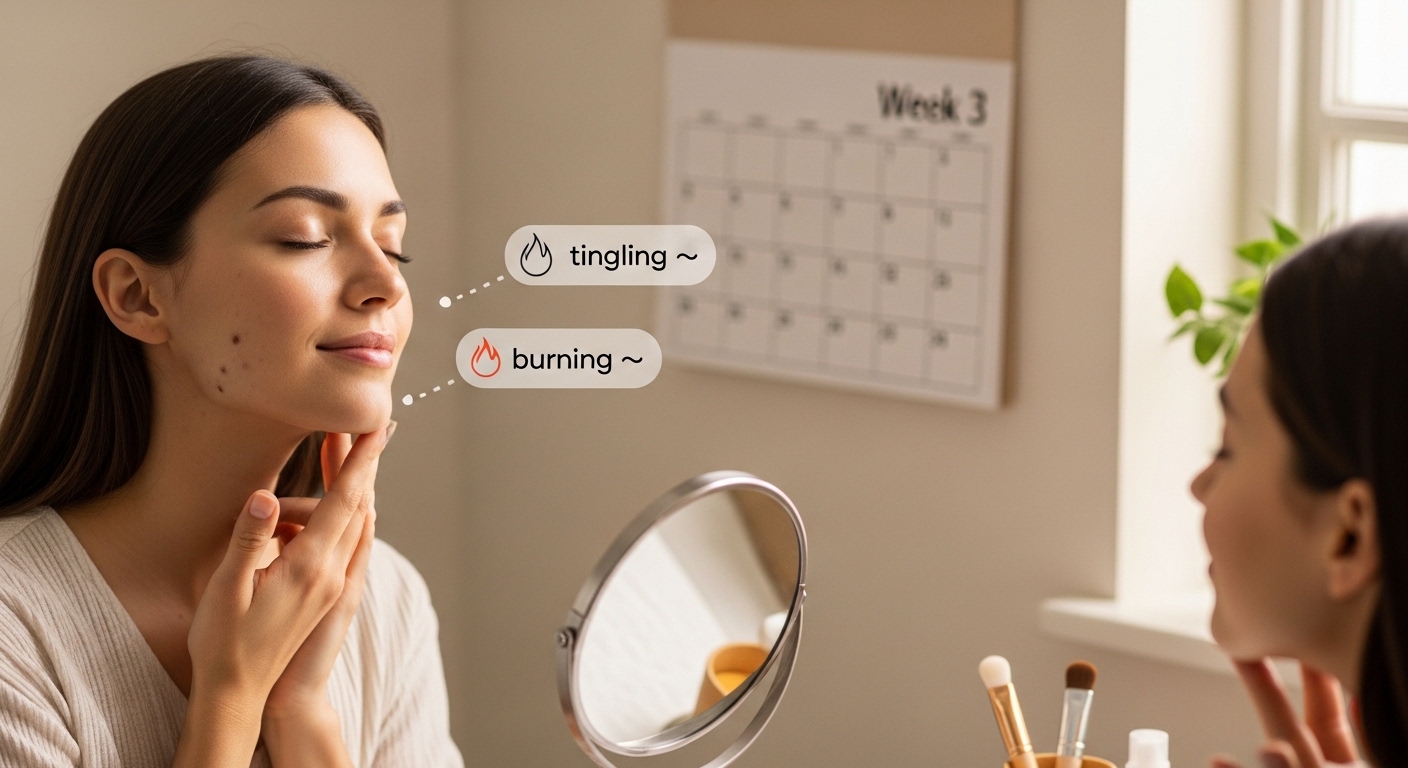
First 24 hours: the skin may be red or feel tight. Dark spots can look darker at first — this is common and temporary. Do not rub, pick or touch the skin.
Days 2–5: light flaking is common. Many people do not visibly peel at all, and that is normal — visible peeling is not a sign that the peel worked. Never force peeling or pull at flaking skin; forcing it worsens the risk of pigmentation. Keep the skin moisturised.
Days 6–10: the skin starts to look smoother and brighter, and dark spots may look lighter or more broken up. This is the stage where most people make the mistake of reintroducing actives too soon. Wait until the skin has been calm for at least a week.
Aftercare
Aftercare is where the result is won or lost. A peel without aftercare is a wasted peel — and sometimes a worse spot than the one you started with.
- Sun protection cannot be skipped. UV exposure after a peel triggers melanin production and can undo the improvement, or make the spot darker than before. Use a broad-spectrum sunscreen with SPF 30 or higher every morning, and reapply every two hours when outdoors. For melasma, the AAD recommends a tinted sunscreen containing iron oxide, which also protects against visible light.
- Keep the barrier strong. Gentle cleanser, hydrating moisturiser, barrier-repair cream. Avoid over-cleansing — dry, slow-healing skin pigments more easily.
- Avoid actives for at least 7 to 10 days. No retinoids, no vitamin C, no exfoliating acids, no scrubs. Reintroduce them one at a time, only after the skin has been calm for a week.
- Do not pick, scrub or force peeling. Let flaking shed on its own.
Mistakes that make dark spots worse
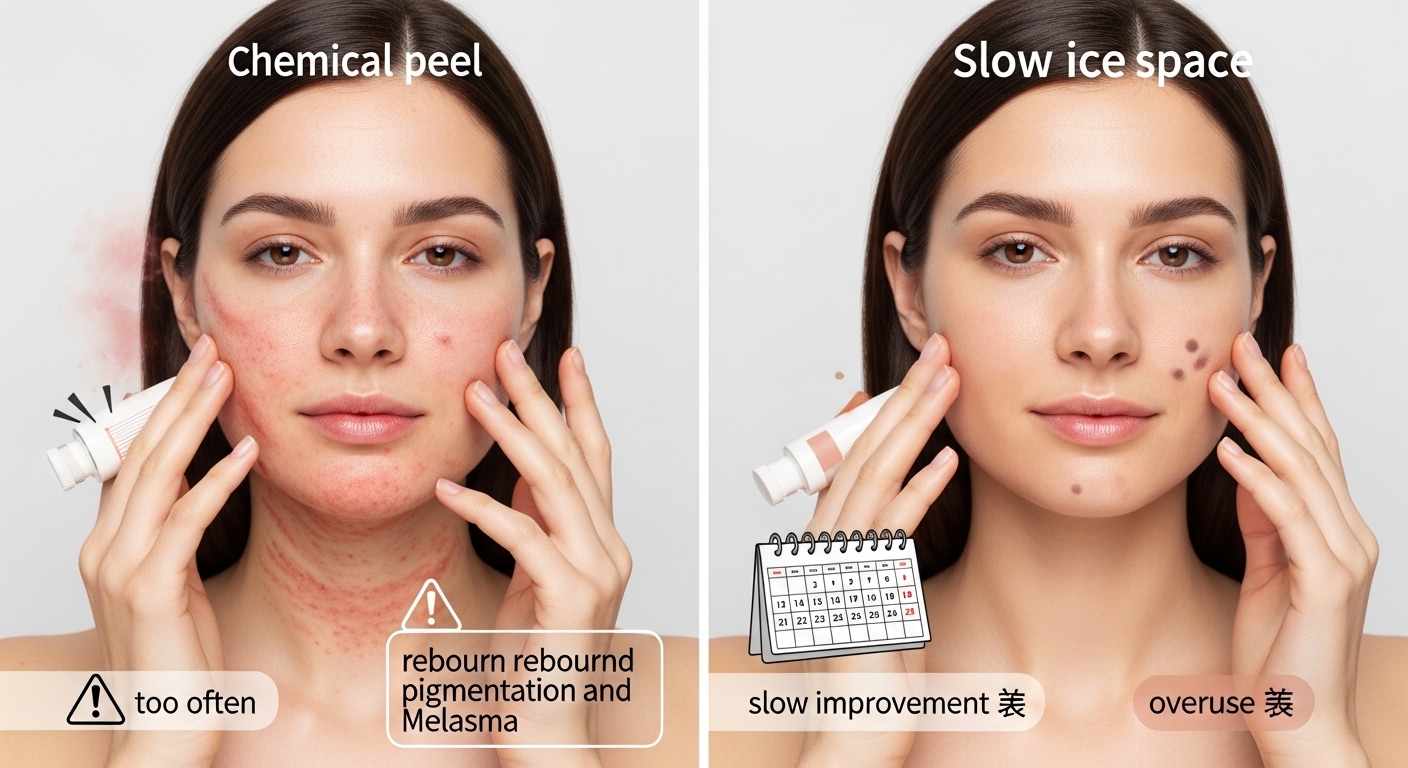
- Using a stronger peel to get faster results. Stronger peels cause more inflammation, and inflammation causes more pigment. Slow, gentle improvement is the only kind that lasts.
- Peeling too often. Most beginners should wait two to three weeks between peels. More often than that weakens the barrier and deepens pigmentation.
- Ignoring skin signals. Tightness, redness that does not fade, and stinging are warnings, not part of the process. Stop and let the skin recover.
- Skipping sunscreen. One unprotected day in the sun after a peel can undo weeks of progress.
- Treating melasma as an ordinary dark spot. Melasma needs a dermatologist, not a stronger home peel.
- Peeling on irritated or broken skin. A peel on a flare is not a treatment — it is an injury on top of an injury.
When to see a dermatologist
See a dermatologist promptly if: the peel caused blistering, swelling, or a burn; the skin darkened and the darkening has not settled after a few weeks; the dark spots are deep, widespread, or melasma; you have dark spots that keep coming back despite gentle care; or you are unsure whether a peel is safe for your skin at all. A dermatologist can diagnose the type of pigmentation, arrange formal patch testing, choose a peel strength and type that fits your skin, and discuss prescription options that over-the-counter products cannot provide.
Summary
A gentle home peel can gradually help surface dark spots fade — but only with preparation, a proper patch test, a short first application, and strict sun protection afterwards. It can also make dark spots worse: a peel is a controlled inflammatory event, and inflammation is what makes skin produce more pigment. That risk is highest in darker skin, in skin that has darkened after injury before, and in melasma. Do not peel at home if you have melasma, if your skin darkens easily, or if your skin is broken or irritated. Never use TCA or deeper peels at home — those are professional treatments. Patch test for 7 to 10 days, start low, follow the manufacturer’s instructions, wear SPF 30+ every day, and see a dermatologist if the spots are deep, widespread, or melasma.
Sources: American Academy of Dermatology, 7 Rosacea skin care tips (patch-test method: apply a new product to a quarter-sized patch of skin on the inside of the arm for 7–10 days); American Academy of Dermatology, How to select anti-aging skin care products (broad-spectrum sunscreen, SPF 30 or higher every morning, reapply every two hours outdoors). This is a researched overview, not a hands-on review.