Researched overview.
Table Of Content
Quick answer
“Glowing skin” is not a product result. It is what healthy skin looks like when it is clean, hydrated and protected from the sun: even tone, a smooth surface, and no flaking or irritation. No cream, serum or treatment guarantees it, and no routine produces it on a fixed schedule.
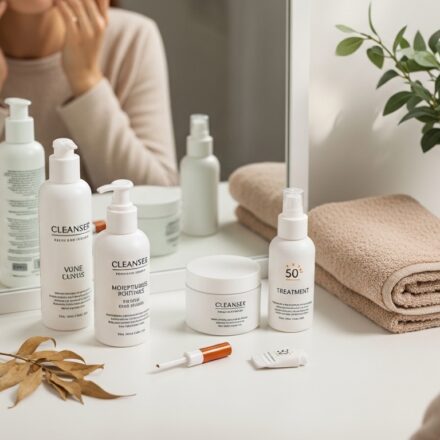
The routine that gets you there is short: a gentle cleanser, a moisturiser, and sunscreen every morning. Everything else — vitamin C, retinoids, exfoliation — is optional, and each one needs to be added slowly and patch-tested. This guide explains the routine, how to tell your skin type, what to avoid, and what is realistic to expect.
Contents: What glow means · Know your skin type · The morning routine · The evening routine · Optional steps · Patch test · Exfoliation · Water temperature · Night and sleep · Food and water · Realistic expectations · Mistakes to avoid · When to see a dermatologist
What “glow” actually means
Healthy skin reflects light evenly because its surface is smooth and its barrier is intact. Dry, flaky or irritated skin scatters light and looks dull. So “glow” is really three things:
- Hydration — skin that holds enough water looks plumper and smoother.
- An intact barrier — skin that is not irritated or over-exfoliated keeps moisture in.
- Protection — skin that is protected from the sun ages more slowly and keeps a more even tone.
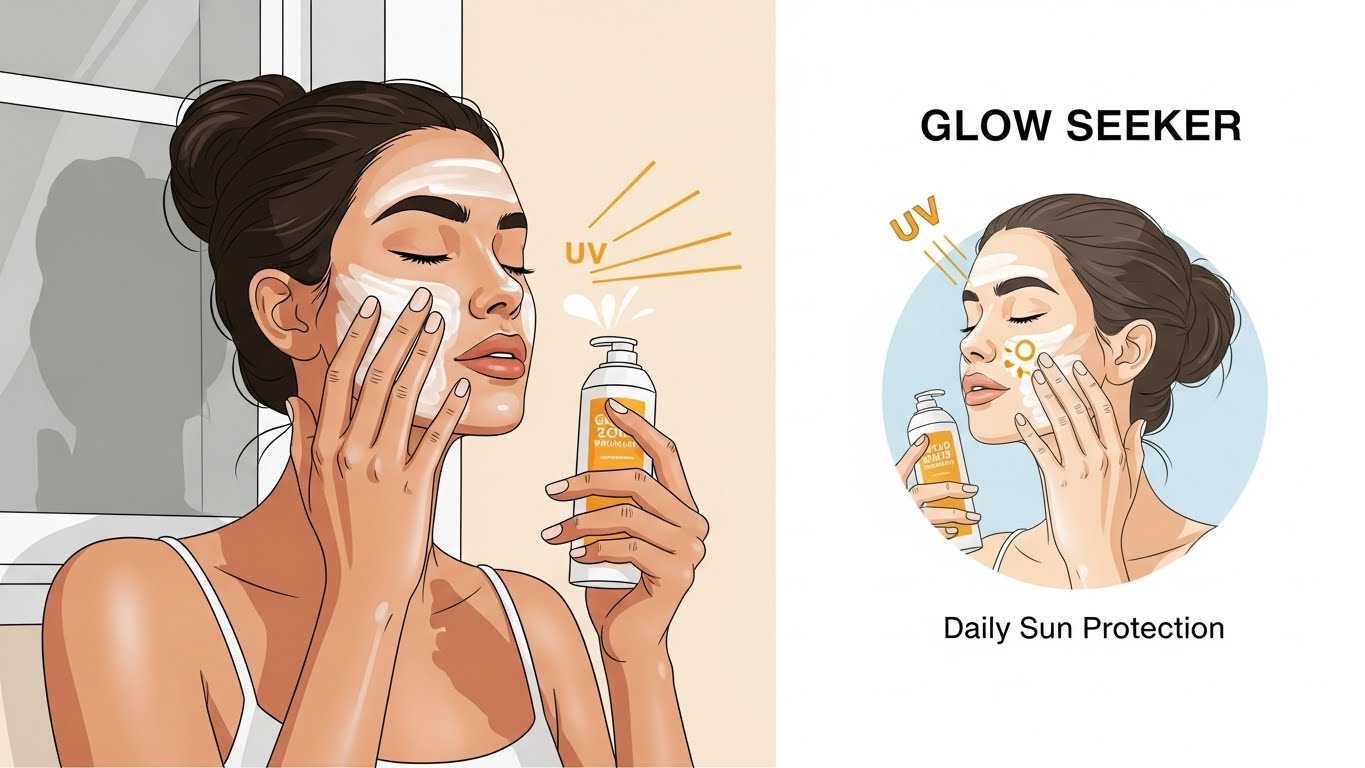
Sunscreen is the single most effective anti-ageing step (Hughes et al. 2013: daily sunscreen use led to 24% less skin ageing over 4.5 years). No moisturiser or serum matters as much as that.
Know your skin type
Skin type is a starting point, not a diagnosis. A simple at-home check — practical guidance, not a medical rule:
- Wash your face with a gentle cleanser and pat it dry.
- Wait about an hour without applying anything.
- Look and feel:
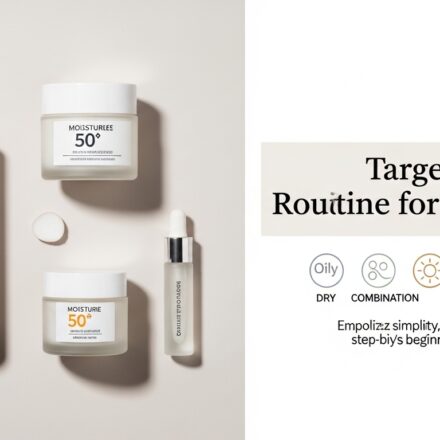
| What you notice | Likely skin type |
|---|---|
| Tight, sometimes flaky, no shine | Dry |
| Shine across the forehead, nose and chin (T-zone), normal cheeks | Combination |
| Shine all over, feels oily | Oily |
| Comfortable, no tightness, no shine | Normal |
| Stings, reddens easily, reacts to new products | Sensitive |
Skin type can change with the seasons, with age, and with the products you use. If your skin is very reactive, or you are not sure, a dermatologist can assess it properly.
The morning routine
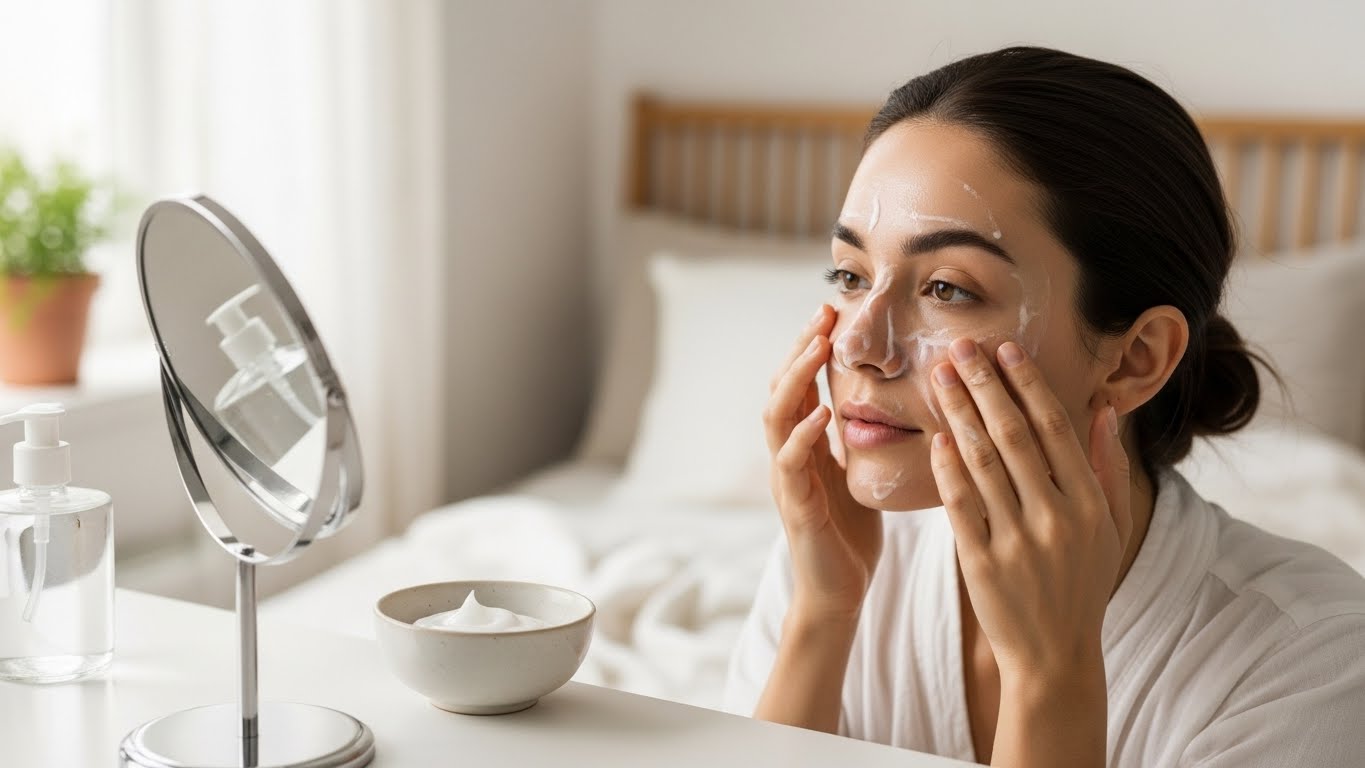
Three steps, in this order:
- Cleanse. A gentle cleanser, lukewarm water. If your skin is dry, water alone in the morning is enough for some people — judge by how your skin feels.
- Moisturise. Apply moisturiser to damp skin. It does not need to be expensive: a plain moisturiser with glycerin, ceramides or hyaluronic acid holds water in the skin. Hyaluronic acid and glycerin are humectants — they attract and hold water — not treatments for oiliness or ageing.
- Sunscreen. Broad-spectrum SPF 30 or higher, every morning, even on cloudy days. Apply enough to cover the face and neck, and reapply every 2 hours when you are outdoors. Sunscreen is the step that protects the “glow” you are building — without it, sun damage undoes the rest of the routine.
The evening routine
- Cleanse. Wash off sunscreen, makeup and the day’s dirt with a gentle cleanser.
- Moisturise. A slightly richer moisturiser at night is fine if your skin is dry. If your skin is oily, a light gel moisturiser is enough.
- Nothing else is required. The evening routine is deliberately short. Adding more steps does not make skin healthier faster.
Optional steps — add one at a time
Only add one new product at a time, and give it at least two weeks before judging it. If your skin reacts, stop the newest product first.
Vitamin C (optional). A vitamin C serum in the morning, under sunscreen, can help with uneven tone. It is not a replacement for sunscreen, and it does not work in a set number of weeks. If it stings or irritates, stop using it.
Retinoids (optional, strongest evidence). Retinoids are the strongest topical ingredient for fine lines, but they take 3–6 months to show results, and they irritate easily at first. Start slowly: 2–3 nights a week, a pea-sized amount for the whole face, moisturiser before and after if needed. Do not use retinoids if you are pregnant or trying to become pregnant — ask a doctor first. Do not scrub before applying a retinoid; that increases irritation.
Niacinamide (optional). Niacinamide is a well-tolerated ingredient that can help with redness and the skin barrier. One study (Draelos et al. 2006) found 2% niacinamide reduced sebum excretion in Japanese subjects, but not significantly in Caucasian subjects — so do not expect it to control oil or shrink pores.
Peptides (optional, thin evidence). Peptides are popular in anti-ageing products, but the evidence that they reduce wrinkles is thin. They are not a substitute for sunscreen or retinoids.
Patch test
Before using a new leave-on product on your whole face, patch-test it:
- Apply a small amount to a quarter-sized area on the underside of your arm or the bend of your elbow.
- Apply it twice a day for 7–10 days.
- If there is no redness, itching or swelling, it is likely safe to use on your face.
This is the AAD’s patch-test method.
Exfoliation
Exfoliation removes dead skin cells from the surface, which can make skin look smoother. But over-exfoliating damages the skin barrier and makes skin red, tight and more sensitive — the opposite of glow.
- Start gently: 2–3 times a week at most, with a mild exfoliant. Stop if the skin stings, peels or stays red.
- Do not combine too many actives. Exfoliating acids plus retinoids plus vitamin C in the same routine is a common cause of irritation. One active at a time.
- Do not scrub hard. A harsh scrub does not clean better; it scratches the surface. Gentle pressure is enough.
- Salicylic acid 0.5–2%: a common range for leave-on products.
Water temperature
Use lukewarm water to wash your face. Hot water can dry out the skin and strip its natural oils. Very cold water does not clean better. Lukewarm is the safer choice, morning and evening.
Night and sleep
Skin does carry out repair processes overnight, including cell renewal. That does not mean products work “faster” at night, and it does not mean a night cream is essential. Sleep supports general health, including skin, but it is not a treatment and it does not restore skin “at a high rate” compared with products — that comparison has no meaning. A regular sleep schedule helps; no product can replace it, and no product works better because you slept.

Food and water
Eating well and drinking enough water support general health, including skin. But no food or drink is a treatment for dull skin, and no meal or water amount makes skin “fat and smooth” or changes elasticity on a fixed schedule. If your skin is persistently dull, dry or irritated despite a gentle routine, the cause is more likely a product, an irritant, or a skin condition — not your diet.
Realistic expectations
No routine gives visible results in a fixed number of days. Skin changes slowly:
- Hydration can improve within days of using a good moisturiser.
- Tone and texture take weeks to months to change, and the change is gradual, not dramatic.
- Fine lines take 3–6 months to respond to retinoids, and only modestly.
- Some things do not change. No cream removes deep wrinkles, tightens sagging skin, or changes your skin type permanently.
If a product promises “glow in two weeks” or “guaranteed results”, that promise is marketing, not evidence.
Mistakes to avoid
- Too many products at once. A 10-step routine makes it impossible to tell what helps and what irritates. Three steps done consistently beat ten steps done inconsistently.
- Skipping sunscreen. The most common reason a routine “doesn’t work” is that sun damage is undoing it every day.
- Over-exfoliating. More exfoliation does not mean faster glow — it means a damaged barrier.
- Chasing “miracle” ingredients. There is no ingredient with a secret mechanism that other products lack. If a product name or technology cannot be found anywhere else — no published ingredient list, no independent source — treat it as invented, not innovative.
- Spa treatments as a fix. A spa treatment can feel pleasant, but there is no evidence it clears skin or produces lasting glow. It is not a substitute for a daily routine.
When to see a dermatologist
- Persistent redness, itching, flaking or breakouts that do not improve with a gentle routine.
- A rash, swelling, or pain after using a product.
- Sudden changes in skin colour, new moles, or a spot that bleeds, itches or does not heal.
- You want to start a prescription treatment (retinoids, or anything stronger than over-the-counter products).
Summary
Glowing skin is healthy skin: clean, hydrated and protected. The routine is short — gentle cleanser, moisturiser, sunscreen SPF 30+ every morning, reapplied every 2 hours outdoors. Add vitamin C or a retinoid slowly, one at a time, with a 7–10 day patch test first. Use lukewarm water, exfoliate gently and no more than 2–3 times a week, and do not expect results on a fixed schedule. Food, water and sleep support general health; they are not treatments. If your skin stays irritated or does not improve, see a dermatologist.
Sources: AAD skincare and patch-test guidance; Hughes et al. 2013; Draelos et al. 2006; NHS retinoid guidance. This is a researched overview, not a hands-on review.