Researched overview.
Table Of Content
- Quick answer
- What “natural” means — and what it does not
- A simple natural routine
- Morning steps
- Night steps
- Skin types — a rough check
- Kitchen ingredients, used safely
- Face masks by skin type
- Moisturisers and hydration
- Sun care — honestly
- Food, water and sleep — support, not treatment
- Common mistakes
- When to get help
- Summary
Quick answer
A natural beauty routine is a short, steady routine built mostly from plant- and food-based ingredients: cleanse gently, add water back to the skin, moisturise, and protect from the sun every day. A weekly mask can add temporary moisture.
Two things to know before you start. First, “natural” on a label does not mean safe — the FDA has never legally defined the word for cosmetics, and some natural substances irritate or burn skin. Second, do not put lemon or lime juice on your skin: citrus juice plus sunlight can cause a burn-like reaction with blisters and dark marks that last for years.
If your skin is red, painful, flaking badly, or has a rash, blisters or open sores, skip the home ingredients and ask a dermatologist or pharmacist first. This guide is general information, not medical advice.
Contents: What “natural” means · A simple routine · Morning steps · Night steps · Skin types · Kitchen ingredients, used safely · Masks by skin type · Moisturisers · Sun care · Food, water and sleep · Mistakes · When to get help
What “natural” means — and what it does not
“Natural” usually means ingredients that come from plants, fruits, milk or oils rather than a lab. But the word has no legal definition for cosmetics in the United States — the Food and Drug Administration (FDA) has never legally defined it and has no rules on its use, according to Mayo Clinic Health System. A product can call itself natural while containing mostly synthetic ingredients.
And natural does not mean gentle. Lemon juice, undiluted essential oils and strong plant extracts can all irritate skin. Poison ivy is natural too. Judge an ingredient by what it does to your skin, not by the word on the front of the bottle. The ingredient list on the back is the honest part.
That said, a routine built from simple ingredients can work well. The point of this guide is to use them carefully, one at a time, with a patch test first.
A simple natural routine
You need four kinds of step, not four of each kind:
- Gentle cleanser
- Hydration (water-based moisture on damp skin)
- Moisturiser (an oil, butter or cream that seals water in)
- Sunscreen in the morning
Use the same routine morning and night, with two differences: sunscreen is for the morning only, and a mask or gentle exfoliation — if you use one — belongs once or twice a week, not every day.
Morning steps
- Cleanse gently. Lukewarm water and a mild cleanser — a gentle soap, a milk cleanser, or just water if your skin is very dry. Avoid hot water and harsh scrubbing. If your skin feels tight after washing, your cleanser is probably too strong.
- Hydrate on damp skin. While the skin is still slightly damp, apply a hydrating layer: aloe gel, rose water, or a glycerin or hyaluronic acid product. Humectants draw water into the skin; they work best on damp skin.
- Moisturise. A few drops of a light oil (jojoba is a common choice) or a light cream. Oils do not add water — they seal the water that is already there. A little is enough; too much can feel greasy and sit on the skin.
- Sunscreen — every morning. Use a broad-spectrum sunscreen with SPF 30 or higher as the last step. The American Academy of Dermatology (AAD) recommends this daily, including on cloudy days, because UV rays pass through cloud and windows, and reapplying every two hours when outdoors, or after swimming or sweating. (AAD sunscreen guidance)
Night steps
- Cleanse. Remove sunscreen, makeup and the day’s build-up before bed.
- Hydrate and moisturise. The same hydrating step and moisturiser as in the morning. A slightly richer cream or a little more oil at night is fine if your skin is dry.
- Weekly, not nightly. Once or twice a week, use a mask (see below) or a gentle exfoliant. Do not exfoliate every night, and do not use a scrub on skin that is already red or irritated.
Sleep matters too, but not because skin “repairs itself” on a schedule. Most adults need 7 or more hours of sleep a night, according to the CDC, and poor sleep shows on skin as dullness and dark circles. A clean pillowcase, changed weekly, is a small habit that helps.
Skin types — a rough check
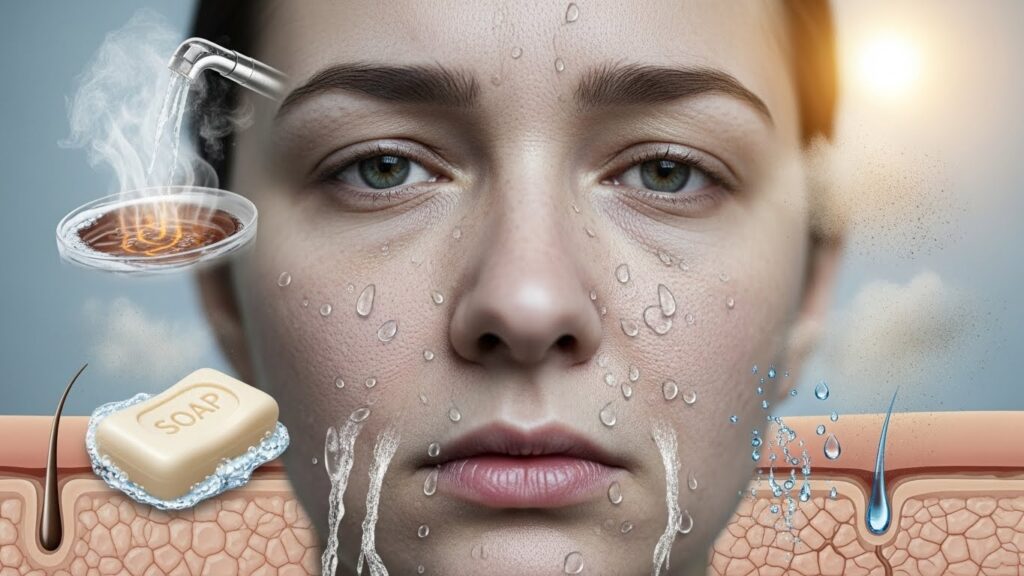
Skin type is a starting point, not a diagnosis. To get a rough idea, wash your face with water only and wait an hour without applying anything:
- Dry: skin feels tight, rough or flaky.
- Oily: skin looks shiny all over.
- Combination: shiny in some places (usually the forehead, nose and chin) and tight in others.
- Normal: skin feels comfortable, neither tight nor shiny.
- Sensitive: products often sting, or skin turns red and itchy easily.
Skin changes with weather, age and routine, so re-check rather than treating the result as permanent. If a product stings for more than a minute or two, wash it off — whatever your skin type.
Kitchen ingredients, used safely
These are the ingredients the live post recommended, with honest notes on each. Patch test every new ingredient first (see below) and use one new thing at a time.
| Ingredient | What it can do | What it cannot do |
|---|---|---|
| Honey | A humectant — it draws water to the skin’s surface and can help dry skin feel softer | It does not heal skin or treat acne on its own |
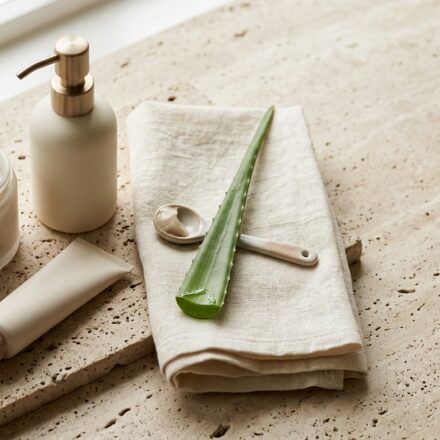
| Aloe gel | Feels cooling and can calm the look of redness; adds light moisture | It does not repair skin or remove marks |
| Colloidal oatmeal | An FDA-listed skin protectant; moderate evidence it temporarily relieves minor itching and dryness | It does not cure redness or dryness |
| Yogurt | Contains lactic acid, a gentle exfoliant, and can leave skin feeling smoother | It does not “dispose of dull skin” or fade dark spots |
| Coconut oil | A rich oil that suits very dry skin; the only common oil shown to penetrate the hair shaft | It is heavy and can feel greasy; it does not grow hair |
| Olive oil | A softening oil for dry skin and hair | It does not repair damage |
| Jojoba oil | A light oil that feels less greasy than most; suits many skin types | It does not add water — it seals in moisture |
| Shea butter | A rich butter that protects very dry areas | It is heavy; a little goes a long way |
| Rose water | Feels refreshing and can add light moisture | It does not tighten pores — pores have no muscles and cannot open or close |
| Cucumber | Feels cool and soothing on warm skin | It does not treat anything |
Do not use on skin: lemon or lime juice. Citrus juice contains furanocoumarins. When they sit on skin and meet sunlight, they can cause phytophotodermatitis — a burn-like reaction with redness, blisters and dark marks that can last for years. Cleveland Clinic lists limes and other citrus fruits among the common causes. (Cleveland Clinic, Phytophotodermatitis) This applies even in small amounts, and even if the juice was meant to “lighten” dark spots — it is more likely to create new ones.
Patch test first. Apply a small amount to a quarter-sized area on the inside of your arm or the bend of your elbow, twice a day, for 7–10 days, following the AAD patch-test method. If there is no redness, itching or swelling, it is probably safe to use on your face. Stop at once if irritation appears.
Face masks by skin type
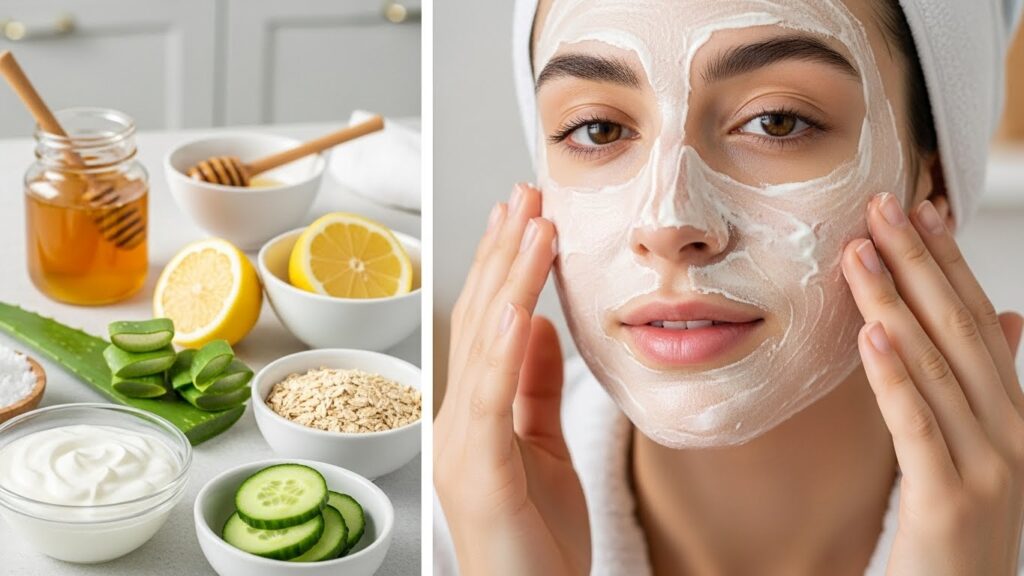
A mask is a once-or-twice-a-week step, not a daily one. Apply to clean skin, leave on for 10–15 minutes, rinse with lukewarm water, then moisturise. A mask adds temporary surface moisture; it does not feed new skin cells, and no mask makes skin sun-proof.
- Dry skin: honey mixed with yogurt. Both add moisture to the surface and leave skin feeling softer.
- Oily skin: oatmeal mixed with a little water or yogurt. Oatmeal absorbs surface oil and is gentle. Do not use lemon — see the warning above.
- Dull skin: aloe gel with cucumber. Both feel cooling and add light moisture. They do not create new skin cells.
- Acne-prone skin: honey on its own, applied gently with clean fingers. Do not scrub acne, and do not expect a mask to treat it. If acne is painful, spreading or leaving scars, ask a pharmacist or dermatologist — home care is not a treatment for acne.
- Dark spots: yogurt on its own. Its lactic acid is a mild exfoliant. It will not fade spots quickly, and any lightening takes weeks of steady use plus daily sunscreen — sun exposure is what darkens spots in the first place.
Stop using a mask if your skin turns red, stings or feels tight afterwards.
Moisturisers and hydration
Moisturisers do not add water to the skin. They stop water leaving it. That is why the order matters: water or a hydrating product first, on damp skin, then an oil, butter or cream on top to seal it in.
- Very dry skin: shea butter or coconut oil, used sparingly.
- Normal skin: a light cream or a few drops of oil.
- Oily skin: a light lotion or gel. You still need moisturiser — skipping it can leave skin dehydrated and looking flat. Oil-free does not mean moisture-free.
- Sensitive skin: fragrance-free products, and one new product at a time.
Sun care — honestly
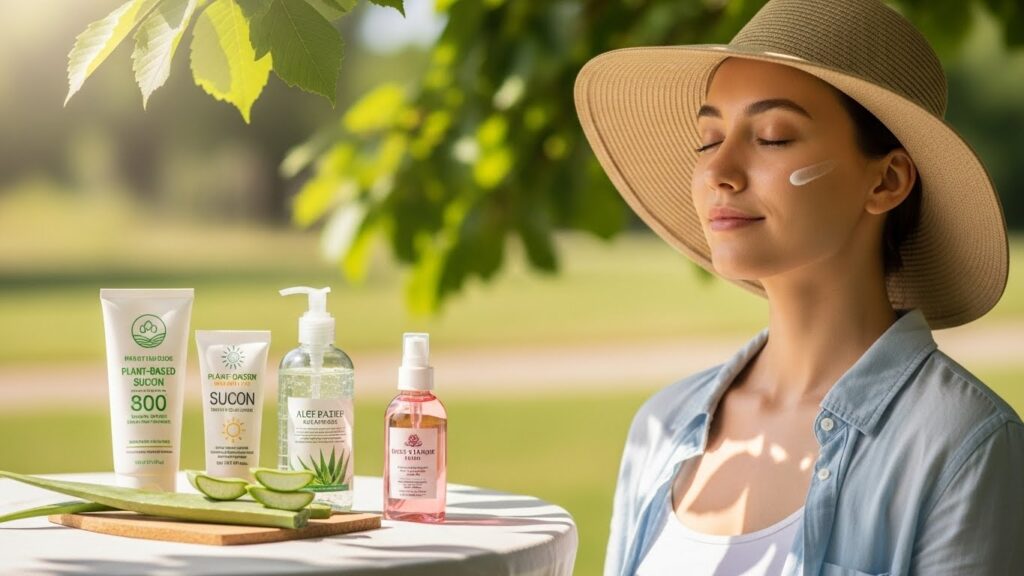
Sunlight causes dark spots, dryness and early fine lines. Hats and shade help. Aloe feels soothing after sun exposure, but it does not undo sun damage and it is not sun protection.
No plant-based cream replaces sunscreen. If a product does not list an SPF number and “broad spectrum” on the label, do not count on it for sun protection. Use a broad-spectrum sunscreen with SPF 30 or higher every morning, and reapply every two hours when outdoors, or after swimming or sweating. Sunscreen is the single most effective anti-ageing step in any routine — a four-and-a-half-year trial found daily sunscreen use slowed skin ageing by about 24% (Hughes et al. 2013).
Food, water and sleep — support, not treatment
Food and water support skin health; they do not treat skin problems. Vitamin C from oranges helps the body make collagen, which skin needs. Berries, nuts, seeds, green leaves and fish all contribute nutrients. But no food lightens skin, firms skin or clears acne. Water keeps the body hydrated; it does not “fill skin cells” or remove toxins.
Sleep is the same: most adults need 7 or more hours a night (CDC). Short sleep shows as dullness and dark circles, but sleep alone does not fix skin problems.
Common mistakes
- Using several new products at once, so you never learn what helps or what irritates.
- Over-washing or using hot water and harsh soap, which strip the skin’s natural oil.
- Skipping sunscreen — UV exposure can undo everything else in the routine.
- Putting lemon or citrus juice on the skin.
- Touching your face often, which moves dirt and oil onto the skin.
- Expecting a fixed result by a fixed date. Hydration can feel better within days, but changes in tone take weeks of steady use, and the timing varies from person to person. No routine can promise smoother skin in one week and clearer skin in one month.
When to get help
Ask a dermatologist or pharmacist if: your skin is persistently red, sore, swollen or blistering; you have a rash that does not settle; you have acne that is painful, spreading or scarring; you have a skin condition such as eczema or rosacea that is getting worse; or you are unsure whether an ingredient is safe for you. If you have used lemon or lime juice on your skin and then been in the sun, and the skin is red, blistered or darkened, get medical advice — do not try to treat it with more home ingredients.
Summary
Cleanse gently, hydrate on damp skin, moisturise, and wear broad-spectrum SPF 30+ every morning. Use kitchen ingredients one at a time, patch test first, and never put lemon or lime juice on your skin. A mask once or twice a week adds temporary moisture. Food, water and sleep support skin; they do not treat it. Keep the routine the same for a few weeks before judging it. If your skin becomes irritated, simplify back to cleanser, moisturiser and sunscreen.
Sources: AAD sunscreen guidance; AAD exfoliation guidance; Mayo Clinic Health System on “natural” personal care products; Cleveland Clinic on phytophotodermatitis; LiVDerm on pore myths; CDC sleep guidance; Hughes et al. 2013 on daily sunscreen and skin ageing. This is a researched overview, not a hands-on review.