Researched overview.
Table Of Content
Quick answer
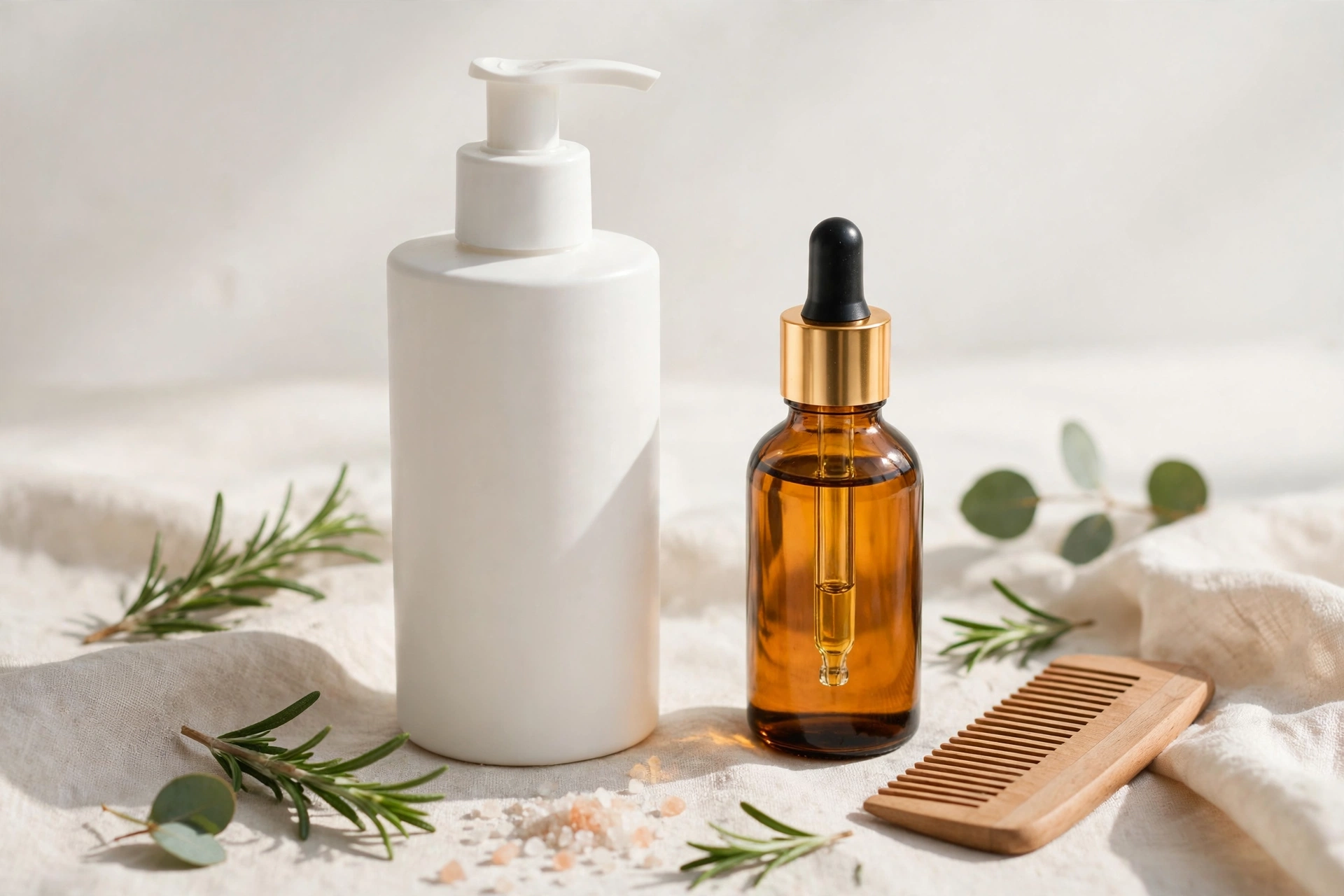
Healthy-looking hair for men comes down to a short list of habits: wash as often as needed with a gentle shampoo, condition the lengths, dry gently, detangle damp hair with a wide-tooth comb, trim split ends, and look after the beard the same way you look after the skin under it.
No shampoo, oil or routine makes hair grow faster, and no grooming habit overrides genetics. Pattern hair loss — the most common cause of thinning in men — is driven by genetics and by how sensitive your follicles are to DHT, a hormone derived from testosterone. If thinning is the real concern, the last section of this guide matters more than any product choice.
Contents: Washing · Drying · Combing and detangling · Trimming · Beard care · Styling products · Hats · Food, water and sleep · Supplements · Pattern hair loss · When to see a doctor
Washing
- Wash as often as needed. There is no rule that washing daily is bad or that washing rarely is better. Wash when the scalp feels oily, sweaty or itchy. Over-washing with a harsh shampoo can irritate the scalp — the reason to avoid it is irritation and dryness, not a proven “oil rebound”.
- Choose a shampoo by what your scalp needs. A gentle shampoo suits most men. If the scalp is dry or sensitive, a sulfate-free shampoo is a reasonable choice; sulfates are not “harmful” as a class, but a gentler formula can feel better on an irritated scalp. If flakes keep coming back, that is usually dandruff, and it needs a dandruff shampoo with a named active ingredient — zinc pyrithione, selenium sulfide, ketoconazole, salicylic acid, sulfur or coal tar. Our dandruff guide for men covers how to choose and use one.
- Use lukewarm water. Hot water can dry out the scalp and the hair.
- Shampoo the scalp, condition the lengths. Shampoo is for the scalp; conditioner is for the hair shaft. Applying conditioner to the scalp can leave residue that makes flakes look worse.
- Rinse well. Shampoo and styling product left on the scalp can build up and irritate it.
- What shampoo does to the scalp microbiome. One 28-day study (Xu et al. 2025) found that shampoo use significantly increased scalp moisture without changing sebum secretion, and shifted the scalp microbial community. That is interesting, but it does not mean washing “prevents follicle suffocation” or that sebum hardens into a “pore-blocking film” — neither claim is in the study.
Drying
- Blot, don’t rub. Towel-dry gently rather than rubbing the scalp and hair hard. Wet hair is more fragile than dry hair, so rough towel-drying causes more breakage.
- Let hair air-dry when you can. If you use a blow dryer, use low or medium heat and keep the dryer moving — never hold it in one spot. A study of hair-dryer damage (Lee et al. 2011) found that drying from about 15 cm (6 inches) away with continuous motion caused less damage than other methods. The AAD advises limiting blow-dryer heat and using low or medium settings.
- Dry the scalp too. Leaving the scalp damp under a hat for hours can make it feel itchy and can worsen flaking. Dry the scalp, then put the hat on.
Combing and detangling
- Detangle damp, not dry. Wet hair is more fragile than dry hair, so detangle damp hair coated in conditioner, starting at the ends and working up, with a wide-tooth comb. Never detangle dry hair by force.
- Be gentle with curly hair. Curly hair tangles more easily and breaks more easily when pulled. Finger-detangle first, then use a wide-tooth comb on damp, conditioned hair.
- Do not brush hard. Aggressive brushing does not distribute oil evenly or make hair healthier — it breaks hair. A few gentle strokes are enough.
Trimming
- Only trimming removes split ends. Damaged hair cannot be repaired, and no oil, mask or treatment closes a split end. Trimming every 6–12 weeks keeps split ends from travelling further up the hair shaft.
- Beard shaping is separate. A common beard-grooming interval is every 3–4 weeks to keep the shape tidy. That is a grooming interval, not a medical rule.
- Cut with clean, sharp tools. Dull or dirty tools tear the hair and can irritate the skin.
Beard care
The beard is facial hair growing out of facial skin, so it is cared for like skin:
- Wash your face and facial hair daily with a fragrance-free, non-comedogenic cleanser, using circular motions, then rinse well and pat dry. Moisturise the skin and facial hair immediately after washing, while still damp.
- Comb the beard while it is still wet with a beard comb.
- If you have stubble and are prone to ingrown hairs, consider an exfoliating product once or twice a week, choosing one containing salicylic acid and labelled “gentle” or “sensitive skin”.
- Beard oil is a moisturiser, not a growth treatment. It softens the beard and the skin underneath. It does not make the beard grow faster or thicker.
(All of the above is the AAD’s beard-care guidance, published December 15, 2021, from Dr. James Ralston, MD, FAAD.)
Before using a new beard oil or styling product, patch test it: put a small amount on the inside of your arm or the bend of your elbow, twice a day for 7 to 10 days. If the skin turns red or itchy, do not use it. (This is the American Academy of Dermatology patch-test method.)
Styling products
- Keep it light on the scalp. Heavy waxes and oils applied to the scalp can trap residue. Apply styling product to the hair lengths, and wash it out properly.
- Read the label, not the marketing. Drying alcohols (ethanol, isopropyl alcohol) strip moisture; fatty alcohols (cetyl, stearyl) are conditioning ingredients. A product is not “harsh” because it contains an alcohol, and not “gentle” because it says “natural” on the front — the FDA has never legally defined “natural” for cosmetics.
- Wash styling product out. Product left on the scalp overnight, day after day, builds up and can irritate the scalp.
Hats
A normal, properly fitting hat does not cause pattern hair loss. Hair follicles get oxygen and nutrients through blood vessels under the scalp, not from outside air, and a hat does not change your hormones or your genes.
What a hat can do is trap sweat and oil against the scalp, which can make an existing scalp problem feel worse, and a very tight hat worn for long periods can contribute to traction alopecia — hair loss from repeated pulling — especially along the hairline. The practical advice is simple: wear a hat that fits comfortably, wash it regularly, and let the scalp breathe when you can. If thinning continues, the cause is almost certainly not the hat.
A hat also protects an exposed scalp from sunburn — the scalp is skin too, so use broad-spectrum SPF 30+ sunscreen on any exposed scalp or parting, or cover it with a hat.
Food, water and sleep
Eating well, drinking enough water and sleeping enough support general health, including skin and hair. But no food, drink or sleep schedule is a treatment for hair loss, and no meal changes hair condition on a fixed timeline. There is no fixed daily water amount that improves hair, and sleep is not the “strongest anti-ageing grooming habit” — that is a ranking nobody has measured. If shedding or thinning is the real concern, the next two sections matter more than diet.
Supplements
This guide recommends no supplement, dose or brand. Supplements help only where a deficiency exists, and the only way to know is a blood test.
- Iron: low iron can contribute to shedding, but iron should only be taken after a blood test confirms a deficiency. Excess iron is harmful.
- Zinc: too much zinc blocks copper absorption, so the NHS advises keeping long-term intake from supplements at or below 25 mg a day. Zinc and iron taken at the same time can interfere with each other’s absorption, so timing should be decided with a clinician or pharmacist.
- Biotin: biotin is vitamin B7. There is no good trial showing biotin helps hair growth in people who are not deficient. High-dose biotin can also interfere with lab tests — the FDA has warned that it can cause falsely low troponin, the heart-attack test — so tell your doctor about any biotin supplement before blood tests.
- Vitamin A: too much vitamin A can cause hair shedding (telogen effluvium). The NHS advises keeping long-term intake below 1.5 mg a day. It is reversible when the excess stops, but it is a real risk of over-supplementing.
Pattern hair loss
About half of men show some pattern hair loss by age 50 (NICE CKS: about 30% of white men by age 30, 50% by age 50, 80% by age 70; prevalence is highest in Caucasians and lower in other groups). It usually starts with a receding hairline or thinning at the crown, and it develops gradually — so thinning can go unnoticed for a while.
What is known:
- It is largely genetic and hormonal. Affected follicles become more sensitive to DHT, the growth phase shortens, and hairs gradually become shorter, finer and less visible.
- Minoxidil is the best-evidenced treatment. It is available over the counter. The AAD says results take 6–12 months, and some shedding at the start is normal. It does not work for everyone.
- Finasteride is prescription-only. It needs a doctor’s prescription and a discussion of benefits and risks.
- Shampoos do not cure it. No shampoo — ketoconazole, caffeine, biotin or otherwise — has good evidence as a hair-loss treatment. Ketoconazole is not FDA-approved for hair loss (1% over the counter, 2% by prescription, as a dandruff treatment). Caffeine trials for hair loss are mostly low or very low quality, and an expert panel did not recommend caffeine. There is no good evidence a biotin shampoo thickens hair.
- Scalp massage is not a treatment. The only study is Koyama et al. 2016 — 9 men, no control group — which cannot support a growth claim.
If you are losing hair in a pattern, or shedding heavily, see a dermatologist. They can confirm the cause and rule out reversible causes — thyroid problems, iron deficiency, medication effects — before you spend money on long-term treatments.
When to see a doctor
- Hair thinning or loss that is progressive, patchy, or comes with scalp symptoms (redness, pain, bumps, heavy flaking).
- Shedding that started suddenly, or after an illness, major stress, or a new medication. (Telogen effluvium — shedding after a trigger — usually appears 2–3 months after the trigger, and fullness returns in 6–9 months.)
- Flakes or itching that have not improved after about a month of using an anti-dandruff shampoo as directed.
- A scalp that is very itchy, red or swollen, or flaky patches on the face or elsewhere on the body.
Summary
Wash as often as needed with a gentle shampoo and lukewarm water, condition the lengths, blot dry, and detangle damp hair with a wide-tooth comb, ends first. Trim split ends every 6–12 weeks. Wash the face and beard daily, moisturise while damp, and comb the beard while wet. A normal hat does not cause hair loss. No supplement, oil or routine makes hair grow faster, and no shampoo cures pattern hair loss — minoxidil is the best-evidenced treatment and takes 6–12 months, finasteride is prescription-only, and a dermatologist should confirm the cause before you commit to either.
Sources: AAD beard-care guidance (Dec 15, 2021); AAD dandruff guidance; NHS dandruff guidance; NICE CKS male pattern hair loss; Lee et al. 2011; Xu et al. 2025; Koyama et al. 2016. This is a researched overview, not a hands-on review.