Researched overview. This guide is based on published dermatology guidance, not on hands-on testing by BeautyKob. No product, supplement or brand is recommended, and no dose is given.
Table Of Content
Quick answer
A body-care reset is a simple way to restart a consistent routine for dry, rough body skin: gentle cleansing, regular moisturising, careful exfoliation and sun protection on exposed areas. It is not a detox, a weight-loss programme or a treatment for an internal health condition. It does not reset metabolism, burn fat, balance blood sugar, remove toxins or cause weight loss. It is limited to external skincare habits that may help dry or rough skin feel more comfortable. If your routine has grown into many products, strong scrubs and several actives at once, the reset is to strip it back to three steps and add things back one at a time. This guide is general information, not medical advice.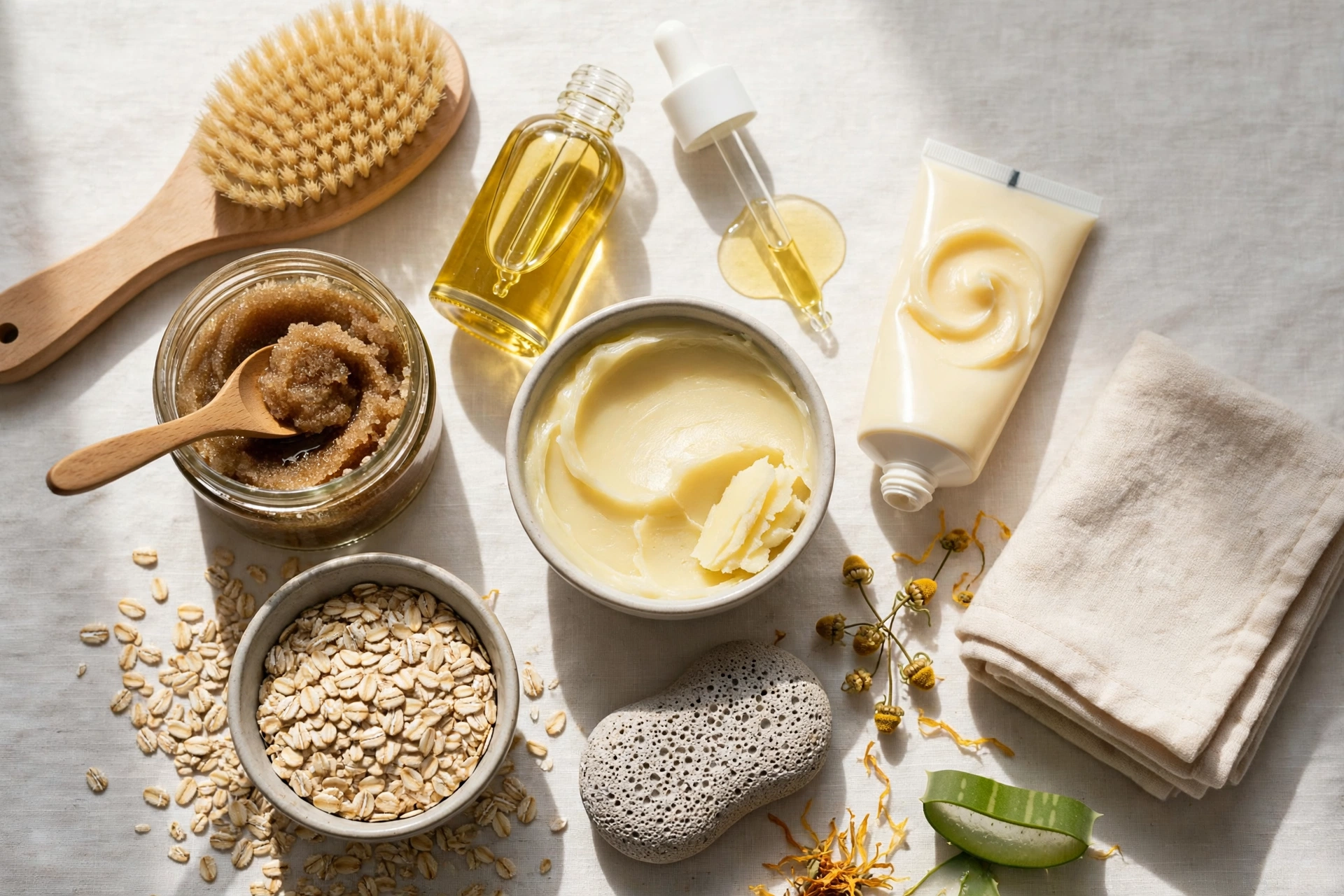
Contents: What a reset is · What it is not · Signs your routine needs simplifying · The four principles · The reset week · Five habits that make dry skin worse · Lifestyle, honestly · What to expect · When dryness is more than dryness · Patch test · When to get help · FAQ
What a reset is
A reset means simplifying. Most dry, rough body skin is made worse by the routine itself: long hot showers, daily scrubbing, several strong products layered together, and moisturiser applied too late or not at all. A reset removes those habits and replaces them with a short routine you can repeat every day:
- Cleanse gently — a short, warm shower and a mild, fragrance-free cleanser.
- Moisturise consistently — cream or ointment on damp skin, every day, not only when skin feels bad.
- Exfoliate carefully — once a week at most while skin is dry or irritated, and never on damaged skin.
- Protect exposed skin — broad-spectrum sunscreen SPF 30 or higher on exposed areas every morning.
That is the whole reset. Anything else is an addition, introduced one at a time so you can tell whether it helps or irritates.
What it is not
- Not a detox. Skin does not need detoxing; the liver and kidneys handle waste removal. No drink, fast, cleanse or supplement “detoxes” skin, and this routine includes none of those.
- Not a weight-loss programme. A body-care reset does not change body weight, burn fat or balance blood sugar.
- Not a diet or supplement programme. It does not require a restrictive diet, a detox drink or any supplement. Eating well supports general health; it is not a skin treatment.
- Not a treatment for a health condition. It does not treat eczema, psoriasis, diabetes-related skin problems or any internal condition. People with persistent or diagnosed skin conditions should follow advice from their healthcare professional.
Signs your routine needs simplifying
- Skin feels tight, flaky or rough even though you use several products.
- You scrub rough areas every day and they stay rough — or get worse.
- You layer several active products and cannot tell which one is causing stinging or redness.
- You moisturise only when skin already feels bad, hours after bathing.
- You keep adding new products because the last one “did not work” within a few days.
If two or more of these sound familiar, the routine is the problem more often than the skin is. Strip it back before adding anything new.
The four principles
1. Simplify the routine. One gentle cleanser, one moisturiser suited to your skin, and sunscreen on exposed areas. Introduce one new product at a time, so it is easier to identify irritation. A reset does not require a restrictive diet, a detox drink or a supplement programme.
2. Cleanse gently. Short, warm showers — about 5 to 10 minutes — with a mild, fragrance-free cleanser. Focus soap on high-sweat zones (underarms, groin, feet); use bare clean hands or a soft cloth for the rest. Pat skin dry instead of rubbing, and moisturise while skin is still damp.
3. Moisturise consistently. Apply cream or ointment to damp skin after every shower, not only on bad days. A cream or ointment seals in water more effectively than a thin lotion. For barrier support, a simple ceramide cream is a reasonable choice. Apply ointment to small cracked areas. Reapply to hands and rough patches whenever they feel dry.
4. Protect exposed skin. Broad-spectrum sunscreen SPF 30 or higher on exposed areas every morning, reapplied every two hours while outdoors and after swimming or sweating. Sun damage makes dry, rough skin worse over time, and sunscreen is the step that stops new damage.
The reset week
A reset is a week of actions, not a week of promised results. Skin does not change on a fixed schedule; what changes in a week is the routine.
- Days 1–2: strip back. Stop all scrubs, acids, strong actives and fragranced products. Use only a gentle cleanser and a plain moisturiser. This is the baseline — if skin calms down, the old routine was part of the problem.
- Days 3–4: keep it simple. Continue the baseline. Note what feels better and what still feels dry or rough. Do not add anything yet.
- Day 5: one addition, if needed. If a specific area is still rough, add one thing — for example, a urea or lactic acid cream on that area only, used as directed. Do not add two things on the same day.
- Days 6–7: settle. Keep the routine steady. If the addition stings, reddens or flakes the skin, stop it and go back to the baseline. If skin feels comfortable, keep the addition and stop adding.
After the week, the routine that remains is your routine. Add new products one at a time, with days between each addition, so you always know what caused a reaction.
Five habits that make dry skin worse
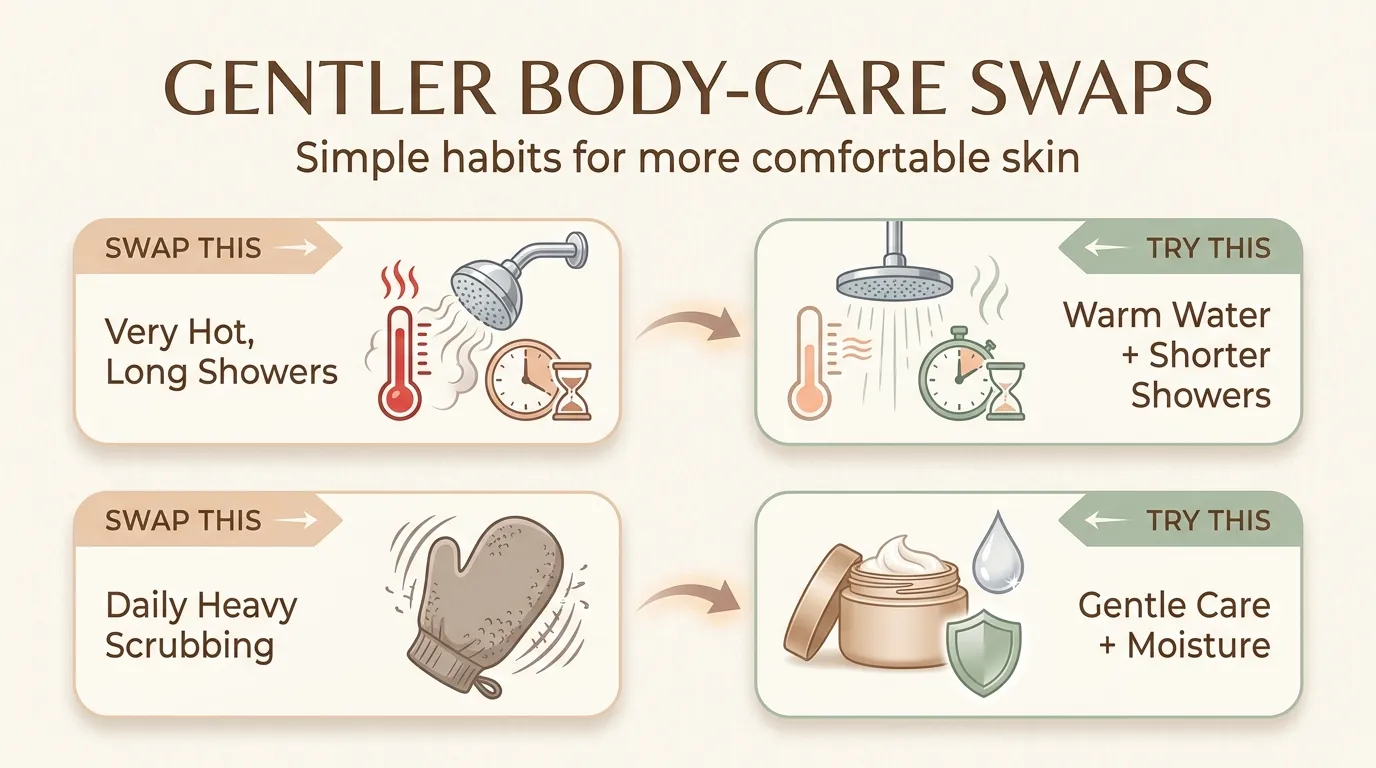
- Very hot, lengthy showers. Hot water strips surface oils. Use warm water and shorten bathing time to about 5 to 10 minutes.
- Scrubbing rough areas every day. Daily scrubbing damages the barrier and makes rough areas rougher. Reduce friction and prioritise moisture; exfoliate once a week at most while skin is dry.
- Layering several active products. Several strong products at once increase irritation without better results. Introduce only one new product at a time.
- Waiting too long to moisturise. Moisturiser works best on damp skin, within a few minutes of bathing. Waiting hours lets the water evaporate first.
- Ignoring repeated stinging or redness. Stinging or redness that keeps coming back is a sign to stop the product and assess the reaction — not to push through it. If a product stings every time you use it, stop using it.
Lifestyle, honestly
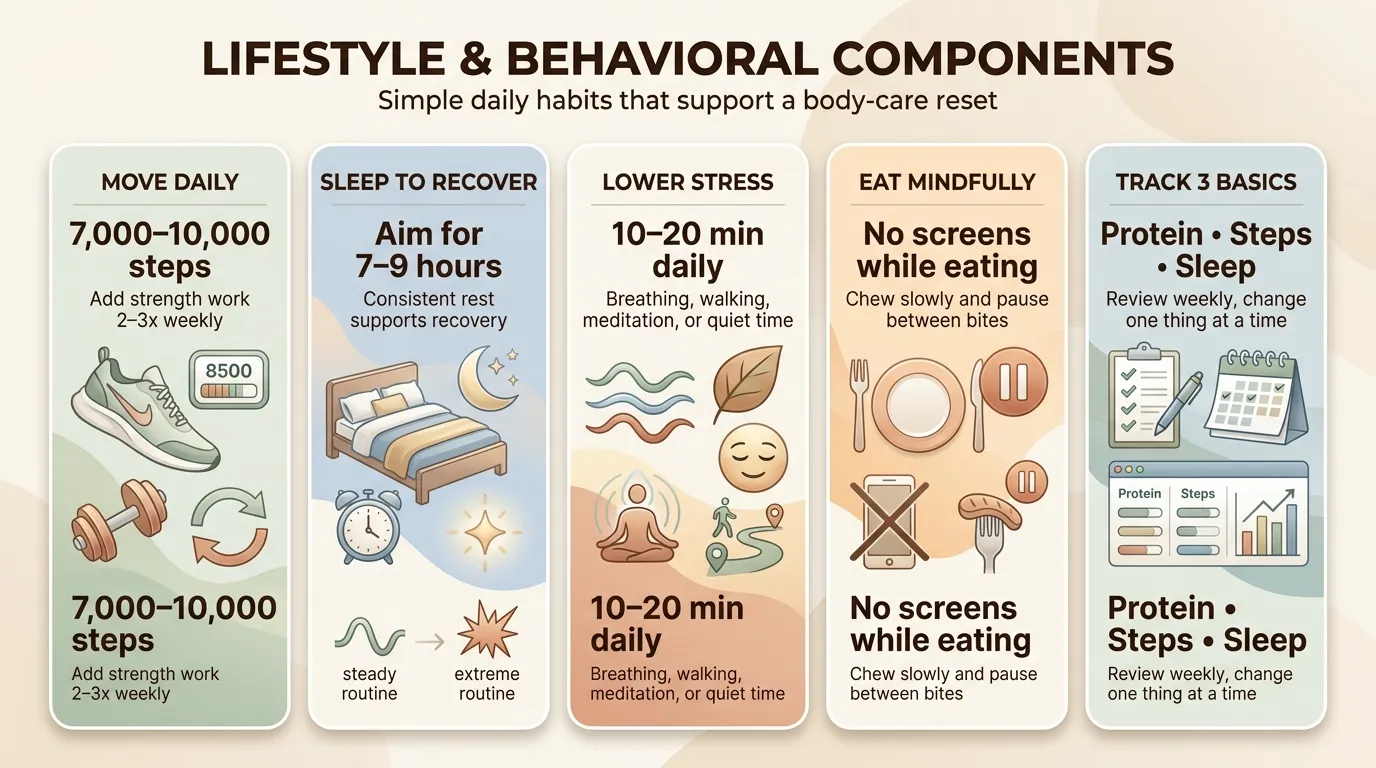
A reset is mostly about the routine, but a few habits around it matter — stated honestly, without overstating what they do.
- Movement. Regular movement is good for general health. Walking and light activity are reasonable; no specific step count or named programme is needed, and no exercise routine is a skin treatment.
- Sleep. Adults need 7 or more hours a night (CDC). Poor sleep makes skin look worse and makes it harder to stick to a routine. Sleep is a practical time to rest, not a biological repair window — no hour of the night is a peak repair window, and no sleep schedule repairs skin on a fixed timetable.
- Stress. Ongoing stress can make skin more reactive and make it harder to keep a routine. Short daily practices such as breathwork, walking outside or meditation can help you feel calmer. No breathing technique or meditation practice lowers stress hormones on a schedule, and none of them is a skin treatment.
- Food. Eat without a screen, chew food thoroughly and notice when you are full — these are general healthy-eating habits. No food, diet or eating pattern is a skin treatment, and no specific food repairs the skin barrier. Readers considering significant dietary changes should seek advice appropriate to their individual health and nutritional needs.
- Tracking. If tracking helps you stick to a routine, note three simple things each day for a week — for example, whether you moisturised after showering, how your skin felt, and how you slept. That is enough. Do not turn tracking into a second routine.
What to expect
A simpler routine may help reduce the dry or uncomfortable feeling caused by harsh cleansing, inconsistent moisturising or excessive exfoliation. Some people may notice skin feels softer or smoother with consistent care, but results vary according to skin type, product choice and the cause of the dryness. Hydration can feel better within days; changes in rough texture take weeks of steady care, and there is no fixed schedule.
This routine is not intended to produce weight loss, improve immunity, balance hormones or treat digestive or metabolic conditions. It does not include fasting, juice cleanses, meal-replacement plans or restrictive diets. If a reset does not help after several weeks of a steady, simple routine, the dryness may have a cause that needs a clinician, not a different product.
When dryness is more than dryness
Seek medical care if dryness becomes painful, deeply cracked, bleeding, swollen, persistently itchy or resistant to regular moisturising. These signs could indicate eczema, an infection or another condition requiring more than cosmetic treatment. A rash that spreads, oozes, or comes with fever or deep pain needs prompt medical attention. Do not try to diagnose yourself from a skincare article.
Patch test
Before using a new body product more widely, patch test it: apply a quarter-sized amount to the underside of your arm or the bend of your elbow, twice a day, for 7 to 10 days. If you get redness, itching, swelling or a rash, stop using it. A 24-hour test can miss an allergic reaction, which often takes several days to appear — that is why this guide uses the AAD 7–10 day patch-test method. This is the American Academy of Dermatology’s patch-test method.
When to get help
Ask a dermatologist or pharmacist if: dryness is painful, deeply cracked, bleeding, swollen or resistant to regular moisturising; a product keeps stinging or causing breakouts; or you have a skin condition such as eczema or psoriasis that is getting worse. See a doctor promptly for a rash that spreads, oozes, or comes with fever or deep pain.
Frequently asked questions
Q1: How long does a body-care reset take?
The routine change takes a week. Skin changes take longer — hydration can feel better within days, rough texture takes weeks of steady care. There is no fixed schedule, and a reset does not produce results by a date.
Q2: Do I need to detox or change my diet for a reset?
No. A body-care reset is about external skincare only. Skin does not need detoxing, and no diet, fast or supplement is part of this routine.
Q3: Can I exfoliate during a reset?
Once a week at most while skin is dry or irritated, and never on damaged skin. Daily scrubbing is one of the habits a reset removes.
Q4: What if my skin does not improve after a reset?
If dryness is painful, cracked, bleeding or resistant to regular moisturising after several weeks of a simple routine, see a doctor — it may be eczema, an infection or another condition.
Q5: Should I buy new products for a reset?
Usually not. A reset mostly means using fewer products, not different ones. Start with a gentle cleanser and a plain moisturiser you already have, and add one thing at a time only if a specific area needs it.
Summary
A body-care reset is simplification, not detox: gentle cleansing, consistent moisturising on damp skin, careful exfoliation once a week at most, and sunscreen on exposed areas. It does not reset metabolism, burn fat, balance blood sugar or remove toxins. Strip the routine back for a week, add one thing at a time, and stop anything that stings or reddens skin. Patch test new products for 7 to 10 days, and see a doctor if dryness is painful, cracked, bleeding or resistant to regular moisturising.
Sources: American Academy of Dermatology, 7 Rosacea skin care tips (patch-test method: apply a new product to a quarter-sized patch of skin on the inside of the arm for 7–10 days); American Academy of Dermatology, How to select anti-aging skin care products (broad-spectrum sunscreen, SPF 30 or higher on exposed skin every morning, reapply every two hours outdoors). This is a researched overview, not a hands-on review.