Researched overview.
Table Of Content
Quick answer
A beginner routine does not need many products. It needs three things: know what your skin and hair are like, do a few gentle steps every day, and change one thing at a time so you can tell what helps.
Start with a gentle cleanser, a moisturiser, and sunscreen in the morning. That is enough for the first few weeks. Add a weekly step only after the basics feel comfortable.
If your skin is red, painful, flaking badly, or has a rash, blisters or open sores, skip the extras and ask a dermatologist or pharmacist first. This guide is general information, not medical advice.
Contents: What beginner friendly means · Know your skin · Know your hair · Morning routine · Night routine · Weekly extras · Habits that matter more than products · Natural remedies, honestly · Beginner mistakes · When to get help · FAQs
What “beginner friendly” means
Beginner friendly means simple, gentle and repeatable. It does not mean buying everything at once, and it does not mean a routine that only works if you never miss a day.
Three rules make a beginner routine work:
- Fewer steps, done daily. Three or four steps you actually do beat ten steps you abandon in a week.
- One change at a time. If you start five new products in one week and your skin reacts, you will not know which one caused it.
- Watch and adjust. Your skin and hair change with stress, sleep, food and the seasons. A routine that stays the same while you change is not a good routine.
You do not need to fix everything at once. Give the basics a few weeks before you judge them. Hydration can feel better within days; changes in tone or texture take longer, and the timing varies from person to person. No routine can promise a specific result by a specific week.
Know your skin first
Before you buy anything, spend a few days noticing your skin. Wash your face with a gentle cleanser, wait about an hour without applying anything, and notice how it feels:
- Tight or flaky — likely dry. Focus on gentle washing and a richer moisturiser.
- Shiny in the T-zone (forehead, nose, chin) — likely oily or combination. Use light, non-greasy formulas, and still use a moisturiser. Skipping moisturiser can leave skin dehydrated and looking flat.
- Red, itchy or stinging — likely sensitive. Keep the routine shorter, use fragrance-free products, and patch test anything new.
- A mix of the above — likely combination. Treat the oily areas lightly and the dry areas with a little extra moisturiser.
This is a practical check, not a medical test. If you have a skin condition such as eczema, rosacea or acne that is getting worse, ask a dermatologist rather than guessing.
Skin changes over time. Stress, sleep, food and the weather all affect it. That is normal, and it is why the routine below is built on habits rather than on chasing every new product.
Know your hair first
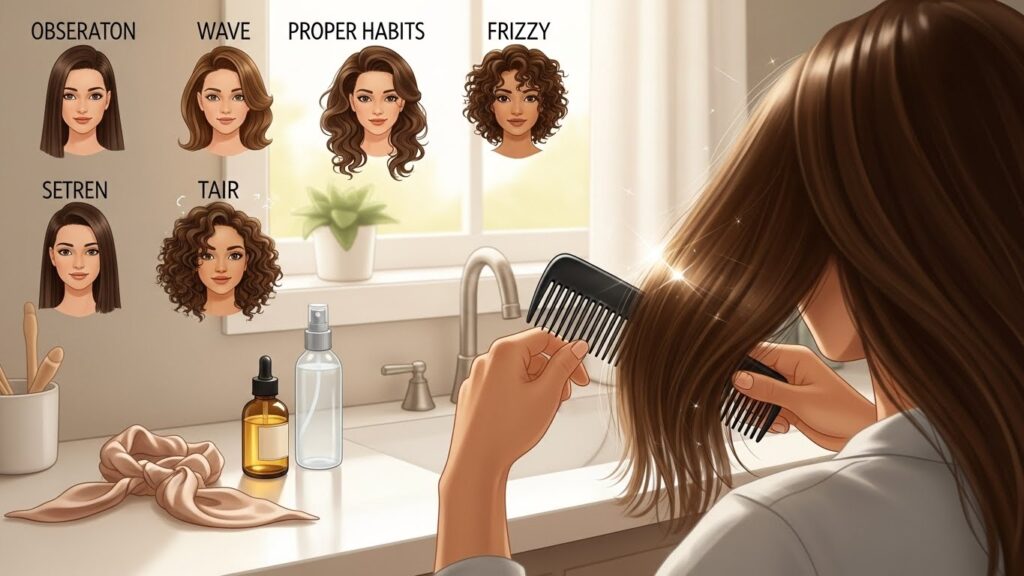
Hair is the same story: watch it before you buy for it.
- Straight hair tends to look oily sooner at the roots.
- Wavy and curly hair tends to be drier and to tangle more easily.
- Frizzy hair usually means the outer layer of the hair (the cuticle) is raised and letting humidity in, so strands swell unevenly.
Notice how your hair feels the day after washing, whether your scalp itches or feels dry, and whether the ends look rough or split. Those observations tell you more than any product label.
Damaged hair cannot be repaired back to its original state. Oils and masks can make it feel smoother and reduce further breakage, but only trimming removes split ends. Trim every 6–12 weeks, or sooner if the ends look split or frayed.
Morning routine
Five minutes is enough. The order matters more than the number of steps:
- Wash gently. Lukewarm water and a gentle cleanser, applied with your fingertips. Do not scrub. Hot water can dry the skin, and scrubbing irritates it rather than cleaning it better. Pat dry with a clean towel.
- Moisturise on slightly damp skin. A light lotion for oily skin; a richer cream for dry skin. Moisturisers work best when they combine a humectant (draws in water, e.g. glycerin, hyaluronic acid), an emollient (softens, e.g. ceramides, squalane) and, for dry skin, an occlusive (seals water in, e.g. petrolatum, shea butter).
- Sunscreen — every morning. Broad-spectrum sunscreen with SPF 30 or higher, as the last step. The American Academy of Dermatology recommends this daily, including on cloudy days and indoors near windows, because UV rays pass through cloud and glass. Reapply every two hours when outdoors, or after swimming or sweating. Sunscreen is the single most effective anti-ageing step there is: in one study, daily sunscreen use led to 24% less skin ageing over 4.5 years (Hughes et al. 2013).
- Hair, quickly. Undo any overnight braid gently. If the ends feel dry, a small amount of leave-in conditioner or a drop of oil on the ends only is enough. Do not pull hairstyles tight at the roots.
- A glass of water and a calm start. Drinking water supports your general health. It does not directly moisturise your skin, but starting the day hydrated and unhurried helps you stick to the routine.
Night routine
Night is for cleaning off the day and letting the skin rest:
- Remove makeup and dirt first. Then wash gently, the same way as in the morning. Double cleansing is only needed if you wear heavy makeup or water-resistant sunscreen.
- Moisturise. The same moisturiser as in the morning, or a slightly richer cream if your skin is dry.
- Hair before bed. Brush gently with a wide-tooth comb, starting at the ends. Tie hair loosely, or wrap it in a soft silk scarf if that is comfortable. Tight styles overnight pull at the roots and can cause breakage — and repeated pulling over time can damage hair follicles (traction alopecia).
Sleep supports your general health, and most adults need 7 or more hours a night on a regular basis (CDC). Sleep does not “cure” skin or hair, but regular sleep helps you keep the routine and feel better the next day.
Weekly extras — only after the basics feel comfortable
Do not add these in the first week. Add one, wait a week, and see how your skin and hair respond.
- Gentle exfoliation, once a week to start. A gentle chemical exfoliant (for example a low-strength lactic acid product) can help remove dead skin from the surface. Start once a week. Increase only if your skin stays comfortable. Stop if you get redness, stinging, flaking or tightness. Do not exfoliate every day, and do not use an exfoliant on the same night as a strong retinoid unless a dermatologist has advised it.
- A face mask, once or twice a week. A moisturising mask suits dry skin; a calming mask suits skin that is red or irritated. A mask adds temporary surface moisture. It does not feed new skin cells, and it is not a treatment on its own.
- A hair mask or deep conditioning, once a week. Apply to the lengths and ends, not the scalp. Leave it on for the time the label says, then rinse well. It coats the hair and makes it feel smoother; it does not repair damage or make hair grow faster.
- Light oil on the ends. A small amount of coconut or argan oil on dry ends can reduce friction and make hair feel softer. Oil seals in moisture; it does not hydrate on its own. Water moisturises, oil seals.
Patch test anything new. Apply a quarter-sized amount to the inside of your arm or the bend of your elbow, twice a day, for 7–10 days (the AAD method). If you get redness, itching or swelling, do not use the product.
Habits that matter more than products

Products are the smaller part of a routine. These habits do more for your skin and hair than any cream:
- Sleep 7 or more hours a night (CDC guidance for adults). Regular sleep supports general health.
- Drink water through the day. It supports general health. It does not directly moisturise your skin or make hair grow.
- Eat a balanced diet with protein, vegetables and fruit. Food supports general health. No food lightens skin, firms skin or grows hair, and diet is not a treatment for skin or hair problems.
- Keep pillowcases and towels clean. Wash them regularly. Dirty pillowcases and towels can carry oil and dirt back onto your skin.
- Touch your face less. Hands carry dirt and oil. Less touching means fewer avoidable breakouts.
- Manage stress in whatever way works for you — light exercise, a walk, something you enjoy. Stress can make breakouts worse for some people, and it makes routines harder to keep.
None of these habits replaces a routine. They make the routine work better.
Natural remedies, honestly
Natural remedies do not replace your routine. They can add to it, in small ways, if you use them gently:
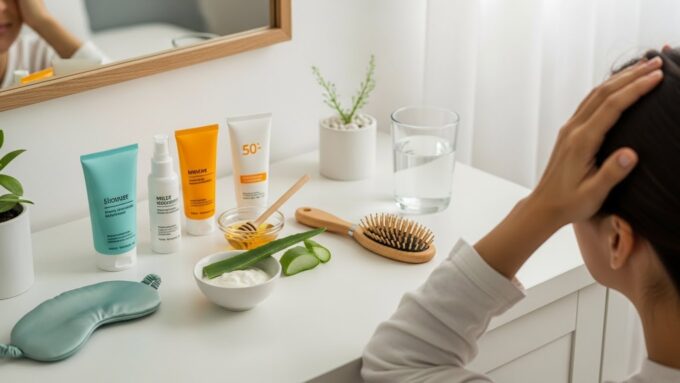
- Honey mask: honey can feel soothing on dry skin. Use it as a mask, rinse well. It is not a treatment for acne or dark spots.
- Aloe vera gel: can feel cooling on red or irritated skin. Use plain gel, not a product with added fragrance.
- Coconut or argan oil on hair ends: a small amount makes ends feel softer and reduces friction. Only coconut oil has been shown to penetrate the hair shaft (Rele & Mohile 2003); other oils mostly coat the surface. Oil does not make hair grow.
- Yogurt: sometimes suggested as a mask ingredient. There is no good evidence it does anything for skin or hair beyond feeling cool and moist.
Patch test any home remedy the same way as any new product — a quarter-sized area, twice a day, for 7–10 days. If your skin reacts, stop using it. And never put lemon or lime juice on your skin: citrus juice contains furanocoumarins, and with sunlight it can cause phytophotodermatitis — a burn-like reaction with redness, blisters and dark marks that can last for years (Cleveland Clinic).
Beginner mistakes to avoid
- Buying everything at once. More products mean more chances of irritation and no way to tell what helps.
- Changing products every few days. Skin and hair need time. Changing constantly means you never learn what works.
- Comparing your results to the internet. Other people’s timelines are not yours. Progress is slow and varies.
- Ignoring sleep, water and clean pillowcases. These are not extras; they are part of the routine.
- Picking at skin or pulling hair tight. Picking can leave marks and make breakouts worse. Tight styles pull at the roots.
- Skipping sunscreen because you are indoors. UV rays pass through windows. Sunscreen is a daily step, not a sunny-day step.
When to get help
Ask a dermatologist or pharmacist if: your skin is persistently red, sore, swollen or blistering; you have a rash that does not settle; you have a skin condition such as eczema, rosacea or acne that is getting worse; your hair is shedding heavily or in patches; or you are unsure whether a product is safe for you.
FAQs
Q1. What does a beginner beauty routine mean?
A simple, everyday routine for skin and hair: gentle washing, moisturiser, sunscreen, and a few weekly extras. It is built around your own skin and hair, not around buying many products.
Q2. How often should a beginner follow the routine?
Morning and evening, every day. Weekly treatments such as gentle exfoliation, a mask or a hair treatment can be added slowly, one at a time.
Q3. Do I need many products to start?
No. A gentle cleanser, a moisturiser, a sunscreen and a simple hair care product are enough to begin. Adding too many products at once is confusing and can irritate your skin.
Q4. How do sleep, water and food affect my skin and hair?
They support your general health, which supports your skin and hair. They are not treatments on their own, and no food or drink can promise clearer skin or faster hair growth.
Q5. How long does it take to see results?
Gradually, and the timing varies from person to person. Hydration can feel better within days. Changes in tone or texture take weeks of steady use. There is no fixed week by which results appear, and no routine can promise them.
Summary
Start with three steps: gentle cleanser, moisturiser, sunscreen every morning. Learn what your skin and hair are like before you buy more. Add one weekly extra at a time, patch test anything new, and keep the habits that support the routine — sleep, water, balanced food, clean pillowcases, and less face-touching. Keep it simple, keep it regular, and let the routine fit your life rather than the other way round.
Sources: AAD sunscreen guidance; AAD face-washing guidance; AAD exfoliation guidance; Hughes et al. 2013; CDC sleep guidance (7+ hours for adults); Cleveland Clinic phytophotodermatitis; Rele & Mohile 2003 (coconut oil); AAD patch-test method. This is a researched overview, not a hands-on review.