Researched overview.
Table Of Content
- Quick answer
- What self-care means here
- Skin care as part of self-care
- Daily skin care steps
- Weekly skin care steps
- Hair care as part of self-care
- Daily hair care
- Weekly hair care
- Body care as part of self-care
- Daily body care
- Weekly body care
- Food and water for beauty
- Sleep and rest
- Habits that improve beauty
- How to create a personal routine
- Clean tools and skin safety
- When to get help
- Summary
Quick answer
A self-care beauty routine is a short set of daily and weekly habits for skin, hair and body: cleanse gently, moisturise, protect from the sun, wash hair when it needs it, look after your body skin, eat and sleep well, and keep your tools clean. It does not need many products. It needs consistency.
Self-care here means the ordinary things that keep skin, hair and body comfortable — not a treatment for any condition, and not a promise of results. Stress, poor sleep and harsh products can all make skin and hair look worse; rest, gentle care and patience can help them look better. But no routine guarantees clean skin, strong hair or permanent results, and anyone who promises that is overselling.
If your skin is red, painful, flaking badly, or has a rash, blisters or open sores, or your scalp is very itchy, red or flaking badly, skip the home steps and ask a dermatologist or pharmacist first. This guide is general information, not medical advice.
Contents: What self-care means here · Skin · Hair · Body · Food and water · Sleep and rest · Habits · Building your own routine · Clean tools · When to get help
What self-care means here
Self-care beauty is a daily and weekly routine that looks after the whole person: skin, hair, body, sleep and rest. It includes gentle products, but it is not only products. Sleep, rest and calm time matter too, because tiredness and stress show on skin and hair.
The parts work together. A gentle routine protects the skin barrier. Sleep gives the body time to rest. Food and water support general health. Clean tools stop germs moving back onto the skin. None of these is a treatment on its own, and none of them works on a fixed timetable.
Skin care as part of self-care
Daily skin care steps
- Cleanse twice a day. Wash your face in the morning and before bed with a mild cleanser and lukewarm water. This removes dirt, oil and sweat. A light cleanser cannot damage skin; harsh soap and hot water can.
- Moisturise after washing. A light lotion or gel helps the skin hold water. Apply it while the skin is still slightly damp.
- Sun care every day. Apply a broad-spectrum sunscreen with SPF 30 or higher before going outside, and reapply every two hours when outdoors, or after swimming or sweating. UV damages skin cells and causes dark spots. The AAD recommends daily sunscreen, including on cloudy days. (AAD sunscreen guidance)
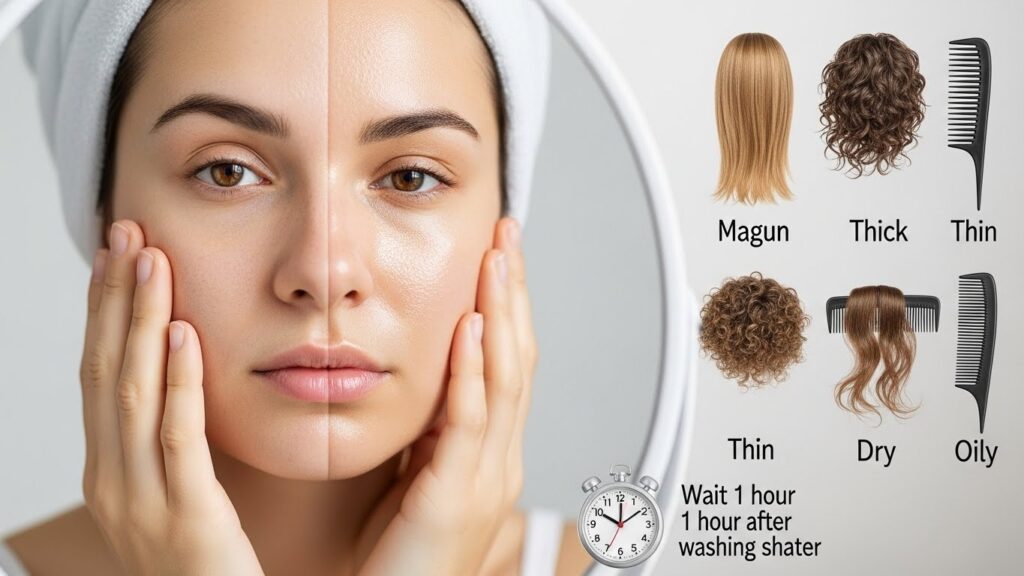
To get a rough idea of your skin type, wash your face with water only and wait an hour without applying anything. Tight means dry; shiny all over means oily; shiny in some places and tight in others means
combination; comfortable means normal; red and itchy easily means sensitive. This is a rough check, not a diagnosis.
Weekly skin care steps
Once or twice a week:
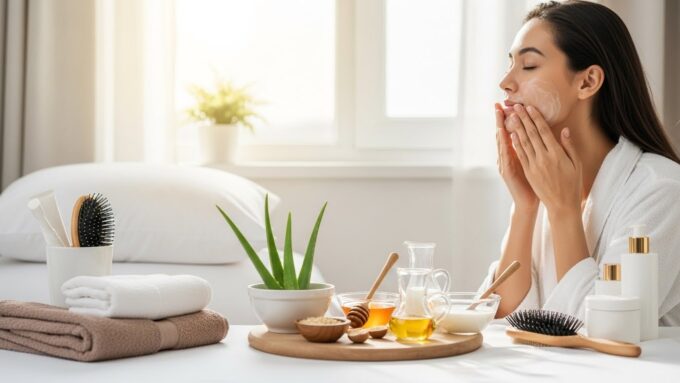
- A face mask. Honey masks suit dry skin; clay masks suit oily skin. Leave on 10–15 minutes, rinse with lukewarm water, then moisturise. A mask adds temporary surface moisture; it does not feed new skin cells.
- A gentle scrub or exfoliant. A mild exfoliant removes dead skin from the surface and can make skin look brighter. Do not rub hard — gentle treatment protects the skin. Stop if you get redness, stinging, flaking or tightness, and do not exfoliate every day.
Patch test first. Before using a new product on your face, apply a small amount to a quarter-sized area on the inside of your arm or the bend of your elbow, twice a day, for 7–10 days (AAD patch-test method). If there is no redness, itching or swelling, it is probably safe to use. Stop at once if irritation appears.
Hair care as part of self-care
Daily hair care
- Brush gently. Brushing with a wide-tooth comb spreads the hair’s natural oil along the strands and keeps hair soft. Do not pull through tangles — work from the ends upward.
- Avoid heat where you can. High heat dries hair out and can damage it. If you use heat tools, use the lowest setting that works and keep the dryer moving, about 15 cm from the hair (Lee et al. 2011).
- Wash when it needs it. Wash your hair as often as your scalp and hair need it, not by a fixed rule. A clean scalp supports hair; a dirty, irritated one does not help it.
Hair grows about 1/2 inch a month (AAD). Nothing in a home routine makes it grow faster. Normal shedding is 50–100 hairs a day (AAD). A sudden large increase, or hair loss in patches, is worth asking a doctor about.
Weekly hair care
- Oil before washing. A little oil on the lengths, left for at least 30 minutes before washing, can make hair feel softer. Only coconut oil is shown to penetrate the hair shaft; other oils coat the surface. Oil does not repair damage and does not make hair grow.
- A hair mask. A milk or egg mask can make hair feel smoother temporarily, because it coats the surface. It does not deliver protein into the hair — egg and milk protein molecules are too large to enter the shaft. Damaged hair cannot be repaired; only trimming removes split ends (trim every 6–12 weeks).
- Scalp massage. Massaging the scalp feels good and is harmless, but it does not grow hair: the only study often cited (Koyama et al. 2016) had 9 men and no control group.
- Loose styles at night. A loose braid reduces pulling and tangling overnight. Avoid tight styles — repeated pulling can cause traction alopecia, a form of hair loss from tension. Early cases can recover when the tension stops.
Body care as part of self-care
Body skin needs the same gentle treatment as face skin.
Daily body care
- Bathe regularly with a mild soap to remove sweat and dirt. A low-irritation soap keeps skin clean without stripping it.
- Moisturise after bathing with body lotion while the skin is still slightly damp, so it does not lose water and become rough and dry.
- Wash hands and feet before going to sleep, and moisturise them too — they dry out easily.
Weekly body care
- A body scrub. Sugar mixed with oil makes a simple scrub that removes dead skin from the surface. Use it gently, once a week at most, and not on broken or irritated skin.
- A warm bath to relax. A warm bath helps tired muscles and is a simple way to rest. Keep the water warm, not hot — hot water dries skin out.
Food and water for beauty
Food and water feed the body from the inside, and skin and hair are part of the body. Fruits give vitamins, vegetables give fibre and water, nuts and seeds give healthy fats. These help skin stay soft and hair stay healthy. But food is support, not treatment: no food lightens skin, firms skin, clears acne or grows hair.
Water helps the body stay hydrated. Drink water through the day. It does not “fill skin cells” or remove toxins, and drinking more water than your body needs does not make skin clearer.
Sleep and rest
Sleep is a strong part of self-care. Most adults need 7 or more hours of sleep a night, according to the CDC. During sleep the body rests, and poor sleep shows on skin as dullness and dark circles. Stress can make breakouts worse for some people, and a calm routine — regular sleep hours, quiet time, slow breathing — can help the body stay in balance. These are general wellbeing habits, not skin treatments, and they do not work on a fixed timetable.
Light exercise also helps general health and blood flow. It supports the body; it is not a beauty treatment.
Habits that improve beauty
- Sleep on fresh sheets; change pillow covers weekly.
- Use a clean towel and a clean face cloth.
- Do not smoke, and keep sugar intake moderate — both are bad for skin over time.
- Do not touch your face often; it moves dirt and oil onto the skin.
- Keep the routine the same for a few weeks before judging it. Changes in skin and hair take weeks of steady care, and the timing varies from person to person.
How to create a personal routine
A routine should fit your skin, your hair and your life — not someone else’s.
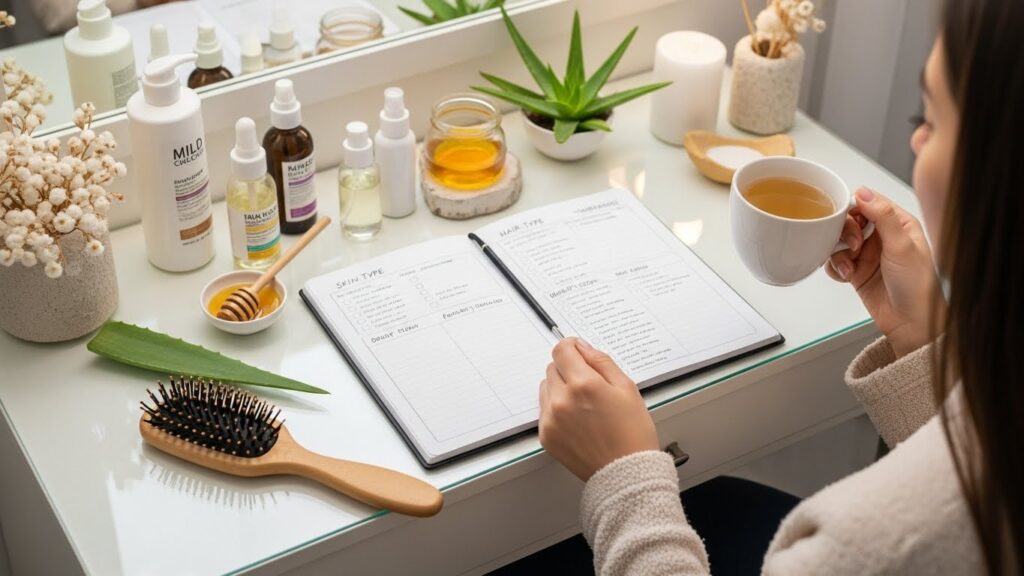
- Know your skin and hair. Use the rough checks above: skin type by the wash-and-wait test, hair by how it feels and behaves.
- Start with the basics. Cleanser, moisturiser and sunscreen for skin; washing, conditioning and gentle detangling for hair.
- Add one thing at a time. A mask, a scrub or an oil — one new step, a few weeks, then decide.
- Keep what works. The best routine is the one you will actually do every day.
Clean tools and skin safety
Face towels, hair brushes, pillow covers and wash cloths collect oil, sweat and dead skin. They can hold germs, and germs moved back onto the skin can cause pimples, redness and itching.
- Wash towels regularly and let them dry fully between uses.
- Clean hair brushes in soap and warm water.
- Change pillow covers once a week.
- Do not share towels, razors or makeup tools.
When to get help
Ask a dermatologist or pharmacist if: your skin is persistently red, sore, swollen or blistering; you have a rash that does not settle; you have acne that is painful, spreading or scarring; you have a skin condition such as eczema or rosacea that is getting worse; your scalp is very itchy, red or flaking badly; or you are losing hair in patches or in large amounts. If you have used lemon or lime juice on your skin and then been in the sun, and the skin is red, blistered or darkened, get medical advice.
Summary
Cleanse gently, moisturise, and wear broad-spectrum SPF 30+ every day. Wash hair when it needs it, oil before washing if it helps, and trim split ends every 6–12 weeks. Look after body skin the same way. Eat well, drink water, sleep 7 or more hours, and keep your tools clean. Add one new step at a time, patch test first, and give it weeks before judging it. No routine guarantees results — the value of self-care is steady, gentle habits that fit your life.
Sources: AAD sunscreen guidance; AAD exfoliation guidance; AAD shedding guidance (50–100 hairs a day); AAD hair growth rate (about 1/2 inch a month); AAD acne guidance on stress; CDC sleep guidance (7 or more hours); Lee et al. 2011 on hair dryer distance; Koyama et al. 2016 on scalp massage; Rele & Mohile 2003 on coconut oil; Billero & Miteva 2018 on traction alopecia. This is a researched overview, not a hands-on review.