Researched overview.
Table Of Content
Quick answer
A simple beauty routine at home is a short routine you can repeat every day: cleanse gently, hydrate, moisturise, and protect from the sun in the morning. For hair: wash when it needs it, condition, detangle gently, and trim split ends. Add one new thing at a time, and give it weeks before judging it.
Simple does not mean weak. A routine only works if you actually do it, and a short routine is easier to keep than a long one. Most problems in home beauty care come from doing too much at once — too many new products, too much exfoliation, too much heat — not from doing too little.
If your skin is red, painful, flaking badly, or has a rash, blisters or open sores, or your scalp is very itchy, red or flaking badly, skip the home steps and ask a dermatologist or pharmacist first. This guide is general information, not medical advice.
Contents: The foundation · Reading your skin · Reading your hair · Morning routine · Night routine · Weekly care · Scalp care · Home ingredients · Frizz and oily hair · Mistakes · When to get help
The foundation
Three rules hold the whole routine together:
- Fewer steps, done every day, beat many steps done sometimes. Light cleansing, hydration and moisturiser every day do more than a long routine you abandon after a week.
- One change at a time. If you start three new products in one week and your skin reacts, you will not know which one caused it. Add one thing, wait a few weeks, then decide.
- Watch and adjust. Skin and hair change with weather, age, stress and routine. A routine that worked in summer may need a richer moisturiser in winter. Pay attention to what you see and feel, and change one thing at a time.
Reading your skin
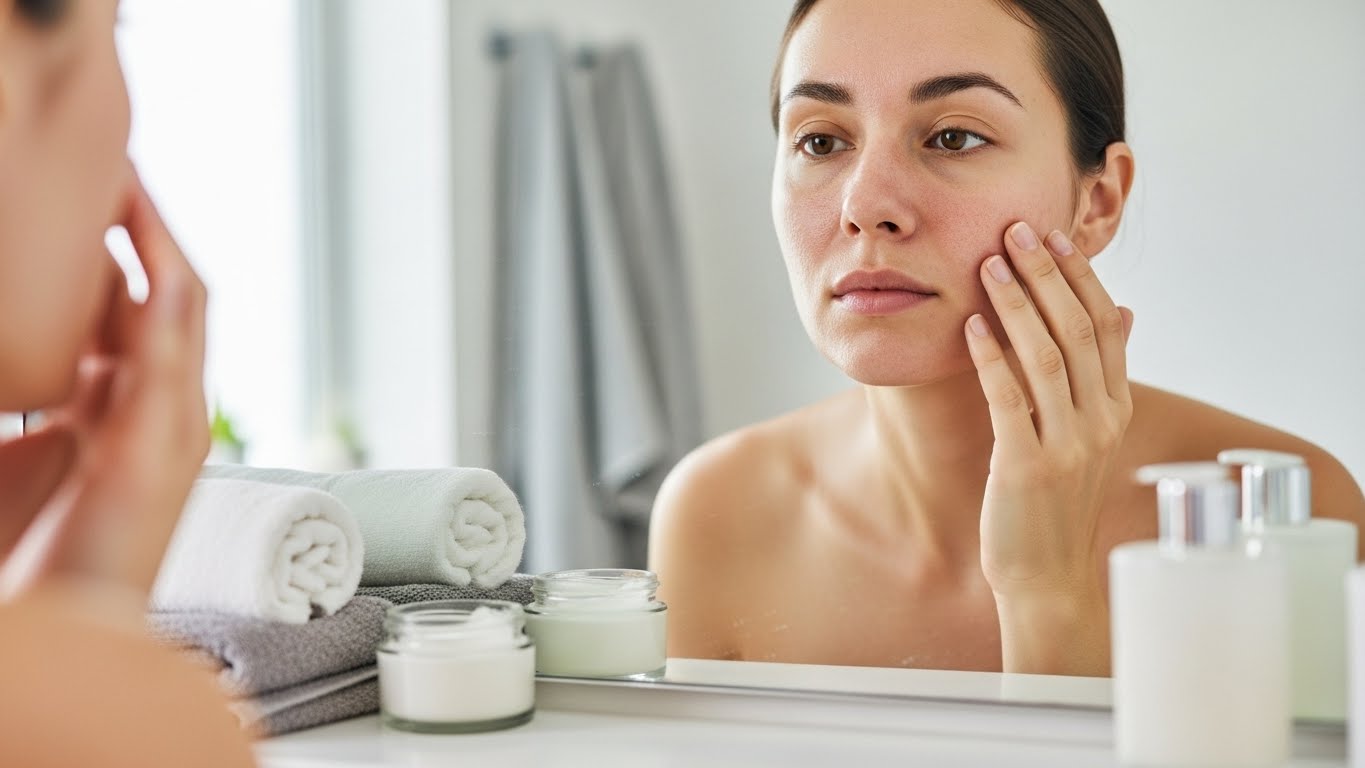
Skin gives signals. Learn them before buying anything new.
| Signal | What it usually means | What to do |
|---|---|---|
| Tight feeling after washing | Your cleanser may be too strong, or the water too hot | Use lukewarm water and a milder cleanser |
| Shine that appears quickly | Oily skin, or a moisturiser that is too heavy | Use a lighter lotion or gel; you still need moisturiser |
| Stinging or redness after a new product | Irritation or a reaction | Wash it off; stop the newest product first |
| Rough or flaky patches | Dryness, or too much exfoliation | Moisturise more; exfoliate less often |
| Breakouts that are painful, spreading or scarring | Needs more than home care | Ask a pharmacist or dermatologist |
To get a rough idea of your skin type, wash your face with water only and wait an hour without applying anything. Tight means dry; shiny all over means oily; shiny in some places and tight in others means combination; comfortable means normal; red and itchy easily means sensitive. This is a rough check, not a diagnosis, and skin changes over time.
Reading your hair
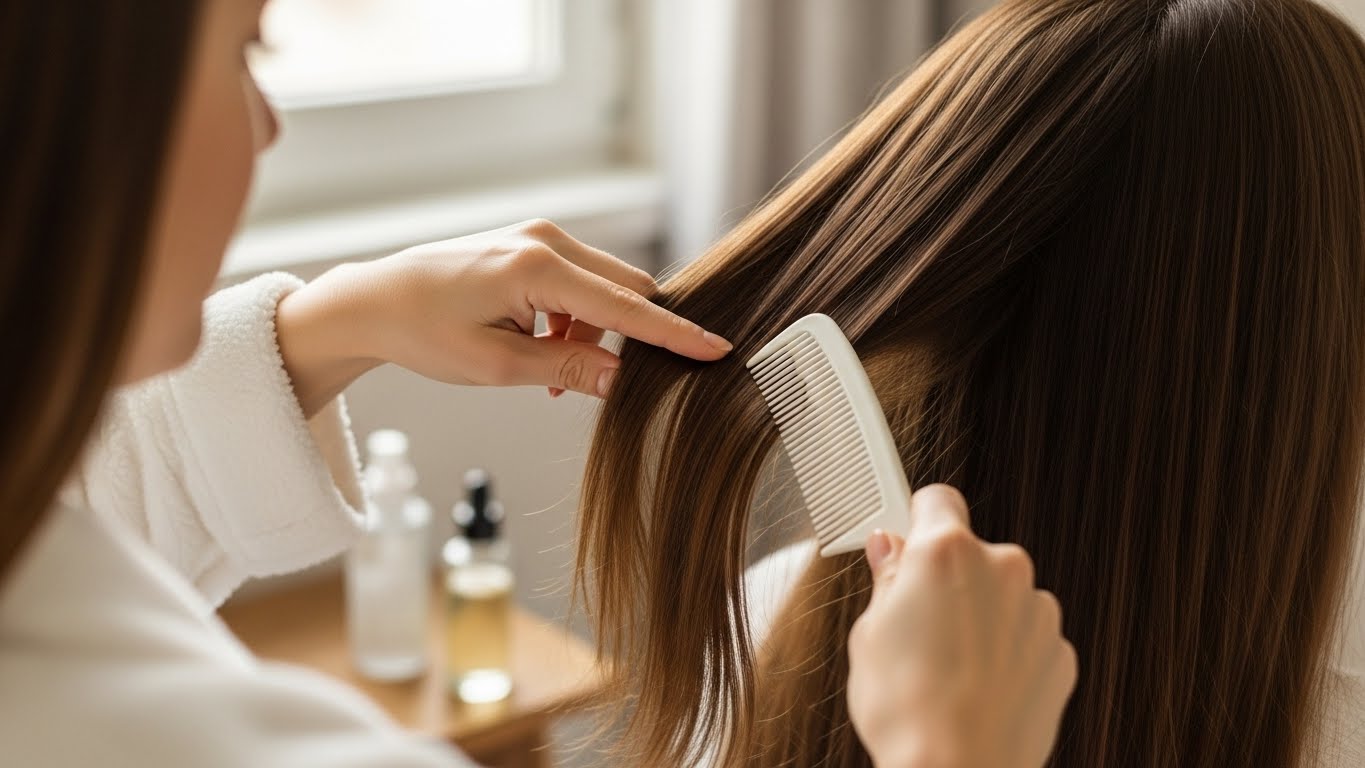
Hair gives signals too:
- Split ends that tangle easily — the ends are damaged. Only trimming removes split ends; no oil or mask repairs them. Trim every 6–12 weeks.
- Flat roots that feel greasy — the scalp needs washing, not more product on the roots.
- More hair than usual coming out when combing — some shedding is normal (50–100 hairs a day, according to the AAD). A sudden large increase, or hair loss in patches, is worth asking a doctor about.
- Dry, rough strands — the hair needs moisture and protection from heat, not more washing.
Hair grows about 1/2 inch a month (AAD). Nothing in a home routine makes it grow faster. What a routine can do is reduce breakage, so the length you grow is the length you keep.
Morning routine
Keep it light. It should take minutes, not half an hour.
- Cleanse. Lukewarm water and a mild cleanser. If your skin is very dry, water alone in the morning is fine.
- Hydrate. A hydrating product on damp skin — glycerin or hyaluronic acid, or aloe gel.
- Moisturise. A light lotion for oily skin; a richer cream for dry skin.
- Sunscreen — every morning. Broad-spectrum SPF 30 or higher, as the last step. The AAD recommends this daily, including on cloudy days, and reapplying every two hours when outdoors, or after swimming or sweating. (AAD sunscreen guidance)
- Hair. Brush gently with a wide-tooth comb. If your hair needs washing, wash it — wash as often as your scalp and hair need it, not by a fixed rule.
Night routine
Night care is repair time only in the sense that skin is left alone to settle. There is no special “repair window” at night; the value of a night routine is that it removes the day’s dirt, oil and sunscreen before you sleep.
- Cleanse. Remove sunscreen, makeup and the day’s build-up before bed.
- Hydrate and moisturise. The same steps as the morning. A slightly richer cream at night is fine if your skin is dry.
- Clean pillowcase. Change pillow covers weekly. A clean pillowcase means less dirt and oil against your face overnight.
- Hair. Detangle gently before bed if your hair tangles easily. A loose braid or a silk or satin pillowcase can reduce friction overnight. Avoid tight styles at night — repeated pulling can cause traction alopecia, a form of hair loss from tension.
Weekly care
Once or twice a week, add one of these — not all of them on the same day:
- Gentle exfoliation. A mild chemical exfoliant, once a week to start. Stop if you get redness, stinging, flaking or tightness. Do not exfoliate every day.
- A face mask. Honey and yogurt for dry skin; oatmeal for oily skin. Leave on 10–15 minutes, rinse with lukewarm water, then moisturise. Do not put lemon or lime juice on your skin — citrus juice plus sunlight can cause a burn-like reaction with blisters and dark marks that last for years (Cleveland Clinic).
- Hair oiling before washing. A little oil on the lengths before washing can reduce dryness. Oil does not repair damage and does not make hair grow; it coats the surface and reduces friction. Only coconut oil is shown to penetrate the hair shaft.
Scalp care
Healthy hair starts with the scalp. A calm scalp supports hair; an irritated scalp does not help it.
- Wash the scalp with your fingertips, not your nails. Scratching with nails irritates the scalp.
- Rinse thoroughly — leftover product can irritate the scalp and make hair look dull.
- Massage is fine if it feels good, but it does not grow hair: the only study often cited (Koyama et al. 2016) had 9 men and no control group.
- If the scalp is very itchy, red, or has thick flakes that do not improve after a month of dandruff shampoo, ask a doctor — see the dandruff guidance in our men’s scalp guide for the one-month rule.
Home ingredients — one at a time
Home ingredients can help when used carefully. Honey adds moisture. Aloe soothes the feel of skin. Yogurt softens texture. Oils help dry areas. But natural does not mean safe for everyone: the FDA has never legally defined “natural” for cosmetics, and some natural substances irritate skin (Mayo Clinic Health System).
Safety rules:
- Test before full use. Apply a small amount to a quarter-sized area on the inside of your arm or the bend of your elbow, twice a day, for 7–10 days (AAD patch-test method). Stop if irritation appears.
- Use one ingredient at a time. If you mix five things and react, you will not know which one caused it.
- Keep use limited. A little is enough. More is not better.
- Stop if irritation appears. Redness, stinging, flaking or itching means stop, not push through.
Frizz and oily hair
Frizz comes from a raised hair cuticle letting humidity into the hair, so strands swell unevenly. What helps: conditioner, a little oil or leave-in product on damp hair, and drying gently without rubbing with a towel. Rubbing wet hair with a towel causes friction and breakage — and wet hair is more fragile than dry hair, because water weakens the bonds inside it. Detangle damp hair coated in conditioner, starting at the ends, never dry.
Oily hair does not need harsh shampooing. Wash with a gentle shampoo as often as your scalp needs it, and keep conditioner off the roots. Whether washing makes the scalp produce more oil is disputed — the AAD has said a harsh wash can irritate skin and trigger more oil, while other sources say there is no good evidence the scalp compensates. Either way, the reason to wash gently is irritation and dryness, not a proven rebound effect.
Mistakes that delay progress
- Starting several new products at once.
- Ignoring irritation and pushing through it.
- Exfoliating daily or using strong actives together.
- Skipping sunscreen.
- Using hot water and harsh soap.
- Expecting a fixed result by a fixed date. New skin cells take weeks to reach the surface, and changes in tone take weeks of steady use. No routine can promise a specific result by a specific week, and no routine gives permanent results.
When to get help
Ask a dermatologist or pharmacist if: your skin is persistently red, sore, swollen or blistering; you have a rash that does not settle; you have acne that is painful, spreading or scarring; you have a skin condition such as eczema or rosacea that is getting worse; your scalp is very itchy, red or flaking badly; or you are losing hair in patches or in large amounts. If you have used lemon or lime juice on your skin and then been in the sun, and the skin is red, blistered or darkened, get medical advice.
Summary
Cleanse gently, hydrate, moisturise, and wear broad-spectrum SPF 30+ every morning. Wash hair when it needs it, detangle damp hair with conditioner, and trim split ends every 6–12 weeks. Add one new thing at a time, patch test first, and give it weeks before judging it. A short routine you keep beats a long routine you abandon.
Sources: AAD sunscreen guidance; AAD exfoliation guidance; AAD shedding guidance (50–100 hairs a day); AAD hair growth rate (about 1/2 inch a month); Mayo Clinic Health System on “natural” personal care products; Cleveland Clinic on phytophotodermatitis; Koyama et al. 2016 on scalp massage; Rele & Mohile 2003 on coconut oil. This is a researched overview, not a hands-on review.