Researched overview. This guide is based on published dermatology and hair-science guidance, not on hands-on product testing by BeautyKob. No product in this guide was tested by us, and no product or brand is recommended.
Table Of Content
Quick answer
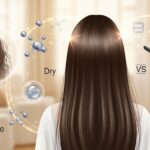
Natural hair — curly, coily and kinky textures — is strong in shape and fragile in structure. Every bend in a strand is a point where the fibre can weaken, and heat, colour, tight styles and everyday handling wear the protein structure down over time. A protein treatment can help, but only if the problem is actually a lack of protein. Dry hair is often mistaken for weak hair, and the two need different fixes: dry hair needs moisture, weak hair needs protein, and too much of either one causes its own problems.
A protein treatment does not repair hair. It temporarily patches the surface — hydrolysed protein fills small gaps in the cuticle and forms a protective layer that makes the strand feel stronger and break less easily. The effect washes out. It does not rebuild the hair, it does not make hair grow faster, and using it too often makes hair stiff and brittle rather than strong.
This guide is about protein treatments for natural hair specifically: how to tell whether your hair needs protein, what porosity changes, how to use a treatment, and how to avoid overdoing it. It is general information, not medical advice.
Contents: What natural hair is made of · Signs your hair needs protein · Dry vs weak: the misdiagnosis table · Protein and moisture balance · Porosity · Types of protein treatments · How often · How to use one · Aftercare: deep conditioning · Over-protein signs · Myths · DIY vs salon · When to get help · FAQ
What natural hair is made of
Hair is made mostly of keratin, a structural protein. Each strand is covered by the cuticle — overlapping scales that protect the inner cortex, where protein chains are bonded together in structures that give the hair its stretch and strength. When the hair is in good condition, the cuticle lies flat and the strand stretches a little and springs back.
Damage weakens those bonds. Gaps form in the cuticle. The strand loses elasticity — it stretches too far and does not spring back, or it snaps. Eventually it breaks.
Natural hair is more vulnerable to this than straight hair for a structural reason: the oils from the scalp do not travel evenly down a curled or coiled strand, so the lengths are drier, and every bend in the strand is a weak point. The tighter the coil, the more bends there are, and the more the fibre is stressed by handling. That is why natural textures often need protein reinforcement — but it is also why they need careful handling, because the same bends that make protein useful also make the hair easy to break.
Signs your hair needs protein
Do not guess. Test the hair and watch how it behaves:
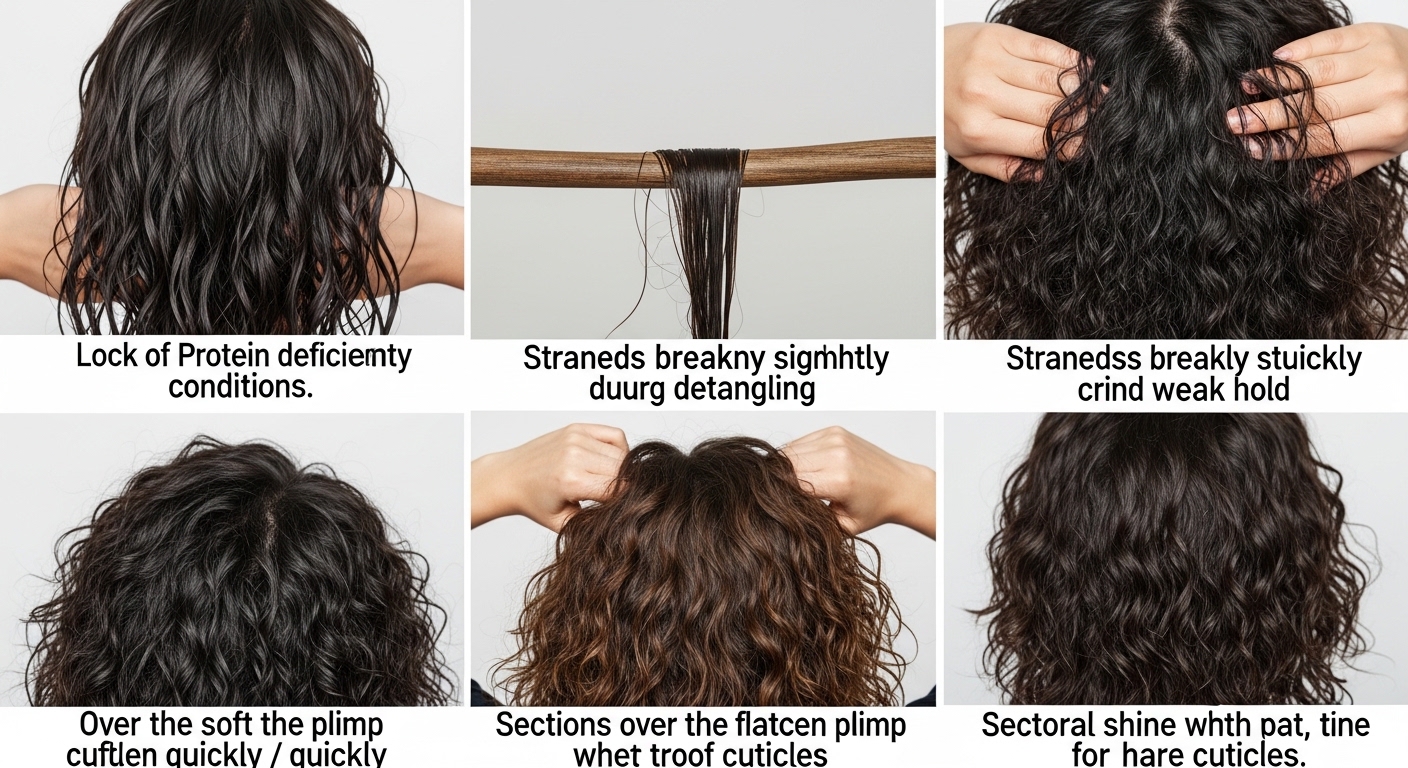
- Overstretch, no spring-back. Take a single wet strand and stretch it gently. Healthy hair stretches a little and returns to its length. Hair that stretches far beyond its length and does not spring back is weak — it may need protein.
- Breakage, not shedding. Short strands snapping off during detangling, without a bulb at the end, are breakage. Long strands with a small bulb at the root are shedding, which is normal — most people shed 50 to 100 hairs a day. Breakage means the strand is weak; shedding means the hair has finished its growth cycle.
- Difficulty holding a style. Curls that look good at first and then flatten and lose definition may lack the support that protein gives.
- Mushy or overly soft texture. Hair that feels too soft when wet, limp, and unable to hold its shape is often over-moisturised and under-supported. This is the classic sign that the balance has tipped too far toward moisture.
Not every problem needs protein. Dryness is often mistaken for weakness. If the hair feels rough and dry but stretches normally and does not snap, it needs moisture, not protein. Adding protein to dry hair makes it stiffer and drier. The table below is the check to run before reaching for a protein product.
Dry vs weak: the misdiagnosis table
| What you feel | Likely problem | What it needs |
|---|---|---|
| Rough, dry, tangled, but stretches and springs back | Dryness | Moisture — deep conditioning, leave-in conditioner, less heat |
| Soft, mushy when wet, stretches too far, will not spring back | Weakness / protein loss | Protein — a light or moderate protein treatment, then deep conditioning |
| Stiff, hard, dry, snaps easily | Protein overload (too much protein, not enough moisture) | Stop protein, deep-condition for moisture, rest the hair |
| Short pieces breaking off during detangling | Breakage from weak strands | Protein, plus gentler detangling (damp, with conditioner, ends first) |
| Long strands with bulbs coming out | Normal shedding | Nothing — this is the hair’s normal cycle, not damage |
If you are unsure which one you have, deep-condition first. If the hair improves, it was dryness. If it stays mushy and stretchy, try a light protein treatment and watch the result.
Protein and moisture balance
Protein gives strength. Moisture gives flexibility. Hair needs both, and the balance matters more than either one alone.
Think of a bridge: protein is the steel structure, moisture is the flexible joints that let it move without breaking. Without protein, the hair is soft and flimsy. Without moisture, it is hard and brittle. Too much of either one causes breakage — just in different ways.
That is why deep conditioning after a protein treatment is not optional. A protein treatment makes the hair firmer; a moisturising deep conditioner afterwards puts back the softness and elasticity. Skipping that step is the most common reason a protein treatment leaves hair feeling stiff.
The most common error is applying protein over and over without rebalancing. The hair becomes hard, dry and easy to snap. That is not strength. That is imbalance.
Porosity
Porosity is how easily your hair absorbs and holds water, and it changes how protein behaves on your strands.
- High porosity. The cuticle is raised or damaged. Hair absorbs water and product quickly, but loses moisture just as quickly. Protein treatments can fill gaps in the structure and smooth the cuticle temporarily, so high-porosity hair often benefits from protein more regularly.
- Low porosity. The cuticle is tightly packed. Water and product sit on the surface rather than soaking in. Protein molecules are more likely to sit on the surface too, so lighter, hydrolysed protein products are usually more suitable than heavy reconstructors, and heat is not needed to force them in.
- Medium porosity. The cuticle is mostly flat with some gaps. This hair usually needs protein only occasionally, when it shows the signs above.
You do not need a laboratory test to judge porosity. Watch how your hair behaves: does it soak up water immediately and dry quickly (high), or does water bead on the surface and take a long time to wet through (low)? That observation is enough to choose a lighter or a stronger product. The unreliable “float test” — dropping a strand in a glass of water — is not recommended; it is affected by oils and products on the hair and does not measure porosity reliably.
Types of protein treatments
Not all protein treatments are the same. They differ in strength, and the strength should match the hair, not the marketing:
- Light protein. Hydrolysed proteins broken into small pieces, found in conditioners and leave-in products. Hydrolysed peptides small enough (under about 1,000 Daltons) can enter the outer cortex; larger molecules form a surface film. Either way the effect is temporary. Light protein can be used more often and is the right starting point if you are unsure.
- Moderate protein. Stronger treatments, usually used once every two to four weeks depending on the hair’s condition. These are for hair that shows clear signs of weakness — overstretch, breakage, mushy texture.
- Heavy or reconstructive protein. Potent treatments made for hair that has been chemically treated or seriously damaged. These must be timed carefully — leaving one on longer than instructed does not make it stronger, it makes the hair stiff and brittle — and deep conditioning afterwards is essential.
The only thing that matters is choosing the strength that suits your hair, not copying what someone else uses. Start light. If a light treatment does not help after two or three uses, step up. If a moderate treatment leaves the hair stiff, step down.
How often
There is no standard schedule, and anyone selling one is guessing. How often you need protein depends on porosity, chemical history, styling habits, and how the hair responds:
- Low porosity, undamaged hair: rarely — only when the signs of weakness appear.
- High porosity or colour-treated hair: more often, because protein and moisture are lost faster — perhaps a light treatment every two to four weeks, or a moderate one monthly.
- Chemically treated or heat-damaged hair: a moderate treatment monthly, or as the hair’s condition requires, with deep conditioning after each one.
The key is observation. Watch how the hair responds after each treatment. If it feels stronger, holds its style better, and breaks less, you are on the right track. If it feels dry and brittle, you have gone too far — stop protein and deep-condition for moisture until the hair feels supple again.
How to use one
Application matters as much as the product:
- Start with clean hair. Wash first. Product build-up, oils and heavy butters form a coating that stops protein from reaching the strand.
- Work in sections. Divide the hair into small sections, especially if it is thick or coily, so the product covers every strand evenly. Uneven application leaves some sections stiff and others weak.
- Focus on the mid-lengths and ends. These are the oldest, most damaged parts of the hair. The roots are newer and usually stronger, unless they have been chemically processed.
- Finger-comb or use a wide-tooth comb to spread the product. Do not be rough at this stage — the aim is coating, not manipulation.
- Follow the timing on the product. Do not leave a treatment on longer than instructed. Longer is not stronger; overexposure stiffens the hair and makes it brittle.
- Rinse thoroughly. Do not panic if the hair feels stiffer than normal straight after rinsing. That firmness is the reinforcement. The softness comes back in the next step.
- Test new leave-on products first. Before using a new leave-in protein product on your scalp and hair, patch test it: apply a small amount to a quarter-sized patch of skin on the inside of your arm or the bend of your elbow, twice a day for 7 to 10 days. Allergic reactions can take several days to appear, and a 24-hour test can miss them. If the patch becomes red, itchy, swollen or blistered, do not use the product. This is the American Academy of Dermatology’s patch-test method.
Aftercare: deep conditioning
Without a follow-up of moisture, a protein treatment is not complete. As soon as you rinse out the protein treatment, use a rich, moisturising deep conditioner. It replaces elasticity, softness and control, and stops the hair feeling stiff.
Leave the conditioner on long enough to coat the hair — follow the product’s instructions. Gentle warmth can help it spread, but do not use high heat on freshly treated hair. When you rinse, the hair should feel firm but supple, not straw-like. If it feels brittle, it needs more moisture before you use protein again.
Handling matters after conditioning too. Wet hair is more fragile than dry hair, so detangle while the hair is damp and has conditioner in it, starting at the ends and working upward with a wide-tooth comb. Never detangle dry hair with a brush.
The scalp burns where hair parts, so use a broad-spectrum sunscreen with SPF 30 or higher on the exposed parting when you will be outdoors, and reapply every two hours. A hat works too.
Over-protein signs
Stop using protein and deep-condition for moisture if the hair:
- Feels hard, stiff or straw-like even after conditioning.
- Snaps easily when gently pulled or combed.
- Looks dull and dry despite regular washing and conditioning.
- Tangles more than usual and will not hold a style.
Over-protein hair is not strong hair. It is imbalanced hair, and the fix is moisture and rest, not more protein.
Myths
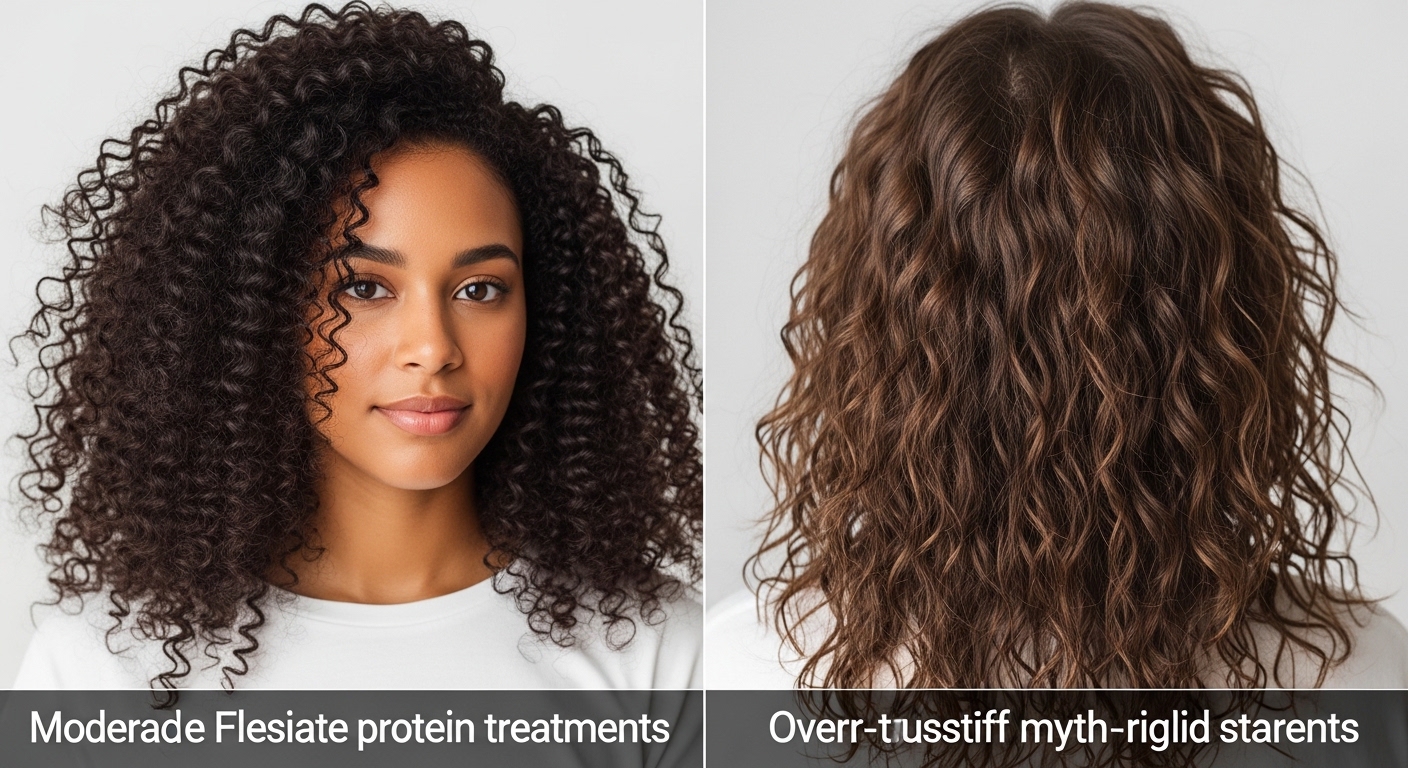
- “Protein makes hair grow faster.” No. Protein strengthens the strands you already have, so less of the length breaks off — that is length retention, not growth. Hair grows about 1/2 inch a month from the scalp; a treatment on the lengths cannot change that.
- “Natural hair needs heavy protein treatments regularly.” No. Heavy treatments used too often cause stiffness and breakage. Most natural hair does best with light protein used when the signs appear, and moderate treatments only when the hair is genuinely weak.
- “Dry hair needs protein.” No. Dry hair needs moisture. Adding protein to dry hair makes it stiffer and drier. Run the dry-vs-weak check first.
- “The longer you leave it on, the stronger the result.” No. Overexposure stiffens the hair and makes it brittle. Follow the product’s timing.
DIY vs salon
- DIY egg or milk masks. Egg and milk protein molecules are too large to enter the hair shaft at all. An egg mask coats the surface and rinses off; it does not rebuild or reinforce the hair in the way a hydrolysed protein product does. It is not harmful, but it is not a protein treatment either.
- Store-bought protein treatments. These use hydrolysed proteins — protein broken into small pieces — which is why they can patch the surface. Choose by strength (light, moderate, heavy) and follow the instructions.
- Salon protein treatments. A stylist can judge the hair’s condition and choose the strength, and can spot damage that needs a different approach — for example, hair that needs trimming rather than treatment. Worth considering if the hair is chemically treated or badly damaged, or if you are unsure what it needs.
When to get help
- Hair coming out in clumps, bald patches, or shedding well above the usual 50 to 100 hairs a day.
- A scalp that is sore, blistered, bleeding, or itchy for more than a few weeks despite gentle washing.
- Hair that breaks off at the same length no matter what you do — this can be a sign of damage, but also of a medical cause worth checking.
- Before any chemical treatment if your scalp is already irritated or broken.
A dermatologist can check for medical causes of hair loss or scalp problems. A hairdresser can advise on cuts and styling for your hair type, but cannot diagnose a medical problem.
FAQ
How do I know if my hair needs protein or moisture?
Do the stretch test on a wet strand: if it stretches too far and does not spring back, it may need protein. If it feels rough and dry but stretches normally, it needs moisture. If in doubt, deep-condition first — if the hair improves, it was dryness.
How often should I do a protein treatment?
There is no fixed schedule. It depends on porosity, chemical history and how the hair responds. Low-porosity, undamaged hair may need it rarely; high-porosity or colour-treated hair may need a light treatment every two to four weeks. Watch the hair, not the calendar.
Can protein treatments make my hair worse?
Yes, if overused. Too much protein makes hair hard, dry and easy to snap. That is protein overload, not strength. Stop protein and deep-condition for moisture until the hair feels supple again.
Does protein make hair grow?
No. Protein strengthens existing strands so less length breaks off. Growth happens at the scalp, at about 1/2 inch a month, and no treatment on the lengths changes that.
Should I use heat with a protein treatment?
Only if the product instructions say so. Gentle warmth can help a conditioner spread, but high heat on freshly treated hair can damage it. Never leave a treatment on longer than instructed to “make it work better”.
Summary
Protein treatments help natural hair when the problem is genuinely a lack of protein: hair that stretches too far when wet, breaks instead of shedding, feels mushy, or will not hold a style. They work by temporarily patching the cuticle surface — hydrolysed peptides under about 1,000 Daltons can enter the outer cortex, larger molecules form a surface film — and the effect washes out. They do not repair hair, they do not make hair grow, and using them too often causes stiffness and breakage. Judge porosity by how the hair behaves, start with a light treatment, follow the product’s timing, always deep-condition afterwards, wear SPF 30+ on the exposed parting when outdoors, and patch test new leave-on products on a small area of skin for 7 to 10 days first. Dry hair needs moisture, not protein — run the dry-vs-weak check before you reach for a protein product. If hair is coming out in clumps, or the scalp is sore or blistered, see a dermatologist.
Sources: American Academy of Dermatology, 7 Rosacea skin care tips (patch-test method: apply a new product to a quarter-sized patch of skin on the inside of the arm for 7–10 days); American Academy of Dermatology, How to select anti-aging skin care products (broad-spectrum sunscreen, SPF 30 or higher on exposed skin when outdoors, reapply every two hours). This is a researched overview, not a hands-on review.