Researched overview. This guide is based on published dermatology and hair-science guidance and on regulator warnings about formaldehyde, not on hands-on product testing by BeautyKob. No product in this guide was tested by us, and no product or brand is recommended.
Table Of Content
Quick answer
A keratin treatment can make damaged hair look smoother, shinier and easier to manage for a few months. It does this by coating the hair shaft with a protein layer and sealing it in with heat. It does not repair damaged hair. Hair is not living tissue, so once the cuticle is damaged and the inner cortex is exposed, no treatment rebuilds it. The only way to remove split ends is to trim them.
The most important thing to know before a keratin treatment is the formaldehyde question. Many keratin smoothing products contain formaldehyde or chemicals that release formaldehyde when heated. Formaldehyde is classified as a carcinogen, and the gas released during the flat-ironing step can irritate the eyes, nose, throat and lungs. Read the formaldehyde section below before booking or buying anything.
If your hair is damaged, ask first whether a keratin treatment is the right step at all. For many people, a gentler routine — a good wash-and-condition routine, less heat, and regular trims — does more for the hair than a chemical smoothing treatment. This guide is general information, not medical advice.
Contents: What damaged hair is · What a keratin treatment does · The formaldehyde question · Salon vs at-home kits · Who should skip it · Before the treatment · The process, step by step · Aftercare · How long it lasts · Mistakes · When to get help · FAQ
What damaged hair is
Hair is made mostly of keratin, a structural protein. Each strand is covered by the cuticle — overlapping scales that protect the inner cortex. When the cuticle lies flat, hair looks smooth and reflects light evenly. When it is raised or broken, the cortex is exposed, moisture escapes, and the strand becomes dry, rough, frizzy and easy to break.
Damage builds up from:
- Heat styling — blow-drying, straightening and curling dry the hair out and weaken the shaft over time.
- Chemical treatments — colouring, bleaching, relaxing and perming change the protein structure and leave hair brittle.
- The environment — sun, pollution, wind and humidity strip natural oils and roughen the cuticle.
- Handling — rough brushing, tight hairstyles, and rubbing with a towel break strands and split ends.
The key point is that this damage is structural and permanent. A product can coat the surface so the hair feels smoother, but it cannot rebuild the cuticle or the cortex. That is why the honest goal of any treatment is to make the hair more manageable and to protect what is left — not to “heal” it.
What a keratin treatment actually does
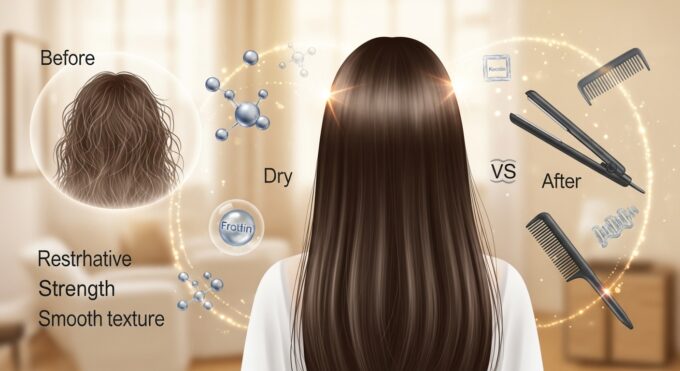
A keratin treatment applies a solution containing hydrolysed keratin (keratin protein broken into smaller pieces) to the hair, then seals it in with a flat iron at high heat. The protein forms a temporary coating on the shaft, the cuticle lies flatter, and the hair looks smoother and shinier and is easier to style.
What it does:
- Smooths frizz and makes hair easier to comb and style.
- Adds shine by flattening the cuticle so it reflects light more evenly.
- Makes hair feel stronger for a while, because the coating reduces friction between strands and therefore reduces breakage from brushing and styling.
What it does not do:
- It does not repair damage. The coating is temporary and washes out over weeks. The damaged cuticle underneath is unchanged.
- It does not remove split ends. Only trimming removes them.
- It does not permanently straighten hair. The effect fades as the coating washes out and new hair grows in. Salon treatments usually last 3 to 5 months, depending on the product, hair type and aftercare.
- It does not make hair grow faster. Hair grows about 1/2 inch a month from the scalp; a treatment on the lengths cannot change that.
Think of it as a temporary smoothing coat, not a repair. If that is what you want, and you understand the formaldehyde risk below, it can be a reasonable choice. If you want your hair genuinely healthier, the routine matters more than the treatment: gentle washing, conditioning, less heat, and trims every 6 to 12 weeks.
The formaldehyde question
This is the part the original article almost entirely left out, and it is the most important part of this guide.
Many keratin smoothing products contain formaldehyde, or chemicals such as methylene glycol that release formaldehyde when heated. The flat-ironing step heats the product to a high temperature, which releases formaldehyde gas into the air. Both the person receiving the treatment and the person applying it breathe it in.
What is known:
- Formaldehyde is classified as a carcinogen. The International Agency for Research on Cancer classifies formaldehyde as carcinogenic to humans. Workplace safety authorities set exposure limits for it — in the United States, the Occupational Safety and Health Administration sets a permissible exposure limit of 0.75 parts per million averaged over an 8-hour working day.
- The US Food and Drug Administration has warned about formaldehyde in hair-smoothing products. The FDA has warned that hair-smoothing products that release formaldehyde when heated can cause eye, nose and throat irritation, breathing problems, and allergic reactions, and that formaldehyde exposure is linked to certain cancers. In 2023 the FDA announced it intended to propose a ban on formaldehyde and formaldehyde-releasing chemicals in hair-smoothing products. As of early 2026 that proposed rule had still not been published, after repeated delays — so formaldehyde-based products remain legal to sell in the United States, and the ban cannot be assumed to be in force.
- “Formaldehyde-free” does not always mean what it says. Some products labelled formaldehyde-free contain methylene glycol, which converts to formaldehyde when heated. Others contain different aldehydes that carry similar irritation risks. Check the full ingredient list, not just the front of the bottle.
- Salon workers are the most exposed. A single treatment exposes the client for an hour or two; a stylist doing several treatments a day, in a small room, is exposed far more. Good ventilation matters for both.
What to do with this information:
- Ask the salon or the product maker directly: does this product contain formaldehyde or any formaldehyde-releasing chemical? Ask to see the ingredient list and the safety data sheet. If they will not show it, do not proceed.
- Choose a well-ventilated salon, and tell the stylist if you have asthma, breathing problems, or a sensitive scalp.
- Do not use a formaldehyde-based at-home kit yourself. Applying the product and then flat-ironing it at home, usually in a bathroom with poor ventilation, is the highest-exposure way to do it.
- If you want to avoid the risk entirely, skip keratin smoothing treatments and use the gentler routine instead — the wash-and-condition routine, heat protection, and regular trims.
Salon vs at-home kits
| Salon treatment | At-home kit | |
|---|---|---|
| Who applies it | A trained stylist | You, or someone helping you |
| Strength | Usually stronger formulas, higher heat | Usually milder formulas |
| Duration | Usually 3 to 5 months | Usually shorter, often weeks rather than months |
| Formaldehyde risk | Still present if the product contains it; a salon should have ventilation | Higher exposure risk at home, because bathrooms are small and poorly ventilated |
| Cost of a mistake | A stylist can adjust technique; a bad result still costs money | Uneven application, over-processing and heat damage are more likely |
Neither option repairs hair. The salon option is safer mainly because a professional applies the product, controls the heat, and works in a ventilated space. An at-home kit with formaldehyde is the combination to avoid: strong chemicals, high heat, and poor ventilation, with no professional watching for a reaction.
A Brazilian blowout is a similar smoothing treatment, not a different category of repair. It uses the same idea — a coating sealed in with heat — and many of the same products contain formaldehyde. The same warnings apply.
Who should skip it
Do not have a keratin treatment, or ask a doctor first, if any of these apply:
- You are pregnant or breastfeeding. Ask your doctor first. Formaldehyde exposure is the concern, and there is no safe-exposure figure for pregnancy that applies to a salon treatment.
- You have asthma, breathing problems, or a history of reactions to hair products. The gas released during flat-ironing can trigger breathing problems and eye, nose and throat irritation.
- Your scalp is broken, irritated, blistered or sunburned. Do not apply a chemical treatment to damaged skin.
- Your hair is very fine and limp. A keratin coating can weigh fine hair down and make it look flatter, not fuller.
- Your hair is already over-processed. Hair that has been bleached, relaxed and heat-styled repeatedly is fragile. Adding a high-heat chemical treatment can make breakage worse, not better. Trim and rest the hair first.
- You have had a bad reaction to a hair treatment before. Tell the stylist, and do a strand test and a skin patch test first (see below).
Before the treatment
A little preparation makes a bad outcome less likely:
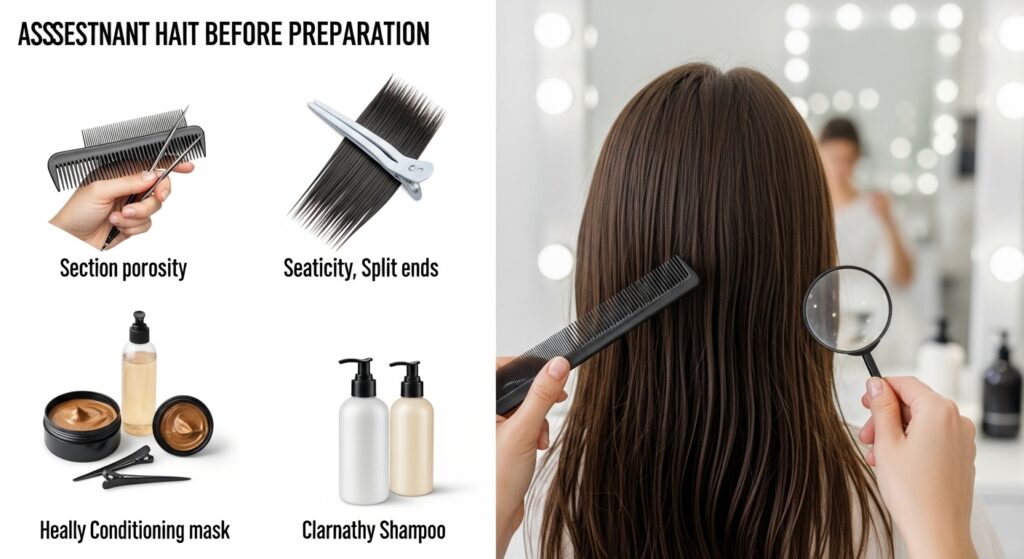
- Assess the damage honestly. Run your fingers down a strand: rough, snagging texture, split ends, and hair that snaps when gently pulled all mean the cuticle is damaged. If the hair is breaking off at the same length no matter what you do, a keratin treatment will not fix it — trimming and a gentler routine will do more.
- Trim the split ends first. Split ends cannot be sealed back together. Cutting them off before the treatment means the keratin coats even, healthy ends instead of frayed ones.
- Do a strand test. Ask the salon to test the product on a small, hidden section of hair first, especially if your hair is colour-treated or chemically treated. If that section feels worse — stiffer, drier, more brittle — do not proceed.
- Do a skin patch test. If the product will touch your scalp or skin, test it first: apply a small amount to a quarter-sized patch of skin on the inside of your arm or the bend of your elbow, twice a day for 7 to 10 days. If the patch becomes red, itchy, swollen or blistered, do not use the product. Allergic reactions can take several days to appear, and a 24-hour test can miss them. This is the American Academy of Dermatology’s patch-test method.
- Check the product. Ask for the ingredient list and the safety data sheet, and check whether it contains formaldehyde or a formaldehyde-releasing chemical. If the salon cannot or will not show it, go elsewhere.
- Plan the aftercare. You will need a sulfate-free shampoo and conditioner, and you will need to avoid washing for the period the product instructions specify — usually 48 to 72 hours. Buy what you need before the appointment, not after.
The process, step by step
A salon keratin treatment usually follows these steps. Knowing them helps you spot when something is being skipped:
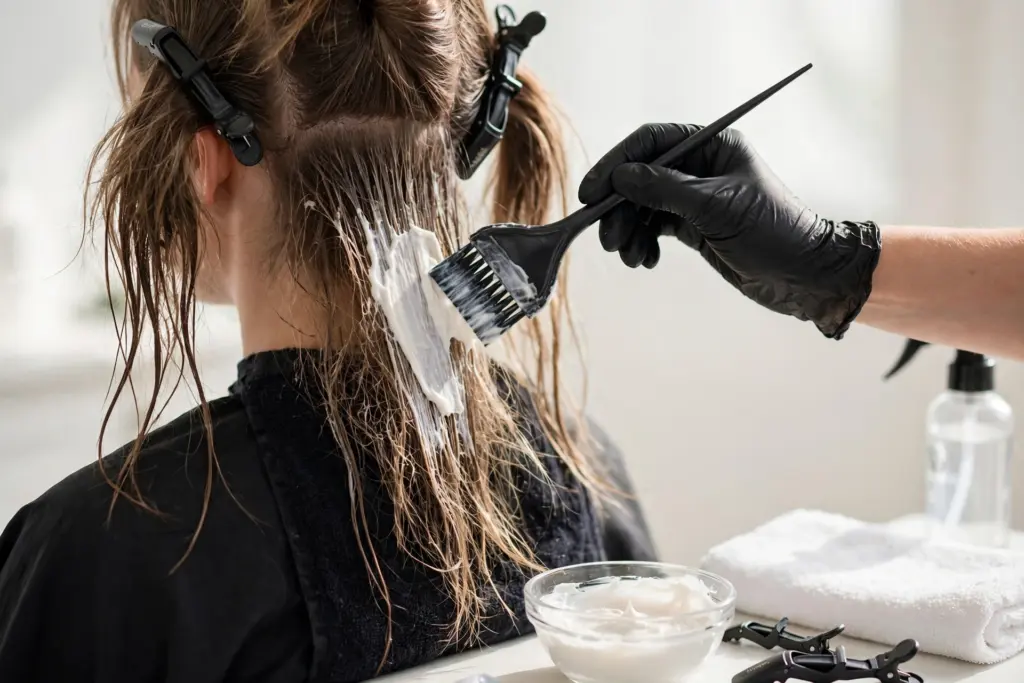
- Wash. The hair is washed with a clarifying shampoo to remove oil, dirt and product build-up so the solution can coat the strands evenly. The hair is towel-dried so it is damp, not dripping.
- Apply the solution. The keratin solution is applied evenly, section by section, from roots to ends. Uneven application is the most common cause of patchy results.
- Wait. The solution sits on the hair for the time the product instructions specify. Do not leave it on longer than instructed — longer is not stronger, and over-processing can make hair stiff and brittle.
- Blow-dry. The hair is blow-dried, usually on a low or medium heat.
- Heat-seal with a flat iron. The stylist passes a flat iron over small sections at a set temperature. This is the step that seals the coating in — and the step that releases formaldehyde gas if the product contains it. The room should be well ventilated, and you should speak up immediately if your eyes, nose or throat start to sting.
- Aftercare instructions. The stylist should tell you when you can wash (usually after 48 to 72 hours, depending on the product), and what shampoo to use.
If a salon skips the strand test, cannot show you the product, or works in a small room with no ventilation, those are reasons to leave, not reasons to trust the process.
Aftercare
- Do not wash for the period the product instructions specify — usually 48 to 72 hours. Do not tie the hair up tightly, clip it, or tuck it behind your ears during this time, because creases can set into the coating.
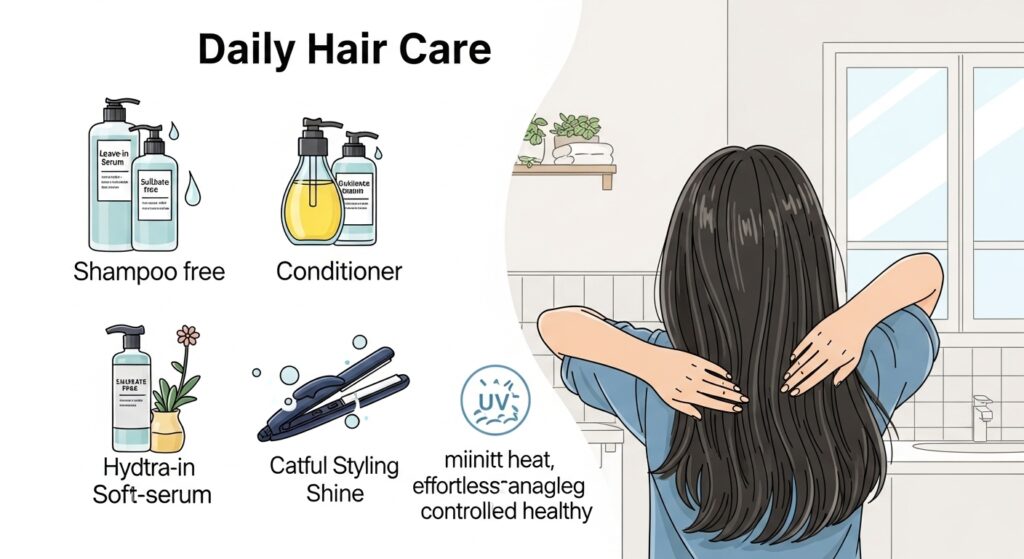
- Use a sulfate-free shampoo and conditioner. Harsh detergents strip the coating faster and shorten the life of the treatment.
- Keep using conditioner. A hydrating conditioner seals in moisture and keeps the smooth texture. Wash two or three times a week as a starting point, and adjust to your hair type.
- Use heat protection. If you blow-dry or straighten treated hair, apply a heat-protectant product first, and keep the heat moderate. Treated hair is still hair — it can still be damaged by heat.
- Protect from sun and chlorine. Both dry the hair out and shorten the life of the treatment. Rinse hair with clean water before and after swimming. The scalp burns where hair parts, so use a broad-spectrum sunscreen with SPF 30 or higher on the exposed parting when you will be outdoors, and reapply every two hours — a hat works too.
- Do not add more treatments on top. Do not colour, bleach or perm treated hair until the coating has mostly worn off and the hair has settled, and ask a professional first. Overlapping chemical treatments is one of the fastest ways to cause breakage.
How long it lasts, and when to re-treat
A salon keratin treatment usually lasts 3 to 5 months. The signs it is wearing off are returning frizz, less shine, and hair that is harder to style again. That is normal — the coating washes out gradually, and new hair grows in untreated.
Re-treat only when the effect has mostly worn off, and not more often than the product instructions allow. Re-treating too soon, or stacking a keratin treatment on top of colour, bleach or a relaxer, over-processes the hair and can make it weaker and more brittle, not stronger. If your hair is breaking more after a treatment than before it, that is a sign to stop re-treating and to rest the hair with a gentle routine and regular trims.
Mistakes
- Believing a keratin treatment repairs damage. It coats the hair temporarily; it does not rebuild it.
- Using a formaldehyde-based at-home kit in a small, poorly ventilated bathroom.
- Trusting “formaldehyde-free” on the front of the bottle without checking the ingredient list for methylene glycol or other formaldehyde-releasing chemicals.
- Skipping the strand test and the skin patch test, especially on colour-treated or chemically treated hair.
- Leaving the solution on longer than instructed, or flat-ironing the same section repeatedly.
- Washing too soon after the treatment, or with a harsh shampoo that strips the coating.
- Re-treating too often, or overlapping a keratin treatment with colour, bleach or a relaxer.
- Expecting the treatment to make hair grow faster or thicker. It does neither.
When to get help
- Hair coming out in clumps, bald patches, or shedding well above the usual 50 to 100 hairs a day.
- A scalp that is sore, blistered, bleeding, or itchy for more than a few weeks despite gentle washing.
- Breathing problems, eye irritation, or a rash after a treatment — stop using the product and ask a doctor promptly, and tell them the product contained formaldehyde if it did.
- Hair that breaks off at the same length no matter what you do — this can be a sign of damage, but also of a medical cause worth checking.
A dermatologist can check for medical causes of hair loss or scalp problems. A hairdresser can advise on cuts and styling for your hair type, but cannot diagnose a medical problem.
FAQ
Does a keratin treatment repair split ends?
No. It coats the hair so split ends look smoother for a while, but the split is still there. Only trimming removes split ends.
Will a keratin treatment permanently straighten my hair?
No. It smooths and flattens the hair temporarily. The effect lasts 3 to 5 months for a salon treatment, then fades as the coating washes out and new hair grows in. Your natural texture returns.
Is it safe to use a keratin treatment on coloured hair?
It can be, but colour-treated hair is more fragile, so a strand test is important, and you should ask a professional first. Colouring and keratin in the same period over-processes the hair.
How soon can I wash my hair after the treatment?
Follow the product’s own instructions — usually 48 to 72 hours. Washing sooner shortens the life of the treatment.
Can I use heat styling tools after a keratin treatment?
Yes, but in moderation and at controlled temperatures, and always with a heat-protectant product. Treated hair still needs protection from heat.
Is a “formaldehyde-free” keratin treatment safe?
Not necessarily. Some products labelled formaldehyde-free contain methylene glycol, which releases formaldehyde when heated. Check the full ingredient list and the safety data sheet.
Summary
A keratin treatment coats damaged hair with a temporary protein layer and seals it in with heat, making it smoother, shinier and easier to manage for 3 to 5 months. It does not repair damage, remove split ends, permanently straighten hair, or make hair grow. The formaldehyde question matters most: many products contain formaldehyde or chemicals that release it when heated, formaldehyde is classified as a carcinogen, the FDA has warned about it and announced an intention to propose a ban that had still not been published as of early 2026, and “formaldehyde-free” labels can be misleading. Ask to see the ingredient list and safety data sheet, do a strand test and a skin patch test for 7 to 10 days first, choose a ventilated salon over an at-home kit, and look after treated hair with sulfate-free products, heat protection, SPF 30+ on the exposed parting when outdoors, and trims every 6 to 12 weeks. If your hair is very damaged, a gentler routine and regular trims will do more for it than a chemical smoothing treatment.
Sources: American Academy of Dermatology, 7 Rosacea skin care tips (patch-test method: apply a new product to a quarter-sized patch of skin on the inside of the arm for 7–10 days); American Academy of Dermatology, How to select anti-aging skin care products (broad-spectrum sunscreen, SPF 30 or higher on exposed skin when outdoors, reapply every two hours). This is a researched overview, not a hands-on review.