Researched overview. This guide is based on published dermatology and hair-science guidance, not on hands-on product testing by BeautyKob. No product in this guide was tested by us, and no product or brand is recommended.
Table Of Content
Quick answer
Thin hair can be oiled — but the wrong oil, the wrong amount, or the wrong method will make it flatter, greasier and more fragile. The rule is simple: light oils, a few drops, on the right place, washed out properly. Heavy oils sit on fine strands, attract dust and sweat, and are hard to wash out. A few drops of a light oil on the lengths can reduce breakage and frizz; a scalp soaked in heavy oil once a week does the opposite.
The other thing to know before choosing an oil: no oil grows new hair. Oils cannot create follicles, and no oil has been proven to thicken thin hair. What an oil can do is seal moisture into the lengths, reduce friction and breakage, and keep the scalp comfortable. That is worth doing — but it is maintenance, not a treatment for thinning. If your hair is thinning because of hormones, a nutritional deficiency or a medical condition, oil alone will not fix it, and a dermatologist should check the cause.
This guide is about oils for thin hair specifically: what thin hair is, why it is easy to weigh down, which light oils suit it, how much to use, and what oils cannot do. It is general information, not medical advice.
Contents: Thin vs fine · Why thin hair is easy to weigh down · What oils can and cannot do · Choosing a light oil · The oils, one by one · Rosemary oil, honestly · Castor oil, honestly · How to apply it · How often · Mistakes · When to get help · FAQ
Thin vs fine
“Thin hair” is used loosely, and the difference changes how you should treat it:
- Thin hair means low density — fewer strands on the scalp. The scalp shows more when you part the hair, and ponytails feel smaller.
- Fine hair means thin strands — each strand is small in diameter and fragile. You can have fine hair at high density, or thick strands at low density.
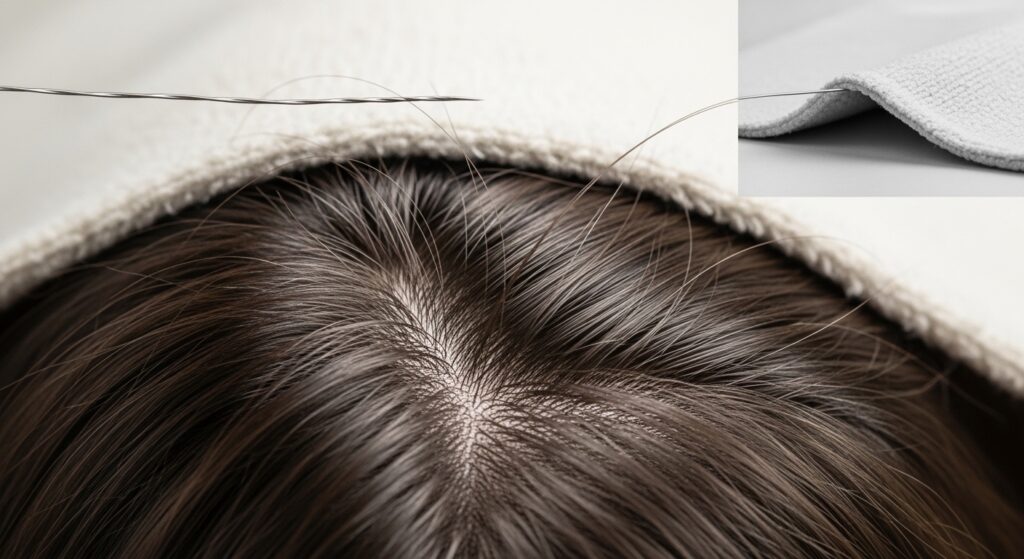
The two problems are slightly different. Fine strands are easy to weigh down because they have little mass to support a coating. Low-density hair shows oil quickly because there is less hair to spread it over, and the scalp looks oily within hours. Many people have both. Knowing which one you have helps you choose: fine strands need the lightest oils and the smallest amounts; low-density hair needs careful placement — lengths, not roots.
Why thin hair is easy to weigh down
Fine strands lack the structural strength of coarse hair. A smaller diameter means less mass to support weight, so a coating that a coarse strand carries easily will bend a fine one flat. The result is roots that lie flat, no volume, and hair that looks greasy rather than shiny.
The scalp adds to the problem. It produces sebum naturally, and if your scalp is already oily, adding heavy oil on top means the roots flatten within hours. Volume disappears, and the hair needs washing sooner — which, if you wash roughly to remove the oil, damages the fragile strands further.
Thin hair does not need to be smothered. It needs balance: enough oil to protect the lengths, little enough to keep the roots light.
What oils can and cannot do
What oils can do:
- Seal moisture into the lengths. Water moisturises, oil seals. An oil on damp hair after washing slows moisture loss and reduces frizz.
- Reduce breakage. A light coating reduces friction between strands when you brush, comb or sleep, so fewer strands snap.
- Keep the scalp comfortable. A small amount of a light oil massaged gently into the scalp can reduce dryness and flaking.
What oils cannot do:
- Grow new hair. Oils do not create follicles. Hair grows about 1/2 inch a month from the scalp, and no oil changes that.
- Thicken thin hair. No oil has been proven to increase the thickness of strands or the density of hair.
- Penetrate the hair shaft. With one exception — only coconut oil has been shown to penetrate the hair shaft. Other oils sit on the surface. That is not a flaw; a surface coating is exactly what protects the lengths. But any claim that an oil “nourishes from within” or “feeds the follicle” is marketing, not evidence.
- Fix thinning caused by hormones, nutritional deficiency or a medical condition. If thinning has a medical cause, oil will not treat it. A dermatologist should check it.
Choosing a light oil
For thin hair, choose by weight and wash-out, not by marketing claims:
- Light and fast-absorbing. The oil should spread thinly, sink into the surface of the hair, and wash out easily with one gentle shampoo. If it still feels greasy after washing, it is too heavy for your hair.
- No strong fragrance or added essential oils unless you know what they are. Fragrance and essential oils can irritate the scalp, especially a sensitive one.
- A short ingredient list. A single oil, or a simple blend, is easier to judge than a mixture of many oils and fragrances. If your scalp reacts, you will know what caused it.
- Patch test first. Before using a new oil on your scalp, patch test it: apply a small amount to a quarter-sized patch of skin on the inside of your arm or the bend of your elbow, twice a day for 7 to 10 days. Allergic reactions can take several days to appear, and a 24-hour test can miss them. If the patch becomes red, itchy, swollen or blistered, do not use the oil. This is the American Academy of Dermatology’s patch-test method.
The oils, one by one
These are the light oils that suit thin hair, described by what they are — not ranked, because no evidence-based ranking exists. Pick by how your hair feels after use, not by which one is called “best”.
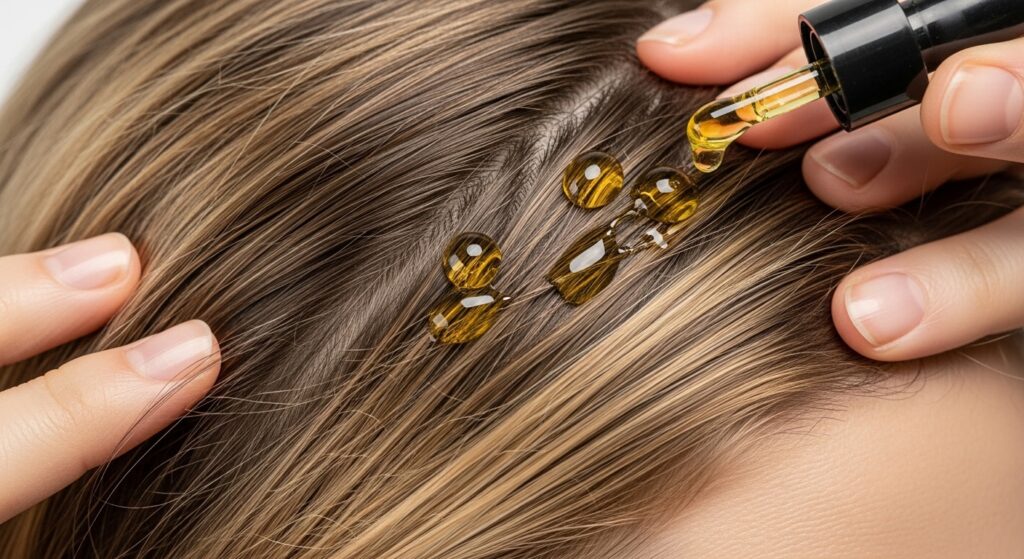
- Argan oil. A light oil rich in fatty acids, often recommended for fine hair. Use it as a lengths treatment, not as a heavy scalp soak: warm a drop or two between your palms and smooth it over the ends to reduce dryness and frizz without flattening the roots. Small amounts work well on thin hair.
- Jojoba oil. Technically a liquid wax, and close in form to the scalp’s natural sebum. It is light, absorbs easily, and suits people with thin, greasy hair. Apply a couple of drops along the parting lines and massage gently. There is no good evidence that jojoba oil reduces sebum production — it does not “balance” oil production; it is simply a light oil that does not add much weight.
- Grapeseed oil. One of the lightest carrier oils. It is almost weightless, washes out easily, and does not build up quickly when used properly. It works well as a pre-wash treatment for limp hair that tangles easily and gets oily quickly.
- Coconut oil. The only oil shown to penetrate the hair shaft, which is why it protects the hair from protein loss during washing. But it is heavier than argan, jojoba or grapeseed, and on thin hair it can weigh the lengths down and be hard to wash out. If you use it, use a small amount on the ends only, before washing, and wash it out thoroughly. It protects the shaft; it does not grow hair.
Rosemary oil, honestly
Rosemary oil is the oil most often sold as a growth oil for thin hair. Here is what the evidence actually says:
- There is one small study (Panahi 2015) that compared rosemary oil with minoxidil 2% for hair loss. It is a single study, not proof, and it tested the oil — not a rosemary rinse, which is a different thing.
- Rosemary oil is an essential oil, not a carrier oil. Used undiluted on the scalp it can irritate, especially a sensitive scalp — the very scalp that shows most when hair is thin.
- Always dilute it in a light carrier oil such as jojoba or grapeseed — a few drops in a spoonful of carrier oil is enough. Massage gently for a few minutes, then wash it out. Once or twice a week is more useful than aggressive daily use.
- Do not expect it to thicken your hair. The honest position is that rosemary oil may support a healthy scalp, and there is weak evidence it may help with hair loss — but it has not been proven to grow hair or to thicken thin hair.
Castor oil, honestly
Castor oil is thick. Very thick. On thin hair it quickly becomes overpowering: it sits on the strands, flattens the roots, attracts dust and sweat, and is hard to wash out completely.
If you want to use it, dilute it: mix a small amount into a light base oil such as grapeseed or jojoba, so it is less heavy but still gives the coating effect. Use it occasionally as a scalp treatment, not as a heavy weekly mask. Thin hair cannot handle castor oil the way coarse hair can — precision matters here.
There is no strong evidence that castor oil grows hair. A 2022 systematic review found no strong evidence for castor oil and hair growth. Use it, if you use it, as a coating oil — not as a growth treatment.
How to apply it
Method matters more than the oil you choose:
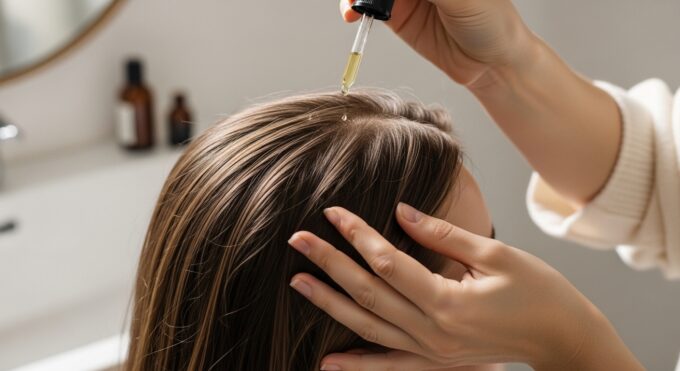
- Scalp, lightly. If you want to oil the scalp, use a dropper to place a few drops along the parting lines, then massage gently with your fingertips for three to five minutes. Gentle massage is comfortable and helps spread the oil; it has not been proven to grow hair. One small study (Koyama 2016, 9 men, no control group) found thicker hair after months of daily massage, but that is not proof — do not treat massage as a growth treatment.
- Lengths, sparingly. Rub a drop or two between your palms and smooth it over the ends only. Do not coat the whole strand unless it is very dry. Roots need air and lift; ends need light protection. Keep the two separate.
- Pre-wash, not overnight. There is no need to leave oil on overnight. A short treatment — 30 minutes to two hours before washing — is enough, and thin hair usually responds better to it. Leaving heavy oil on for twelve hours causes build-up, especially if your scalp produces oil overnight.
- Wash it out properly. Use a gentle shampoo and rinse thoroughly. If the hair still feels greasy after one wash, you used too much oil, or the oil is too heavy for your hair.
- Sun on the parting. Thin hair leaves more scalp visible where it parts, and that skin burns. Use a broad-spectrum sunscreen with SPF 30 or higher on the exposed parting when you will be outdoors, and reapply every two hours. A hat works too.
How often
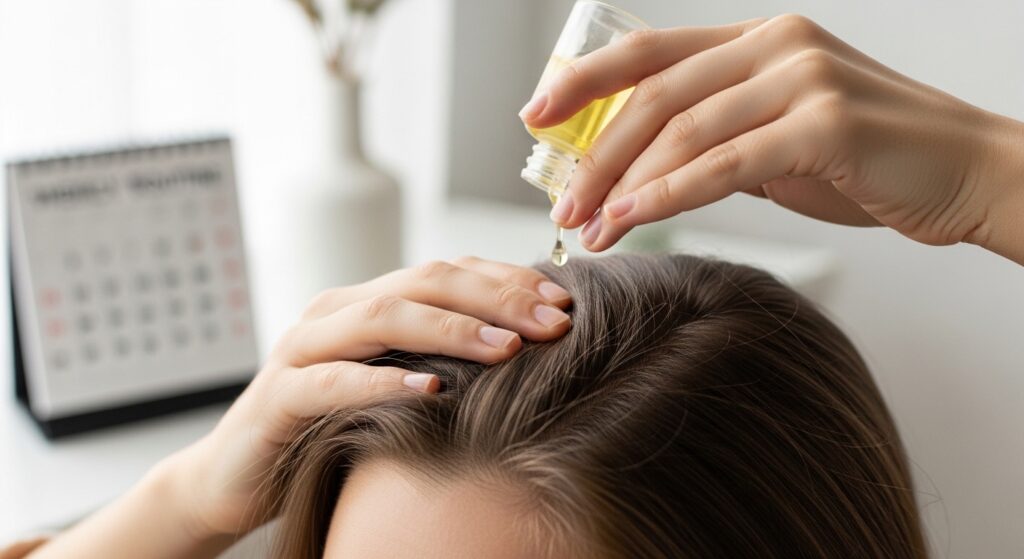
Thin hair does not need oiling every day. Once a week is a good starting point for scalp care. If your scalp is naturally oily, once every ten to fourteen days may be enough.
Judge by how the hair behaves after washing. If it is soft and not flat, the frequency is right. If it looks limp for days afterwards, use less oil, or oil less often. Do not copy someone else’s routine — hair type, scalp oiliness and climate all change what works.
Mistakes
- Using heavy oils (undiluted castor oil, heavy herbal blends) on fine strands. They sit on the surface, flatten the roots, and are hard to wash out.
- Pouring oil over the whole head instead of placing a few drops where they are needed.
- Leaving heavy oil on overnight, or for days, and letting it build up.
- Using undiluted essential oils (rosemary, peppermint, tea tree) directly on the scalp. They can irritate, and a thin-haired scalp shows irritation more.
- Believing a “growth oil” will thicken thin hair in weeks. Oils do not create follicles, and no oil has been proven to thicken hair.
- Skipping the patch test for a new oil, especially an essential oil.
- Treating food, water or stress management as a hair treatment. Eating well and drinking water are good for health, but no food has been shown to thicken hair, and drinking water does not directly hydrate hair. Manage stress for your health, not as a hair-growth strategy.
When to get help
- Hair coming out in clumps, bald patches, or shedding well above the usual 50 to 100 hairs a day.
- A scalp that is sore, blistered, bleeding, or itchy for more than a few weeks despite gentle washing.
- Thinning that is getting worse quickly, or a widening part — a dermatologist can check for medical causes such as hormonal changes, nutritional deficiency or a scalp condition.
- Before using any oil or treatment if your scalp is already irritated or broken.
A dermatologist can check for medical causes of hair loss or scalp problems. Minoxidil is the best-evidenced treatment for pattern hair loss, but it takes 6 to 12 months to show results and should be discussed with a doctor or pharmacist first — it is not something to start on the basis of a hair-oil article.
FAQ
Can hair oil make thin hair thicker?
No. No oil has been proven to increase strand thickness or hair density. Oils can reduce breakage and make the hair you have look healthier, which helps it keep its length — but that is length retention, not thickening.
Which oil is best for thin hair?
There is no evidence-based ranking. Light oils — argan, jojoba, grapeseed — suit thin hair because they spread thinly and wash out easily. Choose by how your hair feels after use, and use a few drops, not palmfuls.
Should I oil my scalp every day?
No. Once a week is a good starting point; every ten to fourteen days may be enough if your scalp is oily. Daily oiling builds up and flattens thin hair.
Can I leave oil on overnight?
You can, but there is no need to, and thin hair usually does better with a short pre-wash treatment of 30 minutes to two hours. Heavy oil left on overnight causes build-up.
Is rosemary oil proven to grow hair?
No. There is one small study comparing rosemary oil with minoxidil 2%. It is not proof. Rosemary oil must always be diluted in a carrier oil, and it should not be treated as a growth treatment.
Does oiling cause hair fall?
Oiling does not cause hair fall, but it can reveal shedding that was already happening — loose hairs come out with the oil and the massage. Over-oiling can irritate the scalp, and an irritated scalp is not a healthy environment for hair. Use a little, wash it out properly, and stop if the scalp becomes sore or itchy.
Summary
Thin hair needs light oils, a few drops, in the right place. Thin means low density and fine means thin strands — often both at once — and either way heavy oils flatten the roots and are hard to wash out. Light oils such as argan, jojoba and grapeseed suit thin hair; coconut oil is the only oil shown to penetrate the shaft, but it is heavier and best used sparingly on the ends. Rosemary oil has only one small study behind it and must always be diluted; castor oil has no strong evidence for growth and must be diluted too. No oil grows new hair or thickens thin hair — oils seal moisture, reduce breakage and keep the scalp comfortable. Patch test a new oil on a small area of skin for 7 to 10 days first, oil once a week as a starting point, keep treatments short (30 minutes to two hours before washing), wear SPF 30+ on the exposed parting when outdoors, and see a dermatologist if hair is coming out in clumps or thinning quickly.
Sources: American Academy of Dermatology, 7 Rosacea skin care tips (patch-test method: apply a new product to a quarter-sized patch of skin on the inside of the arm for 7–10 days); American Academy of Dermatology, How to select anti-aging skin care products (broad-spectrum sunscreen, SPF 30 or higher on exposed skin when outdoors, reapply every two hours). This is a researched overview, not a hands-on review.