Researched overview.
Table Of Content
- Quick answer
- What protective styles do — and what they do not do
- The one rule: pain means too tight
- Before styling: prepare the hair
- Styles that work for long curly hair
- Moisture while the style is in
- Scalp care while the style is in
- How long to keep a style in
- Taking a style down gently
- Extensions and added weight
- Mistakes that turn a protective style into a damaging one
- When to get help
- Frequently asked questions
- Summary
Quick answer
A protective style is a style that keeps long curly hair out of the way so it suffers less friction, handling and rubbing against clothes. Loose braids, twists and low buns do this well. They do not make hair grow — hair grows at its own pace. What they do is reduce breakage, so the length you grow is kept instead of snapping off.
One rule matters more than any other: if a style hurts, it is not protective. Pain means the style is pulling on the follicles, and repeated pulling can cause hair loss. A protective style should feel calm and comfortable from the moment it is put in.
Contents: What protective styles do · The one rule · Before styling · Styles that work · Moisture while styled · Scalp care · How long to keep a style · Taking a style down · Extensions · Mistakes · When to get help
What protective styles do — and what they do not do
Long curly hair breaks more easily than short curly hair for a simple reason: length adds weight, and weight pulls. Every curve of a curl is a point of stress, and long curls catch on clothes, bags, fingers and pillows all day. The damage adds up slowly — a few broken strands at a time — until the hair never seems to get longer, even though it is growing.
A protective style reduces that daily stress. It:
- Keeps the ends — the oldest, driest part of the hair — tucked away instead of rubbing on clothes.
- Reduces how often you touch, brush and restyle the hair.
- Cuts down friction while you sleep and move around.
A protective style does not:
- Make hair grow faster. Growth happens at the root and no style changes its speed.
- Protect hair that is put into it dry, tangled or damaged. A style only protects hair that was prepared properly first.
- Work if it is tight. Tightness is the opposite of protection.
The one rule: pain means too tight
Repeated pulling on the hair follicles can cause a type of hair loss called traction alopecia. It usually starts with thinning at the hairline, soreness, bumps or broken hairs where the style pulls hardest. If the pulling stops early, the hair often recovers. If it goes on for a long time, the follicles can be damaged permanently.
The American Academy of Dermatology (AAD) gives a simple rule of thumb: if your hairstyle feels painful, it is too tight. The same applies to heaviness: a style that drags at the roots all day is pulling, even if it does not hurt at first.
Watch for these warning signs and loosen or remove the style if you notice them:
- Pain, soreness or tenderness at the scalp or hairline.
- Bumps or redness where the style pulls.
- Thinning at the front or sides of the hairline.
- Broken hairs around the edges.
- A headache that starts when the style goes in and eases when it comes out.
Before styling: prepare the hair
A style can only protect hair that is in good condition when it goes in. Prepare the hair in this order:
- Wash gently. Use a gentle, sulfate-free shampoo on the scalp. The goal is clean, soft hair — not squeaky hair. The AAD advises washing curly hair only when needed, and at minimum every 2–3 weeks for scalp health.
- Condition well. Conditioner makes curls flexible. Long curls that are dry and stiff snap when they are braided or twisted. Condition the lengths, not just the ends.
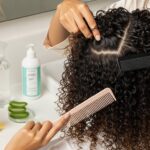
- Detangle wet. Detangle on wet, conditioned hair with your fingers first, then a wide-tooth comb, starting at the ends and working up. Never style dry, tangled curls — they snap inside the style. (See the companion guide, “How to Detangle Curly Hair Without Breakage”.)
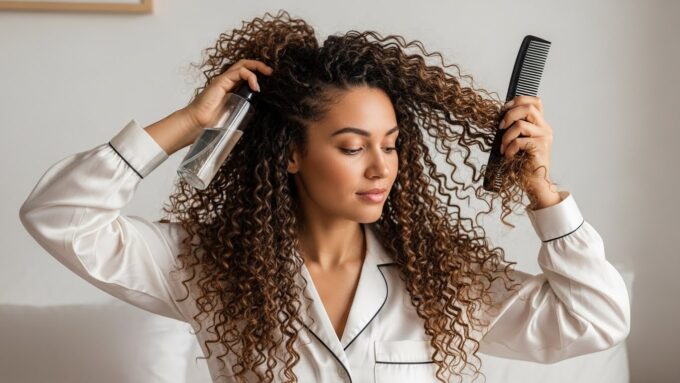
- Moisturise before styling. Apply a leave-in conditioner and a few drops of a light oil on the ends. Water moisturises hair; oil seals that moisture in. Hair that goes into a style dry will keep drying out underneath it.
Before using a new leave-in, oil or styling product, patch test it: put a small amount on the inside of your arm or the bend of your elbow, twice a day for 7 to 10 days. If the skin turns red or itchy, do not use it. (This is the American Academy of Dermatology patch-test method.)
Styles that work for long curly hair
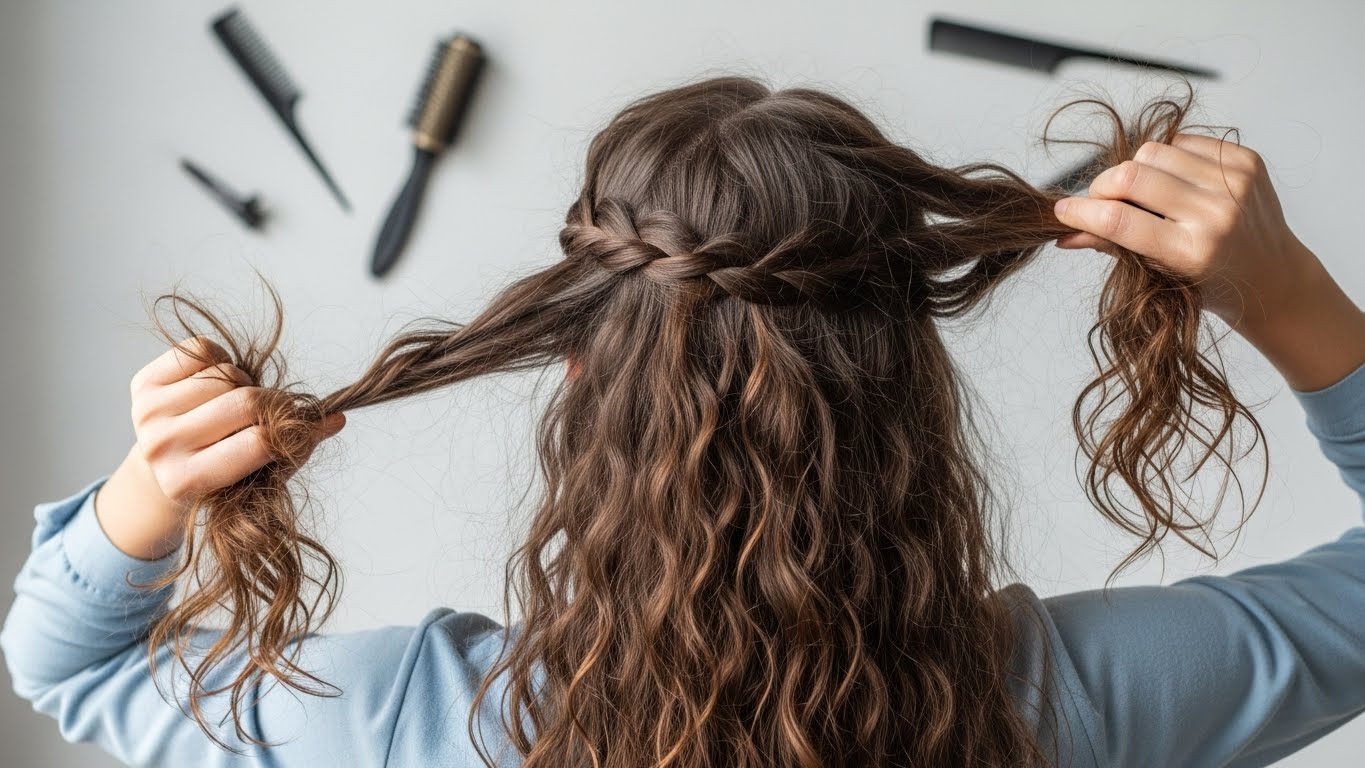
The best style depends on your curl pattern, density, length and lifestyle. The right one is the one that is comfortable, keeps the ends tucked away, and lets the curls fall naturally rather than pulling them tight.
| Style | What it does | Watch out for |
|---|---|---|
| Loose braids | Separate the curls so they tangle less; reduce friction along the length | Must not be tight at the scalp; heavy braids pull at the roots |
| Twists | Less movement between strands; strands rest against each other instead of rubbing | Same as braids — looseness matters more than neatness |
| Low buns | Protect the ends, the oldest part of the hair; sit at the nape so they do not pull the hairline | High or tight buns strain the hairline and crown |
| Pineapple (overnight) | A loose, high ponytail on top of the head that keeps curls from being crushed while you sleep | Must be loose; a tight ponytail is not a protective style |
A good style feels light as well as secure. If you can feel it pulling when you move your head, it is too tight. If the roots ache by the end of the day, take it down.
Moisture while the style is in
Hair in a protective style still needs moisture. Curls tucked into a braid or bun dry out over days, and dry hair under a style still rubs and breaks. Mist the hair lightly with water and a little leave-in conditioner, and smooth a few drops of light oil over the surface. Heavy products will build up on the scalp and shorten the life of the style, so keep it light.
Do not let a style stay in so long that the hair inside it becomes dry and matted. If the hair feels rough and the style is hard to move, it is time to take it down, wash, condition and start again.
Scalp care while the style is in
A healthy scalp is part of protecting the hair, but scalp care is hygiene and comfort — it is not a growth treatment. Gentle scalp massage feels pleasant, but there is no good evidence that it makes hair grow (the only study, Koyama et al. 2016, had 9 men and no control group).
- Wash the scalp when it needs it. Do not skip washing to avoid frizz. Build-up, itching and flaking are worse for the hair than a little frizz. Wash gently, keeping the style as intact as you can, and rinse well.
- Do not ignore itching or pain. Itching that will not settle, tightness or soreness are signals to take the style down, not to endure it.
- Keep products light. Heavy oils and creams on the scalp clog the follicles and cause build-up. A little goes a long way.
- Protect the parting from sun. The scalp is skin too — an exposed parting can sunburn, so use broad-spectrum SPF 30+ sunscreen on it, or cover it with a hat.
How long to keep a style in
Protective styles are temporary. Left in too long, they mat at the roots, dry out and become harder — and more damaging — to remove.
The only sourced time limits found are from a Johns Hopkins review of styling and hair loss (Aguh et al., Journal of the American Academy of Dermatology): braided styles should be in place no longer than two to three months, and weaves and extensions should be removed for a period after six to eight weeks. For ordinary braids, twists and buns, there is no fixed number of days that suits everyone. Take a style down when you notice any of these:
- Itching, tightness or pain that was not there at first.
- Matting or tangling at the roots.
- Visible new growth loosening the style.
- The hair inside feels dry and rough.
When in doubt, take it down sooner rather than later. A style left in too long causes more breakage on removal than the style ever saved.
Taking a style down gently
How you remove a style matters as much as how you put it in. Pulling a style out quickly causes more breakage than the style itself ever prevented.
- Moisturise first. Mist the hair with water and leave-in conditioner, or smooth a little oil over the style, so the strands are slippery before you start.
- Unravel slowly. Undo braids and twists one at a time, with your fingers, from the ends up. Never pull dry hair out of a style.
- Detangle after, not during. Once the style is fully out, detangle on wet, conditioned hair as usual.
- Rest the hair. Wash, condition and let the curls hang loose for a while before putting them into another style. Hair that goes straight from one protective style into the next never gets a break.
Extensions and added weight
Extensions and added hair make a style heavier, and that weight pulls on the roots and follicles. They add to the risk of traction alopecia, especially when they are installed tightly or worn for a long time. If you use them:
- Choose light extensions and keep them balanced across the head.
- Do not install them tightly at the hairline.
- Remove them on schedule — after six to eight weeks, with a break before the next set (Johns Hopkins review).
- Take them out sooner if there is pain, thinning at the edges, or soreness.
Mistakes that turn a protective style into a damaging one
- Styling dry hair. Dry curls snap inside the style. Always style damp, conditioned, detangled hair.
- Pulling tight for neatness. A style that looks neat but hurts is damaging the follicles.
- Leaving a style in too long. Matting and dryness build up, and removal causes breakage.
- Skipping scalp washing. Build-up and itching are worse than frizz.
- Rushing the takedown. Pulling a style out dry and fast undoes everything the style saved.
- Going straight into the next style. Hair needs time loose between styles.
- Ignoring pain. Pain is a message from the hair and scalp, not something to push through.
When to get help
See a doctor or dermatologist promptly if you notice:
- Thinning at the hairline or around the edges that does not fill back in.
- Bald patches, or hair loss in the shape of the style you wear.
- Scalp pain, bumps, sores or scarring.
- Shedding that lasts more than six months, or sudden heavy shedding. Losing about 50 to 100 hairs a day is normal (AAD).
Early traction alopecia can recover when the pulling stops. Long-standing traction can permanently damage follicles, so it is worth getting checked early rather than waiting.
Frequently asked questions
Do protective styles make hair grow faster?
No. Hair grows at its own pace — about half an inch (around 1 cm) a month. Protective styles help you keep the length you grow by reducing breakage. That is the whole benefit, and it is a real one.
Can protective styles damage long curly hair?
Yes — when they are tight, heavy, left in too long, or put in on dry, tangled hair. A loose, comfortable style on prepared hair does the opposite.
How often should I wear protective styles?
There is no fixed schedule. Many people wear them loosely and regularly, with breaks in between when the hair is worn loose. Judge by comfort and by how the hair and scalp feel.
Is it safe to wash my hair while it is in a protective style?
Yes. Gentle washing keeps the scalp clean and comfortable and does not harm the style. Skipping washing to avoid frizz causes more damage than washing does.
Do protective styles suit all curl types?
Yes, but the style has to suit your curl density, length and comfort. A style that works for someone else may pull too much on your hair. Comfort is the test.
Summary
Protective styles for long curly hair work by reducing daily friction, handling and breakage — they do not make hair grow. Style damp, conditioned, detangled hair; keep styles loose; keep the hair moisturised and the scalp clean while styled; take styles down on time and gently. If a style hurts, it is too tight — loosen it or take it down. Pain is never part of protection.
Sources: American Academy of Dermatology (hairstyles that pull can lead to hair loss; curly hair tips; hair shedding); Johns Hopkins review of styling and traction alopecia (Aguh et al., Journal of the American Academy of Dermatology); IADVL Hair Care Basics; Koyama et al. 2016 (scalp massage). This is a researched overview, not a hands-on review.