Researched overview.
Table Of Content
Quick answer
Curly hair tangles more easily than straight hair, and pulling a knot out is what breaks it. The method that causes the least breakage is simple: detangle wet or damp hair coated in conditioner, work in small sections, loosen knots with your fingers first, then use a wide-tooth comb starting at the ends and working up. Never detangle dry curls, and never yank through a knot from the roots down.
Detangling does not make hair grow faster. Hair grows at its own pace. What detangling gently does is stop breakage, so the length you grow is actually kept.
Contents: Why curly hair tangles · What detangling can and cannot do · Before you start · Tools · Step by step · After detangling · Long-term care · Mistakes · When to get help
Why curly hair tangles and breaks
Curly hair is not fragile because it is curly. It tangles because of its shape:
- The shaft twists and turns. Every bend is a point where the strand can catch on its neighbour, and a bend is a weak point where the strand can snap under tension.
- Scalp oils travel poorly down a twisted shaft. The natural oils from the scalp coat straight hair easily; on curls they struggle to reach the mid-lengths and ends. The ends are the oldest and driest part of the hair, so they tangle first and break first.
- Dry hair knots more easily. Dry curls catch on each other. Wet or damp hair coated in conditioner is slippery, so strands slide past each other instead of locking together.
- Heat and chemical damage weaken the shaft. Colouring, relaxing, bleaching and frequent high-heat styling make the hair weaker, so it snaps more easily when pulled. Damaged hair cannot be repaired; it can only be protected while it grows out, and split ends can only be removed by trimming.
None of this means curly hair is doomed to break. It means the handling has to be gentler than the handling straight hair gets away with.
What detangling can and cannot do
Detangling gently can:
- Remove knots without snapping the strands around them.
- Keep the curl pattern defined instead of pulled out into frizz.
- Reduce the breakage that stops curly hair keeping its length.
Detangling cannot:
- Make hair grow faster. Growth happens at the root; detangling protects the length you already have.
- Repair split ends or damaged hair. Only trimming removes split ends.
- Fix tangles permanently. Curls will tangle again; the point is to make each detangling session cause as little damage as possible.
Before you start
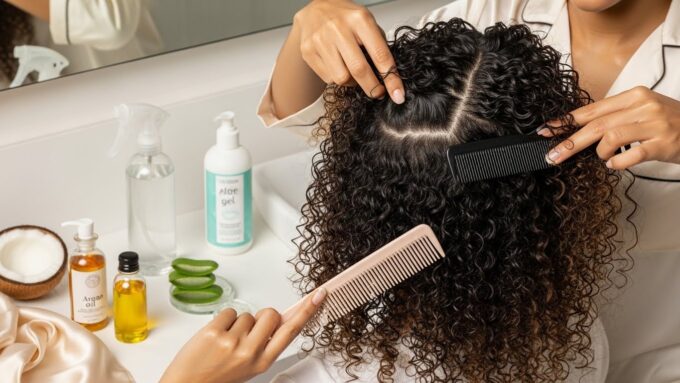
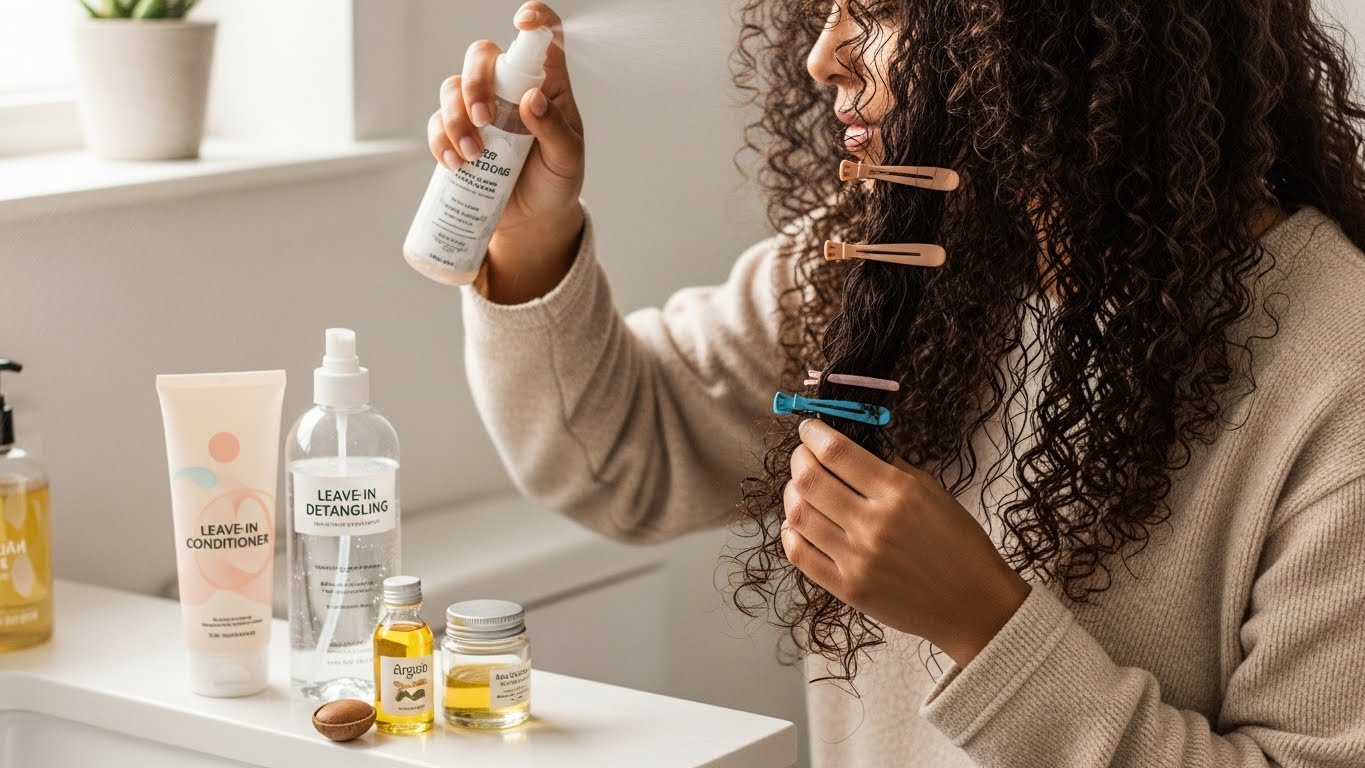
Wet or dampen the hair, then add conditioner. Detangling dry curls is the single biggest cause of breakage. Wet the hair thoroughly and work conditioner through the lengths. Conditioner gives the hair “slip” — it makes the strands slippery so they slide past each other instead of catching. Leave-in conditioner or a detangling product does the same job. A few drops of a light oil on the ends can reduce friction further, but oil does not remove tangles on its own; the technique does the work.
Work in small sections. Divide the hair into four to six sections and clip the rest out of the way. Small sections mean you can see each knot, hold the hair above it, and pull less. Work through one section completely before moving to the next.
Give yourself time. Rushing is what turns a small knot into a snapped strand. If a section is badly matted, leave it, dampen it again with conditioner, and come back to it.
Before using a new detangling product or oil, patch test it: put a small amount on the inside of your arm or the bend of your elbow, twice a day for 7 to 10 days. If the skin turns red or itchy, do not use it. (This is the American Academy of Dermatology patch-test method.)
Tools: what to use and what to avoid
| Tool | When to use it |
|---|---|
| Your fingers | First, always. Fingers can feel a knot and loosen it strand by strand. |
| Wide-tooth comb | After fingers, on wet or damp conditioned hair, to clear what is left. |
| Flexible detangling brush | An alternative to a comb for some curl types, if it glides without force. |
| Fine-tooth comb | Do not use on wet curls. The teeth are too close together and drag through knots. |
| Stiff bristle brush | Do not use on wet hair. It pulls and snaps strands. |
The rule for any tool is the same: if it catches and you have to force it, stop. Add more conditioner, use your fingers, and take a smaller section.
Step by step
- Wet the hair and add conditioner. Wet thoroughly, then work conditioner through the lengths, from mid-length to ends. Leave it in while you detangle.
- Section the hair. Clip it into four to six sections. Start with the section at the back, where the hair is usually the most tangled.
- Loosen with your fingers. Starting at the ends of one section, gently pull the strands of a knot apart with your fingers. Work one knot at a time. Never pull hard — pulling hard is what snaps the hair.
- Hold the hair above the knot. With one hand, hold the section firmly between the knot and your scalp. This stops the pull reaching your roots and keeps the tension on the knot, not on the follicle.
- Comb from the ends up. Once the fingers have loosened a section, take a wide-tooth comb and start at the very ends. Clear the lowest inch or two, then move a little higher and repeat until you reach the roots. Never start at the roots and drag down through a knot.
- Rinse and repeat. Move to the next section. When all sections are done, rinse the conditioner out if you used a rinse-out conditioner, or leave a leave-in in place.
If a knot will not come apart, do not cut it out in frustration and do not rip through it. Add more conditioner, let it sit for a few minutes, and try again with your fingers. A knot that will not move is usually a knot that is dry — it needs more slip, not more force.
After detangling
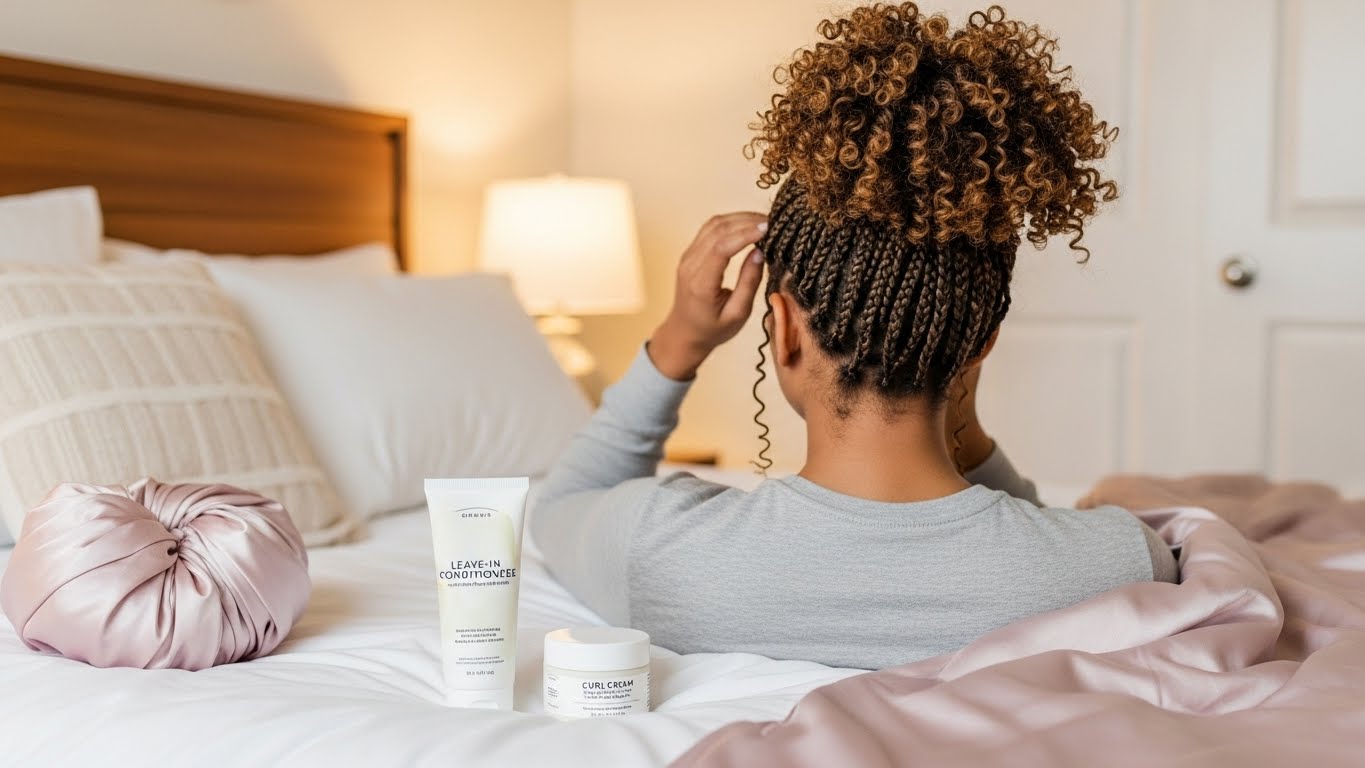
Add a leave-in and seal the ends. After detangling, apply a light leave-in conditioner or curl cream to keep the hair soft, then a few drops of a light oil on the mid-lengths and ends. Water moisturises hair; oil seals that moisture in. Oil on its own does not hydrate.
Style loosely for the night. Loose braids, twists or the pineapple method — a loose, high ponytail on top of the head — keep curls from rubbing and re-tangling while you sleep. A silk or satin pillowcase may reduce friction further, although the evidence for pillowcases is weak and it should not be relied on alone.
Keep the hair moisturised between washes. Damp hair tangles less than dry hair. A light mist of water and leave-in conditioner between wash days keeps curls softer and easier to manage. How often you detangle depends on your curls: some people detangle at every wash, others once a week or as needed when the hair feels tight and knotted. Judge by how the hair feels, not by a fixed schedule.
Long-term care
- Moisturise regularly. Use a conditioner every time you wash, and a leave-in or deep conditioner as your hair needs it. The American Academy of Dermatology (AAD) advises washing curly hair only when needed, and at minimum every 2–3 weeks for scalp health — most people wash far more often than this minimum.
- Trim split ends every 6–12 weeks. Split ends catch on neighbouring strands and create new tangles. Trimming is the only way to remove them.
- Limit heat and chemical damage. High heat and chemical treatments weaken the shaft and make it snap more easily. When you do use heat, use a low or medium setting and never use a flat iron on damp hair.
- Protect the hair at night. The same loose styles and silk or satin pillowcase that help after detangling also prevent new tangles forming overnight.
- Protect the scalp from sun. The scalp is skin too — an exposed parting can sunburn, so use broad-spectrum SPF 30+ sunscreen on it, or cover it with a hat.
Mistakes that cause breakage
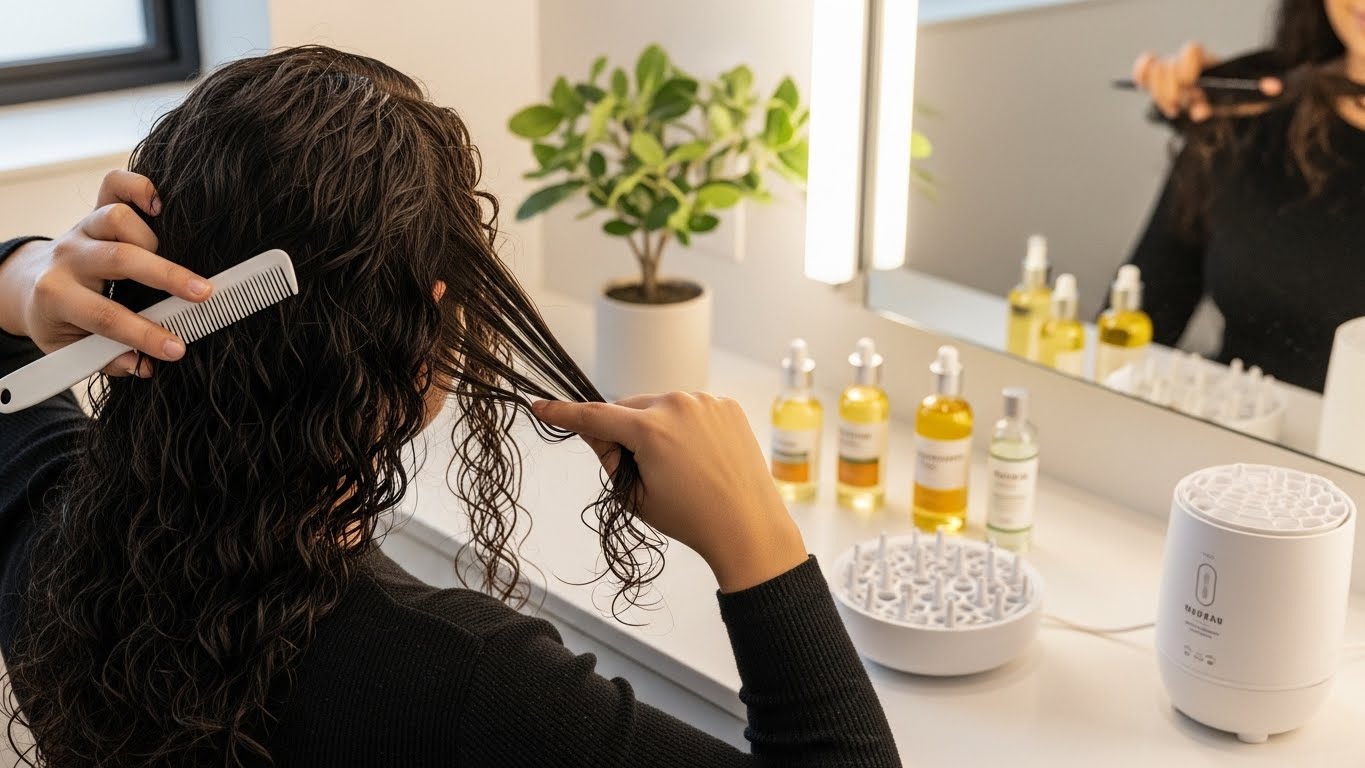
- Detangling dry hair. Dry curls are at their most fragile. Always detangle wet or damp, with conditioner.
- Starting at the roots. Dragging a comb from the roots down through a knot pulls the whole tangle tight and snaps strands. Start at the ends.
- Pulling hard. If a tool catches, more force is never the answer. More conditioner and a smaller section are.
- Using the wrong tools. Fine-tooth combs and stiff brushes on wet curls.
- Skipping conditioner. Without slip, strands catch on each other and every knot is harder to undo.
- Rushing. Detangling is slow work. Saving ten minutes by pulling through knots costs far more in broken hair.
When to get help
Losing about 50 to 100 hairs a day is normal. See a doctor or dermatologist promptly if you notice:
- Shedding that lasts more than six months, or sudden heavy shedding.
- Bald patches, or thinning at the hairline.
- Scalp pain, sores, redness or flaking that does not settle.
- Hair that breaks off in large amounts despite gentle handling.
These can be signs of a scalp condition or a medical cause of hair loss, and they need checking rather than a new detangling product.
Frequently asked questions
How often should I detangle curly hair?
As often as it needs it — at every wash for some people, once a week or as needed for others. Judge by tightness and dryness, not by a calendar.
Can children use the same detangling method?
Yes. Fingers first, then a wide-tooth comb, on damp conditioned hair, in small sections. Be extra gentle and patient — the same method, more slowly.
Should I detangle wet or dry hair?
Wet or damp, always, with conditioner for slip. Dry curls are fragile and snap easily.
Do oils prevent tangles?
No. Oils can reduce friction and help strands slide, but they do not remove tangles. Technique — sections, fingers first, ends up — is what removes them.
Is finger detangling better than combing?
Finger detangling is gentler and causes less breakage, especially for tight curls, because you can feel each knot. A wide-tooth comb afterwards clears what is left. Use both.
Summary
Detangle wet or damp hair with conditioner for slip, in small sections, fingers first, then a wide-tooth comb from the ends up. Never detangle dry curls, never pull hard, and never start at the roots. Trim split ends every 6–12 weeks and protect the hair at night. Gentle detangling does not make hair grow faster — it stops breakage, so the length you grow is kept.
Sources: American Academy of Dermatology curly hair tips and hair-loss guidance; IADVL Hair Care Basics; Rele & Mohile 2003 (coconut oil and protein loss); Koyama et al. 2016 (scalp massage); Patel et al. 2017 (biotin); FDA biotin lab-test warning. This is a researched overview, not a hands-on review.