Researched overview.
Table Of Content
Quick answer
Frizz is not a flaw in your hair. It is a sign that the outer layer of the hair — the cuticle — is lifted, letting moisture from the air into the inner part of the strand. The strand swells unevenly, bends, and lifts away from its neighbours. Curly hair frizzes more visibly than straight hair because every bend in a curl lifts the cuticle slightly, and because the scalp’s natural oils cannot travel easily down a twisted shaft, so curls are drier to begin with.
You cannot eliminate frizz. Any product or routine that promises “frizz-free” curls is promising something it cannot deliver. You can reduce it: keep the hair moisturised, handle it gently, protect it from heat and friction, and seal damp hair with a light coating so moisture from the air enters more slowly.
This guide is the curly-hair companion to the general frizz guide on this site (“How to Manage Frizzy Hair”). The mechanism and the routine are the same; this guide adds what is specific to curls — curl type, porosity, and curly washing and night-care methods.
If your scalp is red, sore, flaking badly, or you have patches of hair loss, ask a dermatologist or pharmacist before changing your routine. This guide is general information, not medical advice.
Contents: What frizz is · Why curls frizz more · The routine · Washing · Drying · Night care · What does not help · Mistakes · When to get help
What frizz is
Hair is roughly 95% keratin, a protein that readily absorbs water. The cuticle is six to ten layers of flat, overlapping cells that normally keep water out. When those cells lift — from dryness, heat damage, rough handling, or bleaching — water vapour from the air slips past the cuticle into the cortex, the inner part of the strand. The strand swells unevenly, so it bends, kinks and lifts. That is frizz. (Monselise et al. 2015.)
Two things follow from this. First, frizz is a moisture problem, not a dirt problem: washing harder will not fix it. Second, no coating stops moisture entering the hair entirely. Silicones and plant oils coat the cuticle and slow the rate at which water vapour enters; they delay frizz, they do not prevent it. A product that claims to eliminate frizz is overstating what a coating can do.
Why curls frizz more
- Curl shape. Each bend in a curl is a point where the cuticle sits slightly lifted, and where the hair is weaker. Tighter curls and coils have more bends, so they frizz more visibly than loose waves.
- Dryness. The scalp’s natural oils travel down a straight shaft easily and down a twisted one poorly. The American Academy of Dermatology (AAD) states that people with curly or tightly coiled hair are more prone to breakage and dryness than people with other hair types. (AAD, 6 curly hair tips from dermatologists)
- Porosity. Porosity is how easily hair absorbs and loses water. High-porosity hair — from bleaching, heat damage, or natural texture — takes in moisture fast and loses it fast, so it frizzes daily. Low-porosity hair takes in moisture slowly and can feel weighed down by heavy products. You do not need a test to use this: if your hair dries very fast after washing and frizzes in humidity, it behaves like high-porosity hair; if products sit on it and it takes a long time to get wet, it behaves like low-porosity hair.
- Humidity. Humid air carries more water vapour, so more of it enters lifted cuticles. Frizz is worse on humid days for a physical reason, not because you did something wrong.
The routine in short
- Wash gently, only when needed, with lukewarm water.
- Condition all your hair after every wash.
- Apply leave-in conditioner or curl cream to damp hair, then a few drops of light oil to seal it.
- Detangle wet hair only, from the ends up.
- Dry gently — air-dry when you can, or diffuse on low heat.
- Protect curls overnight.
Washing
Water temperature. Wash with lukewarm water. Hot water strips natural oils and dries curls out. There is no good evidence that a cold-water rinse “closes” the cuticle or reduces frizz, so this guide does not recommend one.
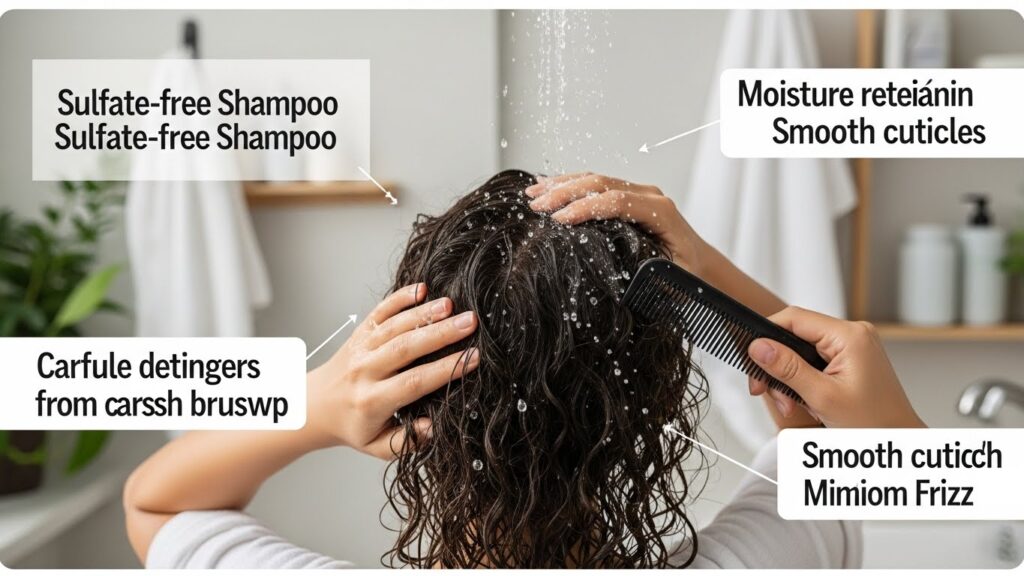
Shampoo. Shampoo the scalp, not the lengths. Massage it into the scalp with your fingertips and let the suds run down the lengths as you rinse — that is enough to clean them without stripping them. Use a small amount; a squirt about the size of a quarter is enough for most people. Sulfate shampoos are strong detergents that can strip the little oil curly hair has; a gentler, sulfate-free shampoo suits most curls for regular washing. If you use gels, oils, creams or pomades, the AAD advises using a clarifying shampoo before your moisturising shampoo sometimes, to remove build-up. The full guide to choosing a sulfate-free shampoo is the companion post in this batch, “How to Choose a Sulfate-Free Shampoo for Curly Hair”.
Conditioner. Condition all your hair after washing, not just the ends — this is the AAD’s advice for curly hair. Leave it in for a few minutes, then rinse. If your hair is very dry or hard to detangle, you can also apply conditioner before shampooing.
Deep conditioning. A deep conditioner or moisturising mask once a week is a common starting point for dry curls, and twice a week is reasonable if your hair is very dry. It is a conditioning step, not a repair: masks condition the surface; they do not rebuild the hair shaft. Damaged hair cannot be repaired — it can only be protected while it grows out, and split ends can only be trimmed.
Detangling. Wet hair is fragile. Detangle while it is wet and conditioned, with your fingers or a wide-tooth comb, starting at the ends and working up in small steps. Do not brush dry curls: it snaps hair, lifts the cuticle, and makes frizz worse.
Styling products
Apply styling products to damp hair, not dry hair. A leave-in conditioner or curl cream first, then a light oil over the top to seal in the moisture — water-based product first, oil last. Glycerin is a humectant: it draws water toward the hair. In humid air that can help; in very dry air it can draw water out of the hair instead, so a glycerin-heavy product is not a reliable frizz fix on its own. Coconut oil reduced protein loss from the hair shaft in one study (Rele & Mohile 2003) — it protects the shaft during washing; it does not grow hair or eliminate frizz. Use a few drops on the mid-lengths and ends, never a palmful on the scalp.
Before using a new styling product, patch test it: put a small amount on the inside of your arm or the bend of your elbow, twice a day for 7 to 10 days. If the skin turns red or itchy, do not use it. (This is the American Academy of Dermatology patch-test method.)
Drying
Drying changes frizz more than most products do. Rough towel-drying lifts the cuticle through friction.
- Do not rub. Squeeze out excess water gently with a microfiber towel or a soft cotton T-shirt. Ordinary bath towels are rougher and lift the cuticle more.
- Air-dry when you can. It is the gentlest option and lets curls keep their natural shape.
- Diffuse on low heat if you use a dryer. Use a diffuser attachment on the lowest effective heat setting, and do not hold hot air on one spot. Heat damage builds up over time, and no heat protectant makes unlimited heat safe.
- Do not touch curls while they dry. Touching and separating curls while they dry breaks up clumps and creates frizz.
The scalp is skin too — an exposed parting can sunburn, so use broad-spectrum SPF 30+ sunscreen on it, or cover it with a hat.
Night care
Hair rubs against the pillow all night, and friction lifts the cuticle and flattens curls.
- Pineapple. Gather hair loosely on top of the head with a soft scrunchie. It keeps curls from being flattened and tangled overnight. Do not use a tight style: tight hairstyles that pull can cause hair loss over time.
- Loose braids or twists. A loose braid or a few loose twists overnight keep the curl shape and reduce tangling. Keep them loose.
- Silk or satin pillowcase. A silk or satin pillowcase reduces friction compared with cotton. The evidence for it is weak — it is a reasonable friction-reducing step, not a proven treatment.
What does not help
These are common in curly-hair articles, including the live version of this post. None of them has good published evidence behind it as a frizz treatment, so none of them is recommended here.
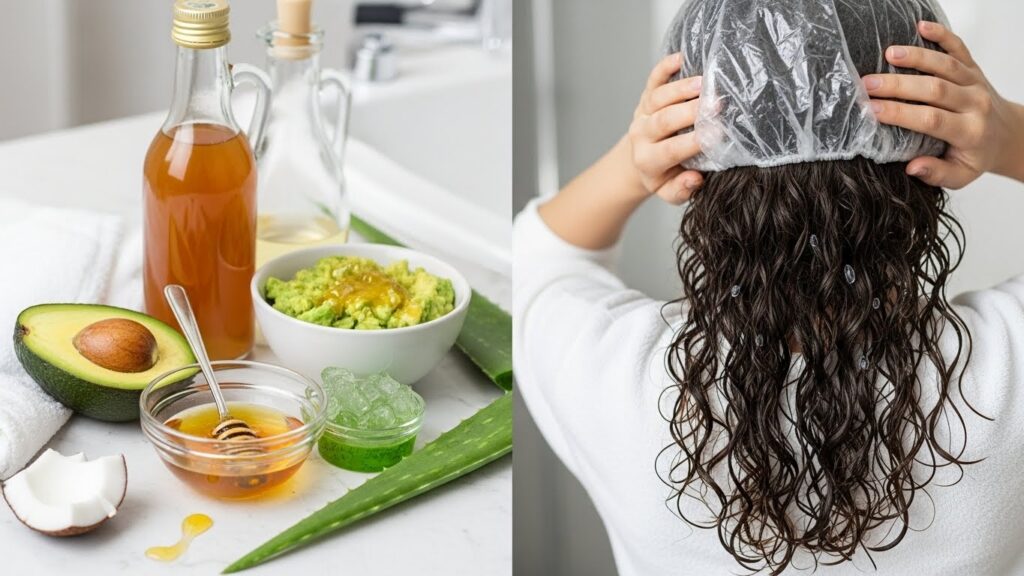
- Avocado, honey and coconut-oil masks. They condition the surface. There is no human evidence they reduce frizz, and honey does not moisturise hair from the inside.
- Apple cider vinegar rinses. No published evidence that they normalise scalp pH, seal the cuticle, or reduce frizz.
- Aloe vera treatments. No good evidence aloe vera reduces frizz, strengthens hair, or works as a heat protectant.
- Rosemary rinses for growth. The only study usually quoted tested rosemary oil against minoxidil 2% (Panahi et al. 2015), a single study. A rinse is a different preparation and was not tested.
- Nutrition as a frizz treatment. A balanced diet supports general health, but no good trial shows omega-3 alone, biotin, or vitamins A, C and E reducing frizz. Biotin helps only in deficiency, which is rare (Patel et al. 2017). Drinking more water does not change hair texture.
- Stress relief as a frizz treatment. Stress does not cause frizz, and relaxation will not smooth the cuticle. Sleep and stress matter for general health, not for frizz.
Mistakes that make frizz worse
- Washing too often with a harsh shampoo, or skipping conditioner.
- Brushing dry curls.
- Rough towel-drying, or drying with high heat.
- Using heavy products that weigh curls down, then adding more product to fix the flatness.
- Changing products every few days, so you never learn what helps.
- Expecting frizz to disappear. It can be reduced and managed; it cannot be eliminated. If a product promises “frizz-free” curls, it is promising something it cannot deliver.
When to get help
Ask a dermatologist or pharmacist if: your scalp is persistently itchy, red, sore or flaking; you have patches of hair loss; shedding lasts more than six months; or a new product causes a reaction that does not settle after you stop using it. Shedding about 50–100 hairs a day is normal, according to the AAD.
Summary
Frizz is a lifted cuticle letting humid air into the hair shaft. Keep curls moisturised with conditioner and leave-in on damp hair, seal with a few drops of light oil, wash gently, detangle wet hair only, dry without friction or high heat, and protect curls overnight. Skip the DIY masks, vinegar rinses and nutrition claims — they have no good evidence behind them. Frizz can be managed. It cannot be eliminated, and no product can promise otherwise.
Sources: AAD curly hair tips; AAD hair shedding guidance; IADVL Hair Care Basics; Monselise et al. 2015; Rele & Mohile 2003; Panahi et al. 2015; Patel et al. 2017. This is a researched overview, not a hands-on review.