Researched overview. This guide is based on published dermatology and eye-care guidance, not on hands-on product testing by BeautyKob. No product in this guide was tested by us, and no brand is recommended.
Table Of Content
- Quick answer
- Surface skin tone vs undertone: what is the difference?
- Understanding skin undertones: warm, cool, neutral, and olive
- Rough tests to get a sense of your undertone
- How to properly swatch and test foundation shades
- Why swatching on your hand or arm often misleads
- The three-stripe jawline technique
- Checking foundation in natural lighting and accounting for oxidation
- The trick of department store lighting
- Understanding foundation oxidation
- How skin type influences foundation formula and shade
- Oily skin
- Dry and mature skin
- Combination skin
- Seasonal shade adjustments: the two-bottle strategy
- Common mistakes when choosing foundation
- Patch test
- Summary
- FAQ
- Q1: What should I do if I am in between two foundation shades?
- Q2: How do I know if my foundation undertone is wrong?
- Q3: What is an olive undertone, and how do I match it?
- Q4: Can foundation oxidize even if it is oil-free?
- Q5: Does SPF in foundation cause a white flashback in photos?
Quick answer
Finding a foundation match comes down to two things: your surface depth (fair, light, medium, tan, dark, deep) and your undertone (warm, cool, neutral, or olive). Surface depth shifts with sun exposure and seasons; undertone usually stays the same over your life. The tests below are rough guides to your undertone — none of them is reliable on its own. What actually decides the match is swatching on your jawline in natural daylight and letting the swatch dry for 10 to 15 minutes before judging it.
If your skin is red, sore, or has open sores or a rash, skip makeup on the affected area and ask a dermatologist or pharmacist first. This guide is general information, not medical advice.
Contents: Surface tone vs undertone · Undertone categories · Rough tests for your undertone · How to swatch properly · Lighting and oxidation · Skin type and formula · Seasonal adjustments · Common mistakes · Patch test · FAQ
Surface skin tone vs undertone: what is the difference?
Before testing foundation bottles, it helps to understand the difference between surface tone and undertone. Mixing up these two concepts is the single biggest reason people end up with the wrong foundation colour.
Your surface skin tone refers to the apparent depth of your complexion — fair, light, medium, tan, dark, or deep. Your surface tone can change noticeably throughout the year based on sun exposure, seasonal shifts, tanning, or even temporary redness from skin sensitivity or rosacea.
Your undertone, on the other hand, is the subtle, permanent shade beneath the surface of your skin. While your surface tone might darken from light to medium after a summer at the beach, your undertone usually stays the same.
If you pick a foundation that matches your surface depth but clashes with your undertone, the makeup will look like a foreign layer sitting on top of your face rather than blending into it.
Understanding skin undertones: warm, cool, neutral, and olive
Finding your undertone narrows your shade options considerably. Undertones generally fall into four categories:
- Warm undertones: Your skin carries yellow, golden, peachy, or honey tones beneath the surface. In deep skin, warm undertones often appear golden, rich bronze, or caramel. Foundations for warm skin are often labelled with a “W” or named shades like sand, honey, golden, or warm beige.
- Cool undertones: Your skin carries pink, red, or soft bluish hues underneath. In deeper complexions, cool undertones can appear espresso, rich reddish-brown, or deep blue-black. Cool foundation bottles are often marked with a “C” and carry names like porcelain, rose, petal, espresso, or cocoa.
- Neutral undertones: Your skin displays a balance of both warm and cool qualities, with no distinct yellow or pink dominance. Neutral shades are often labelled with an “N” or descriptions like buff, natural, ivory, or neutral tan.
- Olive undertones: Your skin carries a subtle green or grey cast beneath the surface, often combined with yellow or neutral characteristics. Olive skin is common across fair, medium, and deep skin tones. If conventional warm foundations look too orange and neutral foundations look too pink, look for ranges that offer dedicated olive shades.
Shade letters and names vary by brand and are not standardised — a “W” in one brand does not mean the same undertone as a “W” in another.
Rough tests to get a sense of your undertone
You do not need specialised equipment to get a sense of your undertone. These four simple tests are rough guides, not reliable diagnostics — each one can mislead on its own, so treat the pattern across them as a hint, and let the jawline swatch decide.
The wrist vein test
Look at the veins on the inside of your wrist under indirect natural daylight. If your veins appear distinctly green or olive, you may have warm undertones. If your veins look blue or purple, you may have cool undertones. If you see a mix of blue and green, or cannot easily tell, you may have neutral undertones. This test is the least reliable of the four: vein colour appearance depends on skin depth, fat, and lighting, not only on undertone.
The white cloth test
Hold a sheet of crisp, bright white paper or a pure white towel next to your freshly cleansed, bare face in natural light. Does your face look yellow, creamy, or golden next to the stark white? You may be warm. Does your skin look pink, rosy, or reddish? You may be cool. If your skin looks greyish or remains unchanged, you may be neutral or olive.
The jewellery test
Think about which jewellery finish looks more harmonious against your bare skin. If yellow gold makes your complexion glow while silver looks dull, you may be warm. If silver, platinum, or white gold complements your skin while yellow gold looks brassy, you may be cool. If both look equally flattering, you may be neutral. This is a matter of taste as much as undertone, so treat it as a hint only.
The sun reaction test
How does your skin react to unprotected sun exposure? Skin that burns easily and rarely tans often leans cool. Skin that tans readily without burning often leans warm. Skin that burns initially and then turns into a tan often sits in the neutral range. Sun reaction is influenced by many factors, so this is a rough guide too — and it is not a reason to skip sunscreen.
How to properly swatch and test foundation shades
Now that you have a sense of your surface depth and undertone, the next step is hands-on testing. How and where you test foundation determines whether you walk away with an exact match or another disappointing purchase.
Why swatching on your hand or arm often misleads
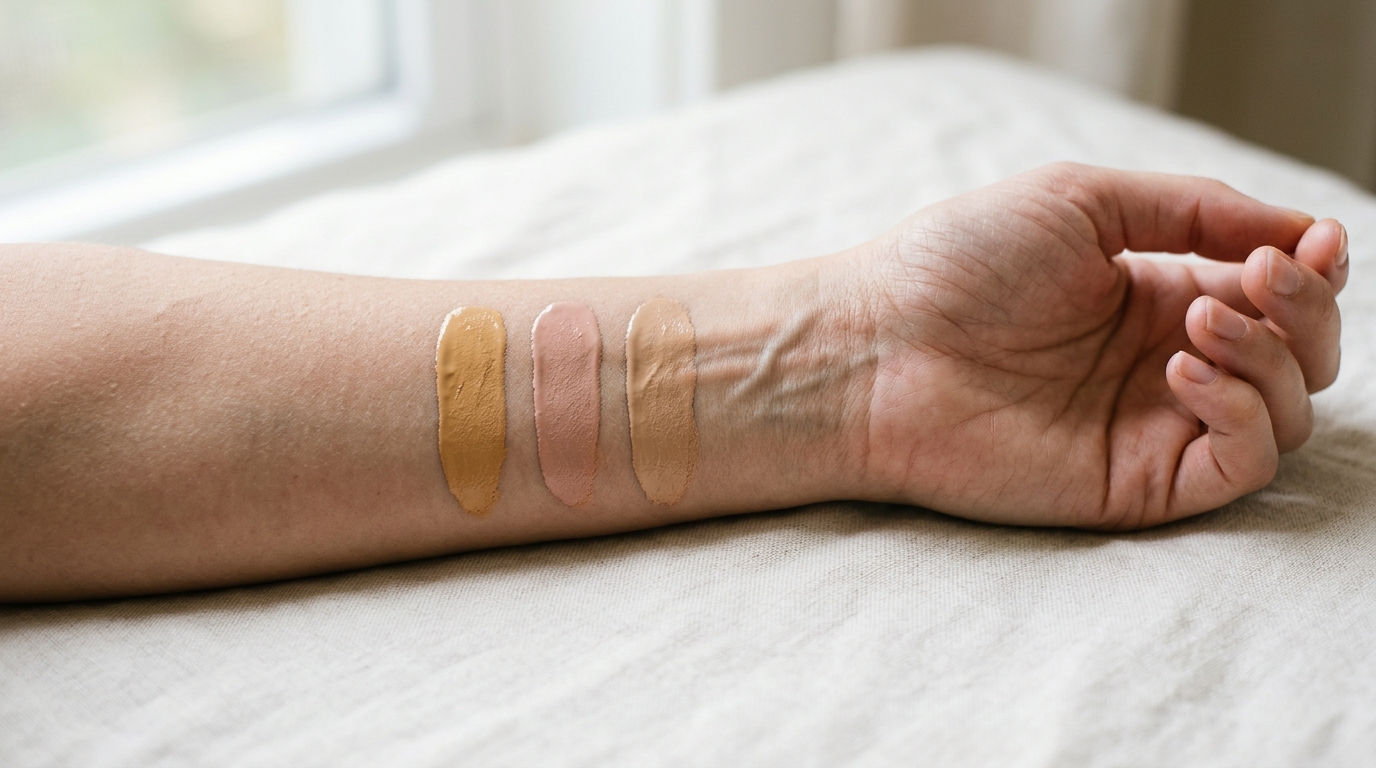
Many people start by swatching foundation on the back of their hand or inner forearm. This often leads to the wrong shade.
Your hands and arms receive very different levels of sun exposure, friction, and daily washing compared to your face. For most people, the back of the hand is one to two shades darker than the face, while the inner forearm is significantly paler and rarely matches the facial undertone. Testing on your hand shows product texture, not colour accuracy.
The three-stripe jawline technique
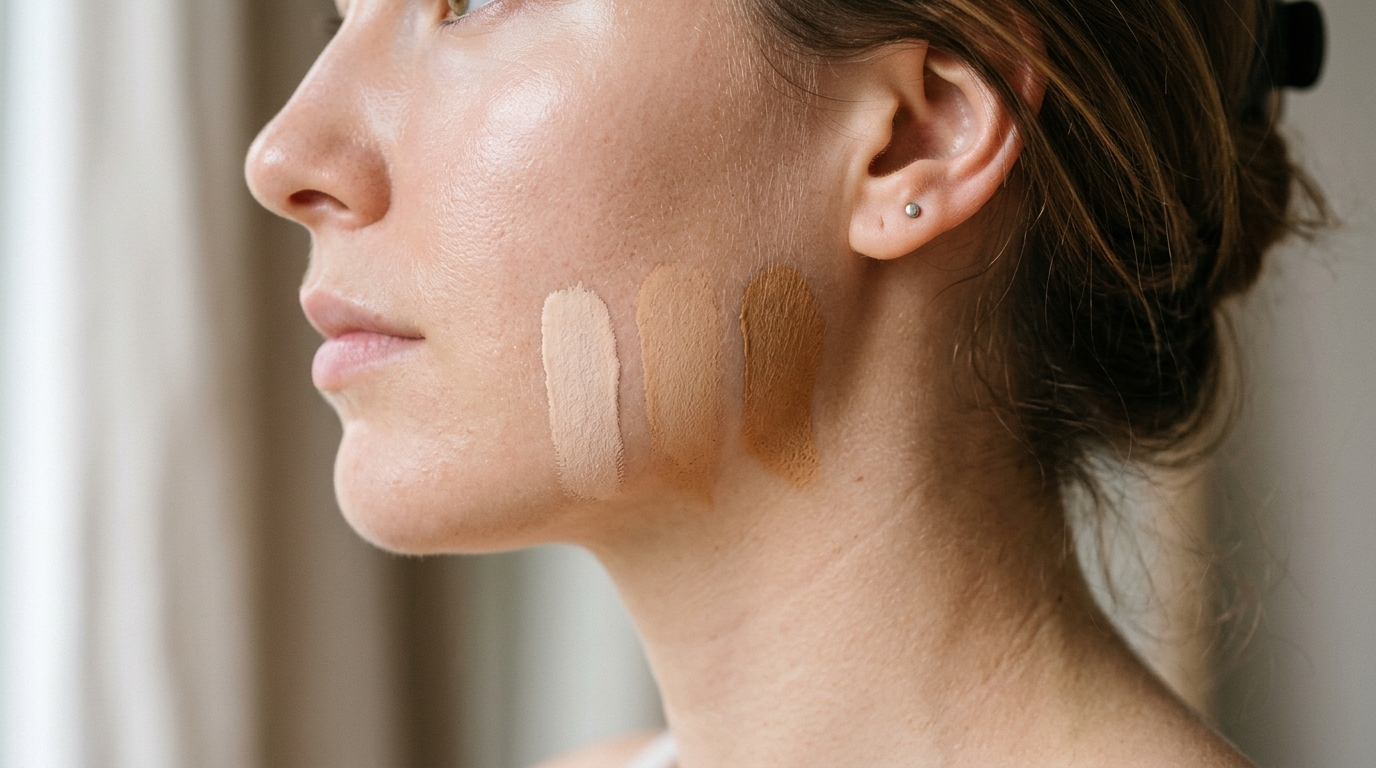
The jawline is the most useful testing ground for choosing the right foundation colour. Testing along the jawline ensures that your chosen shade matches both your face and your neck, preventing that awkward contrast line along the jaw.
Follow this simple method:
- Select three potential shades that look close to your skin: one you think is your exact match, one slightly lighter, and one slightly deeper.
- Using clean fingers or a cotton swab, apply a vertical stripe of each shade starting on your lower cheek, crossing directly over your jawline, and extending down onto your upper neck.
- Step back and evaluate the stripes. The correct shade usually will not stand out as a separate stripe; instead, it will visually disappear into both your face and neck skin.
- If a shade disappears on your face but looks too dark against your neck, choose a shade slightly lighter or blend down your neck during application.
Checking foundation in natural lighting and accounting for oxidation
You found a stripe that seems to disappear on your jawline while standing in the beauty store. Before rushing to the checkout counter, there are two factors to address: lighting and oxidation.

The trick of department store lighting
Store lighting uses intense fluorescent and overhead halogen bulbs designed to brighten product displays. This lighting casts artificial warmth or harsh cool reflections that skew how colours appear. A shade that looks perfectly balanced in the store mirror can look chalky or orange as soon as you step outside into genuine sunlight.
Whenever possible, ask for a sample to take home, or apply your three jawline stripes and walk over to a window or outside. Check your reflection using a handheld compact mirror in open daylight. Natural, indirect daylight provides the true test of whether your foundation blends invisibly.
Understanding foundation oxidation
Have you ever applied a foundation that matched perfectly at 8:00 AM, only to notice by noon that your complexion turned a noticeable shade of orange or peach? This darkening on drying is often called oxidation.
Oxidation happens when cosmetic pigments, binders, and iron oxides react with oxygen in the air, your facial sebum, and your skin’s natural pH level as the formula dries. The exact mechanism varies by product, and not every foundation oxidises noticeably.
- The 10-minute rule: When testing any liquid foundation, never judge the shade immediately after swatching wet product. Allow the stripe to dry down completely for ten to fifteen minutes. The dry shade is the true colour you will wear all day.
- Formulas that may oxidise more: Matte and oil-control foundations contain higher concentrations of powders and minerals, and they may dry noticeably deeper than their wet application.
- How to compensate: If you have oily skin and love a matte foundation that darkens as it dries, consider buying half a shade lighter to account for the dry-down shift.
How skin type influences foundation formula and shade
Finding your match is not solely about colour; your skin type affects how the formula adheres, reflects light, and holds its true pigment over hours of wear.
Oily skin
Oily complexions produce sebum that breaks down emollient foundations and speeds up oxidation. Choose oil-free, matte, or powder foundations containing silica or kaolin clay. Remember that matte finishes absorb light, which can make your skin look slightly deeper than a luminous formula in the same shade code.
Dry and mature skin
Dry skin lacks moisture and natural lipids, causing powder or ultra-matte foundations to cling to dry patches, emphasize fine lines, and look ashen. Opt for hydrating liquid foundations, serum foundations, or tinted moisturisers formulated with hyaluronic acid, squalane, or glycerin. Dewy and luminous finishes reflect light, giving the illusion of a brighter, fresher complexion.
Combination skin
Combination skin requires balance. A semi-matte, natural-finish, or satin liquid foundation works best. It controls shine across the forehead and nose while providing enough comfort not to emphasize dryness on the cheeks.
Seasonal shade adjustments: the two-bottle strategy
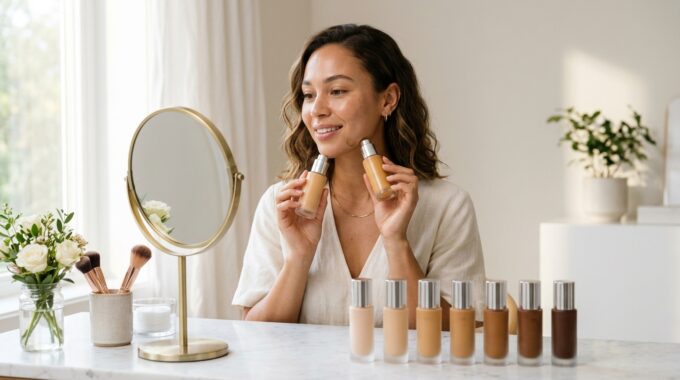
One practical approach professional makeup artists recommend is keeping two foundation shades in your routine: a winter shade and a summer shade.
Very few people remain the exact same depth throughout the entire year. During sunny summer months, incidental sun exposure and outdoor activities typically deepen your complexion by one to two shades. In the winter, reduced UV exposure and indoor living return your skin to its lightest baseline depth.
Rather than buying an entirely new bottle every few months, buy your match in your lightest winter depth and another bottle in your deepest summer depth — ensuring both bottles share your exact undertone.
During transitional seasons like spring and autumn, you can mix one drop of your winter shade with one drop of your summer shade on the back of your hand. This blend gives you a close match through most of the year.
Common mistakes when choosing foundation
Avoid these common mistakes to save time, money, and frustration:
- Matching to facial redness: Many people have surface redness from acne, irritation, or broken capillaries on their cheeks and nose. If you match your foundation to this redness, your entire face will look pink and disjointed from your neck. Always match to clear areas on your jawline or chest.
- Ignoring the neck and décolletage: Your face is frequently shaded by hats, hair, or daily SPF, making it lighter than your chest and shoulders. Make sure your chosen shade creates a smooth transition from your jawline down to your collarbones.
- Assuming shade names are universal: A “Natural Beige” in one cosmetic brand might have cool pink undertones, while “Natural Beige” in another brand is golden and warm. Never buy a new brand solely based on the shade name you wear elsewhere.
- Testing over existing makeup: Trying to swatch a new foundation over your current makeup prevents the formula from touching your bare skin. Always clean the jawline area with a gentle wipe before swatching.
Patch test
Before using a new foundation or makeup product more widely, patch test it: apply a small amount to the underside of your arm or the bend of your elbow, twice a day, for 7 to 10 days. If you get redness, itching, swelling or a rash, stop using it. A 24-hour test can miss an allergic reaction, which often takes several days to appear — that is why this guide uses the AAD 7–10 day patch-test method. This is the American Academy of Dermatology’s patch-test method.
Summary
Choosing the right foundation comes down to a reliable, repeatable process: determine your undertone first, identify your current surface depth second, and always verify swatches on your jawline in natural daylight after allowing them time to dry.
Foundation should never look like a separate layer or a mask. Its purpose is to even out your natural canvas so the rest of your features shine. As a practical next step, try the wrist-vein and white-paper tests beside a window with clean skin — then confirm whatever they suggest with three jawline stripes in daylight. No product in this guide was tested by us, and no brand is recommended.
FAQ
Q1: What should I do if I am in between two foundation shades?
When caught between two shades, it is generally safer to choose the slightly lighter shade. You can easily add warmth, depth, and dimension back to your face using bronzer or blush. Correcting a foundation that is too dark, on the other hand, is much more difficult and often creates an obvious demarcation line along the neck.
Q2: How do I know if my foundation undertone is wrong?
If your foundation looks chalky, gray, or ashen on your face, it is likely too cool or too light for your skin. If your foundation makes you look orange, sunburned, or overly yellow, the formula is too warm or has oxidised. An exact undertone match will disappear into your skin without leaving any visible edges.
Q3: What is an olive undertone, and how do I match it?
Olive undertones feature a subtle green or grayish cast beneath the surface, often combined with yellow or neutral characteristics. Olive skin is common across fair, medium, and deep skin tones. If conventional warm foundations look too orange and neutral foundations look too pink, look for foundation ranges that offer dedicated olive shades, or add a pinhead-sized drop of blue or green colour adjuster to a neutral foundation.
Q4: Can foundation oxidize even if it is oil-free?
Yes, oil-free foundations can still oxidise. While natural skin oils accelerate the darkening, the reaction is mainly linked to oxygen interacting with the pigments and minerals in the formula as moisture evaporates during dry-down. To minimise oxidation, prep your skin with an antioxidant serum, use an oil-control primer, and set your base with a translucent powder.
Q5: Does SPF in foundation cause a white flashback in photos?
Foundations containing physical (mineral) sunscreens like zinc oxide and titanium dioxide can bounce flash photography back into the camera lens, creating a white or pale cast known as flashback. If you are choosing foundation for evening events, photography sessions, or weddings, opt for a formula without SPF or one formulated with chemical sunscreen filters. Note that the SPF in foundation is not a substitute for sunscreen on its own, because people apply far less foundation than the amount used in SPF testing.
Sources: AAD sunscreen guidance (broad-spectrum SPF 30 or higher, reapply every two hours outdoors); AAD patch-test method. This is a researched overview, not a hands-on review.