
Researched overview.
Table Of Content
Quick answer
Damaged hair cannot be repaired. The hair shaft is made of keratin, and once it is damaged — by heat, chemical treatments, sun or rough handling — no oil, herb, mask or rinse can rebuild it. What you can do is stop new damage, trim off split ends, and protect the hair while new hair grows out. Hair grows about 1 cm a month, so growing out damage takes months, and no routine can promise a result by a fixed date.
If your hair is breaking badly, or you are losing hair suddenly or in patches, that is a reason to see a doctor, not a reason to buy a new product.
Contents: What damage is · What causes it · What cannot be fixed · The repair routine · Oils and masks, honestly · Scalp care · Rinses · Food and lifestyle · Salon treatments · Mistakes · A simple week · When to get help
What damage is
Hair damage is wear to the hair shaft. The cuticle — the outer layer of overlapping scales — lifts, chips or wears away, and the cortex underneath loses protein and moisture. Damaged hair looks dull, feels rough, tangles easily, breaks when brushed, and develops split ends.
The important fact is that the hair shaft is not alive. It cannot heal. The IADVL’s hair-care guidance is clear on this: hair care is about protecting the shaft, because damaged hair cannot be repaired.
What causes it
- Heat: blow dryers, straighteners and curling irons used often or on high heat. Heat damage builds up over time.
- Chemical treatments: bleaching, colouring, perming and relaxing weaken the shaft.
- Rough handling: brushing wet hair hard, rubbing with a towel, tight hairstyles that pull.
- Sun and wind: long exposure dries the hair and roughens the cuticle. A hat helps. The scalp is skin too — an exposed parting can sunburn, so use broad-spectrum SPF 30+ sunscreen on it, or cover it with a hat.
Most damaged hair has more than one cause. The routine below addresses all of them at once.
What cannot be fixed
- Split ends. Once a strand splits, it cannot be fused back together. The only way to remove split ends is to trim them off. Any product that claims to repair split ends is describing a temporary coating, not a fix.
- Breakage. Broken hair does not rejoin. Gentler handling stops new breakage; it does not undo the breakage that already happened.
- “Reconstruction” by oils, herbs or kitchen ingredients. Oils and masks coat and condition the hair. They do not rebuild the shaft, restore elasticity, or feed nutrients into it.
The honest goal is: stop new damage, trim the damage that is already there, and protect the hair that is growing in.
The repair routine

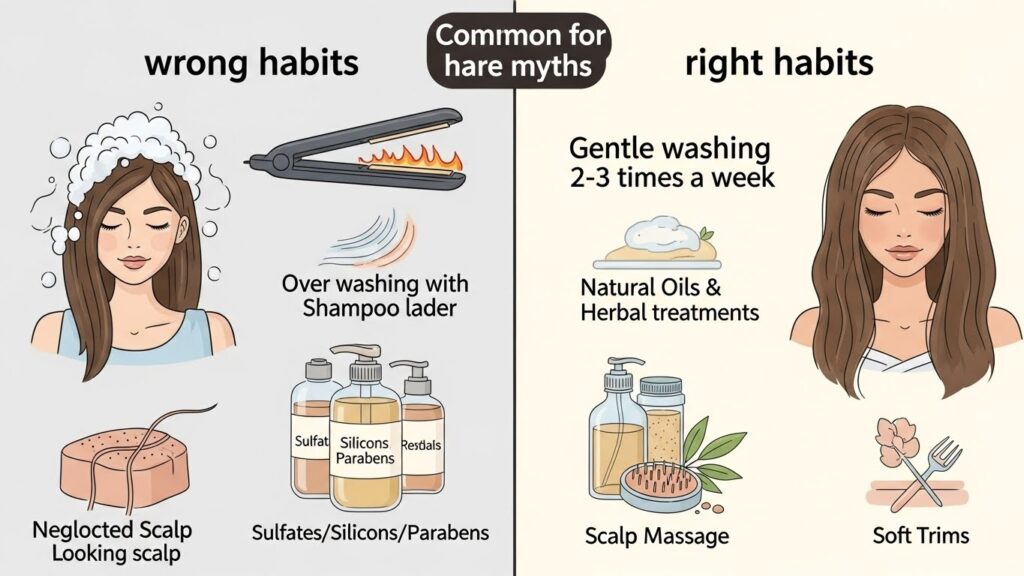
- Wash the scalp gently. Shampoo is for the scalp. Massage it in with your fingertips, not your nails. Rinse with lukewarm water.
- Condition the lengths after every wash. Conditioner smooths the cuticle and helps it lie flat. Apply from the mid-lengths to the ends, not on the scalp.
- Detangle gently. Wet hair is fragile: it stretches and breaks more easily than dry hair. Use a wide-tooth comb, starting at the ends and working up. Do not brush wet hair hard from the roots down.
- Dry gently. Pat hair with a towel instead of rubbing it. Let it air dry when you can. If you use a hairdryer, use the lowest effective heat setting.
- Protect from heat. If you use a hot tool, use a heat protectant product and the lowest heat that works. Heat protectant reduces some damage; it does not make unlimited heat safe. Aloe vera and argan oil have no good evidence as heat protectants.
- Trim regularly. A small trim every 6 to 12 weeks removes split ends before they travel further up the strand. Trimming does not make hair grow faster — it removes damage.
- Wear hair loosely. Hairstyles that pull can cause hair loss (traction alopecia). Early on it can reverse if the pulling stops, but pulling over a long time can permanently damage the follicles.
- Space out chemical treatments. The AAD suggests waiting 8–10 weeks between colouring sessions. Bleaching over already damaged hair makes the damage worse.
Oils and masks, honestly
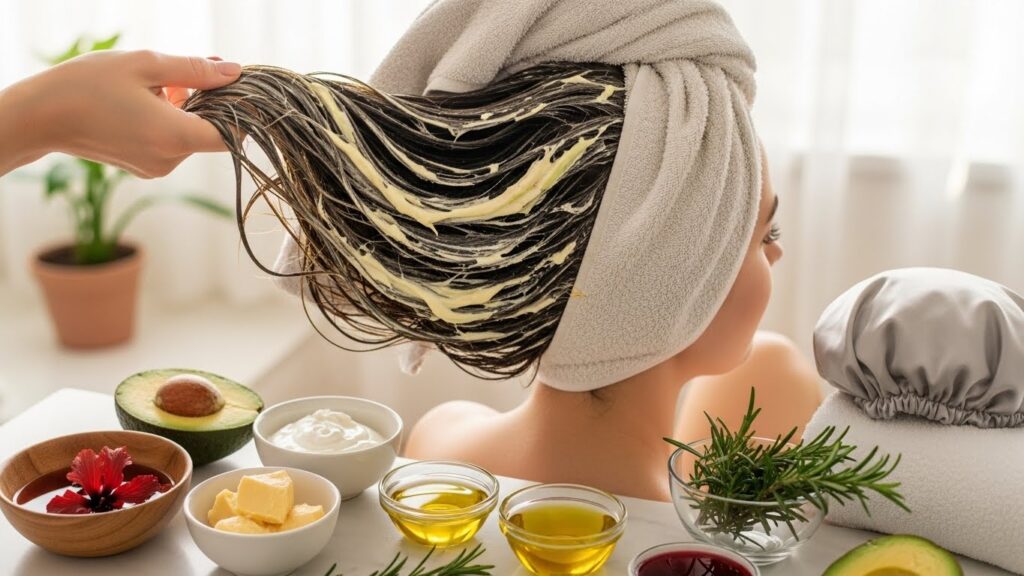
Oils and masks condition the hair and can make it feel softer and smoother. They do not repair damage, restore the shaft, or remove split ends.
- Coconut oil reduces protein loss from the hair shaft (Rele & Mohile 2003) — it protects the hair, it does not grow it. Apply a small amount to the lengths before washing, then wash it out.
- Argan, olive and almond oils coat the hair and can make it feel smoother. Use a few drops on damp lengths.
- Castor oil has no strong evidence for hair regrowth (2022 systematic review). Do not use it expecting growth.
- Egg masks are conditioning only. Egg protein does not repair hair or reduce split ends.
- Avocado, honey, banana and yogurt masks coat and condition the hair. They do not revive dry or split hair. If you enjoy them, use them as a conditioning treatment once a week at most.
- Shea butter is a thick conditioner for coarse or thick hair. It softens the feel of the hair; it does not remove frizz or repair damage.
Before using a new oil or mask, patch test it: put a small amount on the inside of your arm or the bend of your elbow, twice a day for 7 to 10 days. If the skin turns red or itchy, do not use it. (This is the American Academy of Dermatology patch-test method.)
If a mask makes your hair feel softer, that is the whole benefit — and it is a real one. Do not expect more from it.
Scalp care
A healthy scalp matters, but scalp care does not repair damaged lengths.
- Scalp massage feels pleasant and helps you notice changes in your scalp. It has no good evidence as a way to grow hair or prevent damage. The only study often quoted (Koyama et al. 2016) had nine men and no comparison group.
- Oiling the scalp does not feed the roots or improve circulation in any way that grows hair. Keep oil on the lengths, where it can protect the shaft.
- Dandruff and flaking: yogurt and honey masks do not treat dandruff. There is no good evidence that yogurt probiotics or lactic acid fight scalp fungi. If flaking, itching or redness does not settle, ask a doctor or pharmacist — medicated shampoos exist, and persistent scalp problems should be checked.
Rinses
Herbal and vinegar rinses are common in damaged-hair guides, including the live version of this post. None of them has good evidence for repairing or strengthening hair:
- Apple cider vinegar — no good evidence it balances pH or smooths the cuticle.
- Green tea rinses — no good human evidence for shine or strength.
- Hibiscus, rosemary and fenugreek rinses — no good published evidence. A rosemary rinse is not the rosemary oil tested in Panahi et al. 2015 (a single study of rosemary oil against minoxidil 2%).
A rinse can make hair feel clean, and that is fine. It does not repair damage.
Food and lifestyle
A balanced diet with enough protein supports normal hair growth, because hair is mostly keratin. That is a general health point, not a treatment for damage.
- No supplement is recommended here. Biotin is vitamin B7, not B1. It helps only when there is a deficiency, which is rare, and there is no good trial of biotin in people who are not deficient (Patel et al. 2017). Iron should never be self-started: too much iron is harmful, and it is a common cause of accidental poisoning in children. Zinc from supplements should not exceed 25 mg a day (NHS guidance). High-dose biotin can interfere with laboratory tests, including falsely low troponin, the heart-attack test (FDA warning, 2017, updated 2019).
- Omega-3 has no good trial as a hair treatment on its own.
- Stress can trigger temporary shedding, but it does not tear hair or cause damage to the shaft.
- Smoking and heavy drinking are bad for general health. There is no good evidence that they “destroy hair structure” as the live post claimed.
If you think a deficiency is affecting your hair, ask a doctor for a blood test before taking any supplement.
Salon treatments
Salon treatments such as keratin treatments, bonding treatments and deep conditioning can make hair feel smoother for a while, because they coat the shaft. They do not permanently repair damage, and some chemical treatments add damage of their own. If you are considering one, ask the salon what it actually does, what it contains, and how long the effect lasts — and be cautious if the claims sound too good to be true. This guide recommends no salon treatment and no brand.
Mistakes that keep hair damaged
- Using high heat every day without a protectant.
- Brushing wet hair aggressively from the roots.
- Rubbing hair hard with a towel.
- Colouring or bleaching over already damaged hair.
- Expecting a mask, oil or rinse to repair the hair.
- Waiting too long to trim split ends — a split can travel further up the strand.
- Changing products every few days, so you never learn what helps.
A simple week
Most days: Wash the scalp if it needs it, condition the lengths, detangle gently from the ends, dry gently, style loosely.
Once a week: One conditioning treatment — a mask or an oil on the lengths, not both. Check your scalp while you are at it.
Every 6 to 12 weeks: A small trim to remove split ends.
When you notice it: If shedding increases, or the scalp becomes sore, flaky or red, stop adding new products and pay attention to whether it settles.
When to get help
It is normal to shed about 50 to 100 hairs a day, and shedding is different from breakage: shedding releases a whole hair from the follicle, while breakage snaps the shaft along its length. See a doctor if you notice:
- Sudden hair loss, or shedding that goes on for more than six months.
- Patchy bald spots, or a part that is rapidly widening.
- Scalp pain, itching, scaling or redness that does not settle.
- Hair loss together with other symptoms, such as tiredness, weight change or irregular periods.
A dermatologist can examine the scalp, do a hair pull test, and order blood tests or a scalp biopsy when disease is suspected. See a GP first to get a clear idea of the cause before going to a commercial hair clinic.
Summary
Damaged hair cannot be repaired. Stop new damage with gentle washing, conditioning, careful detangling, low heat and loose styles. Trim split ends every 6 to 12 weeks. Oils and masks condition; they do not restore the shaft. Herbal rinses, vinegar and green tea have no good evidence for repair. Protect the hair that is growing in, and see a doctor if shedding or scalp problems persist.
Sources: IADVL Hair Care Basics; AAD hair-loss and hair-damage guidance; NHS 111 Wales hair loss; Rele & Mohile 2003; Koyama et al. 2016; Panahi et al. 2015; Patel et al. 2017; Philip Kingsley trichology guidance; 2022 systematic review on castor oil. This is a researched overview, not a hands-on review.