Researched overview.
Table Of Content
Quick answer
Frizz happens when the cuticle — the outer layer of each strand, made of overlapping scales — lifts instead of lying flat. Moisture from the air slips past the lifted cuticle into the cortex, the strand swells unevenly, and the hair loses its shape. Curly and wavy hair frizzes more visibly because its cuticle is naturally less flat, and damaged or high-porosity hair absorbs moisture faster.
Frizz cannot be completely eliminated. It can be managed: keep the cuticle smooth with conditioner, coat the hair lightly so moisture enters more slowly, handle hair gently, and keep heat low. No mask, rinse or herb has good evidence for removing frizz, and no product eliminates it permanently.
Contents: What frizz is · What actually helps · Masks and oils, honestly · What has no good evidence · Washing and styling for frizz-prone hair · Food and lifestyle · Mistakes · A simple week · When to get help
What frizz is
Each strand of hair is wrapped in a cuticle, six to ten layers of flat, overlapping cells like roof shingles. When those shingles lie flat, the strand is sealed, reflects light, and slides smoothly past its neighbours. When they lift — from dryness, chemical treatment, heat damage or mechanical wear — two things happen: the surface turns rough and dull, and water vapour from the air can slip past the cuticle into the cortex.
Hair is mostly keratin, a protein that readily absorbs water. When moisture enters an unsealed strand, the strand swells — but not evenly. Some sections take on more water than others, so the fibre bends, kinks and lifts away from the hair around it. That uneven swelling is frizz.
Curly and wavy hair frizzes more visibly because the hair has an elliptical cross-section rather than a round one, and its cuticle scales are naturally less flat. Straight hair also swells in humidity; it just swells more uniformly, so the effect is less dramatic. High-porosity hair — hair with a more open cuticle from bleaching, heat damage or natural texture — absorbs moisture faster.
The practical point: the fix is not to “add moisture”, because on a humid day the air is already the moisture. What helps is smoothing the cuticle down and laying a thin film over the surface so the air cannot move water in and out so freely.
What actually helps
- Conditioner after every wash. Conditioner smooths the cuticle and helps it lie flat. Apply it to the lengths, not the scalp, and rinse after a couple of minutes.
- A light coating. Silicones, plant oils and some leave-in products coat the cuticle and slow the rate at which water vapour enters the strand. They do not stop moisture entry entirely; they delay it. That is why a small amount of oil or a leave-in conditioner on damp hair helps on humid days. Silicones do not damage hair or make it “dead”; they can build up over time, which is why some people wash with a clarifying shampoo occasionally.
- Gentle washing. Use a gentle shampoo on the scalp and lukewarm water. Hot water does not need to be avoided entirely, but very hot water and harsh scrubbing rough up the cuticle. There is no good evidence that a cold-water rinse flattens the cuticle or removes frizz.
- Gentle drying and detangling. Wet hair is fragile. Pat it dry instead of rubbing, and detangle with a wide-tooth comb from the ends up.
- Low heat. Use the lowest effective heat setting, and a heat protectant product. Heat protectant reduces some damage; it does not make unlimited heat safe.
- A silk or satin pillowcase. It may reduce friction overnight. The evidence is weak, but it is harmless and many people find it comfortable.
- A hat on humid days. A simple physical barrier between hair and damp air helps more than most products. The scalp is skin too — an exposed parting can sunburn, so use broad-spectrum SPF 30+ sunscreen on it, or cover it with a hat.
Masks and oils, honestly
Masks and oils can make hair feel softer and smoother. They condition; they do not repair damage, remove frizz, or “strengthen” the strand.

- Coconut oil reduces protein loss from the hair shaft (Rele & Mohile 2003) — it protects the hair, it does not grow it and it does not eliminate frizz. Apply a small amount to the lengths before washing, then wash it out.
- Argan, almond and jojoba oils coat the hair and can make it feel smoother. Use a few drops on damp lengths. More is not better; too much leaves hair limp.
- Avocado, honey and yogurt masks coat and condition the hair. They are not a “miracle” and they do not repair the shaft. If you enjoy them, use them as a conditioning treatment once a week at most.
- Egg masks are conditioning only. Egg protein does not repair hair.
Before using a new oil, mask or leave-in product, patch test it: put a small amount on the inside of your arm or the bend of your elbow, twice a day for 7 to 10 days. If the skin turns red or itchy, do not use it. (This is the American Academy of Dermatology patch-test method.)
Do not expect a mask to change your hair’s structure. If a mask makes your hair feel softer, that is the whole benefit — and it is a real one.
What has no good evidence
These are common in frizz guides, including the live version of this post. None of them has good published evidence for frizz:
- Apple cider vinegar rinses — no good evidence that they smooth the cuticle or reduce frizz.
- Green tea rinses — no good human evidence for frizz or shine.
- Hibiscus, amla and fenugreek — no good published evidence for frizz. They are traditional ingredients, not proven treatments.
- Yogurt probiotics for the scalp — no good evidence that probiotics in yogurt help the scalp or the hair.
- Rosemary rinses for growth — a rosemary rinse is not the rosemary oil tested in Panahi et al. 2015 (a single study of rosemary oil against minoxidil 2%). There is no evidence for a rinse.
- Aloe vera as a heat protectant — no good evidence. Use a product made for the purpose.
- Heat helping a mask penetrate — no good evidence that warming a mask makes it work better.
- Scalp massage for growth — no good evidence. The only study often quoted (Koyama et al. 2016) had nine men and no comparison group.
If a product or remedy claims to eliminate frizz permanently, that claim is describing a temporary barrier, not a structural fix. The only interventions that change the underlying structure of hair are chemical treatments, and those come with their own damage.
Washing and styling for frizz-prone hair
How often you wash depends on your scalp and hair type. Frizz-prone hair is often dry or curly, so washing two or three times a week is usually enough; oily scalps need washing more often. There is no single right schedule, and washing less does not “train” the scalp to make less oil.
A simple routine for frizz-prone hair:
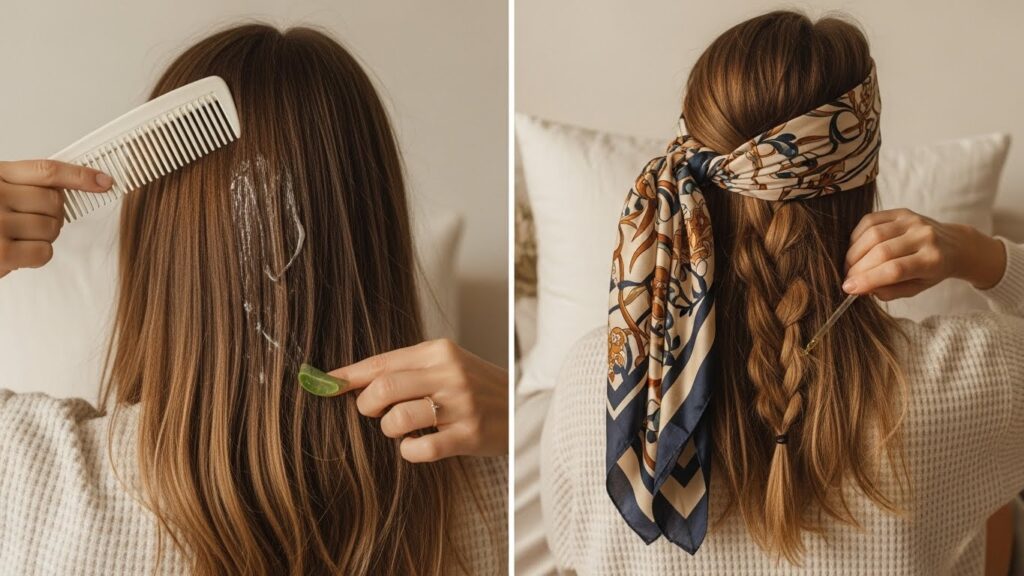
- Wash the scalp gently with a mild shampoo; rinse with lukewarm water.
- Condition the lengths after every wash.
- Detangle with a wide-tooth comb from the ends up, while the hair is still damp.
- Apply a small amount of leave-in conditioner or a few drops of oil to the damp lengths.
- Dry gently — pat, do not rub. Let hair air dry when you can.
- Style loosely. Tight hairstyles that pull can cause hair loss (traction alopecia). Early on it can reverse if the pulling stops.
Food and lifestyle
A balanced diet with enough protein supports normal hair growth, because hair is mostly keratin. That is a general health point, not a frizz treatment.
- Omega-3 has no good trial as a hair treatment on its own.
- Biotin is vitamin B7, not B1. It helps only when there is a deficiency, which is rare, and there is no good trial of biotin in people who are not deficient (Patel et al. 2017). No supplement is recommended here.
- Stress can trigger temporary shedding, but there is no good evidence that stress causes frizz. Frizz is a cuticle and humidity story, not a stress story.
Mistakes that make frizz worse
- Rough towel-drying and brushing wet hair hard from the roots.
- High heat every day without a protectant.
- Skipping conditioner.
- Using a heavy mask and expecting it to repair the hair.
- Chasing “moisture” on humid days — the air is already the moisture.
- Changing products every few days, so you never learn what helps.
A simple week
Most days: Wash the scalp if it needs it, condition the lengths, detangle gently, apply a few drops of oil or leave-in to damp lengths, dry gently.
Once a week: One conditioning mask or oil treatment — not both. Check your scalp while you are at it.
On humid days: A hat, or a little extra leave-in on the lengths, helps more than an extra wash.
When to get help
Frizz itself is not a medical problem. See a doctor if you notice sudden hair loss, shedding that goes on for more than six months, patchy bald spots, a rapidly widening part, or scalp pain, itching, scaling or redness that does not settle. It is normal to shed about 50 to 100 hairs a day. A dermatologist can examine the scalp and find the cause; see a GP first before going to a commercial hair clinic.
Summary
Frizz is a raised cuticle letting humidity into the hair shaft. Keep the cuticle smooth with conditioner, coat the lengths lightly, handle hair gently, and keep heat low. Masks and oils condition; they do not repair or remove frizz. Herbal rinses, vinegar, green tea, hibiscus, amla and fenugreek have no good evidence for frizz. Manage frizz, do not chase a cure for it.
Sources: IADVL Hair Care Basics; AAD hair-loss and hair-damage guidance; NHS 111 Wales hair loss; Rele & Mohile 2003; Koyama et al. 2016; Panahi et al. 2015; Patel et al. 2017; Monselise et al. 2015. This is a researched overview, not a hands-on review.