Researched overview. This guide is based on published dermatology guidance, not on hands-on product testing by BeautyKob. No product in this guide was tested by us.
Table Of Content
- Quick answer
- Why daily tools matter more than styling tools
- The everyday kit
- Detangling tools
- Smoothing brushes
- Scalp tools
- Ties and fasteners
- How to judge a tool before you use it
- The day with daily tools
- Morning: detangle and set up the day
- Midday: leave it alone
- Evening: detangle before bed
- Cleaning the daily kit
- Mistakes that cost length
- When to get help
- Summary
Quick answer
The tools you touch every day matter more than the tools you use once a week. A curling iron is used for minutes; a brush, a comb and a hair tie touch your hair every single day. Small stresses add up: a rough brush, a tight tie in the same spot, detangling in a hurry. None of them damages hair on its own. Together, repeated daily, they are the reason hair breaks, frizzes and never seems to get longer.
The fix is not more products. It is a small kit of gentle tools, used gently. This guide covers which tools earn a place in daily use, how to judge each one, and how to use them through the day without costing yourself length.
One honest fact first: tools do not grow hair. Hair grows about half an inch a month, and no tool changes that. What daily tools do is keep the length that grows — by reducing the breakage that snaps strands off before they ever get long. Most “slow growth” is normal growth with breakage at the ends.
Why daily tools matter more than styling tools
A styling tool is used occasionally. A daily tool is used hundreds of times a month. That frequency is what makes the choice matter: a brush with a sharp edge, a tie that grips too hard, a comb with rough teeth — each one does a little damage, and the damage is repeated every day.
Conditioners and masks improve how the surface feels, but they cannot fix damage that keeps happening. If the same harmful tools are used every day, no product will keep the hair healthy. The tool choice comes first; products support it.
The everyday kit
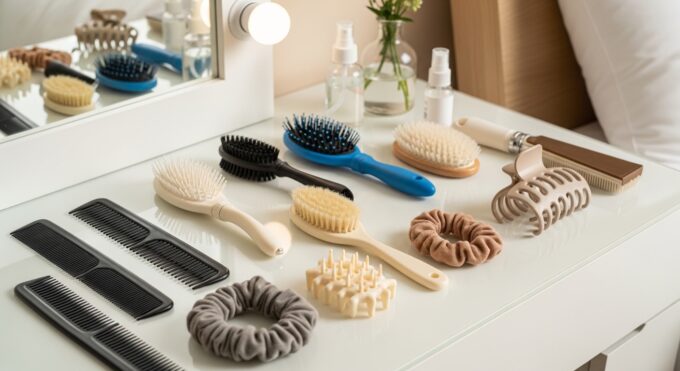
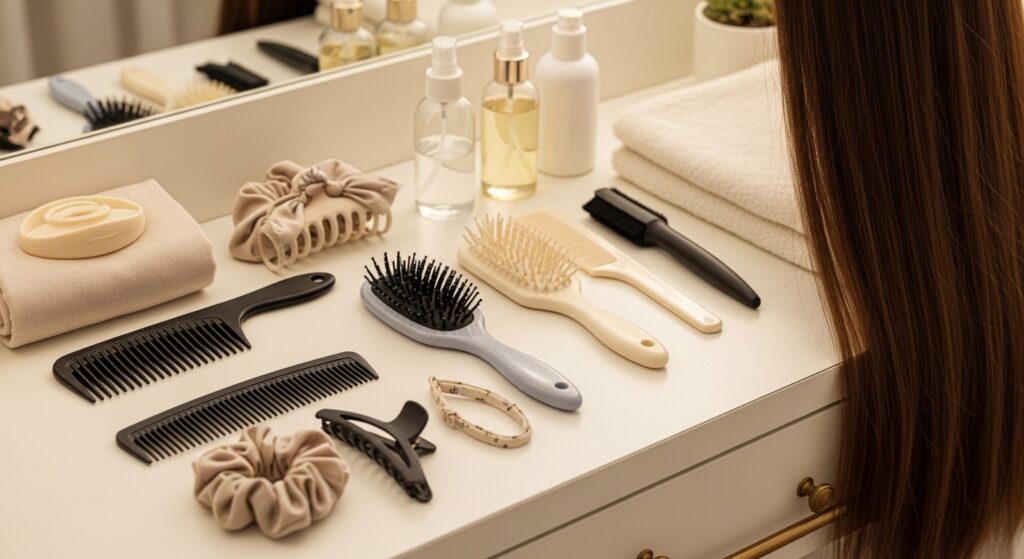
A daily kit is small. If a tool is not used at least a few times a week, it does not belong in the kit — it belongs in a drawer. These are the tools that earn a place.
Detangling tools
Detangling is where most length is lost, so this is the most important part of the kit.
Wide-tooth comb. The safest everyday detangler. The teeth are spaced far apart, so they pass through tangles with less pulling than a fine comb or a brush. Use it on damp hair with a leave-in conditioner or detangling spray in it, starting at the ends and working upward slowly. Hold the section above the tangle so the roots do not take the pull. Never force through a knot — forcing it breaks the strand, and a broken strand is length lost.
Flexible detangling brush. The bristles bend with the hair, which spreads tension instead of concentrating it on one weak spot. Good for dry or slightly damp hair. Check the bristles regularly: if they are broken or sharp-edged, do not use the brush — it will snag the hair and undo every benefit of the routine.
Fingers. The gentlest method of all. Use your fingers first on textured or very tangled hair, feeling for knots before a comb or brush touches them.
Wet hair is more fragile than dry hair, so never detangle soaking-wet hair roughly — and never detangle dry hair roughly either. The safest way is damp hair, with conditioner in it, ends first. A fine-tooth comb on wet hair is the worst combination in this guide: the teeth are close together, the hair is at its most fragile, and every pull creates tiny splits along the shaft.
Smoothing brushes
Paddle brush. Spreads pressure over a large section, which makes it good for smoothing long or straight hair that is already detangled. Use it on dry hair, with one or two light strokes per section. It is not a detangling tool — do not drag it through knots, and do not use it on soaking-wet hair.
Soft-bristle brush. Moves the scalp’s natural oils along the hair shaft, which is a light, natural conditioning that helps keep strands flexible. Best for light daily grooming, not for serious detangling. Brush with one or two light strokes per section. Too much brushing increases friction, lifts the cuticle and causes frizz and breakage — more brushing is not better brushing.
Scalp tools
Scalp massager. A soft silicone or rubber tool used during shampooing. It feels pleasant and helps spread shampoo evenly. The evidence that scalp massage grows hair is very thin — the one study often cited had only 9 men and no control group — so treat it as a comfort step, not a growth treatment. Use light pressure for a few minutes, with your fingertips or a soft tool. Use your fingertips, not your fingernails, which can scratch the scalp. Stop if the scalp feels sore, red or tender.
Fingertips. The simplest scalp tool. Light, circular pressure during washing is enough. Anything that scratches or drags does not belong on the scalp.
Ties and fasteners
Fabric-covered ties. Cloth-covered elastic ties reduce friction and grip without tearing. They hold a ponytail or bun without scratching the hair.
Claw clips and soft fasteners. Hold the hair without pulling it tight. They let the hair rest in a loose shape instead of being held under constant tension.
Tight styles worn in the same place every day can cause hair loss over time — traction alopecia. Keep styles loose, vary where the hair is tied, and take styles down at night. If the scalp hurts, the style is too tight. Comfort is the guide: a style that aches is doing damage.
How to judge a tool before you use it
Before a new tool touches your hair, check three things:
- Edges. Run a finger over the teeth, bristles and seams. Anything sharp, rough or cracked will snag hair. Do not use it.
- Flexibility. A tool that bends a little with the hair is kinder than a rigid one that forces the hair to bend instead.
- Cleanliness. A dirty tool puts oil, dead skin and product residue back onto clean hair. Clean brushes and combs with mild soap and warm water, let them dry fully, and replace a tool when it is worn, cracked or shedding bristles.
Patch test any new scalp oil or treatment before you use it with a tool: apply a small amount to a quarter-sized patch of skin on the inside of your arm or the bend of your elbow, twice a day for 7 to 10 days. If there is redness, itching or swelling, do not use it. The American Academy of Dermatology recommends this length because allergic reactions can take several days to appear, and a 24-hour test can miss them.
The day with daily tools
Morning: detangle and set up the day
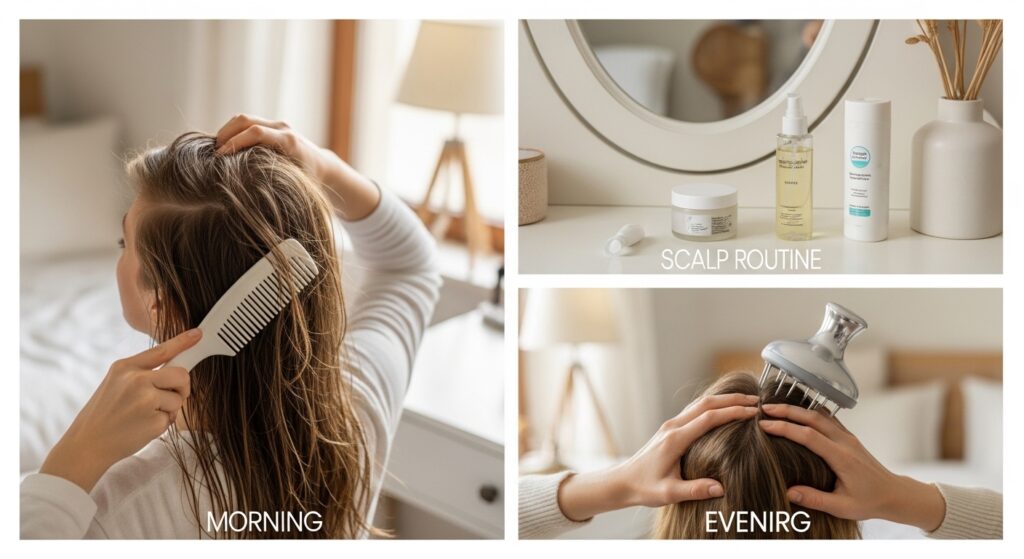
Sleep tangles hair through friction and movement, so morning detangling should not be violent. Lightly dampen the hair or add a small amount of leave-in product — this makes the shaft less stiff and reduces resistance. Detangle from the ends upward, slowly. If you meet resistance, stop and work the knot apart with your fingers instead of pulling through it.
Once detangled, brush only as much as needed to smooth the hair — one or two light strokes per section. If the hair still looks rough after brushing, it usually needs moisture, not more brushing.
Tie the hair back loosely if you need it out of the way for work or exercise. Rotate the position and the fastener so the same spot is not under tension every day.
Midday: leave it alone
Most midday damage is unconscious: touching, twisting and pulling at the ends, or re-tying the same tight ponytail. Twisting hair around the fingers and pulling at the ends creates weak spots that break. Limited unnecessary touching saves length in the long run.
Wind tangles hair, sun dries it, and humidity changes its texture. On windy days, a loose braid or clip keeps the hair from knotting without holding it tight. Sun protection is for skin — wear sunscreen with SPF 30 or higher on exposed skin when outdoors, and reapply every two hours. Hair itself does not need sunscreen, but very dry hair benefits from being covered or kept out of long, direct sun.
Evening: detangle before bed
Evening detangling stops knots tightening overnight. The hair should not be dripping wet — slightly damp or dry, with a little leave-in product if needed. Go slower than in the morning: this is also the time to remove shed hair and check the tools for wear.
A short, light scalp massage in the evening is a comfort step. Keep it light and brief. If the scalp is stimulated too hard it becomes irritated rather than relaxed.
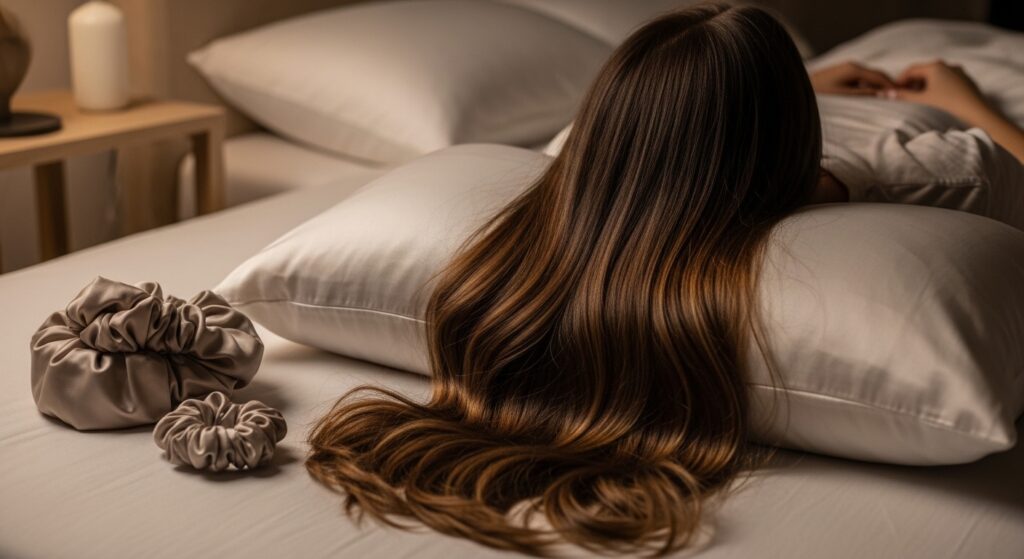
Before sleep, protect the hair from friction: a loose braid or a satin or silk pillowcase lets the hair slide instead of catching, which reduces breakage overnight. Do not tie the hair tightly for sleep — the purpose is to reduce movement, not to hold the hair still.
Cleaning the daily kit
Tools that touch hair every day collect oil, dead skin and product residue. A dirty tool spreads that residue back onto clean hair and scalp.
- Brushes and combs: remove trapped hair after each use. Wash with mild soap and warm water once a week, rinse well, and let them dry fully before use. Do not soak wooden handles for long — they can warp or crack.
- Ties and clips: wash fabric ties with mild soap and warm water; wipe clips clean. Replace ties when the elastic goes slack or the fabric tears.
- Scalp tools: rinse after each use and wash with mild soap and warm water weekly.
A tool that is worn, cracked, rusty or shedding bristles should be replaced, not kept in use. Cleaning cannot fix a broken tool, and a broken tool causes the damage cleaning is meant to prevent.
Mistakes that cost length
- Detangling in a hurry. Rushing through knots is the fastest way to break hair. Slow down, or the knot wins.
- Using the wrong tool for the job. A paddle brush is not a detangler; a fine-tooth comb is not for wet hair.
- The same tight style every day. Tension in the same spot, day after day, weakens the hairline and the roots.
- Over-brushing. More strokes do not mean smoother hair. One or two light strokes per section is enough.
- Dirty tools. A clean tool is part of the routine, not an optional extra.
- Expecting tools to repair damage. Damaged hair cannot be repaired — only trimming removes split ends. Trim every 6 to 12 weeks. Tools keep new growth from breaking; they do not fix what is already damaged.
When to get help
See a doctor or dermatologist if: shedding suddenly increases well beyond the usual 50 to 100 hairs a day; hair is coming out in patches; the scalp is painful, sore, blistered or has sores that do not heal; or hair loss comes with other symptoms such as tiredness, weight change or irregular periods. These can point to a medical cause — thyroid problems, iron deficiency and medication changes are known triggers for shedding — and a doctor can check for them. A tool change will not fix a medical cause.
Summary
The everyday kit is small: a wide-tooth comb, a flexible detangling brush, a smoothing brush, a soft scalp tool, and fabric ties or clips. Choose tools with smooth edges, use them gently — damp hair with conditioner, ends first, never forced — and keep them clean. Rotate styles so no one spot takes the tension every day. Tools do not grow hair and cannot repair damage; they keep the length that grows by reducing breakage. Trim every 6 to 12 weeks, patch test any new scalp product for 7 to 10 days, and see a doctor if shedding suddenly changes.
Sources: American Academy of Dermatology, 7 Rosacea skin care tips (patch-test method: apply a new product to a quarter-sized patch of skin on the inside of the arm for 7–10 days); American Academy of Dermatology, How to select anti-aging skin care products (sunscreen: SPF 30 or higher on exposed skin when outdoors, reapply every two hours). This is a researched overview, not a hands-on review.